 Playable Books
Jean-Philippe Rameau · section 77 of 109
Chapter thirty-four
Read and hear this section in the playable edition →On the Chromatic
In melody, the chromatic consists of a melodic succession moving by semitones, both upward and downward. It produces a wonderful effect in harmony, because most of these semitones, which lie outside the diatonic order, continually cause dissonances that suspend or interrupt conclusions. They even make it easier to fill chords with all their constituent sounds without disturbing the diatonic order of the upper parts.
The chromatic is used only in minor keys. It is more difficult to understand when the parts descend than when they ascend.
Article one
On Descending Chromatic Movement
After beginning the chromatic in a certain key by making any part descend in semitones, one may continue it successively in that key, in the key of its dominant, and more particularly in that of its fourth note. The tonic of the first key then becomes a dominant. Thus, in a chain, each tonic may become the dominant of the key being entered, without departing too far from the opening key; for one must take the first opportunity to return to it.
Successive tonics becoming dominants provide the first means of gaining a clear understanding of the chromatic.
After passing from the tonic to its dominant, return to the tonic and make it a dominant. Continue according to the rule of sevenths, Chapter XXI, making the upper parts descend through as many semitones as possible. Each of these semitone notes forms a third, seventh, or sometimes diminished fifth with the fundamental bass, whose note nevertheless bears a seventh chord. The only difference between the chromatic and our ordinary rules will be that the leading note may here descend a semitone, although it should always ascend. But the sound to which it should ascend is always understood within the chord, and only the chromatic permits this liberty.
Example
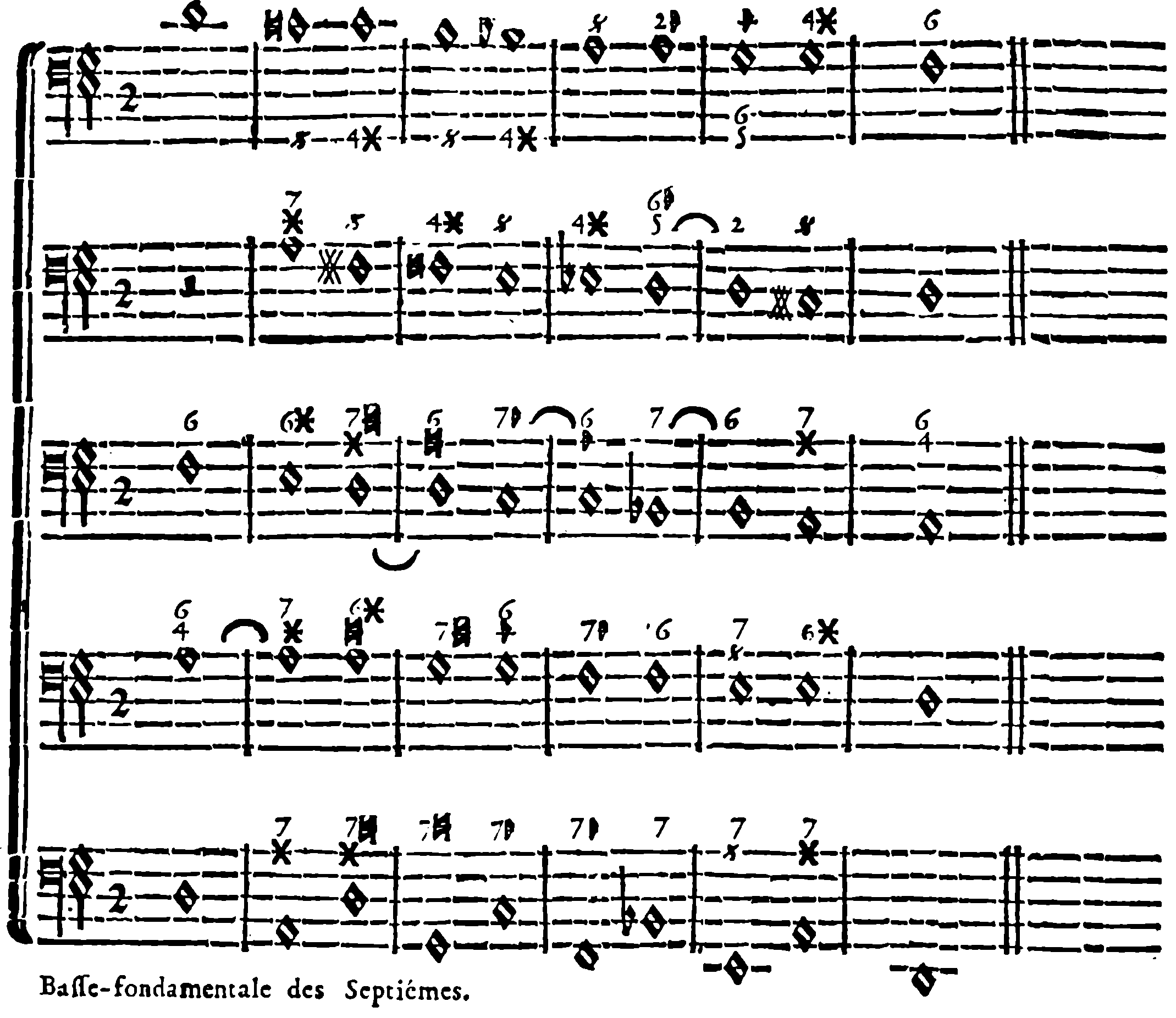
[Manuscript note: see the Supplement.]
The natural signs ♮ attached here to the 7s make minor an interval that was previously major, as may be observed in the parts.
If each part serves as bass in turn, with the fundamental bass then omitted, one first finds a succession of 7s and 6s like that derived from the fundamental progression of sevenths, with the chromatic difference observed here. One then sees how tritones and diminished fifths take the place of 2 and [6/5], and how these intervals resolve one another through the chromatic, the leading note descending everywhere except at the end, instead of ascending.
Here is another way of using the chromatic over a tonic held firmly, or remaining on the same degree, in the bass.
Example
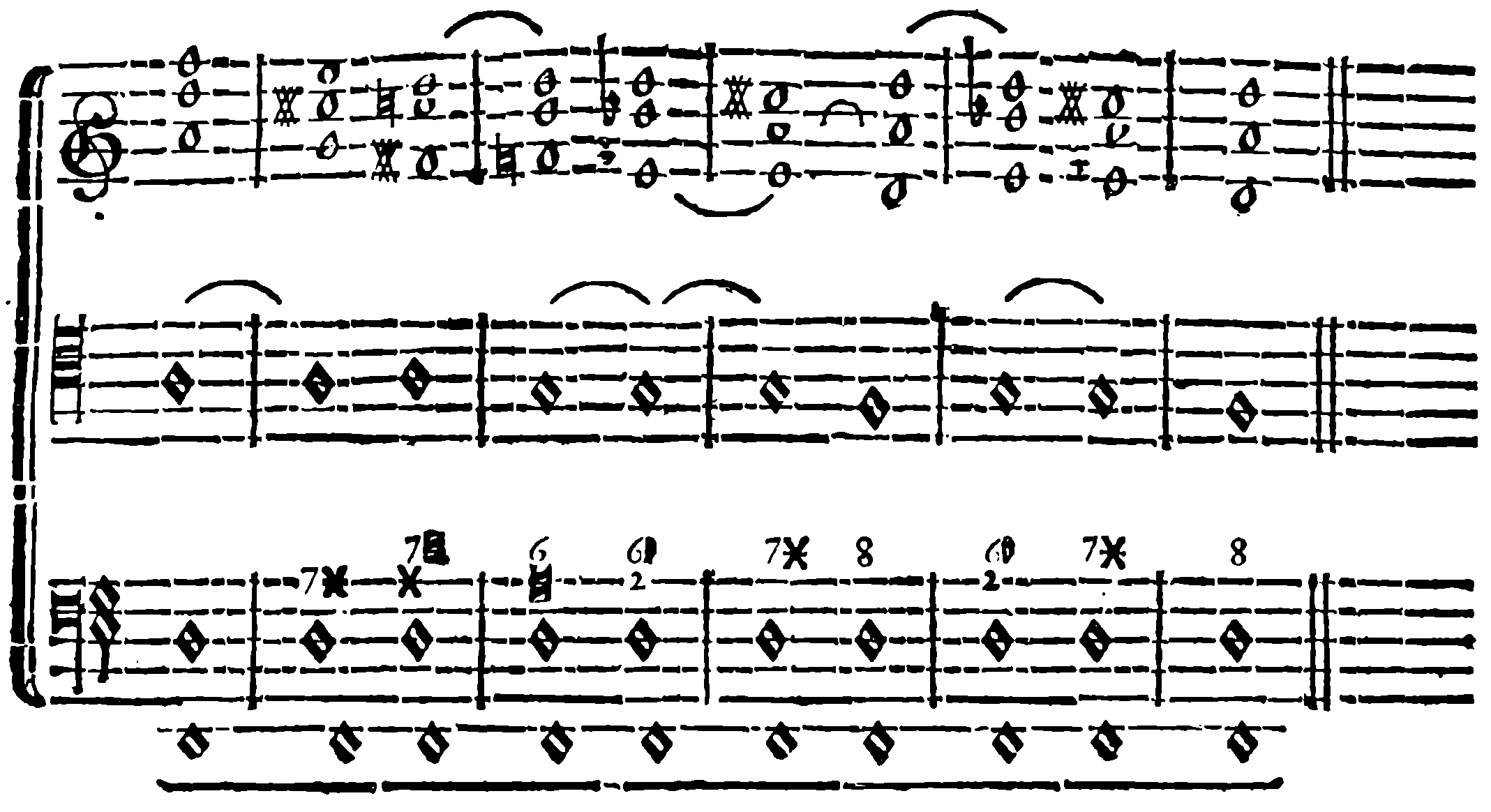
This may be called a pedal point.
The leading note occurs almost always in the chromatic, so one may employ all chords in which the major dissonance sounds, such as those just seen. One may also use the augmented-second chord and its derivatives, and especially the augmented-fifth chord when wishing to interrupt a cadence, as could be observed in the example in Chapter XXX, where the leading note descends a semitone. Now that the construction of all augmented or diminished chords by borrowing or supposition is known, they may be used wherever the leading note seems appropriate. Do not, however, avoid the perfect or seventh chord and their derivatives when they lie in your path, and still preserve a diatonic order in the upper parts as far as possible.
[Manuscript note: page 274.]
Article two
On Ascending Chromatic Movement
The chromatic may also ascend, but it then lacks the sadness of the former kind, and its resulting harmony agrees perfectly with the fundamental bass.
Example
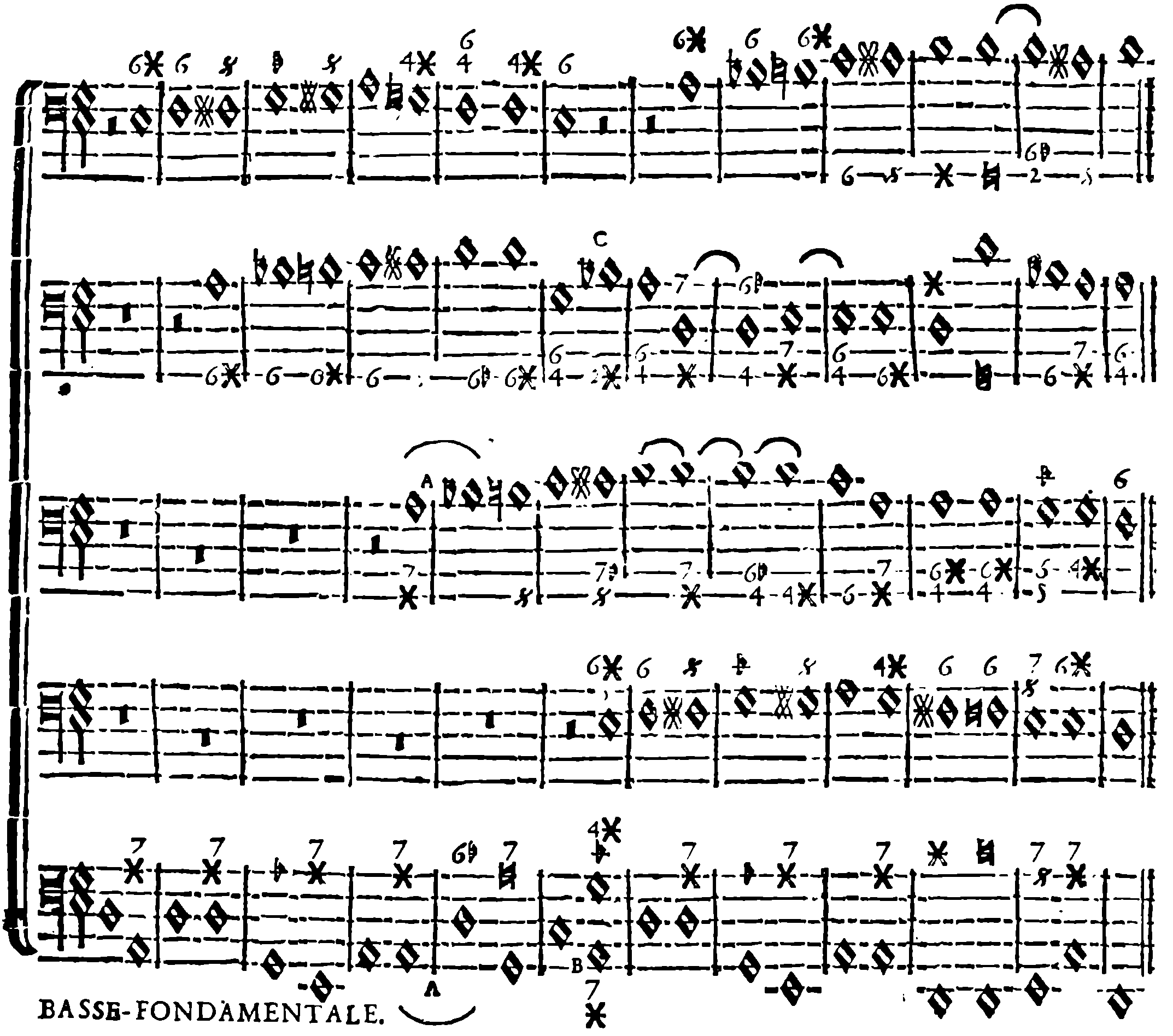
B. This note, although fundamental, cannot occur while the note at C borrows its foundation.
A. Interrupted cadence.
Example
Of Two Parts Ascending and Descending Simultaneously by Semitones
Turn the page to see the example.
The Three Upper Parts May Be Inverted Among Themselves, Each Serving as Bass in Turn
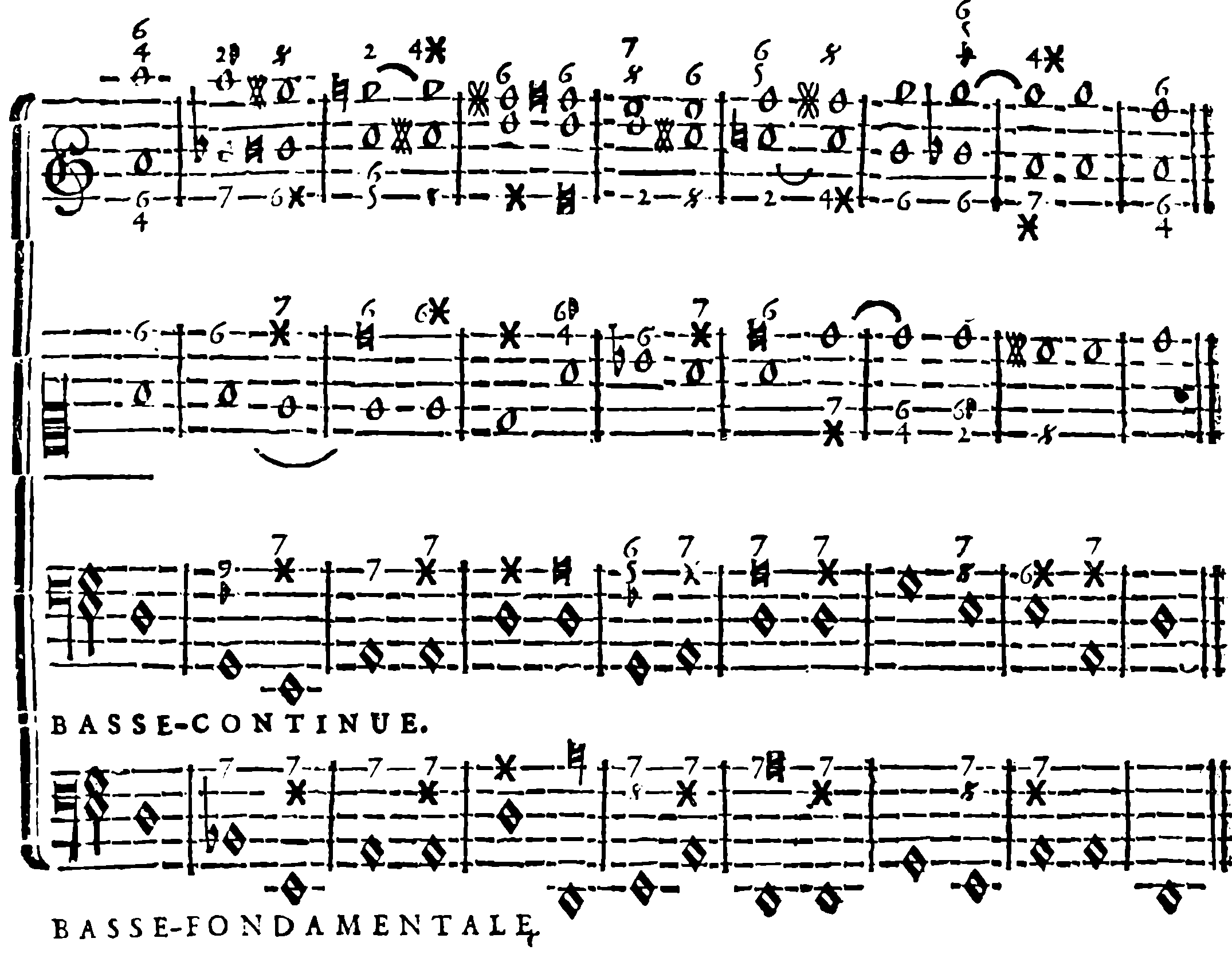
Observe carefully that all the semitones used in the chromatic concern only the sixth and seventh notes of the key being treated. In minor keys the leading note must be lowered a semitone to descend, and the sixth note must likewise be raised a semitone to ascend. Thus these notes may pass through either form, both ascending and descending.
To complete one’s conviction of the truth of the rules in this book, compare their details with the recapitulation in Book II, Chapter XVIII. There one finds all the chords with their different successions, and all the different melodies that may be used.
See also our observations on the establishment of the rules; they cannot fail to be very useful.
Chapter XLIV contains an example of the chromatic with chords by supposition and borrowing that produce a very good effect.