 Playable Books
Jean-Philippe Rameau · section 78 of 109
Chapter thirty-five
Read and hear this section in the playable edition →On Putting into Practice Everything Said Thus Far
Article one
On Bass Progression
First compose a bass with the most beautiful melody you can imagine, in a familiar key from which you can pass to several others equally familiar, as discussed in Chapter XXIV. Fill this bass with perfect cadences as often as possible, for this is the natural progression of a bass, which should move by consonant rather than diatonic intervals. Admit interrupted and irregular cadences only insofar as you can distinguish them and sense where they may be used: the interrupted cadence to avoid too frequent perfect cadences in one key, a very agreeable variety in this case; or the irregular cadence to bring the melody to rest on a tonic dominant or even the tonic, another variety that keeps the listener in pleasing suspense. Also try to include bass progressions supporting harmonic successions derived from the different cadences, according to our examples, without forgetting the progressions of 7, 7 and 6, 2 and 6, barred 5, 4♯, 2♯, 9, 11, 5♯, and 7♯.
Each bass note should represent a beat, and each chord likewise. Thus a whole note may be divided into four quarter notes to form four beats, assuming a measure of four beats.
Some people, mistrusting their ability, may fear they cannot compose a good bass. If they lack the natural taste that invents varied and consistently agreeable melodies, let them know that they cannot go wrong by moving the bass freely among all the notes of a key, preferring smaller intervals to larger ones—for instance, ascending a third rather than descending a sixth. Remember that the leading note requires the tonic next, except in the chromatic; that a final cadence must be heard before entering another key; and that one should proceed in that key much as in the first, then from key to key as explained in Chapters XIII, XIV, XV, XVI, XXIV, and XXV. Moreover, the note ending a perfect, interrupted, or irregular cadence must sound on the first beat of the measure, so compose the bass to observe this regularity. If the first cadence fails to do so and you do not wish to change the bass melody, simply begin it on a different beat. If it began on the first, start it on the second or third; if on the second or third, start it on the first, and so forth. If this happens in the middle of the piece, add or remove one or two notes as needed. Also make cadences perceptible every two or four measures, though this last rule may be broken when good taste dictates or when words compel us and must then guide us.
Article two
On the Use of Consonant and Dissonant Chords
The perfect chord must serve for beginnings, endings, and all cadences within a piece. It may also occur in diatonic bass progression, as may its derivatives, the sixth and sixth–fourth chords. Observe that in such progressions consonant and dissonant chords are interwoven. See the octave example in Chapter XI and the sixths example in Chapter XVI. All dissonances must be prepared and resolved according to the rules; this needs little attention once chord succession is perfectly understood. We also know that dissonances may be unprepared only after the tonic’s perfect chord, on that note or on its derivatives, provided the key does not change—although it may change when the bass ascends a third and then descends a fifth.
Example

[Manuscript note: see the Supplement.]
When the bass ascends a third and then descends a fifth, and the key changes, a first key that is major leads to a minor key, A; conversely, a first key that is minor leads to a major key, B. The lines passing from one note to another,
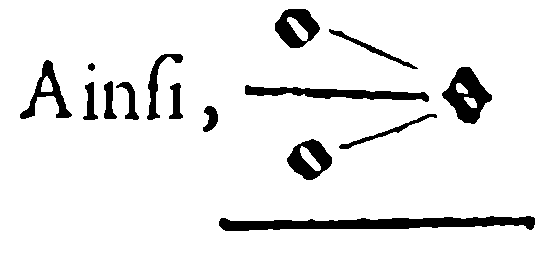
show that the dissonance formed by the note to the right of the line is unprepared, and show the progression the upper part must follow in this case.
One may freely use inversions of these fundamental progressions.
Do not yet disturb the diatonic order of the upper parts, except to make a chord more complete, to restore a part above the bass, or to bring it into its natural range. In these cases avoid two consecutive octaves or fifths, unless they are inverted.
Parts ascending or descending together must be arranged in thirds or sixths, in fourths as little as possible, and never in octaves or fifths. That is, any two parts forming a third or sixth together may do so again in the following chord, and so on.
When one part ascends or descends diatonically while another moves by a consonant interval, this is always good, pending a more precise explanation.
Remember that the chord succession contained in one key is the same in every other key. Simply identify the current key to give each note the chord suited to its rank there, since the second note, mediant, dominant, and so forth always occupy the same ranks and bear the same chords in every key.
Article three
On Major Dissonances Caused by the Leading Note, and the Notes on Which They Occur
1. The tritone occurs only on the fourth note when that note then descends to the mediant or tonic.
2. The diminished fifth occurs only on the leading note when it then ascends to the tonic, or sometimes the mediant.
3. The major small-sixth chord occurs only on the second note of the key; when its sixth is minor, it is ordinarily on the sixth note.
4. The major third and seventh can occur together, forming a tritone or diminished fifth, only on the tonic dominant. These four dissonances are the most commonly used.
5. The augmented seventh occurs only on the tonic, which remains on the same degree to prepare and resolve this dissonance.
6. The augmented fifth occurs only on the mediant of minor keys, as stated elsewhere.
7. The augmented second occurs only on the sixth note of minor keys, and that note must then descend.
8. The diminished seventh occurs only on the leading note, which must then ascend.
9. Other dissonances derived from these last two occur on the same notes as those whose chords differ only by replacing the dominant with the sixth note, in minor keys alone.
Article four
On Minor Dissonances
1. The heteroclite eleventh, called the fourth, may occur on any note requiring a perfect or seventh chord, provided that chord follows immediately. Exclude the first and last notes of a piece from this rule. In this way it will always be prepared, observing two things.
First, if a perfect chord follows one of its derivatives, the two being the same chord, the eleventh cannot be sounded there.
Second, always give the sixth to the note ascending a third to the note on which the eleventh is desired.
2. A seventh without the major dissonance prefers to be prepared by the octave, fifth, sixth, third, or sixth, and even by the fourth, a consonance arising from a tonic dominant’s sixth–fourth chord, according to the different bass progressions.
3. The ninth must always be prepared by the third or fifth, according to the bass progression; it may also be prepared by the diminished fifth.
4. The eleventh must likewise be prepared by the fifth, and sometimes, though rarely, by the seventh. When heteroclite, it may be prepared by any consonance, and also by the seventh or diminished fifth.
5. The second, prepared in the bass, may be preceded in the upper part by any consonance while the bass holds on the same degree. All dissonances must, moreover, be resolved as already described.
From any dissonant chord, one may omit one of the two sounds forming the dissonance together, leaving only the perfect chord or one of its derivatives.
Article five
On Which Consonances to Prefer When Doubling Them
Simply count the consonances in order—octave, fifth, fourth, third, sixth—to know that the octave should be preferred to the fifth, and so on. Observe that the octave is already a duplication, and in the consonant sixth chord, an octave doubling of the third or sixth is as good as one of the bass.
Article six
On Meter and Beat
Music without rhythmic movement loses all its grace; without it, one cannot even invent beautiful melodies. Therefore do not merely concern yourself with making chords. The melodies of the parts composing them must also have a certain movement in which one can distinguish a caesura, a section, a cadence, a long syllable from a short one, and the beats on which dissonance must be used. All this must be felt at the very beginning of a measure’s first beat. See Chapter I, and Book II, Chapters XXVI, XXVII, XXVIII, and XXIX.
Article seven
On Syncopation
To follow the natural order of meter, each note’s duration must begin and end within the span of a beat. Nevertheless, a note beginning at the first instant of a strong beat may remain on the same degree as long as taste allows, whether its sound is sustained or not. But when a note begins on another beat and half its duration is heard in the following strong beat, this strikes against the ear, and the note is called syncopated. Such a note can be distinguished in four ways.
First, when the barline dividing measures splits a note into two equal durations, thus:

Second, when two successive notes of equal duration on the same degree are joined by a semicircle shaped thus [upper arc] or thus [lower arc]. This indicates that their sound must remain continuous.
Example

Third, when a note is preceded by another worth only half the first beat, or by a rest of that same value, provided the note so preceded extends into the following beat.
Example

Notes A, B, C, D, F, G, H, and J are syncopated.
Fourth, when two notes of equal value on the same degree are repeated rather than tied, the first striking on a weak beat and the second on a strong beat, either to accommodate words or to make the air more lively or cheerful.
Example

For a note to be syncopated, it must not only begin on a weak beat or in the second half of the first beat; its duration must also divide into two equal parts, one sounding in the first beat and the other in the following beat. Instead of one syncopated note, two may be used, each representing half its value. They may be repeated, or their sound sustained by joining them with the semicircle, in which case they are performed as a single note whose duration equals their combined values.
Composers should be free to use these different ways of syncopating; this is the opinion of the most skilled masters. They are equally used in harmony and melody: in harmony to sound prepared dissonances, and in melody to make the line more expressive without changing the kind of interval heard in the two notes of the syncopation or in the single syncopated note.
Example
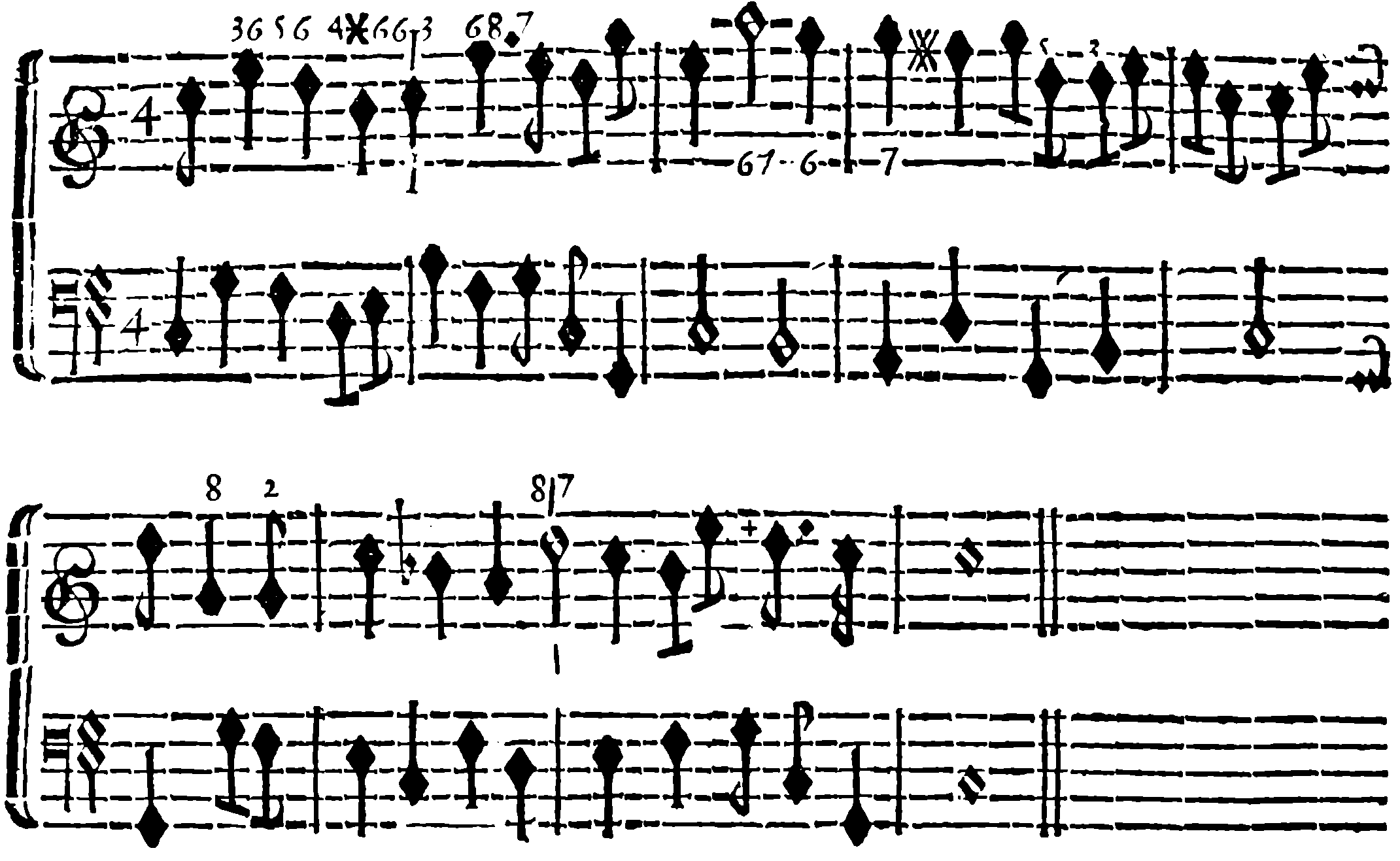
Figures indicating only consonances, such as 3, 6, and so forth, show that syncopation serves only melodic taste. Those indicating a dissonance after a consonance show that the syncopation serves harmony.
The bass may be syncopated like the upper part, together or separately for melodic purposes. For harmonic purposes, however, the bass can be syncopated only in chords of 2, 4♯, or the augmented seventh.
For strict harmonic syncopation, the preparing consonance, the resolving consonance, and the prepared dissonance must have equal durations as far as possible. Exceptions occur only in triple meter, which has two weak beats; there the preparing or resolving consonance may be twice or half the duration of the prepared dissonance.
When several dissonances follow one another, only the first can obey the rule of being prepared on a weak beat and heard on a strong beat.
As soon as a dissonance cannot be prepared, syncopation no longer has a role. But one should preserve, as far as possible, diatonic movement from the consonance preceding the dissonance to the consonance resolving it, with equal values for the notes involved. This equality is less necessary here than in syncopation, and diatonic movement from a consonance to an unprepared dissonance must not be made a general rule, especially for the seventh, diminished fifth, and all major dissonances.