 Playable Books
Jean-Philippe Rameau · section 79 of 109
Chapter thirty-six
Read and hear this section in the playable edition →On Two-Part Composition
The fewer parts a piece of music contains, the stricter its rules become. Certain licenses allowed in four parts may therefore become faults when the number of parts is reduced.
1. We must now distinguish perfect from imperfect consonances.
The perfect consonances are the octave and fifth. Here two consecutive octaves or fifths are forbidden, even when inverted.
The fourth is also a perfect consonance; but as it is little suited to two-part composition, we shall merely prescribe how it should be used there.
The imperfect consonances are the third and sixth. Several may follow one another and be intermingled without fear of error, provided good modulation is maintained.
When passing from a third to a sixth or from a sixth to a third, if the parts move by consonant intervals, their motion must be contrary or inverted: one ascends while the other descends.
As far as possible, it is good to pass from a perfect consonance to an imperfect one and back again.
One can scarcely pass from a perfect consonance to another, or to an imperfect one, or from an imperfect to a perfect one, unless one part moves diatonically while the other moves by a consonant interval. Even then, contrary motion is advisable.
EXAMPLE. Succession of Perfect Consonances
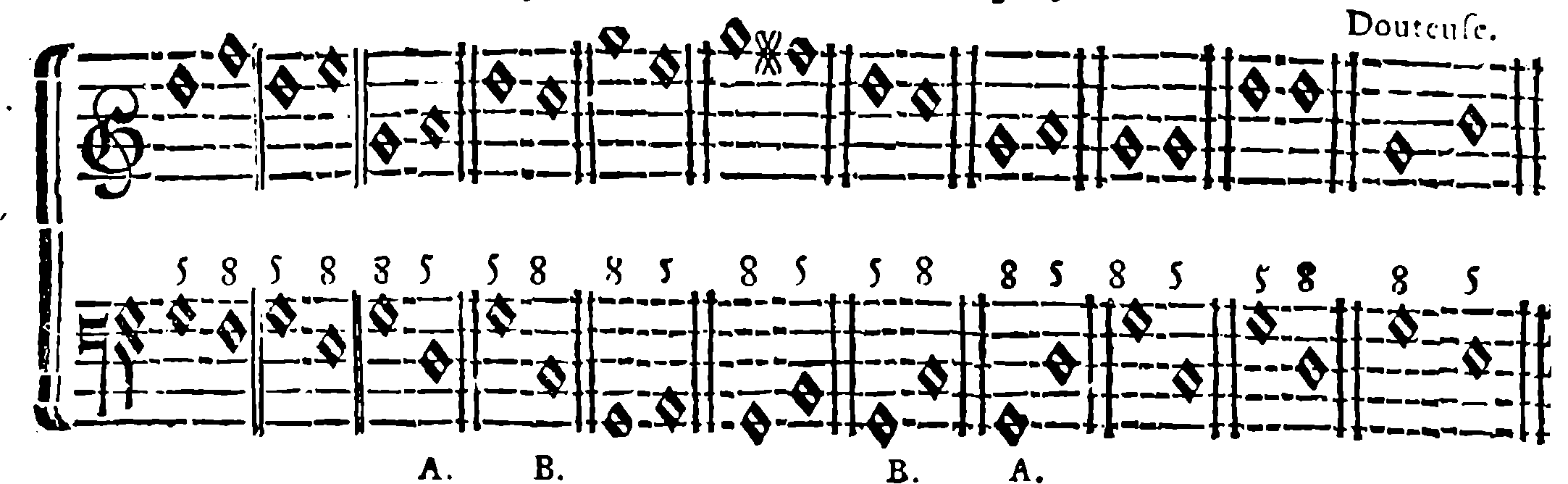
Any other progression of two successive perfect consonances is worthless.
The measures marked A resemble one another, as do those marked B.
2. One part may pass through as many consonant intervals as desired while the other remains on the same degree, provided, of course, that the parts always agree harmonically.
3. All passages from octave to third, fifth to third or sixth, sixth to third, and third to sixth may be called good.
4. Passages from octave to fifth are good provided the parts move in contrary motion. The one in which the bass descends diatonically is nevertheless bad.
5. Passages from octave to sixth are good provided that, when both parts move by consonant intervals, they move in contrary directions; although all is good when the bass descends a third.
6. Passages from sixth to octave are good except when the bass ascends diatonically, the upper part descends diatonically, or both parts move by consonant intervals.
7. Passages from sixth to fifth are good except when the upper part ascends diatonically, the bass descends diatonically, or both parts move by consonant intervals.
8. Passages from fifth to octave are good except when the bass ascends diatonically or both parts move by consonant intervals.
9. Passages from third to octave are good except when the bass descends diatonically. Also observe contrary motion when the bass ascends a fifth.
10. Passages from third to fifth are also good, provided the parts move in contrary motion where the bass ascends a second, third, or fourth. Indeed, make it ascend a fourth rather than descend a fifth, otherwise this progression would be bad.
11. As for the fourth, here is an example of every consonance that may precede and follow it.
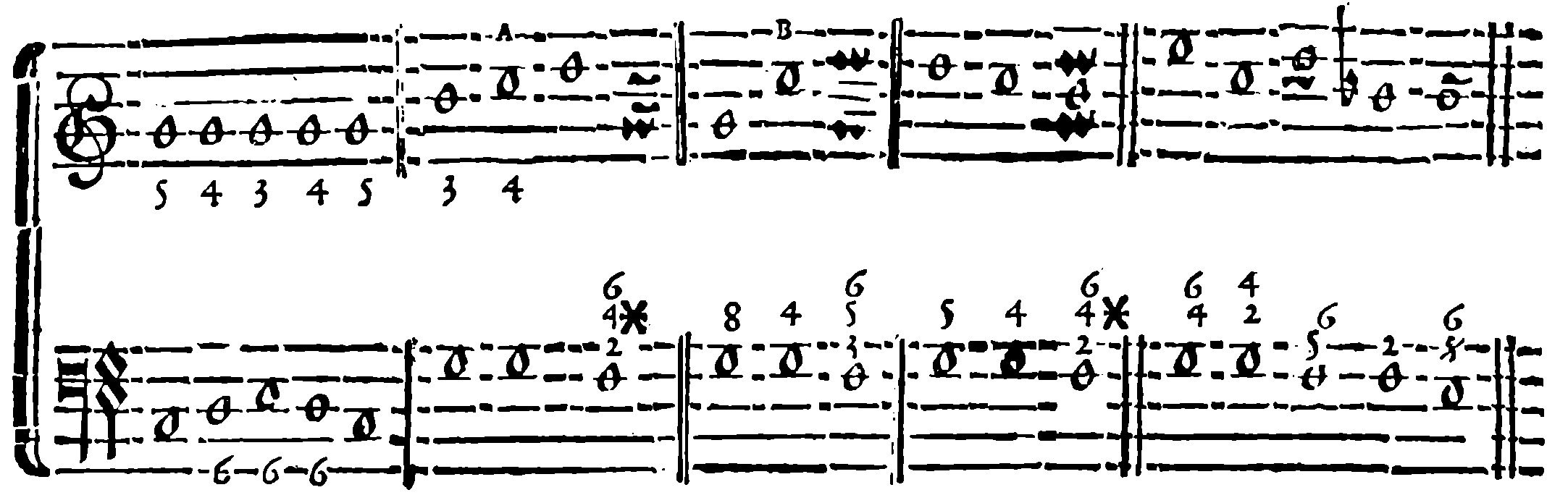
The cue signs show the different consonances, and even dissonances, that may follow the fourth. The figures between the two parts indicate the same thing; those beneath the bass indicate the chords to be used in each case.
Notice that the cue signs in examples A and B indicate two different chords, the tritone or great-sixth chord; one cannot be used when the other occurs.
Any progression other than those just prescribed is not good. Above all, observe that these rules rest on the natural preference for smaller intervals. Ascending a sixth and descending a third amount to the same thing, so prefer the descending third; likewise for other equivalent progressions, unless good taste demands otherwise where the substance of our rules would remain intact.
These rules are equally valid in every key, whether a third or sixth is major or minor.
The other rules concerning four parts, both for the natural progression of major and minor thirds and for that of dissonances, must equally be observed everywhere.
Once good modulation is thoroughly understood, nearly all these rules are observed without much conscious attention.