 Playable Books
Jean-Philippe Rameau · section 80 of 109
Chapter thirty-seven
Read and hear this section in the playable edition →On False Relations
To avoid false relations in the progression of a single part, simply make it move by diatonic or consonant intervals. The diminished fifth, diminished seventh, and diminished fourth are also allowed descending, but not ascending. Nevertheless, once good modulation is observed, any known interval may be used provided it does not exceed an octave, though with somewhat more caution for those not named above than for the others. The Italians also add the descending diminished third, for instance E-flat to C-sharp, which we leave to composers’ discretion.
As for false relations between two parts, it is impossible to fall into them when modulation is perfectly understood.
Example
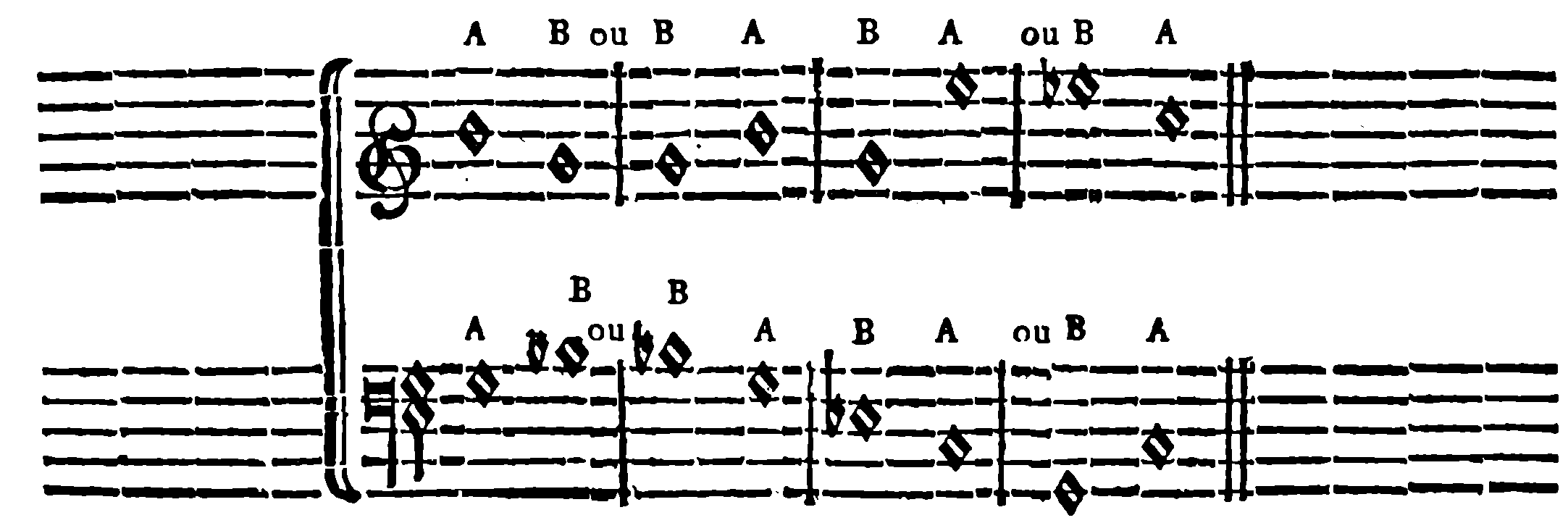
The notes at A represent a major mode, and those at B a minor one. One cannot therefore modulate in a key half major and half minor, nor pass from major to minor or vice versa on the same tonic until after a perfect cadence in the opening major or minor key. Even then this must be done with great caution. Knowledge of modulation thus raises us above these rules, which become almost unnecessary once it is well mastered; for this reason we say no more on the subject.