 Playable Books
Jean-Philippe Rameau · section 81 of 109
Chapter thirty-eight
Read and hear this section in the playable edition →On Making a Melody Above a Bass
To make a melody above a bass, first compose the bass in just one key whose modulation is already known. Knowing also the succession of consonances and dissonances, whose preparation and resolution have been explained, it will not be difficult to write a faultless melody above this bass.
To give greater scope to one’s invention, however, once the chord belonging to each bass note is known, choose one sound from each chord to form a melody as desired. In the perfect chord I choose the third, fifth, or octave; in the seventh chord I may choose the seventh among the others, if I wish and if I can. For I cannot choose the seventh unless prepared, except when the bass ascends a third or fifth while the upper part descends diatonically, or ascends and then descends diatonically. (See the example in Chapter XIX.) If the seventh could not resolve by descending diatonically to a consonance of the next chord, it would have to be omitted or the bass changed—unless the following bass notes are contained in the seventh chord being sounded and are followed by a note whose chord supplies a consonance resolving the seventh. The seventh then stays on the same degree until resolved, provided none of these intervening chord notes in the bass forms an octave with it. If one does, the seventh must descend a third, and that new note then ascend to the consonance that should naturally have followed the seventh. In the same case the seventh could instead descend to the leading note, provided that leading note belongs to the same chord. Thus the note reached by descending a third from the seventh will form a sixth above the bass note doubling that seventh at the octave, while the leading note will form its tritone.
Example
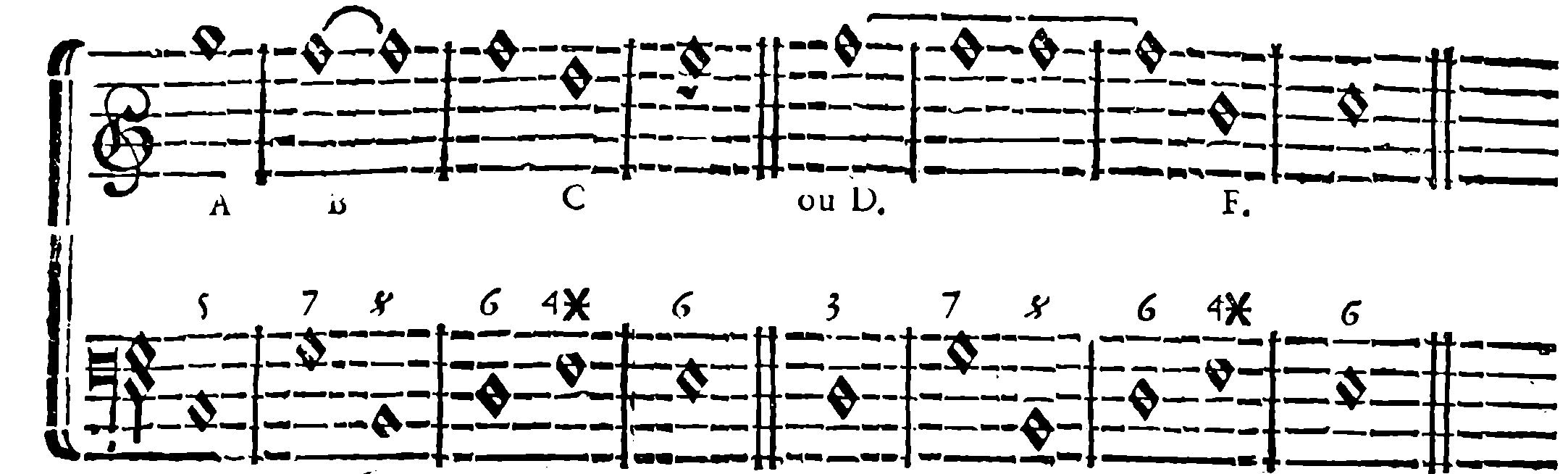
A. I begin with the fifth, though I could have begun with the octave or third. This beginning is preferable, however, so that the seventh may follow unprepared, as just explained.
B. The seventh remains until C, where its octave appears in the bass. I then make it descend a third and ascend afterward to the consonance that should naturally have resolved it, although, strictly speaking, I could have made it descend to the cue sign.
D. Here the third prepares the seventh, which remains until F, where its octave appears in the bass. I may then make it descend to the leading note at F, belonging to the same chord.
It is easy to recognize when a seventh can stay on the same degree while the bass moves through several intervals. Those bass notes must form the third, fifth, diminished fifth, or octave of that seventh, or the seventh must form the third, fifth, or diminished fifth of one of those bass notes. The same applies to other dissonances when referred to their foundation. Otherwise, knowing the limits of consonant and dissonant progression prevents mistakes.
Just as an upper note may remain on the same degree while the bass moves through all intervals contained in one chord, as just seen, a bass note may likewise remain while the upper part passes through all the intervals in that bass note’s chord.
If one bass note may bear several chords, and the third, fifth, sixth, and so forth occur in each, they may be sounded indifferently in either chord. But if an interval is absent from one chord, it cannot be sounded where it does not belong.
If taste is not well formed but the chords belonging to each bass note are known, simply figure them and choose whichever chord note you wish to form the upper melody, without departing from the prescribed rules. Those rules often require certain chord notes in preference to others because of the notes preceding or following them.
In two-part composition, the upper part must always end on the octave, rarely on the third, and never on the fifth.
General example
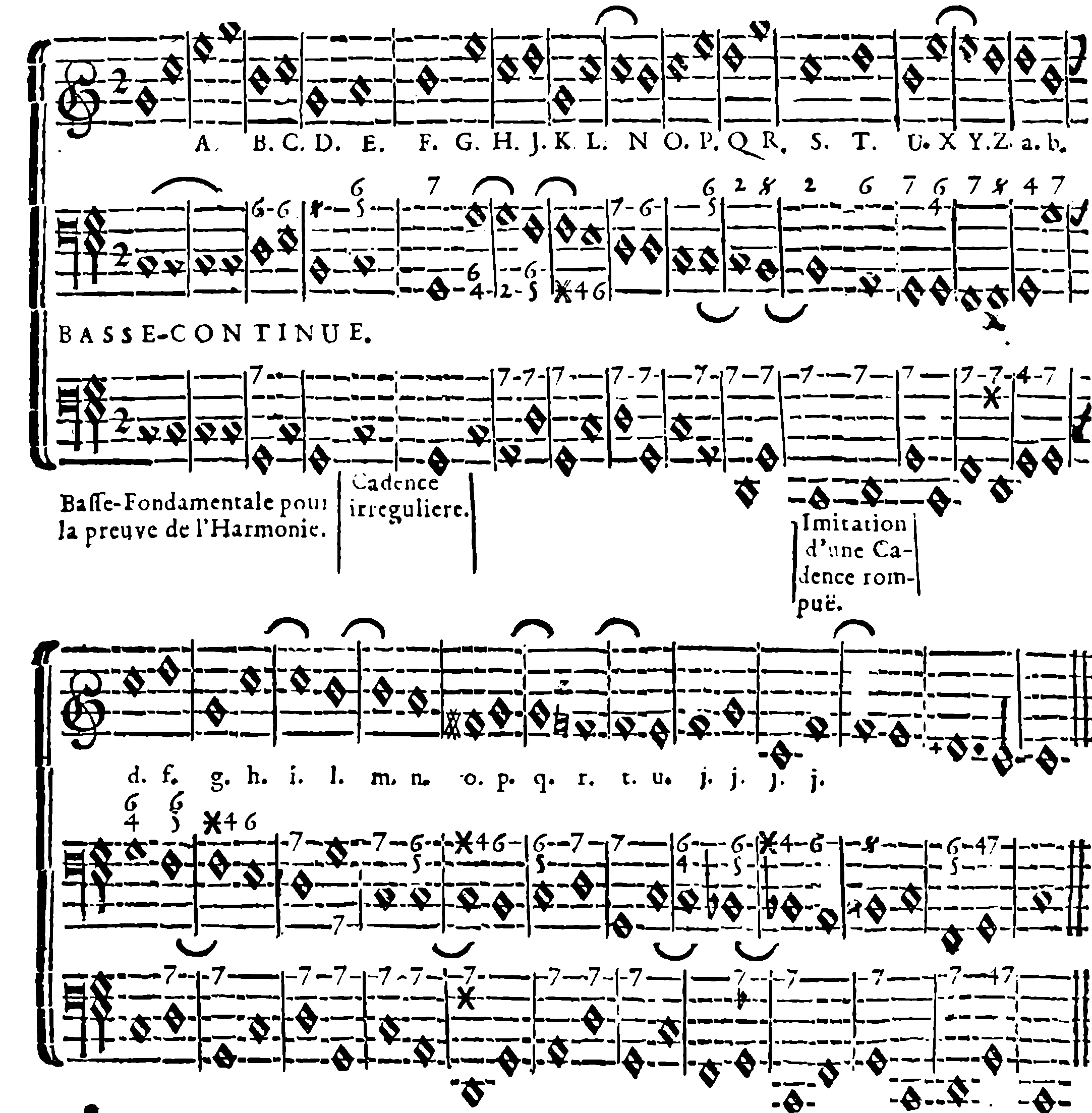
The upper part, composed only against the continuo bass, is full of faults against the fundamental bass. These concern not the foundation of harmony but only the progression of the parts. The fundamental bass is present solely to demonstrate the perfect harmony from which we draw the sounds suited to the melodies desired.
A. I pass freely through all the chord’s sounds.
From the fifth I pass to the sixth at B, though I could have stayed on the fourth without moving the preceding fifth, since this fourth belongs to B’s small-sixth chord. I could also have moved to the third.
B, C, D, E. I use four consecutive sixths because they belong to the chords, though any other interval in each chord could have been used.
F, G. Instead of passing from the leading note to the tonic, I pass to the mediant. This does not violate the rules for consonant progression; moreover, the mediant represents the tonic and belongs to its chord.
H. I sound the fourth, which belongs to the second chord; then I pass to the sixth at J and arrive at the second, belonging to the tritone chord at K.
The sixth sounded at L prepares the seventh at M, which resolves downward onto the sixth at N. This sixth is the leading note and duly rises to the tonic at O. I then pass to the third of that same tonic at P, to sound the second at Q.
The seconds prepared and resolved in the bass at P, Q, R, S, T are preceded in the upper part by the third at P and sixth at R. The octave, fifth, or fourth could equally precede them, because a second may be preceded and followed by any consonance contained in a chord. We see it followed by the fourth at T, part of the small-sixth chord. Naturally, the prescribed bass progression does not change in these cases.
Since the third is the consonance best suited to preparing and resolving the second, it is good to sound it as often as possible in that role. The fourth substituted at T, which forms a dissonance with that third, must fall onto the note to which the third should have descended had it sounded with the fourth, as we do at V. Let this be a general rule: when another note replaces the one that should naturally resolve a dissonance in the upper part, and forms a seventh or second with that absent note, the substitute must proceed to the note that should have followed the absent one, which would have formed a minor dissonance with it. This can occur between third and fourth in the small-sixth chord, and between fifth and sixth in great-sixth and diminished-fifth chords. Thus, if the third or fifth in these chords should resolve a dissonance and then descend diatonically, the substituted fourth or sixth must go to the notes that should naturally have followed that third or fifth.
The rest continues what we have just explained. Observe that the key changes at M, where we give the tonic a seventh instead of raising its leading note to its octave; that leading note now serves as its seventh. The tonic becomes a fourth note through the great-sixth and tritone chords it then bears at N and O. We return to C at J because of the consonant bass progression ending at U, which tells us that the tonic is C. This obliges us to prepare that key by removing F’s sharp at D. Next, the flat on B announces F as the key, after which C is declared by the sharp restoring B to its natural state.
These observations concerning the continuo bass become clearer by comparing the upper part and then the continuo bass with the fundamental bass. From each perfect or seventh chord borne by the fundamental-bass notes, the third, fifth, octave, or seventh is selected for the continuo and upper parts, whose progressions are then conformed to our preceding rules. Observe carefully that when the continuo moves diatonically, as between G, H, J, K, L, and so forth, the upper part often moves like the fundamental bass. We conclude that consonant movement in one part often obliges the other to move diatonically, just as diatonic movement in one often imposes consonant movement on the other.