 Playable Books
Jean-Philippe Rameau · section 82 of 109
Chapter thirty-nine
Read and hear this section in the playable edition →On Figured Melody, or Supposition
We call figured melody what has until now been called supposition. Here are the rules of this figured melody, or supposition.
The perfection of harmony must necessarily manifest itself on each beat of the measure. Since beats are perceptible only at the instant one reaches them, whether beating down or lifting up, as many notes as invention and taste permit may pass between the instant of one beat and the next.
Article one
On Figured Melody Through Consonant Intervals
When inserting notes between beats by consonant intervals, use only notes contained in the first beat’s chord, then arrive on a note of the immediately following beat’s chord. Continue thus from beat to beat until the end.
EXAMPLE of a Figured Upper Part
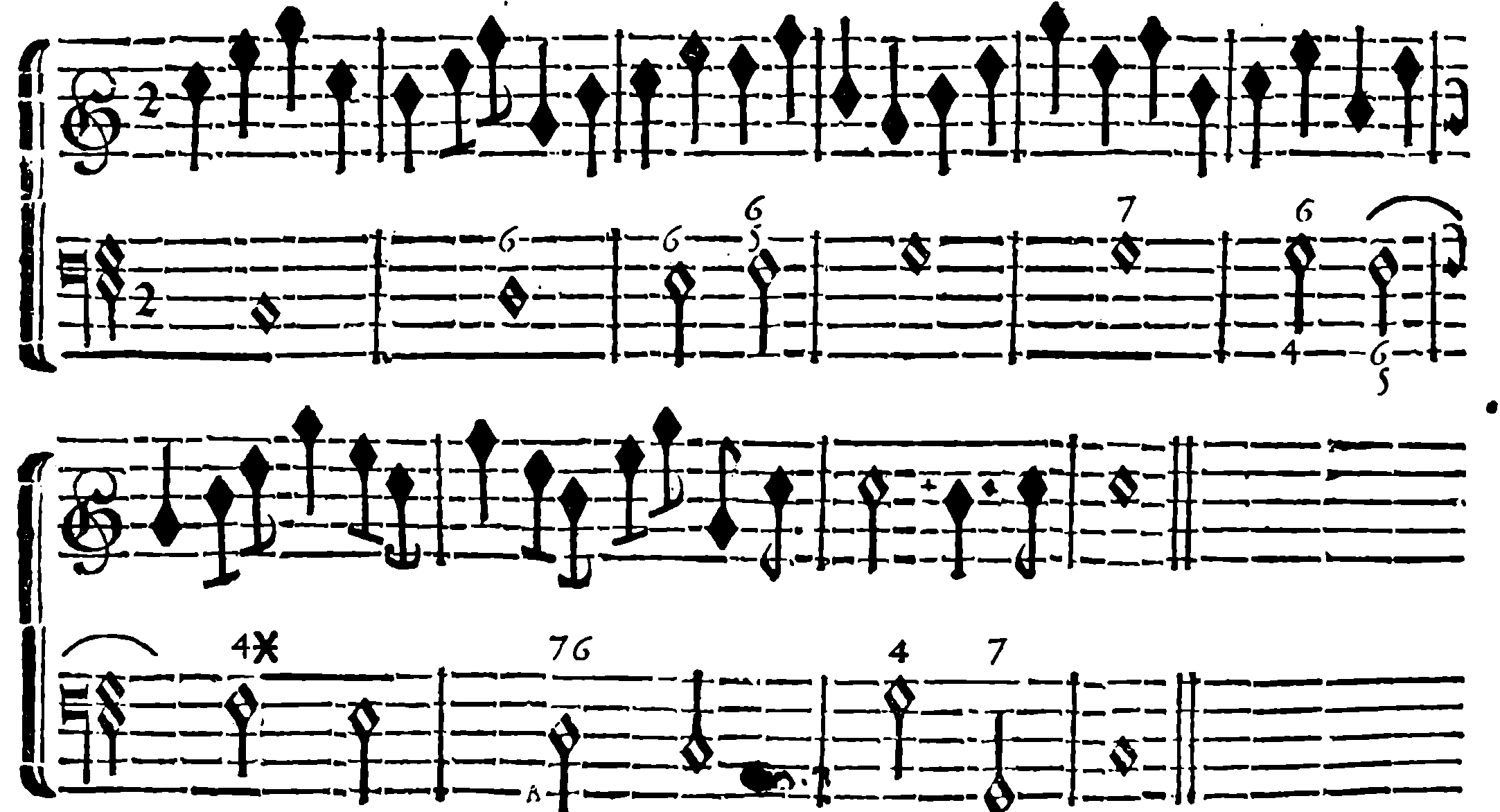
In the upper part, all notes pass only through sounds belonging to the chords figured in the bass.
A measure in two beats may be divided into four at the composer’s discretion. This is seen in note A, whose duration is divided into two beats by its two different chords. Thus several different chords may sound on each beat according to the slowness or speed of the tempo, just as a single chord may sound throughout one or several consecutive measures.
EXAMPLE of a Figured Bass
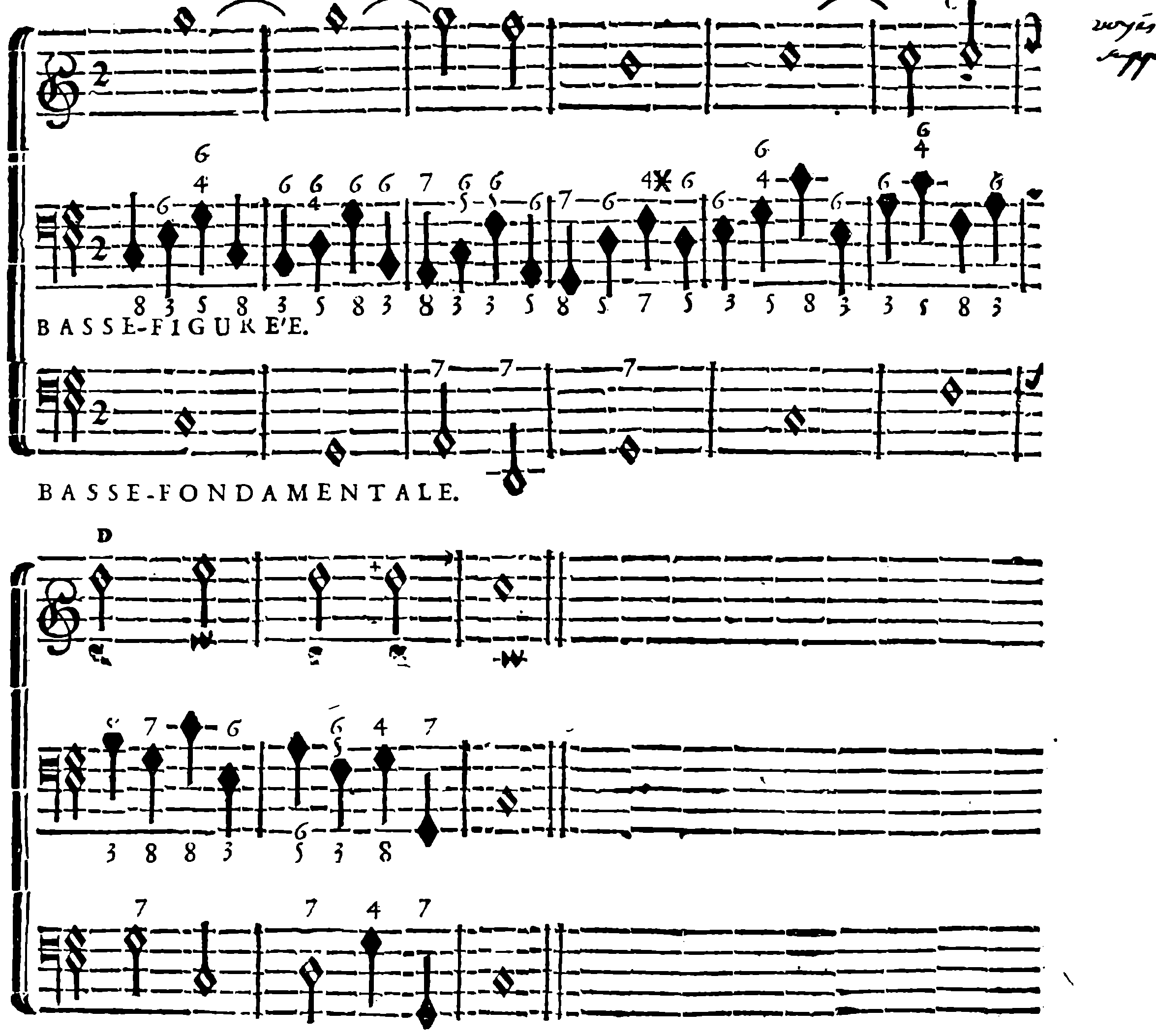
The figures below the figured-bass notes show the intervals they form with the fundamental bass; those above show the chords borne by these notes in such cases.
To write a figured bass, first compose a fundamental bass and write the figured bass above it, much as one writes a figured upper part above a bass. I say “much as,” because instead of avoiding the same notes in both basses, one should, on the contrary, sound the fundamental bass’s root notes in the figured bass as often as possible, even at the first instant of the beat.
Always adapt the upper part to the part that will sound with it. If it is to sound with both basses, it must obey the rules against each. Thus this upper part would have to change at C and D, where it makes two fifths with the fundamental bass, placing notes where the cue signs stand.
One may instead compose the figured bass first. After distinguishing its beats, put beneath it a fundamental bass that conforms completely to the prescribed rules for that bass’s progression and chords. One may then compose an upper part with more or less figuration than the figured bass.
A figured bass often contains notes that can belong to two different chords. Then only the beat following the uncertain one can decide the choice; the fundamental bass may also guide us here.
Seek variety as much as possible, avoiding too frequent repetition of the same passages.
One may figure all the beats of a measure or leave some unfigured. Sometimes only half a beat is figured, now in the bass, now in the upper part, or in both together, always following the rules.
Example
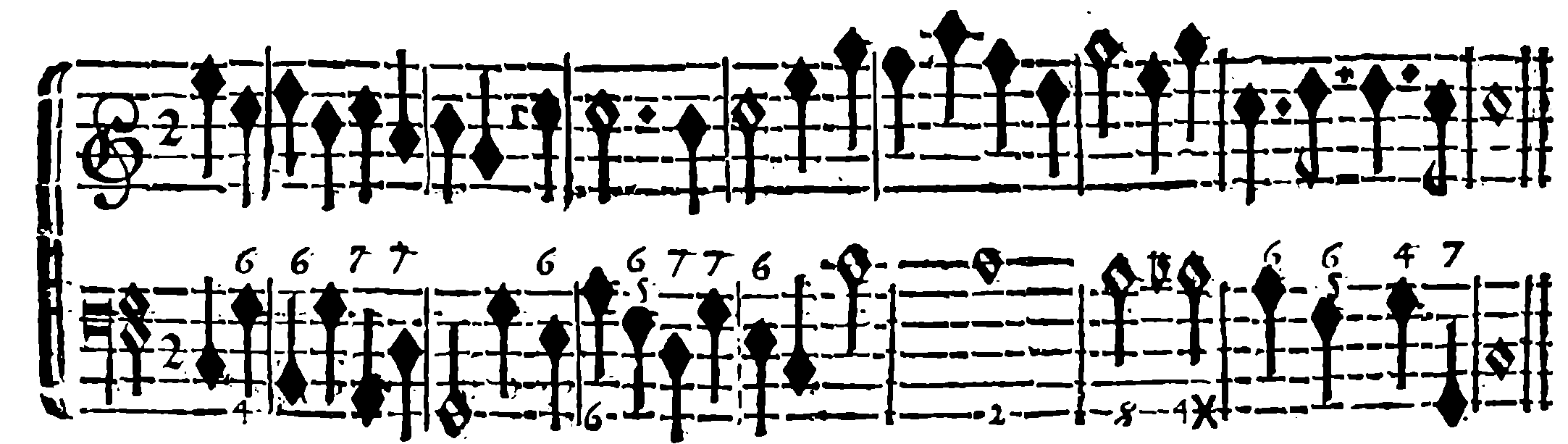
One part may begin first and the other enter two or three beats later, or even one or two measures later, as taste dictates. The same applies to additional parts if there are more.
One may begin at any point in the measure, even the last quarter of a beat. One part may also stop for a while, but if it is the bass, this may last no more than one or two measures, since the continuo bass must always be understood even when only one part is intended to sound.
All these silences are shown by quarter rests and other such signs, explained in Chapter I.
Moreover, a dot after a note must be understood as that same note. It ordinarily forms a chord with the other parts, since it nearly always falls on a strong beat. As it is worth half the preceding note, if its duration happens to be only half a beat or less, the note following it is then admitted solely for melodic taste.
Article two
On Figured Melody Through Diatonic Intervals
As many notes as desired may pass between beats. When they move diatonically, they need not belong to the chord, provided the first does. But if, after several such notes, the final note of one beat moves by a consonant interval to the first note of the next, that final note must also belong to the chord prevailing during its beat.
If beats containing several intervening notes are slow enough to divide into two equal beats, it is always advisable to divide the notes within each beat into equal values too, ensuring that the first note of each division belongs to the chord over which the passage occurs.
Taste sometimes requires these rules to be broken: in diatonic movement, the first note of a beat does not always belong to the sounding chord. That first note is then admitted only as a kind of coulée, or sliding approach, leading immediately afterward to a chord note before the beat’s duration ends.
Example
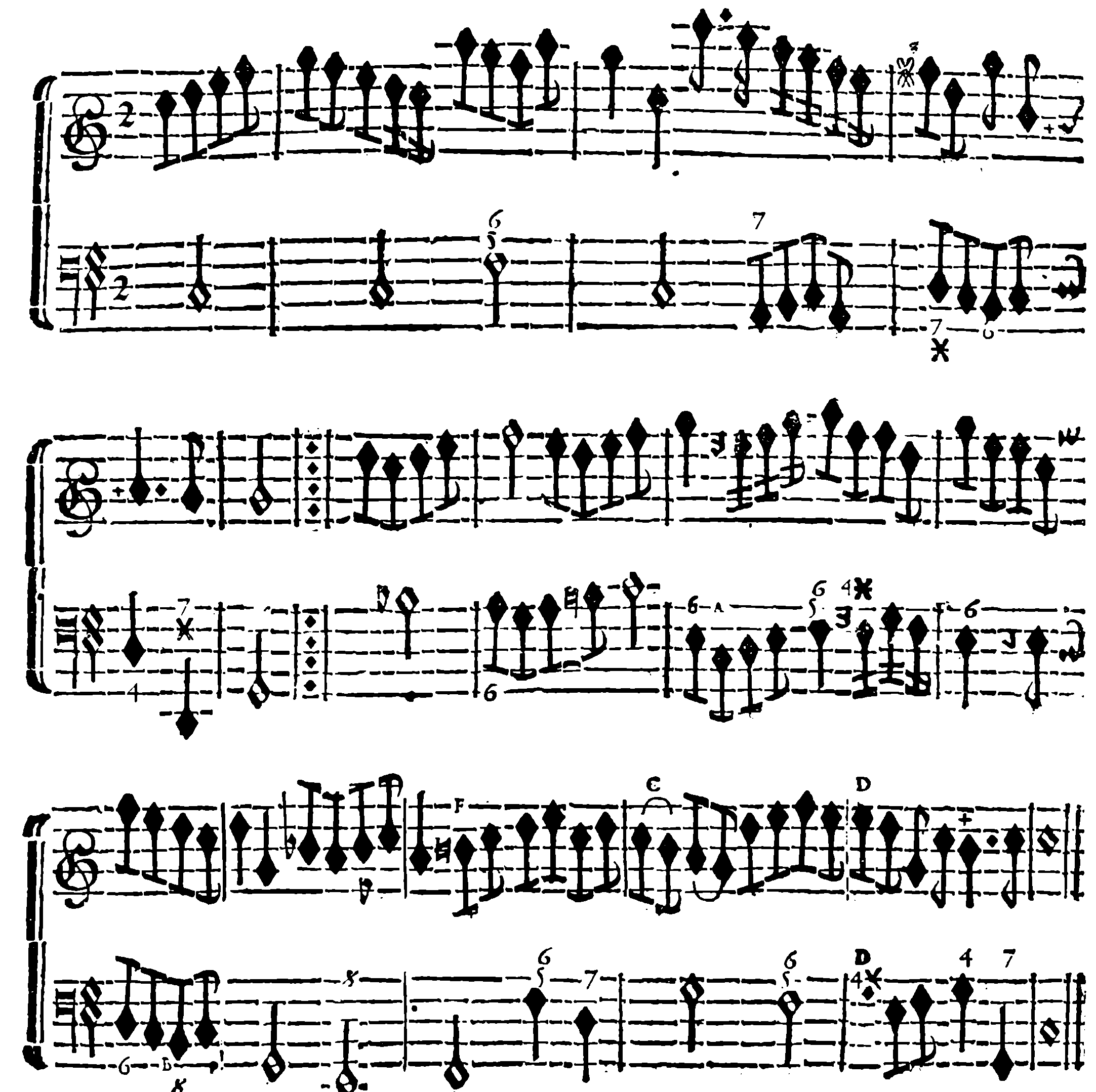
Although this meter has two beats, it is divided into four almost everywhere. The first of each pair of eighth notes is always seen to belong to the chord.
At beat A, the first of the last two eighth notes does not belong to the chord, because the melody moves diatonically from one beat to the next. The first two eighth notes, which do not take part in this progression, do belong to the chord.
Each note of beat B must bear a chord, dividing the beat into four, because as soon as the tonic appears after the leading note it must bear its natural chord. If that tonic appeared immediately in the following measure and the melody rested there, beat B should not be divided. But the melody rests on the dominant, making us feel an irregular cadence from B’s last eighth note to the following note.
The first and third eighth notes of beat C are not chord members, since they act as a kind of coulée toward the second and fourth eighths, which are. The fourth must belong to the chord because it passes to the next beat by a consonant interval. Similar coulées occur at F and D.
The dot at D represents the preceding note. The tritone chord figured there lasts until the dot’s duration expires, so the tritone resolves only on the beat after that dot.
This is how we thought it necessary to explain what has hitherto appeared only under very abstract rules.
This ease of figuring melody, together with chord inversion, gives rise to music’s incomprehensible variety.