 Playable Books
Jean-Philippe Rameau · section 92 of 109
Chapter five
Read and hear this section in the playable edition →Useful Observations on All Chords
In accompaniment, as in all harmony, there are only two different chords: consonant and dissonant. The first is the perfect chord, the second the seventh chord.
Play the first on the keyboard and you will find that it forms every consonant chord, of which it is the source. It contains only three different sounds: the bass note, its third, and its fifth, for example C, E, G. The octave, another C, is not different from the first C; it merely replicates it.
These three sounds, C, E, G, therefore form the perfect chord with C as bass. Take E as bass and play C and G in the right hand: we find the sixth chord. Then take G as bass and play C and E in the right hand: we find the sixth–fourth chord. These comprise all consonant chords. Add the bass note's octave in the right hand to complete each. For a quicker understanding, play any perfect chord in the right hand, then play each of its notes an octave lower with the left. The three consonant chords in question will result.
Example
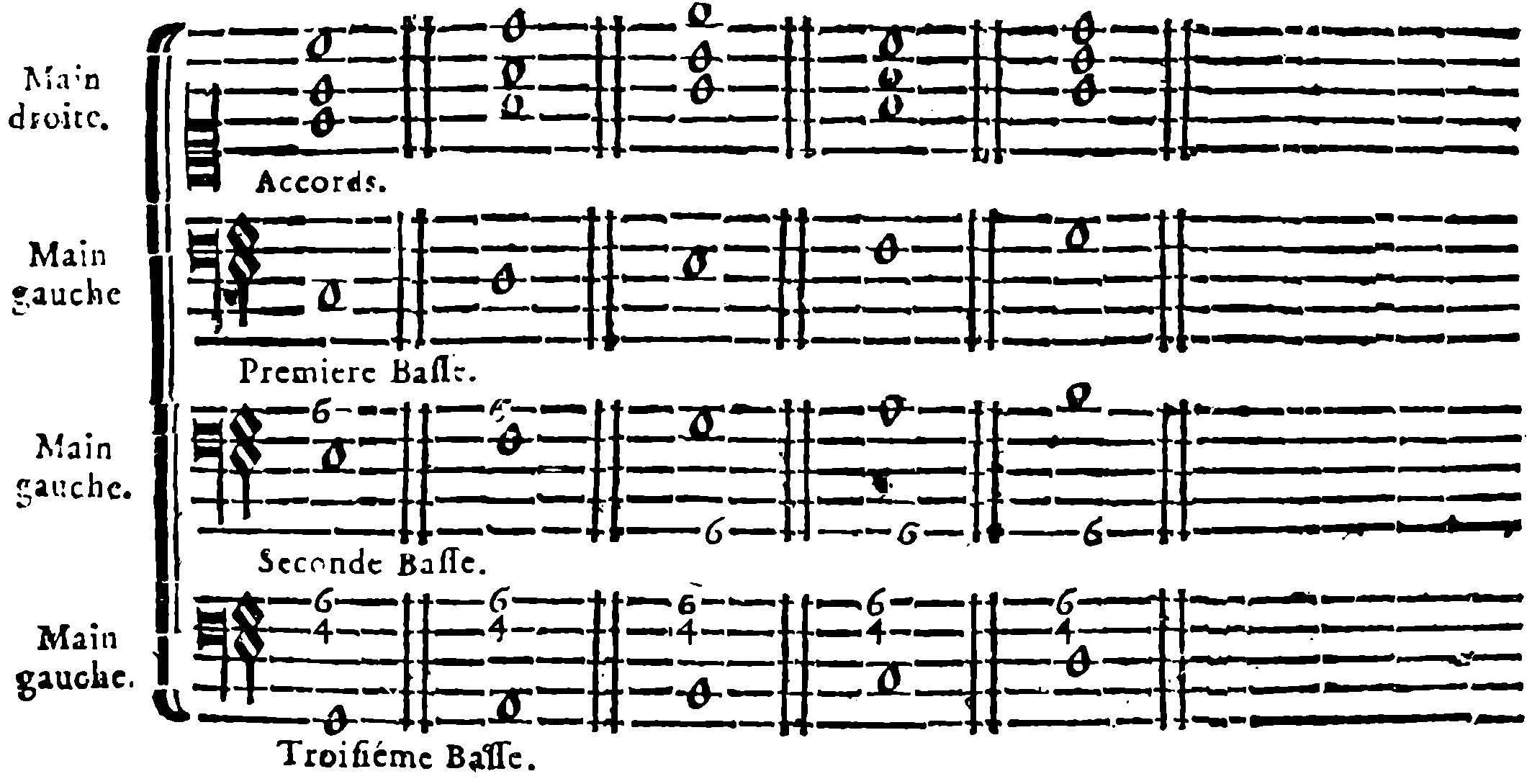
Observe that the perfect chord over the first bass becomes the sixth chord over the second and the sixth–fourth chord over the third. These three basses contain the same three notes composing the chord.
The dissonant seventh chord contains four different sounds. Take each sound in turn as bass, and every dissonant chord that can occur in harmony will be found, with a few exceptions not yet appropriate to discuss.
Example
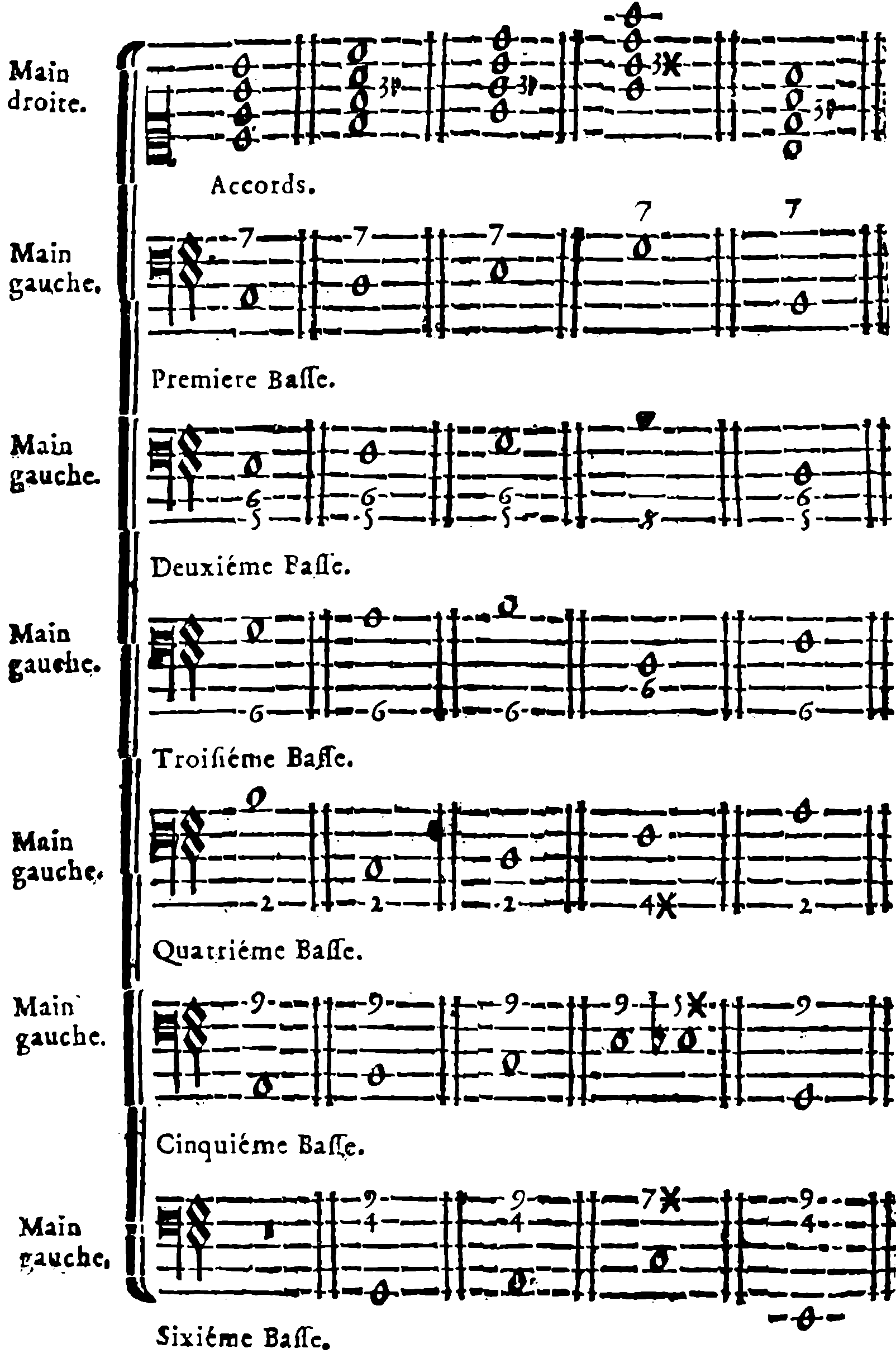
Above this bass, the chords are seventh chords.
Here the chords are great-sixth or diminished-fifth chords. Their difference comes from the first bass's third, minor in one case and major in the other.
Here the chords are small-sixth chords, major or minor according to the thirds of the first bass.
Here the chords are second or tritone chords, again differing according to the thirds of the first bass.
Here the chords are ninth or augmented-fifth chords, the difference still arising from the first bass's thirds.
Here the chords are eleventh chords, called fourths, or augmented-seventh chords; the difference, and so forth.
Do not dwell on this first chord, which is merely incidental.
Do not yet concern yourself with the chords of these last two basses.
Take the perfect or seventh chord of any note, adding the bass's octave to the seventh chord, then play in the bass one of the sounds belonging to the chord held above. The same chords shown in the preceding examples will appear. With a perfect chord, putting its third in the bass gives a sixth chord formed from that same perfect chord; putting its fifth in the bass gives a sixth–fourth chord. Likewise, a seventh chord forms a great-sixth or diminished-fifth chord on the third of its original bass, a small-sixth chord on the fifth, and a second or tritone chord on the seventh. If you are playing a small-sixth, great-sixth, diminished-fifth, tritone, or second chord and wish to identify its source seventh chord, always add the bass's octave to the chord. If the fingers then lie in thirds, the lowest finger's note, put in the bass, will support the seventh chord held by the right hand. Otherwise two fingers will always lie together; put the higher of those two fingers' notes in the bass to find the seventh chord. See also Book III, Chapter XI, where this is discussed. Consonant chords are easy enough to recognize by themselves. Play the chord in a keyboard position where the fingers lie in thirds: the note under the right hand's second finger is the one that would bear the perfect chord if placed in the bass.
These chord relationships cannot receive too much attention. They greatly ease understanding and practice, especially when one immediately recognizes which new chord will result from moving the bass a third, fifth, or seventh upward. Remember that a seventh up equals a second down; a third up equals a sixth down; a fifth up equals a fourth down; a third down equals a sixth up, and so forth.