 Playable Books
Jean-Philippe Rameau · section 93 of 109
Chapter six
Read and hear this section in the playable edition →On Keys and Modes
Good accompaniment is difficult without certain knowledge of keys and modes. You must therefore consult Book III, Chapters VIII and XII, then work to make the following octave exercises easy. Their chords are shown in different keyboard positions, with fingering for each hand. To prove that only the perfect and seventh chords occur, we have placed beneath the first two basses another bass called fundamental. It shows that the different chords marked above the diatonically ascending and descending bass arise only from the perfect and seventh chords figured on this fundamental bass. To make this clearer, each note is named, so that you can see that a note carrying a given chord lies a third, fifth, or seventh above the note that should bear the perfect or seventh chord, and that notes bearing such chords ordinarily occupy the same degree in every key.
Use the fundamental bass only for the proof just described. It is unnecessary in practice; indeed, the chords are not arranged according to the rules relative to it, but only relative to the continuo bass, which is played with the left hand.
If these observations seem somewhat obscure, concentrate simply on practicing the chords until what follows helps explain the present difficulty.
Example of Keys and Modes, with All Chords Required on Each Note of a Key When the Bass Ascends and Descends Diatonically through an Octave
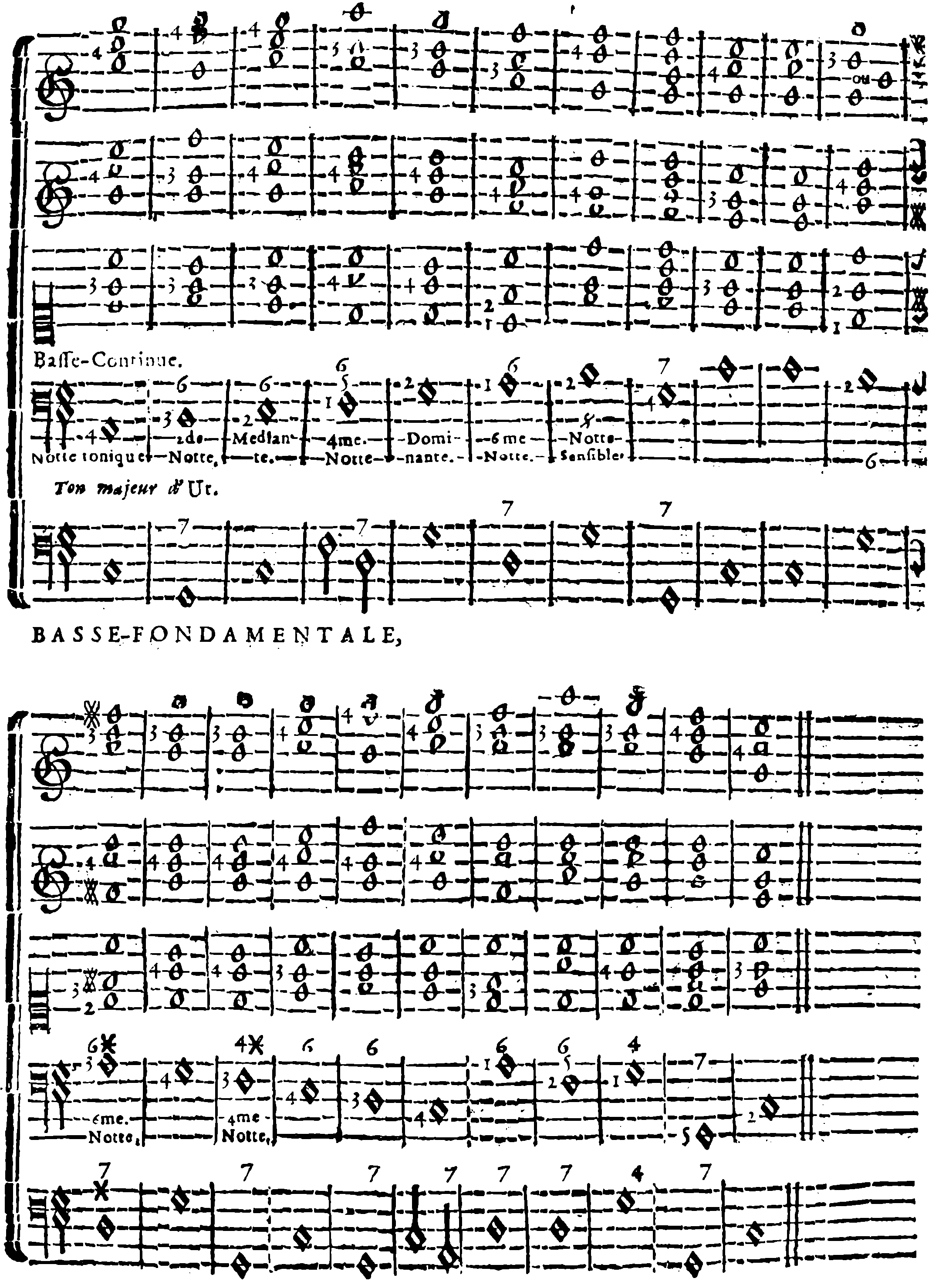
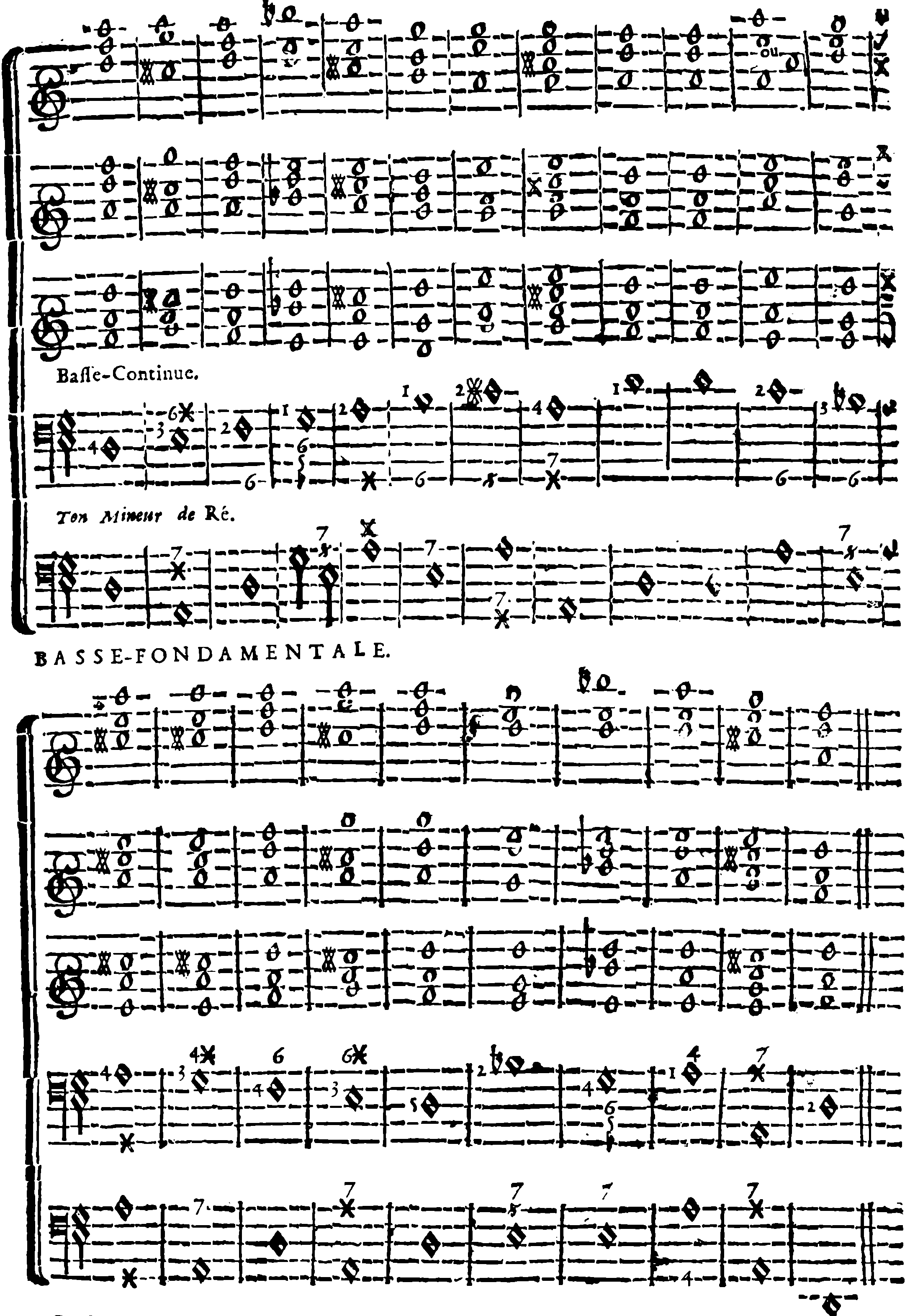
Some say first degree, second degree, and so forth instead of tonic note, second note, and so forth. This should make no difference: properly speaking, these terms are synonymous.
Always master one key thoroughly before moving to another. Study each in the three different keyboard positions, using the fingering shown above, both to avoid surprise wherever the hand lies and to avoid having to lift it.
Observe how chords are linked: a note from one chord almost always also belongs to the next. This greatly assists playing them.
To understand the relationship between the continuo-bass chords and the fundamental-bass chords, add the continuo bass's octave wherever it is absent.
We have given chords in the major and minor modes, with fingering and the name of each note's place in the key, so they may serve for every other key. Keys differ only with respect to the keyboard: knowing the theory of these first two gives the theory of all the others, by relating major keys to major and minor keys to minor.
When a sixth chord follows a perfect chord in a diatonic progression, the third or sixth is sometimes doubled instead of the bass's octave. This both suits the hand and avoids consecutive octaves. The thumb is then necessary.
Example
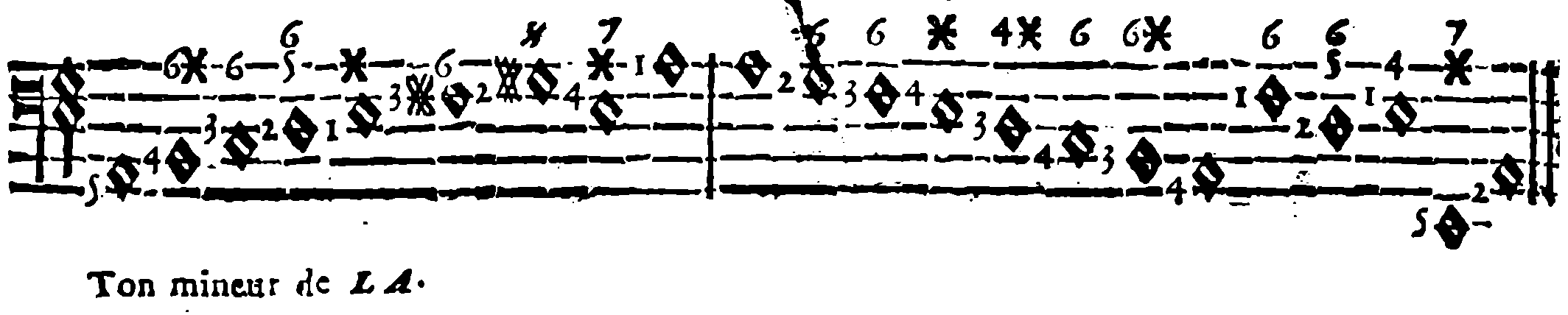






















These last two keys are played on the same keys under different names. This illustrates every other key that can likewise be written under two names: C can be called B♯, and C♯ D♭, so all the notes of the octave change names together. This is so little used that we thought a general indication sufficient, leaving everyone free to acquire this double knowledge of the keyboard, which is very necessary for those wishing to withstand the greatest difficulties.
Try always to look at the book while accompanying, looking at the fingers only when unavoidable. Practice develops this: the ear, trained in harmony, becomes more sensitive to errors than the eye. These octave exercises also give the fingers a habit that naturally guides them to the keys composing each chord. Do not neglect hand position or fingering; their importance is greater than you may imagine.
Once all these octave exercises are mastered, be able to name inwardly every chord you play without looking at either book or hand. If possible, also say: this chord derives from the perfect or seventh chord of such a note; I ordinarily pass next to this chord, derived from that one. No number of approaches is excessive when seeking prompt and thorough knowledge. Once the chord succession throughout every key's octave is known, nearly all the difficulties are overcome. Remember that this succession is the same in every key.
Those who tire of studying every key may continue after the first sixteen or eighteen, returning to the others when they wish to leave nothing uncertain.