 Playable Books
Jean-Philippe Rameau · section 95 of 109
Chapter VIII
Read and hear this section in the playable edition →General rules
For now consider only one key, remembering that the perfect chord belongs only to the tonic and its dominant, without troubling yourself about the seventh that may be added to the dominant’s perfect chord.
Give the great-sixth chord to any note rising a whole tone to a perfect chord, and the diminished-fifth chord to one rising only a semitone. The ascending note may also take a seventh chord, but a figure must explicitly indicate this.
Give the small-sixth chord to any note descending diatonically to a perfect chord or ascending diatonically to the mediant.
Give the tritone chord, or sometimes the great-sixth chord, to any note descending diatonically to the mediant.
Give a sixth chord to any note ascending diatonically to one bearing a great-sixth or tritone chord; to one descending diatonically to a note bearing a small-sixth chord; and to one a third above or below a note that will next bear a perfect chord.
All notes moving by consonant intervals may be given a perfect chord. In a movement of a third, a perfect chord sometimes suits the first note as well as a sixth chord, but the figure must decide in this case.
A seventh may be added to the perfect chord of any note followed by another a fourth above or a fifth below. A sixth may likewise be added to the perfect chord of any note followed by another a fifth above or a fourth below, provided the following notes bear a perfect chord or a seventh chord. These last two rules are the foundation of all the preceding ones.
The following may also be drawn from these rules.
If one may descend diatonically to the mediant after a great-sixth or tritone chord, one may therefore also descend a fourth to the tonic, or ascend diatonically to the dominant bearing a sixth–fourth chord, after those same chords. For the tonic’s perfect chord forms the sixth chord of its mediant and the sixth–fourth chord of its dominant, although one rarely ascends to the dominant after a tritone chord. What follows will make this clearer. Moreover, if a given chord must precede another, then it must—or at least may—be followed by that other chord in accordance with the specified bass progression. Nearly all these different rules can be drawn from the octaves in Chapter VI.
Example of the progression of seventh chords and their derivatives by inversion
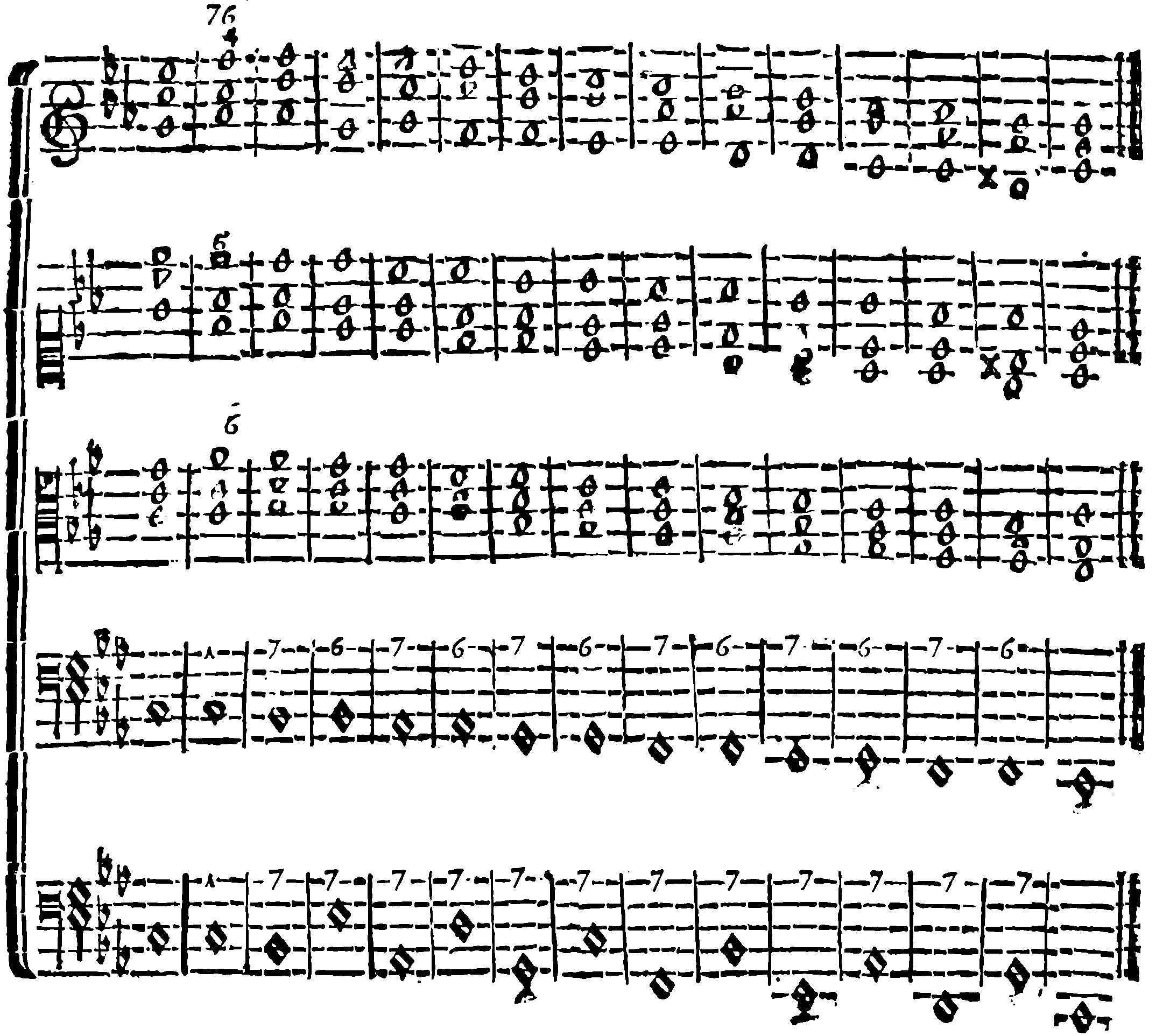
Here two basses stand beneath the same chords. One rises a fourth or falls a fifth, carrying a seventh chord throughout. The other descends diatonically, carrying both a seventh chord and a small-sixth chord on each repeated bass degree, in accordance with our preceding rules.
The notes marked (A) bear three different sixth chords, showing that any one of these may precede only the first seventh chord in a progression like the bass progression here.
This example, intended for all minor keys, will serve all major keys equally well if the flats following the clefs are removed. Simply copy it into other keys on this model, both minor and major. Notice that we have added one flat to those customarily placed at the clef for such a key. This flat marks the minor sixth of every minor key. We ought to have done this throughout, had customary usage not prevailed over this observation.
Practice this chord succession not only in every key but also in the three different keyboard positions shown. The same instruction applies to all the examples that follow. To make the preceding example easier, notice that from one chord to the next two fingers descend while the other stays on the same degree. That finger then descends while the first two remain, and so on alternately to the end.
Other chord successions derive from these first ones. We shall give a new example in the major key, equally usable in minor by adding after the clef the flats from the preceding example. The leading note at the end must remain unchanged in both keys.
We shall also add one note to each chord. Two fingers will then always remain while the other two descend; these in turn remain while the first two descend, and so on to the end. Remember not to use the thumb.
Turn the page for the example.
Example
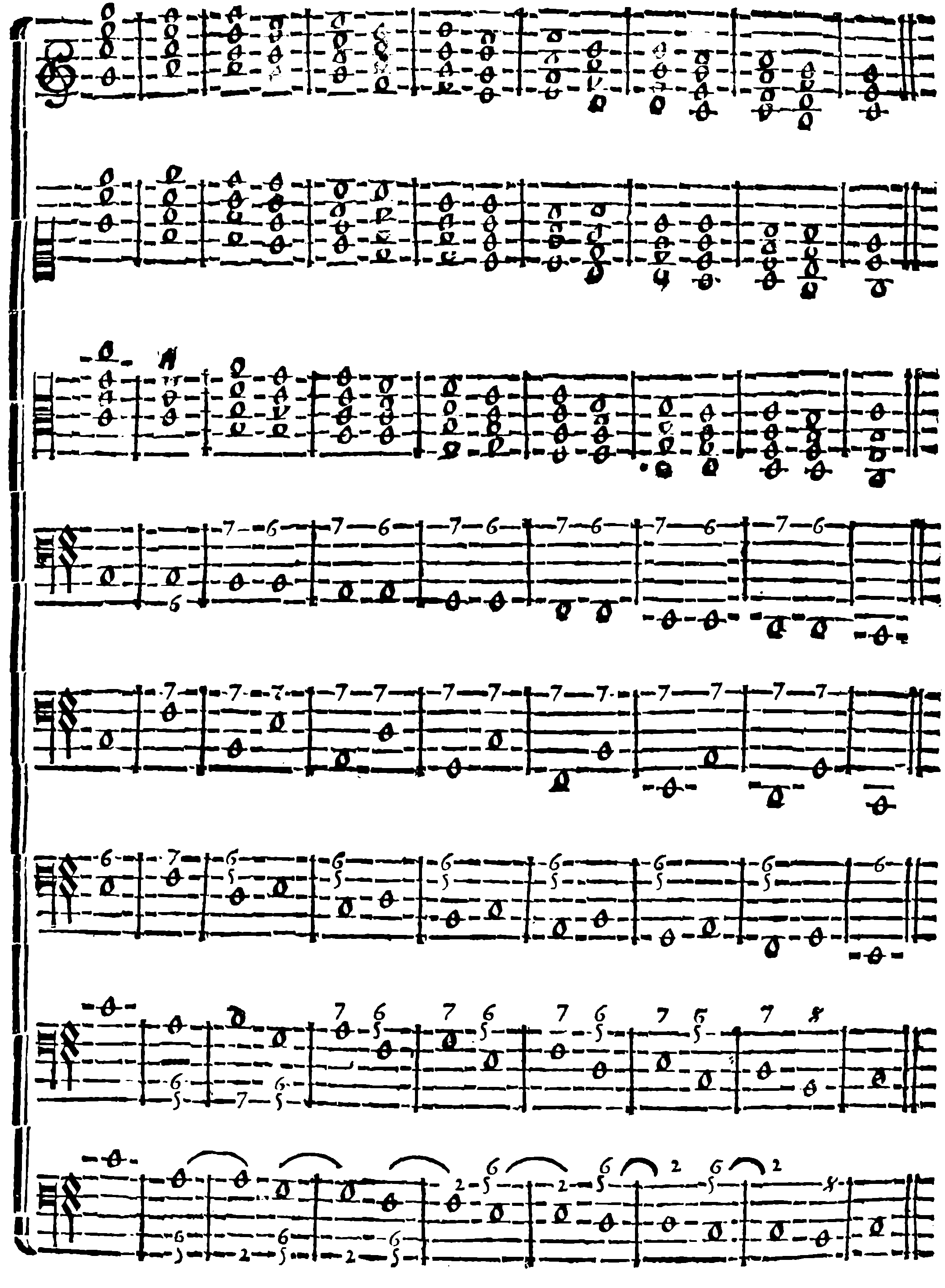
Both ways of playing chords are very necessary: sometimes in four parts, with three in the right hand, and sometimes in five. The first serves all inverted chords; the second serves seventh chords not interspersed with other chords, except great-sixth chords or chords by supposition, which will be discussed later. To use the last example in four parts, simply remove from each chord the note forming an octave with its bass note. This should not be done, however, for the bass that rises a fourth or falls a fifth, since acquiring the habit of that manner is no less useful than the other, as we have just said.
This chord succession has such close connections—it is the bond of the most natural harmony—that habit is often acquired before understanding. In this case the fingers may be said to anticipate the mind, provided one observes the finger positions and arrangement already described.
Since it is easy to make separate examples for the three keyboard positions and all the keys in which these last chords must be practiced, we have been content to give just one example.
You have now seen small-sixth, great-sixth, diminished-fifth, tritone and seventh chords progressing according to our earlier rules. There is no need to say more about them: seventh chords are approached in the same way as perfect chords. Something remains to be added about seventh chords and chords of the second, as the following chapters will explain.