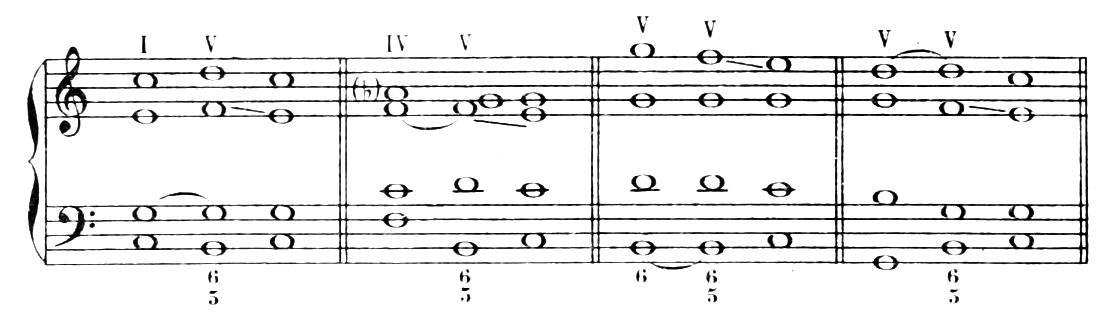
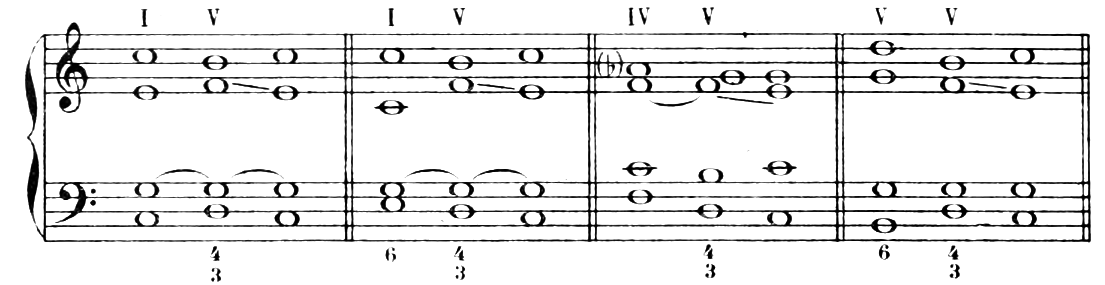
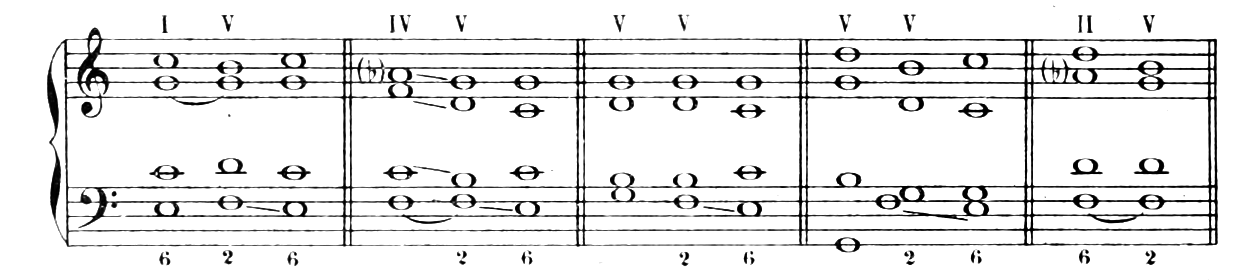
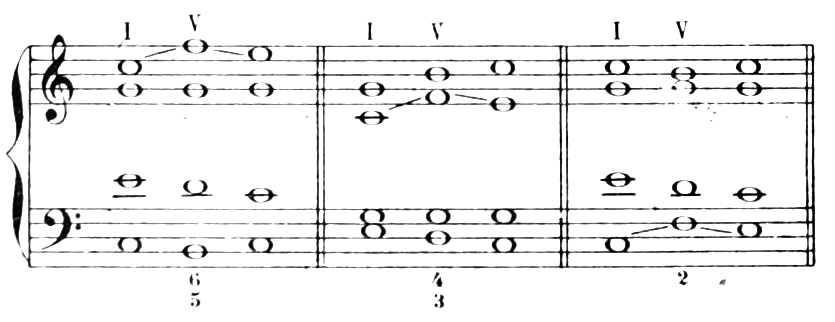
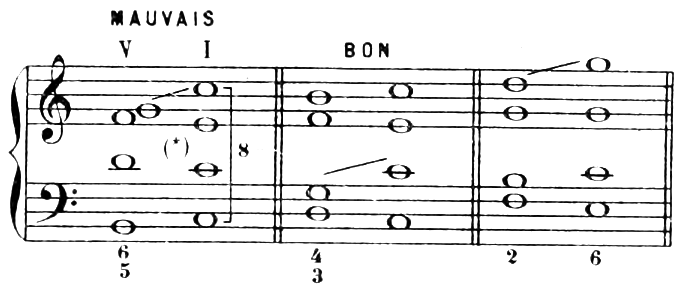
§ 37. — 1) The inversions of the dominant seventh chord resolve onto the first degree, the seventh above the root moving to the third of the tonic chord.
2) First inversion: the chord of the fifth and sixth (six-five chord). It is placed after one of the chords of the first order and resolves to the tonic triad:
3) Second inversion: the chord of the third and fourth (four-three chord). It is placed after one of the chords of the first order and resolves to the tonic triad:
4) Third inversion: the chord of the second (four-two chord). It is placed after one of the chords of the first order and after the sixth chord of the second degree, and resolves to the sixth chord of the tonic:
REMARK. — The chord of the fourth degree, before the four-two chord, can appear only in root position.
The three upper parts move by descending motion.
5) When the three inversions come after the chord of the first degree, the seventh may arise from a leap of a fourth upward in one of the parts; the other parts must not exceed the interval of a third:
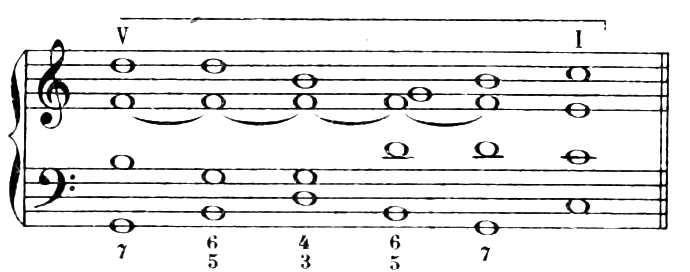
7) The dominant seventh chord and its inversions may be connected with one another, provided that the seventh is a common note; consequently the chord of the second cannot take part in these connections.
 Playable Books