§ 38.—1) As dominant harmony, the leading-note seventh chords (minor in the natural major mode, and diminished in the harmonic major and minor modes) tend to resolve to the tonic chord.
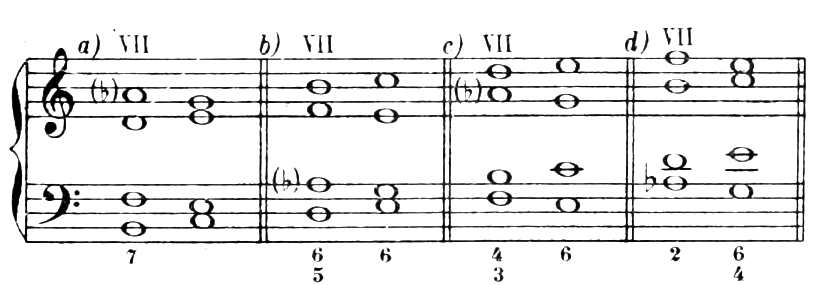
2) The leading note (the root) moves upward to the tonic; the seventh moves downward to the fifth of the tonic; the third and the fifth move in contrary motion, forming a doubled third in the triad of the first degree:
(*) Bad because of the hidden octaves between the outer voices.
REMARK. — The third inversion (ex. d) is not used, because it resolves onto the six-four chord.
3) We advise the student to use the leading-note seventh chord exclusively in root position; moreover, the use of the diminished leading-note seventh chord of the major mode and of the harmonic minor mode is preferable to the minor leading-note seventh chord of the natural major mode.
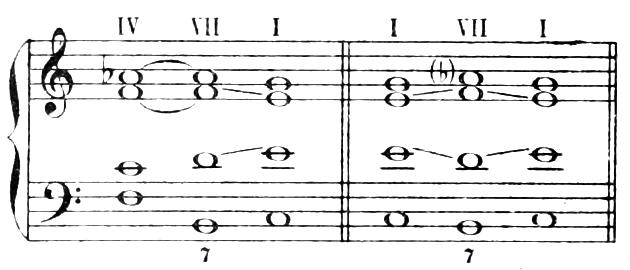
4) Leading-note seventh chords are placed after the triad of the fourth degree, connected to it harmonically through two common notes; preparing them with the triad of the first degree would be less effective:
 Playable Books
 Theory of HarmonyArnold Schoenberg · the leading-note seventh chord and the diminished seventh chord
 Treatise on HarmonyJean-Philippe Rameau · the leading-note seventh chord and the diminished seventh chord
 Guide to the Practical Study of HarmonyPyotr Ilyich Tchaikovsky · the leading-note seventh chord and the diminished seventh chord
 Harmonic AnalysisBenjamin Cutter · the diminished seventh chord