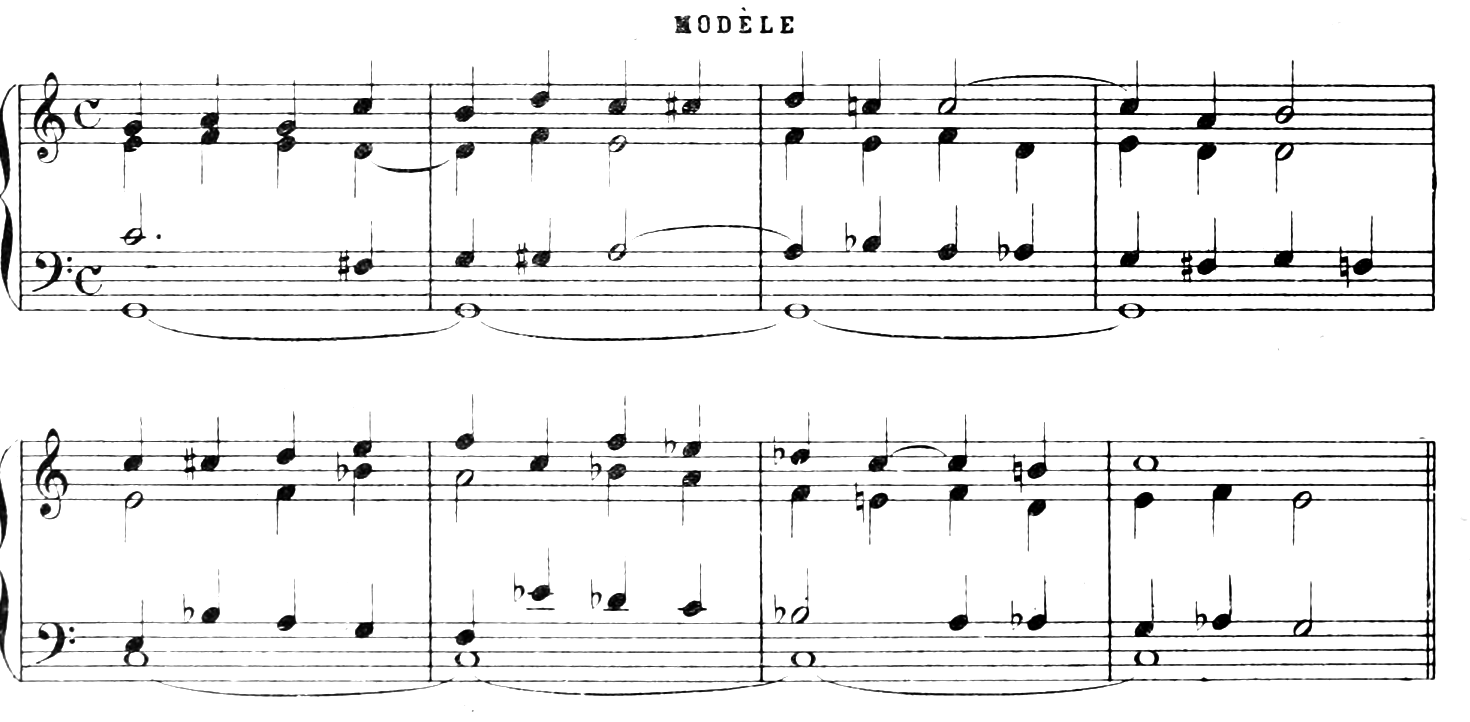
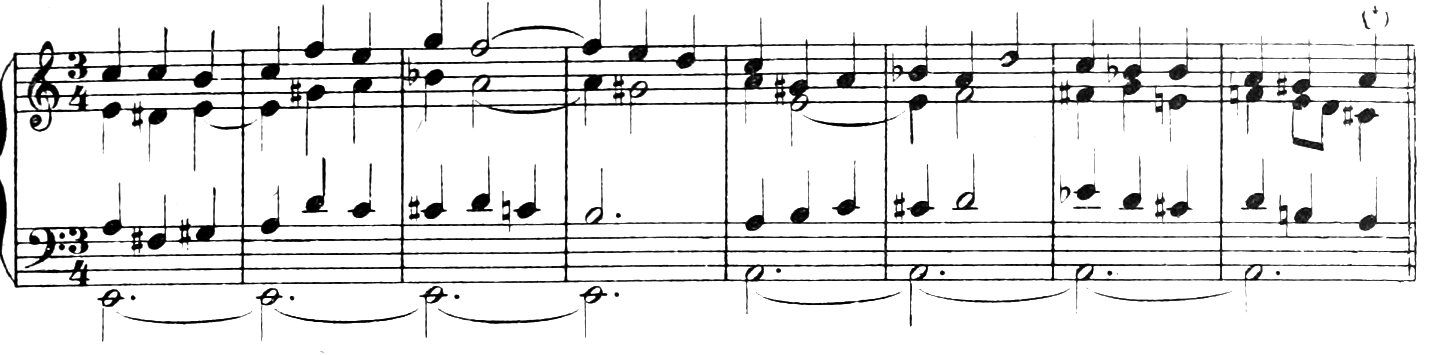
§ 62.— 1) The pedal is a more or less sustained note in the bass, above which the chords formed by the three upper parts move.
2) The upper parts proceed according to the rules of three-part harmony.
In these incomplete chords the fifth is ordinarily omitted; but if, to make the parts sing well, the chord is placed in the melodic position of the fifth, or if the fifth lies in the lowest part, as for example in the chord of the third and fourth, the root is most often omitted.
3) The note that forms the pedal is usually the dominant or the tonic. The former is the sustained bass of the cadential six-four chord; it ends with the dominant harmony, which resolves onto the tonic chord. The latter is the sustained bass of the tonic chord and ends with the authentic or plagal cadence in the three upper parts.
4) The pedal must begin on the strong beat of the bar; the tonic pedal may immediately follow the dominant pedal.
5) Besides the chords belonging to their key, pedals can bear a few passing keys.
6) In a major key (e.g. in C) the pedal on the dominant (G) allows modulation to all the keys of the first class: d, e, F, f, G, a; the pedal on the tonic (C) allows modulation to the keys of the minor and major subdominant and to the keys of the first class of the major subdominant: f, F, g, a, B♭, b♭, A♭, etc.
7) In a minor key (e.g. A minor) the pedal on the dominant (E) allows modulation to the keys of the 5th and 4th degrees: E major and D minor; and the pedal on the tonic (A) allows modulation to the key of the subdominant and to that of the 6th degree of the latter: D minor and G minor.
REMARK. — Such a pedal often ends on a major triad:
 Playable Books