 Playable Books
Percy Goetschius · section 24 of 29
Chapter XXII. Four-Part Harmony
Read and hear this section in the playable edition →


220. The fundamental harmonic conditions are not affected by the number of parts.
The association of four parts is subject to precisely the same rules as govern the association of three, as far as the choice of chords is concerned. Therefore, the tables given in Chapter XVI (Ex. 122 and par. 169) are valid for the present tasks.
221. The chief difference between three-part and four-part harmony is that in the latter the parts are somewhat more crowded, and are therefore more restricted in their individual melodic movements, — especially the two inner parts; the compass of each part is narrower, and the progressions smoother and quieter than when only three parts are used.
Further, there are fewer omissions, and more duplications of the chord-intervals.
222. As a rule, the best tone to double is the root of the chord. But it is always correct to double one of the good scale-steps, namely, steps 1, 5 and 4; excepting when these chance to be the dissonant interval of the chord (the chord-7th or chord-c7th, neither of which should be doubled).
It is almost always wrong to double the 7th scale-step (the leading-tone).
In the six-four chord-form, the bass tone (the chord-5th) is generally doubled.
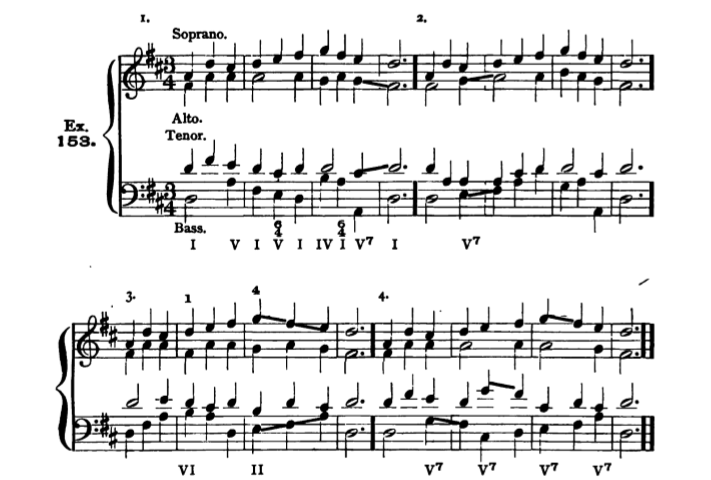
223. Applied to the first melody of Exercise 16, the result is as follows:
Ex.153-1
Ex.153-2
Ex.153-3
Ex.153-4
Version 1. All primary chords, and inversions. In every one the root is doubled, excepting in the two 6/4 chords (doubled bass tone), and in the Dom.-7th chord, where no duplication is necessary. In the last chord, the 5th is omitted, because of the resolution of the leading-tone (7th scale-step) in the Tenor; and therefore the root is tripled.
Version 2. The chord-7th, on the last beat of the first measure, resolves upward instead of downward (par. 58, second clause). This is allowed when the bass part moves in 3rds parallel with it.
Version 3. Primary and secondary chords. The VI, as usual, harmonizes the first scale-step (in soprano), the II harmonizes the fourth step. In measure 3, second beat, the chord-3rd (f-sharp) is doubled, — for the sake of good melodic progressions in the outer parts.
Version 4. More frequent use of the Dom.-7th chord. Compare all four versions very minutely with each other.
In all of these versions it will be observed that neither one of the inner voices is distinctly melodious. In the last one, the alto part is undeniably monotonous. This is a condition which can scarcely be avoided by the beginner, and need give him no concern, at present.
Review par. 184, and transpose the above examples to D minor.
224. When successive 6ths are used (as in Ex. 132) care must be taken to avoid parallel movement in 5ths or 8ves, between any two parts. Thus:
Ex.154
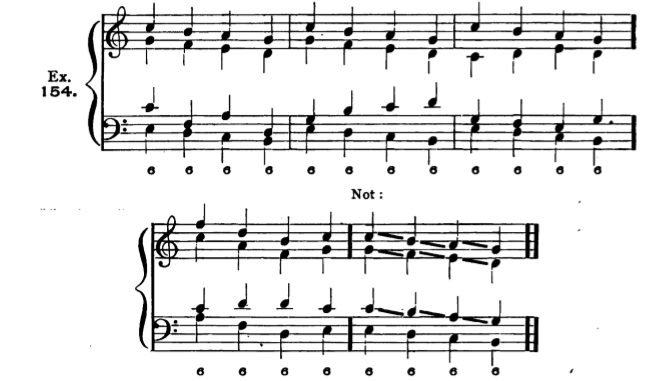
Also in D minor.
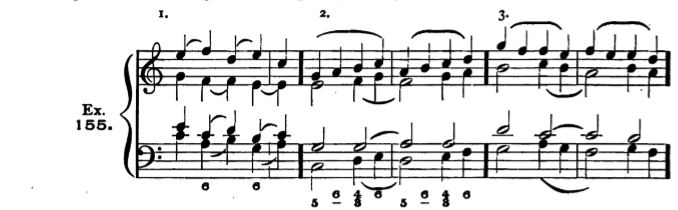
225. Sequences are somewhat more difficult, with four parts, because the greater body of tone is less flexible. But they are possible, if planned carefully, according to par. 183. For illustration:
Ex.155
Ex.155-1
Ex.155-2
Ex.155-3
Ex.155-4
Ex.155-5
Here again, as in Ex. 133, observe how each sequence interlocks with the preceding figure, — as shown by the lower slurs.
226. The so-called Organ-point is particularly valuable in harmony for four (or more) parts, because it adds a line, — usually the lowermost, — without interfering with the movements of the other parts. The principal rule is that the organ-point, as dissonant interval, should neither enter nor progress with a leap. For example (applied to the 7th Melody of Exercise 16):
Ex.156-1
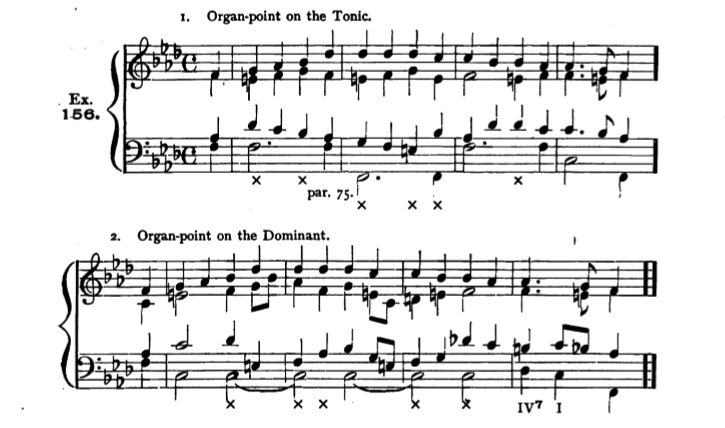
Ex.156-2
1. Organ-point on the Tonic.
2. Organ-point on the Dominant.
The X marks the beats where the sustained tone in bass becomes dissonant. In version 1, it is the Tonic of the key; in version 2, the Dominant. No other steps than these are likely to occur as organ-points.
In version 2 there is a raised 6th scale-step in Alto in measure 3, beat 1; and a raised 4th step in measure 4. beat 1.
Exercise 22
Four Harmonic Parts. Primary and Secondary Chords. Sequences.
Harmonize, again, all the Melodies given in Exercise 16 and Exercise 17, in four-part harmony, according to the above directions. This should be done ■without reference to the former solutions. Do this without fail.
Also write a number of original 4-part sentences, with sequences, successive 6ths, and Organ-points.