 Playable Books
Pyotr Ilyich Tchaikovsky · section 24 of 36
Chapter XXII. The Organ-point
Read and hear this section in the playable edition →

§ 62. When in course of a piece of music we have modulated so far from the main key that a mere prolonged cadence no longer suffices to impart to the main key its original significance, we employ the so-called Organ-point or Pedal *).
This harmonic form is nothing more than a further development of the ordinary cadence of the first group. This cadence of the first group gives the feeling of a close, consisting, as it does, ot the three most important chords of the key (tonic, sub-dominant and dominant) and hence exhausting the possibilities of the entire key. Yet it does not, as we have said, suffice thoroughly to reinstate the main key, after numerous modulations into other keys have taken place. To accomplish which we must prolong the last notes of the Bass of the ordinary cadence and erect upon them diverse harmonies of the main key not found in the cadence, or even harmonies belonging to directly neighboring keys. The cadence proper consists as before, of Dominant and Tonic, while its effect is greatly intensified by these chords not in harmony with the Bass note.
An Organ-point, then, can be constructed
1) on the Dominant
§ 63. In the Organ-point on the Dominant there can occur besides harmonies of the main key, modulations into the key of the Dominant, the Dominant of the Dominant,—equivalent to the second degree and occurring mostly in minor—and the swb-Dominant. The Organ-point on the Dominant, being merely a prolongation of the ordinary cadence, must be introduced by the chord of the six-four of the tonic triad and closed with the triad of the 5-th degree or the Dominant seventh chord.
In minor the organ point occurs more rarely. It contains a greater number of modulations and very often closes with the major triad. The permissible modulations are determined by the same considerations in minor as in major with the exception that the key of the Dominant is taken major and the key of the sub-Dominant in minor.
*) The,Pedal* of an organ is an arrangement for the reproduction of the deepest tones and consist of a sort of manual, which is played by the feet.
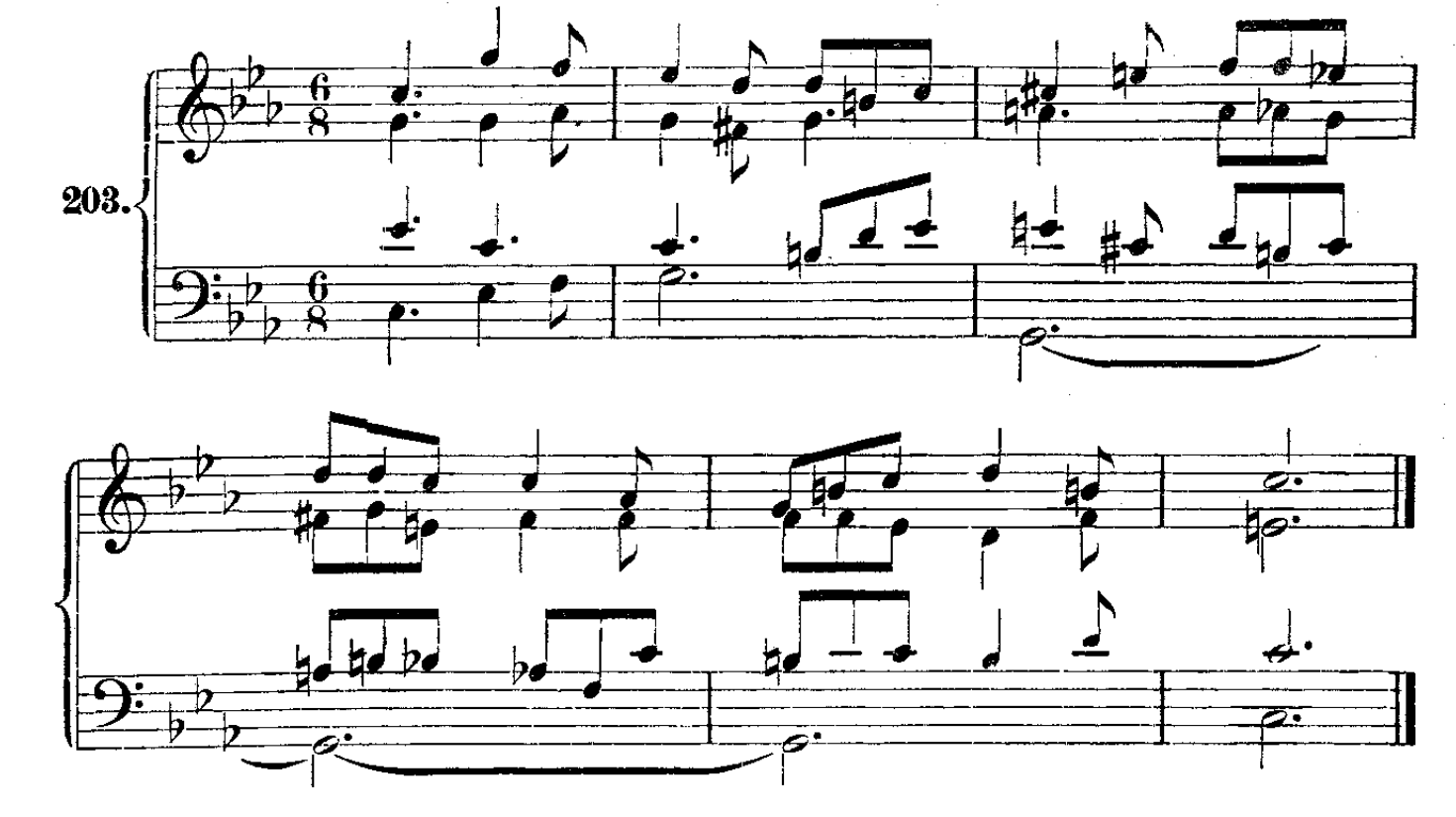
As the Bass of an Organ-point remains stationary, there remain, in fourpart writing but three voices for the chords. The Tenor must not, however, assume the character of a Bass, but must retain the tranquil movement of an inner voice.
In triads the fifth is best omitted.
§ 64, In the organ-point on the tonic we may modulate into the Dominant (mostly in minor), into the sub-Dominant or into the sub-Dominant of the sub-Dominant—that is to say into the key lying a whole tone below the main key.

In minor the modulations remain the same, except that the sub-Dominant is usually taken minor.
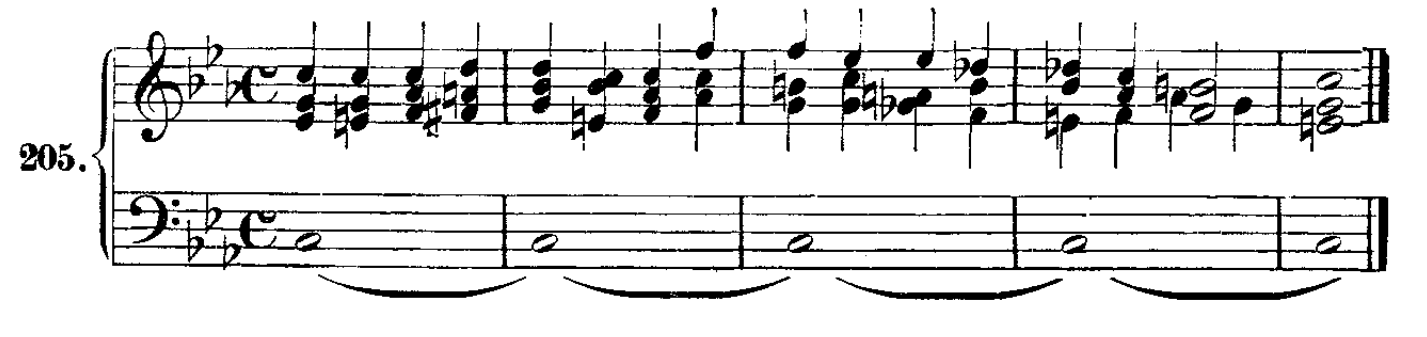
The organ-point on the Dominant is frequently followed by that of the
Note. The figuring of the chord-formations arising in the course of an organ-point is so complicated, that it is only in the rarest cases undertaken at all. In the figured bass of old scores we frequently find but one organnote, under which are written the words,tasto solo‘.
The organ-point on the tonic often ends in the so-called Plagal or Church-Close, which consists of the sub-dominant triad followed by the tonic triad.
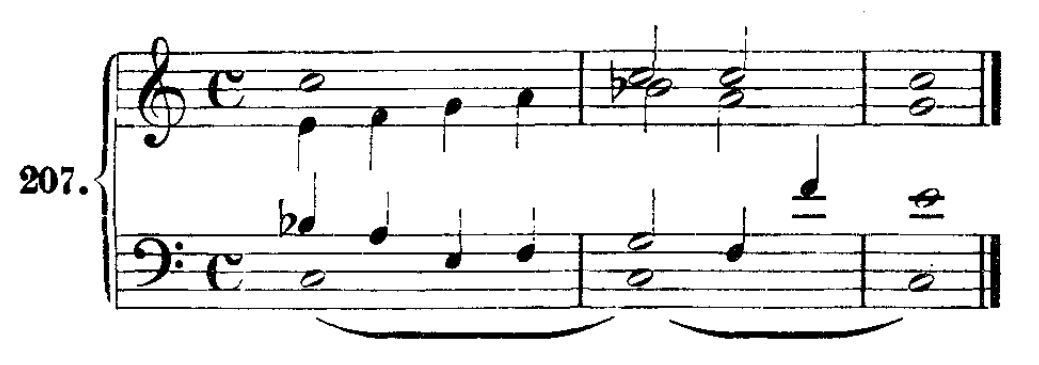
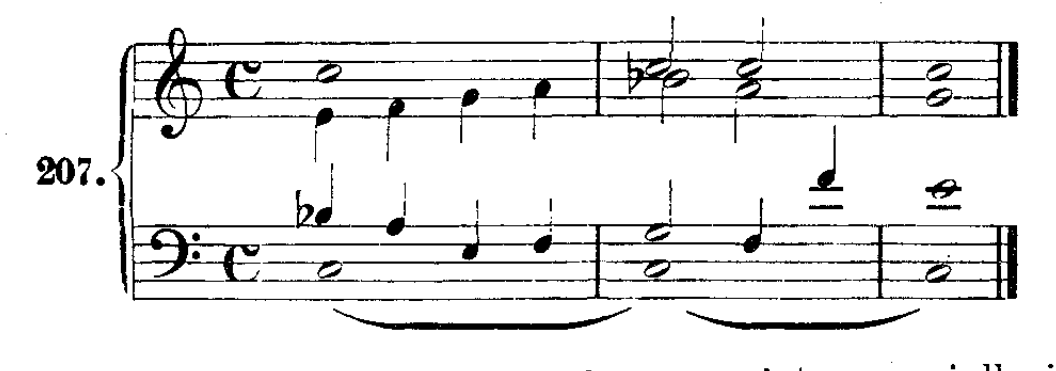
Exercises. Practise the construction of organ-points, especially in major. Also write passing-modulations, closing them with organ-points on dominant and tonic.
§ 65. Although the organ-point has its origin in the prolonged cadence, and hence usually occurs at the close of a composition, it is also found at the beginning or in the middle of a piece of music. In most atich cases, the organ-point is erected on the tonic, and is of short duration.
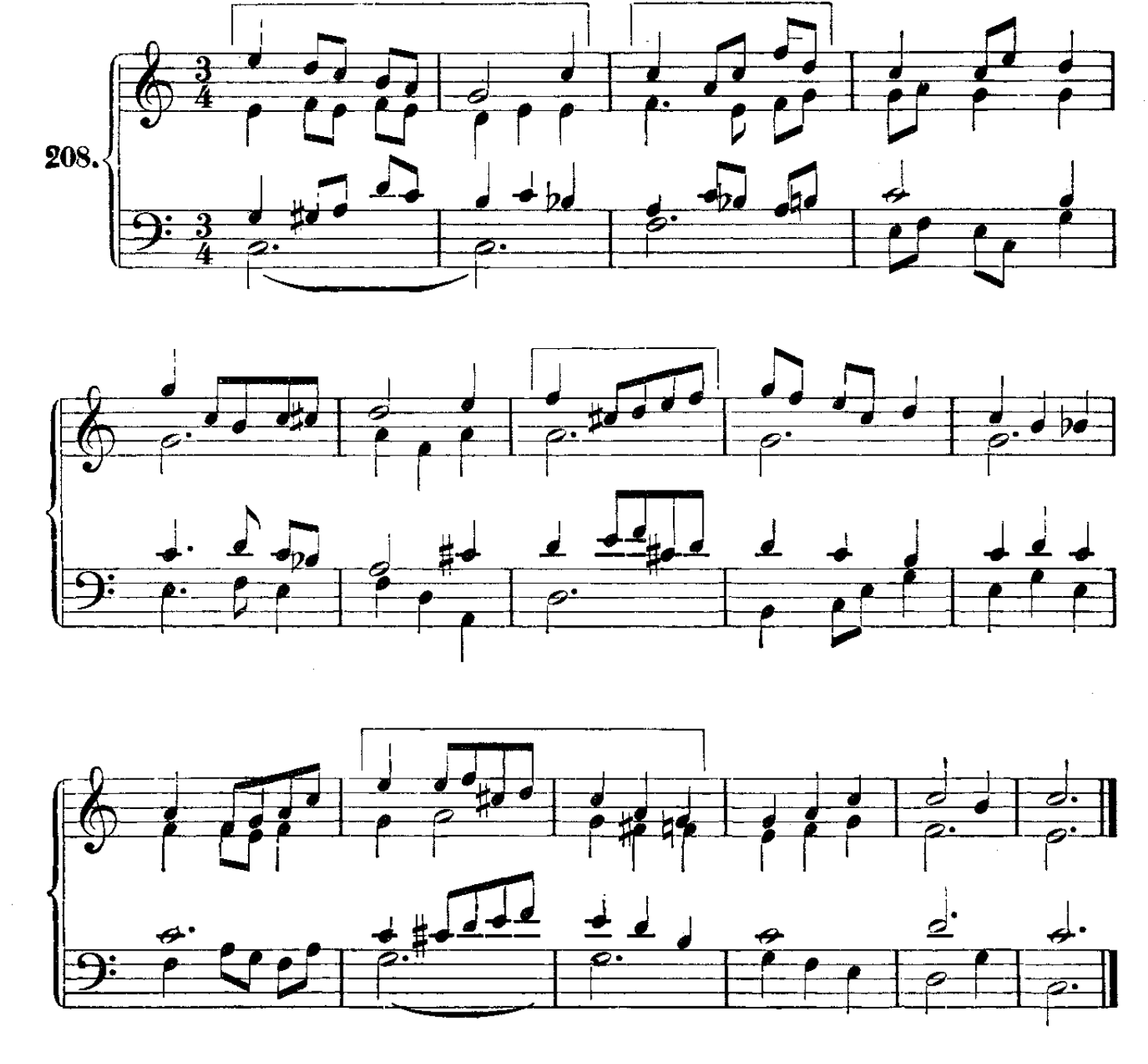
The first and last chords of these organ-points must harmonize with the bass.
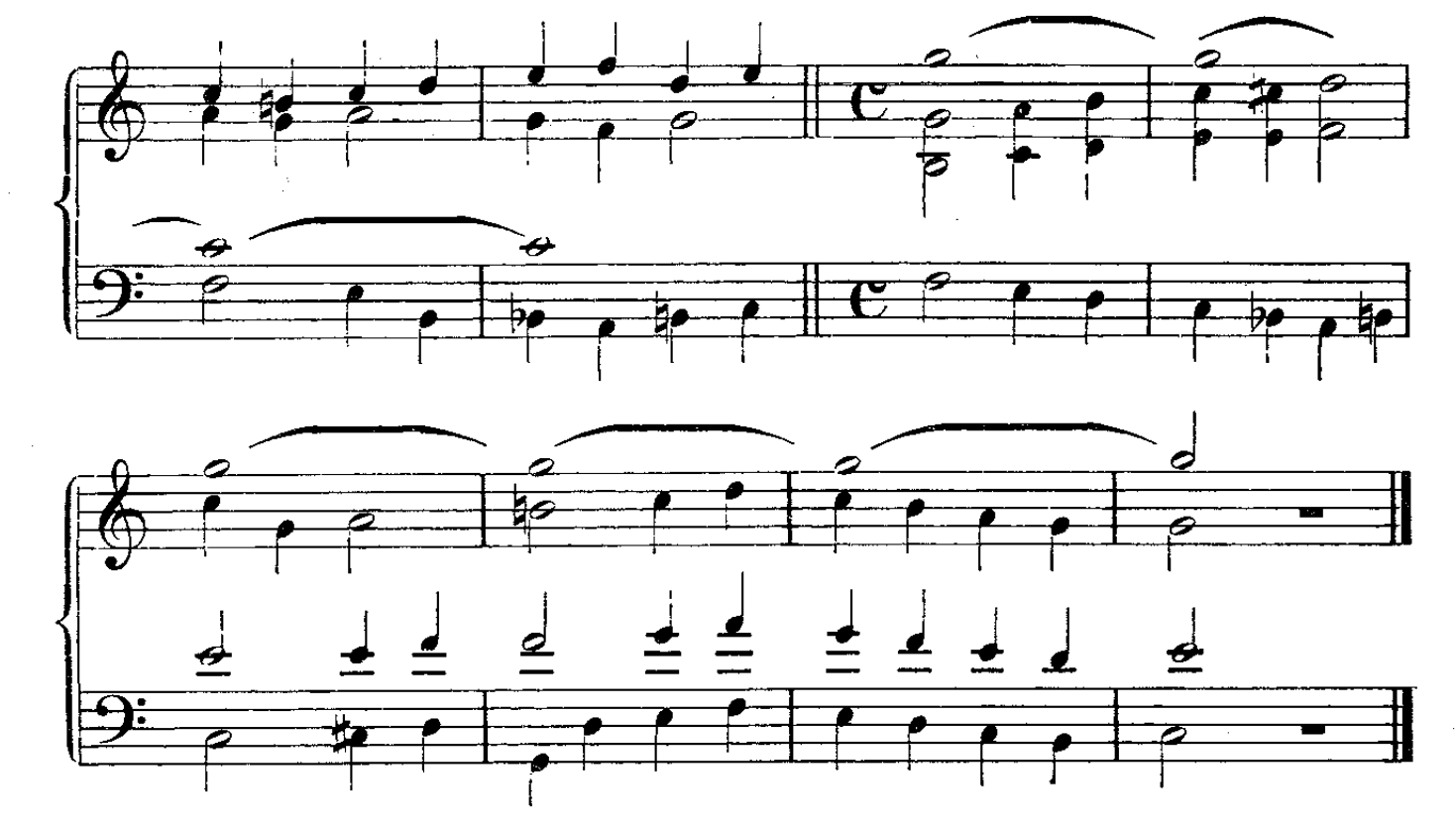
§ 66. The organ-point, or pedal belongs, as its name implies, properly to the bass-voice; yet we meet with a similar harmonic formation in the upper voices, built up, as before, on one prolonged tone, and called an organ-point. Here also there can occur in the other voices chords that are not in harmony with this tone—but only where ohe voice-leading is fluent and stepwise. The first and last chords must harmonize with the prolonged note.
§ 67. Finally, there is the organ-point erected on both tonic and dominant at once; this is much employed in pieces of a pastoral character.
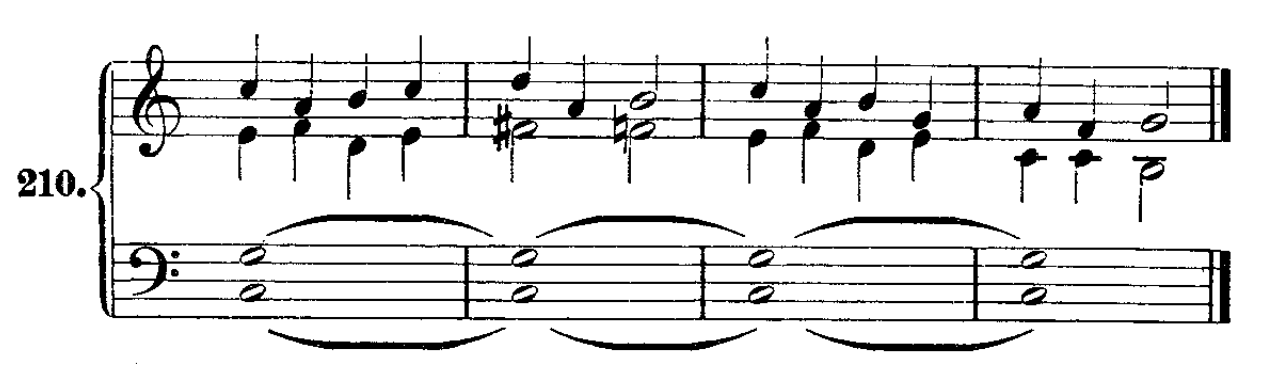
We wish merely to make the pupil acquainted with the organ-points shown in §§ 66 and 67; he should not attempt to make use of them in his exercises. The former of these organ-points demands more experience and skill in voice-leading than can be expected of a beginner, while the latter occurs only in operatic and symphonic compositions.
Accidental harmonic forms.
§ 68. Beside the recognized harmonic combinations, there occur in music tone-combinations which cannot be called chords, as they are not made up of tones systematically erected one on the other, but accidentaly arise through the melodic motion of the voices, without, however, impairing the true character of the Harmony.
Such melodic deviations of the voices from the intervals of a chord arise, when certain tones belonging to the chord do not enter simultaneonsly— as in the case of suspensions and anticipations—or when tones strange to the chord make their entrance—passing and changing notes.