 Playable Books
Nikolai Rimsky-Korsakov · section 45 of 100
Four-part and three-part harmony
Read and hear this section in the playable edition →Harmonic writing for the wood-wind may be considered from two points of view: a) instruments in pairs, 2 Fl., 2 Ob., 2 Cl., 2 Fag.; and b) instruments in three's, 3 Fl., 2 Ob., Eng. horn, 3 Cl., 2 Fag., C-fag.
A. In pairs. There are three ways of distribution: 1. Superposition or overlaying (strictly following the normal order of register), 2. Crossing, and 3. Enclosure of parts. The last two methods involve a certain disturbance of the natural order of register:
Overlaying. Crossing. Enclosure.
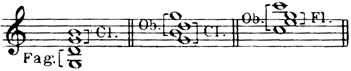
In choosing one of these three methods the following points must not be forgotten: a) the register of a particular isolated chord; the soft and weak register of an instrument should not be coupled with the powerful and piercing range of another:
Overlaying. | Crossing. | Enclosure.
Oboe too piercing. | Low notes of the flute too weak. | Bassoon too prominent.

b) In a succession of chords the general progression of parts must be considered; one tone quality should be devoted to the stationary and another to the moving parts:

When chords are in widely-divided four-part harmony notes may be allotted in pairs to two different tone qualities, adhering to the normal order of register:
Good: | | etc.
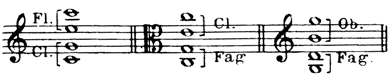
Any other distribution will result unquestionably in a grievous lack of relationship between registers:
To be avoided: | | etc.

If one tone quality is to be enclosed, it must be between two different timbres:
Good: | | etc.
| [Listen] |

It is possible to lend four distinct timbres to a chord in widely-divided four-part harmony, though such a chord will possess no uniformity in colour; but the higher the registers of the different instruments are placed, the less perceptible becomes the space which separates them:
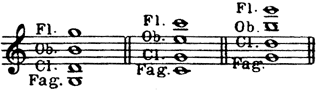
Fairly good Better Still better
The use of four different timbres in close four-part harmony is to be avoided, as the respective registers will not correspond:
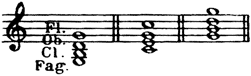
Bad Better Still slightly better
Note. In Mozart and Salieri, which is only scored for 1 Fl., 1 Ob., 1 Cl. and 1 Fag., wood-wind chords in four-part harmony are of necessity devoted to these four different timbres.
The same rules apply to writing in three-part harmony, which is the most customary form when it is a question of establishing a harmonic basis, the lowest register of which is entrusted to another group of instruments (strings arco or pizz., for example). Chords in three-part harmony are generally given to two instruments of one timbre and a third instrument of another, but never to three different timbres. Overlaying of parts is the best course to adopt:

The use of crossing and enclosure of parts (which in a way amount to the same thing) must depend on the manner of their progression:
Enclosure:

B. Wood-wind in three's. Here the distribution of chords in close three-part harmony is self-evident; any grouping of three instruments of the same timbre is sure to sound well:

also: |
| [Listen]
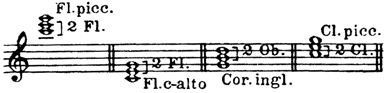
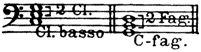
Overlaying of parts is the best method to follow in writing close four-part harmony; three instruments of the same timbre with a fourth instrument of another. Crossing and enclosure of parts may also be employed. Correspondence of timbres and the progression of remote parts must be kept in mind:

The method of using three instruments of the same timbre in widely-divided three-part harmony is inferior:

Not good Better Better Not good Better Better
But if the third instrument is of low register (Bass Fl., Eng. horn, Bass cl., or C-fag.), the resonance will be satisfactory:

In chords of four-part harmony, three instruments of the same timbre should be combined with a fourth instrument of another:
