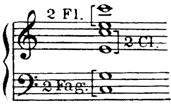
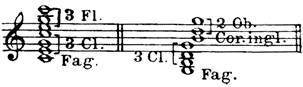
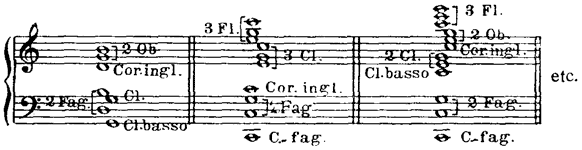
In writing chords of 5, 6, 7 and 8 part-harmony, whether they are independent, or constitute the harmonic basis, the student should follow the principles outlined in the previous chapter, dealing with the progression of wood-wind instruments in octaves. As the 5th, 6th, 7th and 8th notes are only duplications in octaves of lower notes of the real harmony (in 4 parts), instruments should be chosen which combine amongst themselves to give the best octaves. The process of crossing and enclosure of parts may also be used.
Note. In the majority of cases this distribution is employed when the two upper harmonic parts have a special melodic duty to perform—this question is discussed above.
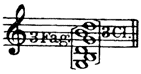
Overlaying of parts is the most satisfactory method in dealing with close three-part harmony. Crossing of parts is not so favourable, as octaves will be produced contrary to the natural order of register:
| Here the arrangement | | is bad. [Listen] | | [Listen] |
 Playable Books