Nikolai Rimsky-Korsakov · section 47 of 100
Duplication of timbres Read and hear this section in the playable edition →
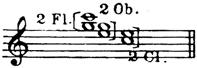
A. If the wood-wind is in pairs it is a good plan to mix the doubled timbres as much as possible:
Fig. 81 · See it in the reader Excellent
also: |
Fig. 82 · See it in the reader In chords of four-part harmony the classical method may be adopted:
Fig. 83 · See it in the reader In this case, though the high C in the flute is fairly powerful, the resonance of the G and E in the oboes is softened by the duplication of the 2nd flute and 1st clarinet, while the C in the 2nd clarinets (not doubled) is feeble in comparison with the other notes. In any case the two extreme parts are the thinnest and weakest in tone, the intermediate parts the fullest and strongest.
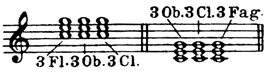
B. Wood-wind in three's admit of perfectly balanced mixed timbres in chords of three-part harmony:
Fig. 84 · See it in the reader These timbres may even originate from three-fold duplication:
Fig. 85 · See it in the reader ← Harmony in several parts All sections Remarks → More Playable Books Forsyth, Orchestration A witty, thorough guide to every orchestral instrument, with the original pages. Fux, Gradus ad Parnassum Learn how independent voices work together, one species at a time. Goetschius, Exercises in Elementary Counterpoint Build independent melodies through graded exercises, with 471 recorded examples. Goetschius, Counterpoint Applied Study imitation, canon, and fugue with 393 recorded examples. Prout, Analysis of J. S. Bach’s Forty-Eight Fugues Follow Prout through all 48 fugues of the Well-Tempered Clavier, every example playable. Rameau, Treatise on Harmony Explore the foundations of harmony, composition, and accompaniment. Rimsky-Korsakov, Practical Manual of Harmony The classic harmony course, newly translated from the 1910 French edition, with all 640 examples playable. Tchaikovsky, Guide to the Practical Study of Harmony Tchaikovsky’s Moscow Conservatory harmony course, with playable examples. Fenaroli, Partimenti Six books of partimenti, with playable basses, contrapuntal exercises, and bilingual rules. Reger, Supplement to the Theory of Modulation Explore Reger’s modulation method with 100 analyses and 102 playable examples. Schoenberg, Theory of Harmony Read all 22 chapters, with the original German beside a new English translation. Berlioz, Treatise on Instrumentation Berlioz’s treatise on the orchestra, revised by Richard Strauss, with the original pages. Sanganeria, Arrival Build jazz lines that land, with 30 original playable examples. Bona, Complete Method for Rhythmical Articulation Practice rhythm through 120 graded studies, with playable notation and original scans. ← All Playable Books  Playable Books