 Playable Books
Arnold Schoenberg · section 8 of 66
Setting the Chords
Read and hear this section in the playable edition →Chords could of course be connected in a purely schematic manner by regarding each chord as a mass followed by another such mass, another chord, much as sometimes happens in piano writing:

The most important principle of harmonic connection—good progression—does not suffer from this. But since many chord connections, as I have already mentioned, are not of purely harmonic origin but can be traced to melodic elements, it becomes necessary to represent the connections in a way that gives melodic influences an opportunity to become visible. Chords are therefore represented as conjunctions arising through the movement of voices; yet one should not forget that the driving force of this movement of the voices, the motive, is absent.
To represent chord progressions through the movement of voices, we use a combination of the four principal types of human voice—soprano, alto, tenor, and bass—since most harmonic events require an average of four voices. With this combination we produce what is called four-part writing.
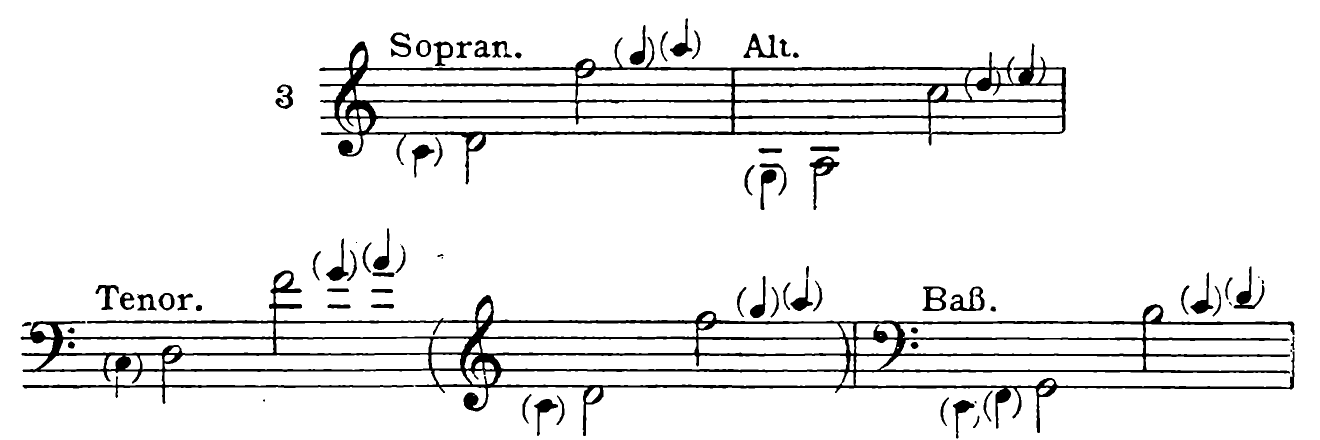
This combination of human voices, as will also become evident later, is as practical as it is natural. It ensures not only those differences of sound that help distinguish the voices clearly from one another, but also that unity of sound which makes it easy to grasp them again as a coherent whole, as a chord. Yet the limitations of the individual voices, their relative imperfection, also offer advantages.* The necessity of using them within the narrow bounds of their capabilities requires characteristic use and treatment suited to the material. Thus even in this simple case the pupil learns to observe an important principle of craftsmanship: to make characteristic use of the strengths and shortcomings of the material available. Insofar as they concern us here, the peculiarities of the human voice—similar things occur, incidentally, with nearly all instruments—are these: there is a register in which every normal, healthy voice sings easily and effortlessly, the middle register; and two registers requiring more exertion and causing more fatigue, the high and the low registers. The middle register sounds less expressive and penetrating than the high or low register. Since, however, representing harmonic connections is concerned less with such effects than with purely harmonic ones, the following principle may be stated for the use of the voice—a principle that also agrees to some extent with actual compositional practice: in general each voice should sing in its middle register; only when other conditions require it, such as difficulties of voice leading or avoidance of monotony, should the higher or lower register be sought. The ranges of the voices, insofar as they concern this purely schematic treatment, are approximately those indicated by the half notes:
* I discuss these matters at such length less out of concern that, unless they are explained, the pupil might accept them unthinkingly and use them mechanically, than to establish expressly that these principles derive from practical suitability, not from aesthetics. Since much of what is called aesthetics consists merely of suitable treatment of material, and since what is called proportion may often be little more than an arrangement that sensibly takes the peculiarities of the material into account, I consider it worthwhile to point out this circumstance. For the conditions of suitability can change when the material appears differently to us and when the purpose becomes a different one. Aesthetics, however, professes to have discovered eternal laws.
The parenthesized quarter notes indicate the extreme high and low tones that may still be used if necessary. Naturally the ranges of solo voices, and even of choral voices, are in reality greater or different from those given here, which are intended only to represent a reasonably accurate average. The middle register, which should be used preferentially, is found a fourth to a fifth away from the highest and lowest tones, giving the following:

Naturally the pupil cannot manage with the tones of the middle register alone and must also use tones of the higher or lower register. At first, of course, the adjacent ones, but then occasionally even the highest or lowest, when there is no other way. In general, however, the span of an octave should seldom be exceeded appreciably. Anyone wishing to write comfortably for the voice will avoid, even in practice, having it sing continuously for a long time in either extreme register. The pupil should therefore visit the two extreme registers only briefly and leave them again as soon as possible. If the treatment of solo or choral voices in practice shows otherwise, the reason is that compositional or tonal effects are sought there which are not sought here.
The conditions for combining voices into a choral sound follow from their peculiarities, supported by experience. If no voice is to stand out, all voices will seek registers whose tonal productivity is approximately equivalent. For a voice singing in a more brilliant register while the others move in a less conspicuous one would naturally attract considerable attention. If the prominence of this voice is intended—for example, when an inner voice has the melody—then it is good for this voice to sing in a more expressive register. But if it is not intended, the choral conductor would have to shade the sound, restoring balance by damping the overly conspicuous voices or strengthening the inconspicuous ones. Since we are not yet dealing with motives or melodies, these problems would scarcely concern us here, were it not that the task of always using only those means of representation suited to the circumstances and absolutely necessary offers an advantage that will benefit the pupil later as well.
Chords may be set in close or open position. Whereas open position generally sounds rather soft, close position is on average sharper. In the purely schematic representation of harmonic relationships the pupil is not faced with having to choose between these two effects. We may therefore content ourselves here with noting this difference and use both positions without asking about the reason for or purpose of their effect. Close position is characterized by the upper three voices singing chord tones so near one another that no further chord tone can be inserted between two adjacent voices. The distance between bass and tenor does not count, provided it is not excessively large. If one or more chord tones can still be inserted between the tones of two adjacent upper voices, the chord is in open position.
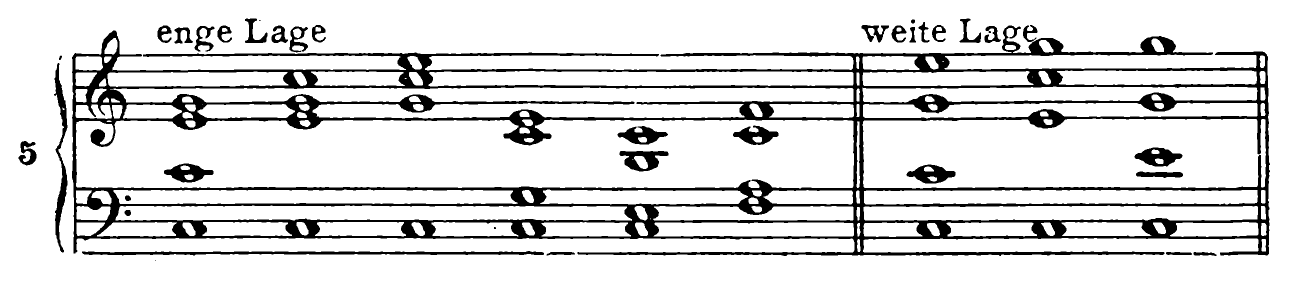
Experience teaches that a generally balanced combined sound is best achieved when adjacent pairs among the upper three voices are no more than an octave apart, while the bass may be farther from the tenor. Naturally, if an effect other than this balanced one is sought—a case that does not concern us—the voices can and must be set differently.
When the three chord tones are distributed among four voices, one of the tones must be doubled. The first choice for this is the root, also called the fundamental; the second is the fifth; and only in third and last place comes the third. This follows from the nature of the overtone series. If one wishes to imitate the sound of the natural tone through synthesis—that is, to produce a sound whose euphony recalls that already possessed by the material given by nature—one must proceed similarly to nature. The sound becomes most similar when the root, since it occurs most frequently in the overtone series, is also used more often in the actual setting. For the same reason the fifth will be less suitable for doubling than the octave, but more suitable than the third. The latter will also be doubled less often because it is already very prominent through characterizing the chord quality, major or minor. Since tonal and other effects do not concern us here, we shall always choose for the setting of chords whatever doubling is necessary at the moment. Thus, since doubling the fifth and third is unnecessary at the beginning, we shall restrict ourselves to doubling the octave.
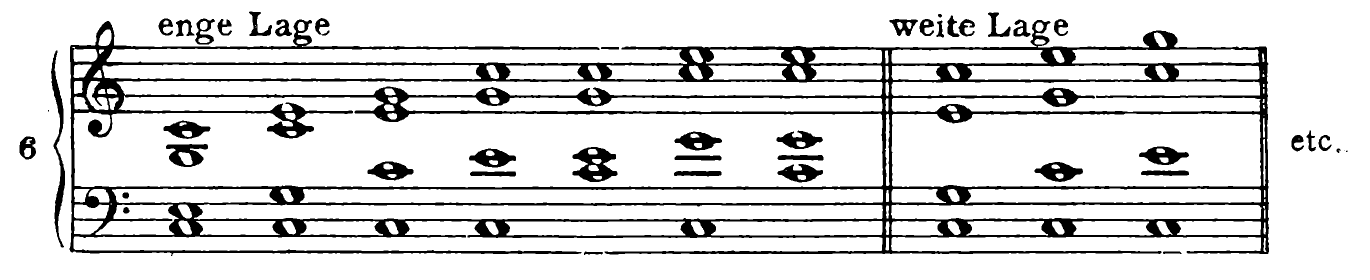
Example 6 shows the triad on degree I of C major in various forms of close and open position. As a first exercise, the pupil is to set the chords on degrees II, III, IV, V, and VI in the same manner, observing the given vocal ranges, and repeat this exercise in several other keys. Degree VII is omitted for the time being. The exercises are notated on two staves in treble and bass clefs. The pupil does best to write soprano and alto on the upper staff, in treble clef, and tenor and bass on the lower staff, in bass clef. Often, or from case to case, the tenor is included on the upper staff.* Then the bass stands alone below. The examples here will mostly be given in C major, but the pupil must always practice what has been learned in other keys as well, since otherwise they will remain unfamiliar.
* The tenor range is the one notated in bass clef in Example 3. The parenthesized notes beside it, in treble clef, refer to the notation generally customary in songs, operas, choruses, and so forth, where the treble clef is then read an octave lower. The notation in our exercises approaches piano writing, and here the tenor, whether entered on the bass or treble staff, is always to be read as the same notes would sound if written for piano rather than for singing: that is, without octave transposition.
The method of so-called thoroughbass or figured bass should also be mentioned here: a kind of musical shorthand formerly used to give the harpsichordist the harmonic skeleton of a composition, whose sound he completed by improvising the added harmonies that filled it out. For this purpose figures were placed below the bass part, schematically expressing the distance of the chord-forming tones from the lowest tone, the bass tone, without regard to whether the interval lay in the same or a higher octave; thus, for example,
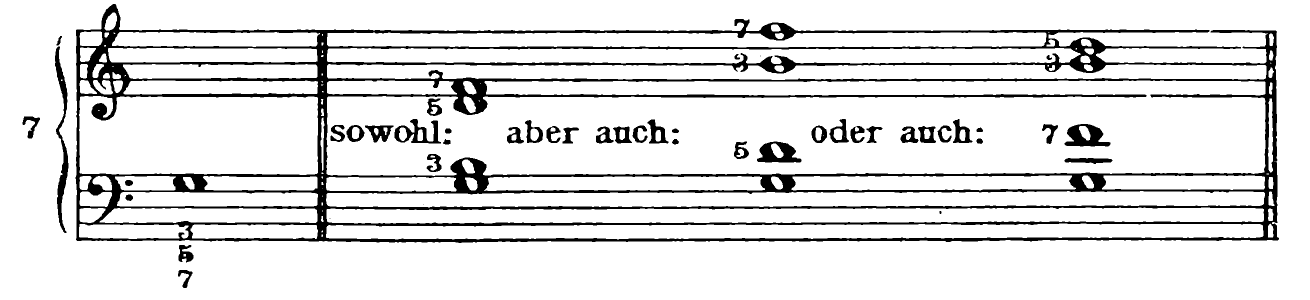
meant these alternatives. Thus 3, 5, 7 indicated merely the schematic arrangement of the chord components compressed into the smallest space, while one or more octaves could be added to 3, 5, or 7. The figure 3 meant that a third lay above, in some higher octave; 5 said the same of a fifth, 7 of a seventh, 9 of a ninth, 6 of a sixth, and so forth. Whether the order chosen in playing was 3, 5, 7, or 5, 3, 7, or 7, 3, 5, or anything else was left to the harpsichordist’s discretion and determined by the necessities of voice leading. Unless a special sign—sharp, flat, or natural—was placed beside the interval figure, the chords were formed from the tones of the scale in accordance with the key signature. A triad in root position, whose figures would have had to be 3 over 5, was left unfigured.* But if 8, 5, or 3 stood beside a bass tone, this meant that the highest voice—in our case the soprano—was to take the octave, fifth, or third respectively. This is then called octave, fifth, or third position of the chord.
* As an ingenious shorthand, figured-bass notation sought to manage with as few signs as possible. Thus only departures from what was self-evident were indicated. It was assumed as self-evident—and historically correctly—that every bass tone is accompanied by a third and fifth, which therefore need not be indicated. On the other hand everything different, but only what is different, must be specially named. Strictly speaking, the figure 6 could also mean that 3 and 5 remain and 6 is added. But since another principle intervenes here as a supplement, that of indicating the position of the dissonance, with 5 over 6, one could use 6 instead of the fuller 3 over 6 by applying this single-figure designation to only one position, the third-sixth chord, while adding at least a second identifying figure to all other positions containing a sixth.