 Playable Books
Arnold Schoenberg · section 9 of 66
Connecting Primary and Secondary Triads
Read and hear this section in the playable edition →A good solution to the task of connecting chords with one another depends on fulfilling certain conditions. These conditions, as already suggested and as will be repeated on many occasions, will be presented here as instructions, not as laws or rules. Laws or rules would have to apply always and unconditionally; and the claim that exceptions confirm the rule applies only to rules whose sole confirmation consists precisely in their exceptions. Instructions, however, serve merely to indicate the means of achieving a particular purpose. Hence they do not hold eternally, like laws, but are changed as soon as the purpose changes. Although the following instructions partly correspond to compositional practice, they nevertheless do not arise from aesthetic intentions but have a limited purpose. Here that purpose is to protect the pupil from errors that can only later be explained and described as such. The first of these instructions requires that, in voice leading, one initially do only what is indispensably necessary for connecting the chords. That means each voice will move only when it must; it will make the smallest permissible step or leap, and only that smallest step which also allows the other voices to make a small step. Thus the voices will follow what I once heard Bruckner call the “law of the nearest way.” It follows that, when two chords to be connected have a tone in common, this tone is taken in the second chord by the same voice as in the first, and thus “remains stationary.” To simplify the task still further, for our first connections we choose only chords having one or more tones in common—two triads cannot have more than two tones in common—and retain the common tone or tones as a harmonic bond. The following table shows the chords suitable for these connections, assuming common tones:
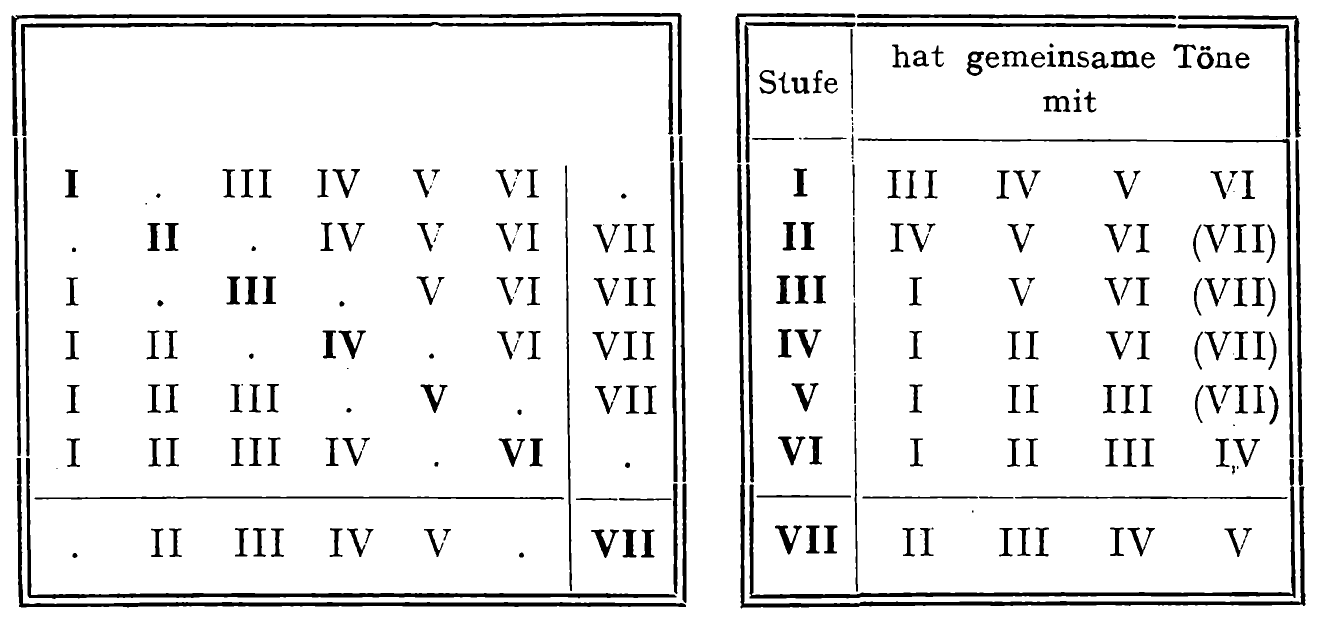
The Roman numerals indicate the degree.
As one sees, each degree has a harmonic bond with all degrees except the one immediately before it and the one immediately after it. This is also self-evident. Degree II is d–f–a. The roots of immediately adjacent degrees, for example c and d, stand one scale step apart; consequently the thirds, e and f, and the fifths, g and a, also stand one scale step apart. Thus no tone is common. Chords whose roots are a fifth or fourth apart, on the other hand, have one tone in common, and those whose roots are a third or sixth apart have two tones in common.
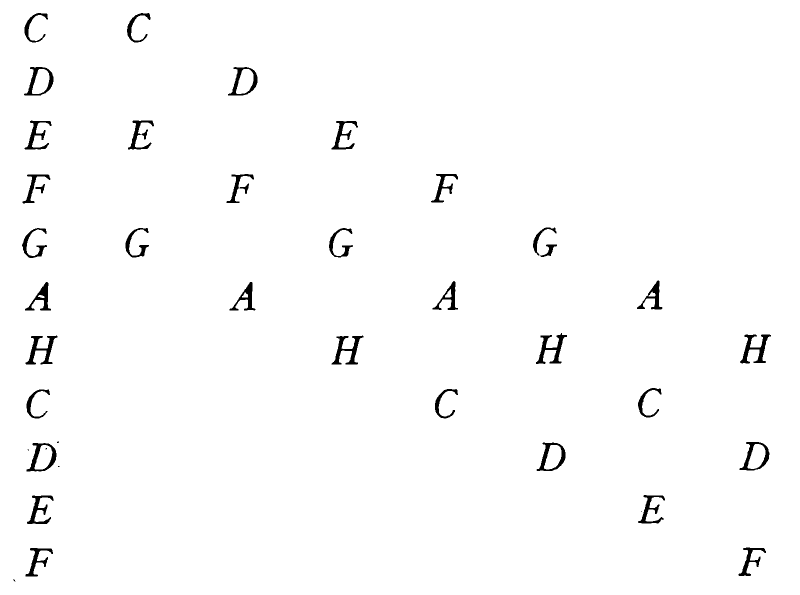
According to the table, degree I can be connected with III, IV, V, and VI, assuming a harmonic bond.
In these first exercises the root must always be taken as the lowest tone of the chord, and thus placed in the bass part. The bass should always be the lowest voice, the tenor the next higher, followed by the alto, with the soprano as the highest voice. The pupil should entirely avoid crossing voices—that is, setting a lower voice, such as the tenor, higher than a higher voice, such as the alto or soprano. First the pupil writes the degree numbers of the chords to be connected below the bass staff, then the bass tone of the first chord in the bass part, and then fills out the first chord in the other voices. Whether in close or open third, fifth, or octave position is his own choice, but he must choose before beginning to solve the task. He thus sets himself the task; we shall maintain this throughout the course. In setting chords the pupil will most easily avoid errors by answering the following questions in order:
Question I: Which tone is placed in the bass? (The root of the degree, the fundamental.)
II. Question: Which note goes in the soprano? (The octave, fifth, or third of the degree, according to whether he has chosen octave, fifth, or third position, which is indicated by placing the corresponding number beside the degree number.)
III. Question: What is missing? (The note or notes still missing are placed so as to produce the chosen close or open position.)
When he now wishes to carry out the connection, the pupil will do well*) to ask himself the following questions:
1. Which note is the root? (Remember: put it in the bass!)
2. Which note is the harmonic link? (It stays in place!)
3. Which notes are missing?
*) On the basis of many years of teaching experience, I most emphatically recommend that the pupil actually solve the exercises by asking and answering these questions. Doing so will benefit his understanding and skill more than proceeding merely by ear or from a remembered image of the notation. He will easily become accustomed to carrying out these reflections so quickly that he will not omit them even when doing the exercises at the piano (which he must certainly do as well). The resulting advantage is that at every moment one works with thought, with quick thought and full awareness, rather than with the memory that has retained a few manual procedures.
Again, to avoid errors that will only be discussed later, in the opening chord of the first exercises we always double the octave, and nothing else. As the pupil will see, this also means that the chords that follow never appear with a doubled fifth or third. We shall use these doublings only when voice leading compels us to, since matters of sonority do not concern us here.
With the aid of the questions, the connection of I and III is worked out as follows (Example 8a):
1. Bass note (degree III): E;
2. Harmonic link: E and G (thus remaining in the soprano and alto);
3. Which note is missing: B (the tenor moves from C to B).
A point to note here: the pupil should always conceive of a chord connection as the result of the movement of voices. He should therefore say, not “I give the tenor B,” but “the tenor moves from C to B”; not “I give the soprano E and the alto G,” but “E stays in the soprano and G in the alto.”
The pupil must distinguish between the root (the note on which the triad is built, the name of the degree: thus D for degree II, E for degree III, and so forth) and the bass note (the note that has been placed in the bass). In our first exercises, until instructed otherwise, we always put the root in the bass. Later, however, chord members other than the root will also be placed in the bass; the pupil must therefore take care not to confuse these two concepts.
For the present we work the examples in whole notes, without division into measures.
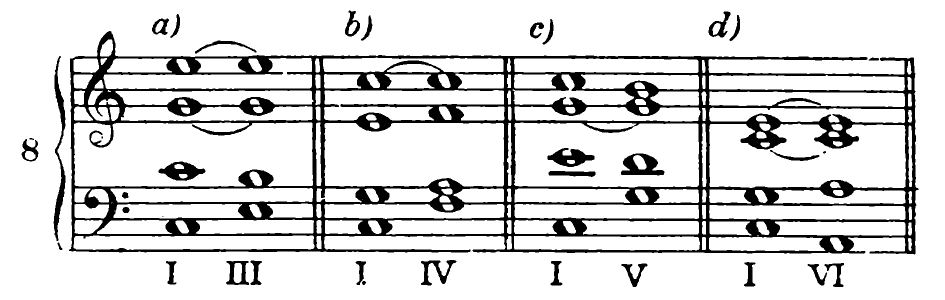
Example 8a shows the connection I–III, in which two notes (E and G) form the harmonic link; in 8b and 8c (I–IV and I–V) only one note in each case forms the harmonic link, while in I–VI there are again two notes. The pupil should indicate the holding of the common note with a tie.
Following this model, connections of the remaining degrees with the chords assigned to them by the table should now also be practised: II with IV, then with V and VI (degree VII is omitted entirely for the present, since it requires special treatment); III with I, V, and VI; IV with I, II, and VI; and so on through degree VI (VII is omitted here too).