 Playable Books
Arnold Schoenberg · section 19 of 66
Connecting seventh chords with one another
Read and hear this section in the playable edition →If we retain only the more important instruction—that the seventh should descend by step in resolution—dispense with the demand for a strong root motion, and are satisfied in preparation that the preparing note was consonant in the preceding chord, thus free and not obliged to follow a prescribed path, we can also follow one seventh chord with another. Only these two conditions need be fulfilled: the preparing note must have been consonant, and resolution must occur through the seventh’s descent. This accords with the procedure I announced when treating degree VII. There I stated that dissonance requires such cautious handling only as long as it remains a conspicuous event in harmonic life.
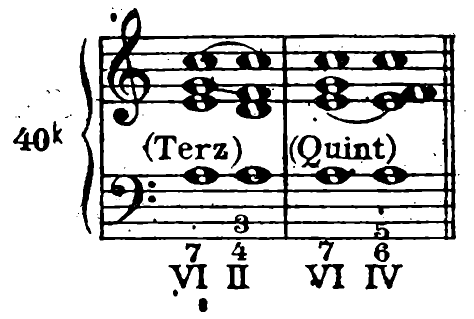
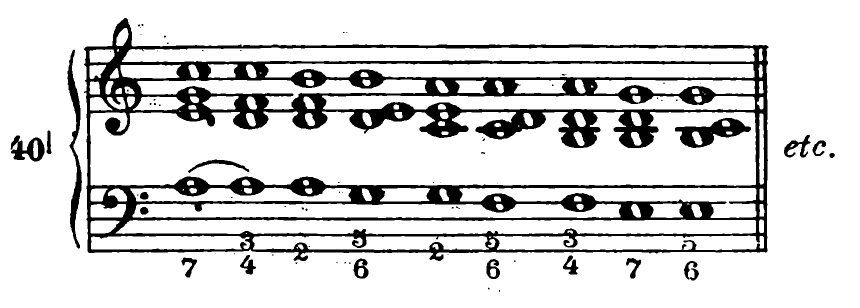
Example 40k shows a four-three chord prepared by a seventh chord—preparation by the third—and a six-five chord prepared by the same seventh chord. Example 40l shows a succession of such connections, in which the position or inversion of each seventh chord is naturally determined by its bass note. Such a succession, especially at this length, is actually of no interest to us. It is mentioned only because such successions often form the harmonic framework of sequential repetitions of motives in earlier composers.
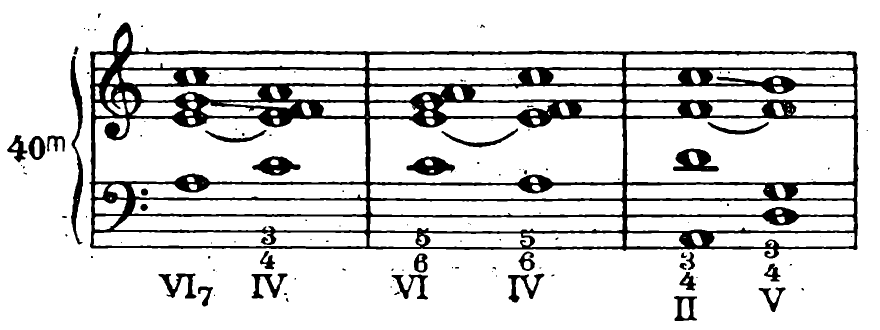
Example 40m shows several connections in which the bass leaps while the seventh resolves and a consonant note prepares another seventh chord. During resolution, two other voices exchange positions.
Once the pupil has gained some security in treating dissonance, many restrictions now imposed will be lifted. Not yet, however, since some matters still need to be considered from this viewpoint. The question now presses itself upon us: if this can be done more simply, why not make it simpler from the start?
My reply is this: the peculiarities of the system of harmony teaching are clearest in the treatment of dissonance. Since this system is only a system for examining and handling things, not a system of the things themselves, one could dispense with all of it and tell the pupil: write according to your ear! Yet one will hardly decide lightly to draw that conclusion. Everyone dimly feels that, left to his ear, the untrained person would write things that need not be wrong, although they do not fit at all into what appears to us as artistic order, yet are not right either. Everyone dimly senses the contradiction between this order, which claims to be natural, and the good ear of the natural, uncultivated person that repudiates it: because the order is not natural but artificial, because it is culture. Nature is admittedly so many-sided that we can even read our artificial constructions into it, and other systems could surely be grounded in it just as naturally as ours—but also just as little! For this is an artificial, imperfect representation of something probably natural and perfect, whose nature is to be taught to the pupil. We must be clear that we are not teaching those eternal laws that emerge from nature as the sole immutable laws of art. Rather, because of our inability to comprehend the unordered, we try to present our art’s traditional craft in the form of a closed theory grounded in nature. This theory is something that can just about also be justified from nature—but no more! And even if our art and its theory rightly appealed to nature, the uncultivated person need not be wrong in producing something different. For art reduces what can be known to what can be represented. One may therefore know differently and represent differently. Above all, art is not something given, like nature, but something that has come into being; it could therefore have become something else. For this product of becoming, the path by which it arose—its development—may often be more characteristic than the nature from which it arose. Thus, in teaching the pupil the traditional meaning of our harmony, it is sometimes less a matter of leading him along nature’s path than along art’s. Though not always the shortest, this path is passable. Though it may not always lead to the facts of nature, it is enough if it leads to the facts of art. If only it truly led to every conceivable fact of art, it might occasionally take a detour past phenomena whose influence on its direction can no longer be clearly discerned today. It is, in any case, the path. A new path could be shorter and avoid unnecessary delays. But who knows precisely—so precisely that he could at every moment answer for it even in relation to future development—which of these delays are truly unnecessary, truly without influence on the future?
If the pupil really were given immediate freedom in treating dissonance, the question of this freedom’s limits could not be left unanswered. Perhaps I could indulge in that luxury. I have such unconditional confidence in the gifted person’s ear that I am certain he would find the right way even so; my experience with myself and my pupils could strengthen that belief. Yet I have seen in myself and others that a need arises to know more about these things, to make them one’s own also by understanding them as order and coherence. Moreover, there are gifted people who need instruction—some perhaps only to save time, time that is not altogether lost when used for independent discovery, even when one errs, but that can nevertheless be used more efficiently when a sure and cautious hand guides.