Playable Books
Arnold Schoenberg · section 21 of 66
Diatonic triads in minor
Read and hear this section in the playable edition →
Example 41 shows the triads possible in minor. Since the raised notes naturally participate in chord formation, there are six more, and their placement, mode, and composition also differ substantially from those in major. Degree I is a minor chord. On II there are a diminished and a minor chord; on III, a major chord and one whose form is new to us. This is the so-called augmented triad, to be discussed separately. It consists of two major thirds adding up to an augmented fifth. The augmented fifth does not occur among the first overtones and is therefore a dissonance. On IV there are minor and major chords, as on V. On VI there are major and diminished triads, as on VII. The following applies to connection: initially we again choose only chords sharing a harmonic link, so we can use our earlier table. Chords containing no raised note present no difficulty in connecting with one another. The relationships here are no different from those in the relative major key. Naturally, the diminished chords arising here are treated as before. Thus the triad on II, B–D–F, identical to VII in major, is prepared by IV, D–F–A, and VI, F–A–C, and resolves into V, E–G–B. It can also resolve into V, E–G♯–B, as will be shown later. But when these triads connect with chords containing raised notes, or when the latter connect with one another, the instructions concerning turning points must be observed. Some difficulties naturally result, and a number of connections are not yet possible.
The pupil will again work by means of the questions. To meet the new conditions imposed by the turning-point laws, the second question now reads:
2. Which dissonance or dissonances, or turning points—notes with a prescribed path—must be considered?
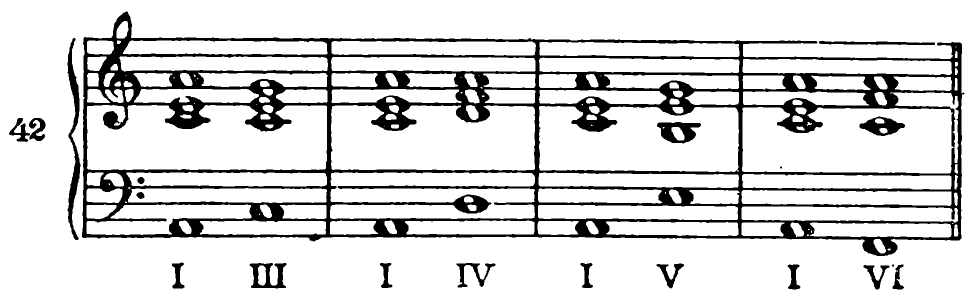
Example 42 shows connections of degree I with the eligible unraised degrees*), all of which can be realized smoothly. The pupil can work through the other unraised degrees on the same model, initially again only in root position.
*) The terms “raised” and “unraised degrees” are incorrect in two respects. 1. The notes are raised only in our notation, by a sharp or natural; otherwise they are not raised but replaced by higher ones. One may speak of raising in chromatic progression, and the term should therefore also be avoided with secondary dominants. 2. In any case, the degrees are not raised: they merely use raised notes, or have substituted such notes. Perhaps the correct, complete wording would be “degree x with a major third, perfect or augmented fifth,” but that is very long. One could also say “degree x upward” or “ascending,” when notes of the ascending scale are used, and “descending.” But I prefer “raised” and “unraised,” since they are vivid and brief, and no more incorrect than “altered,” “altered downward,” and “altered upward”; for “altered” should likewise presumably be translated as “exchanged,” not, as musical usage assumes, “changed.”
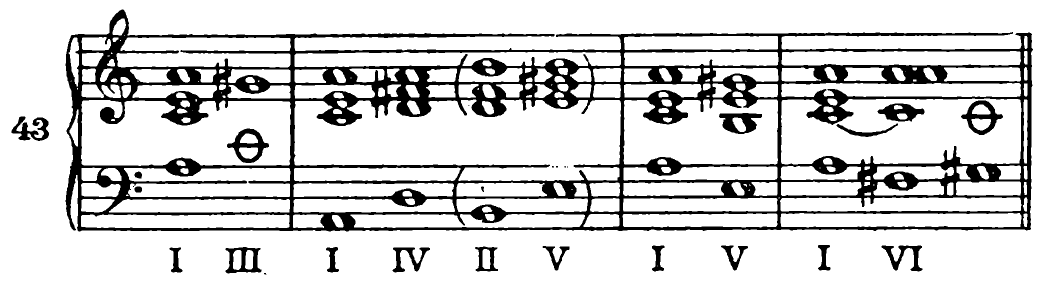
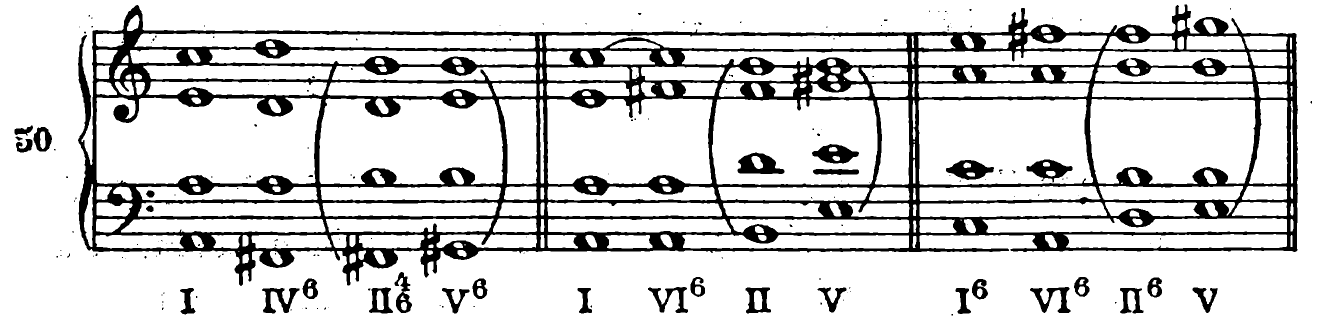
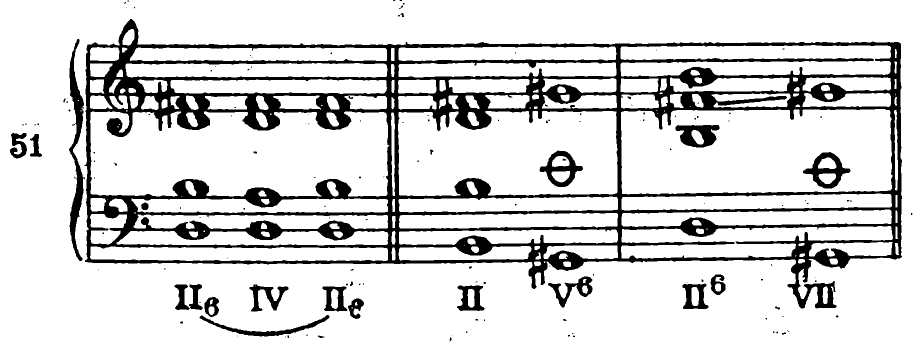
Example 43 attempts connections involving chords with a raised sixth or seventh note. The connection of I with the augmented triad, III, is omitted for now. Connection with raised IV works quite well, but is bound to a specific continuation: for the present IV can be followed only by raised II. Connection with raised V proceeds smoothly. Connection with raised VI is presently unusable, however: VI is a diminished triad and would have to resolve through a fourth leap in the root, but the bass F♯ must move to G♯, the second turning point, and therefore cannot leap away.
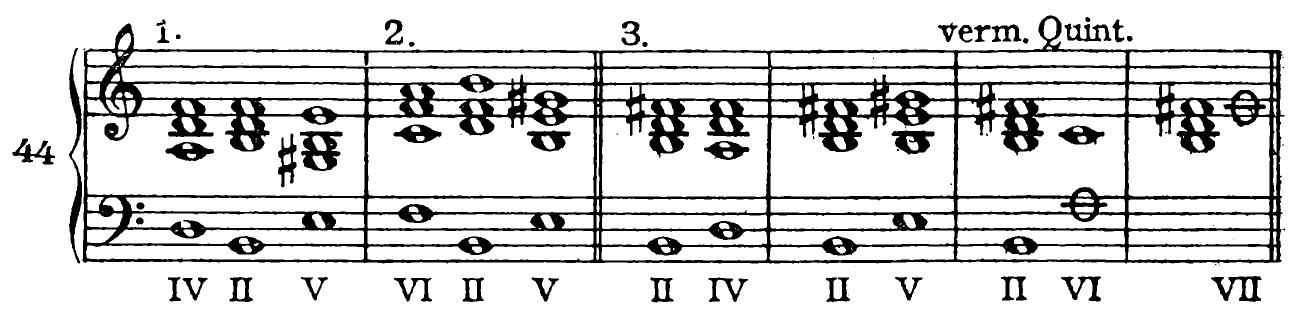
Example 44 shows the connection of II, a diminished triad, with V, prepared once by IV and once by VI. Prepare and resolve!
Example 44, no. 3, shows raised II connected with IV. This would be possible but not useful: as will emerge later, IV could again be followed only by II, and II could be preceded only by IV, as the other examples show. The example would therefore read IV–II–IV–II, surely a superfluous repetition. Raised II connects without difficulty with raised V. II with VI is excluded because VI had to be excluded, and II with VII because VII too, as will be shown, is presently unusable.
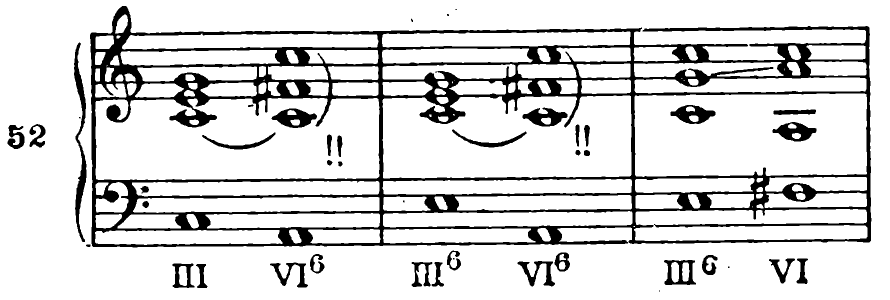
Unraised III naturally cannot connect with chords containing F♯ or G♯. With the only eligible degree if one disregarded the third turning-point law—which is not permitted—namely VI, one might perhaps realize the connection by avoiding G–F♯ through a leap from G to C. But then C, the diminished fifth, would be unprepared; and even if one accepted that, the two F♯s would remain, both obliged to move to G♯. Even without doubling F♯, there would still be F♯ in the bass. We omit the augmented triad on III for the present; it will be considered in another context.
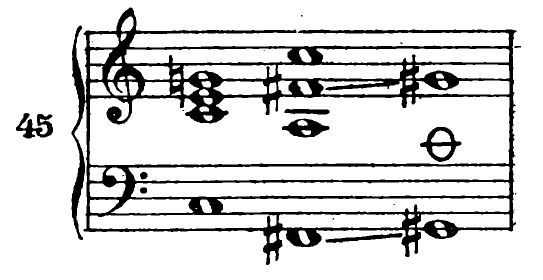
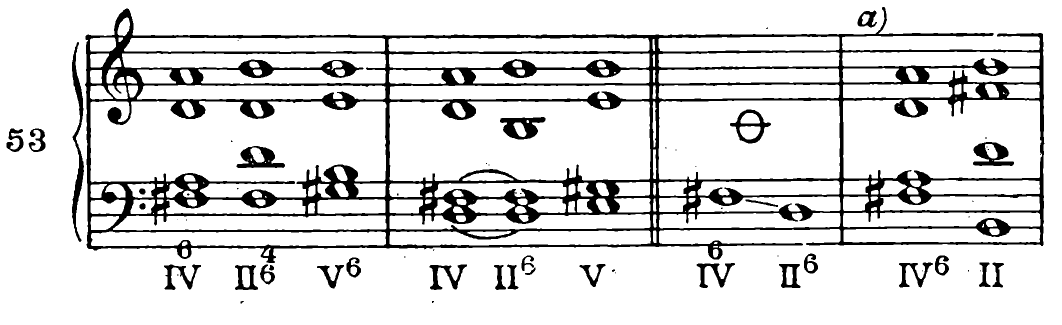
Since raised III and VII are excluded, unraised IV could connect with raised triads only through V; but that too is excluded for now because there is no harmonic link. Clearly, it cannot connect with raised II or VI, since F must not move to F♯; and the so-called cross-relation law forbade another voice to move to F♯.
This law reads: chromatically raising or lowering a note must occur in the same voice that previously contained its unraised or unlowered form. If F♯ occurs in the second chord after F in the first, the voice that had F must supply F♯. Thus, if the alto had F, the tenor should not supply F♯ in the next chord. I would not apply this law with full strictness, since practice contradicts it too often. Formerly the opposite law even prevailed, requiring that chromatic raising never be shown within one voice: another voice had to supply F♯ after F had occurred. Neither law is a law of beauty; they are two different attempts to overcome intonation difficulties. Singing a chromatic semitone in tune is not altogether easy. I would rather follow the first version, since chromatic progression generally produces a good melodic line. Our turning-point instructions regulate the treatment of these notes automatically and differently; chromatic progression is therefore excluded for the present.
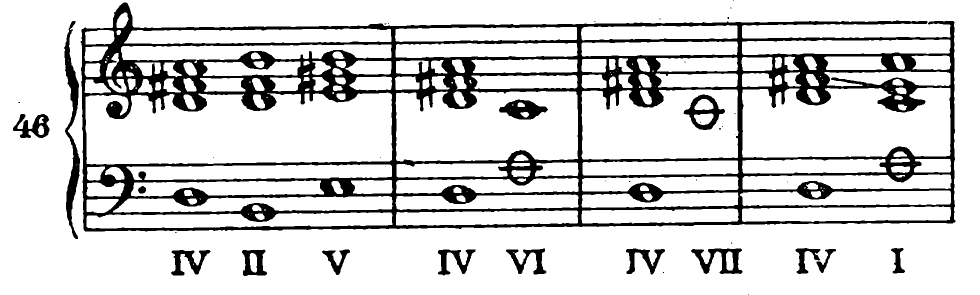
Raised IV connects smoothly with raised II, but not with unraised II. It cannot connect with raised VI, a diminished triad, because that chord’s diminished fifth C must be prepared. Connection with the diminished triad on VII, G♯–B–D, is likewise excluded because that chord is not yet usable; it will be considered separately later. Connection with I is also impossible, since F♯ would have to move to G♯.
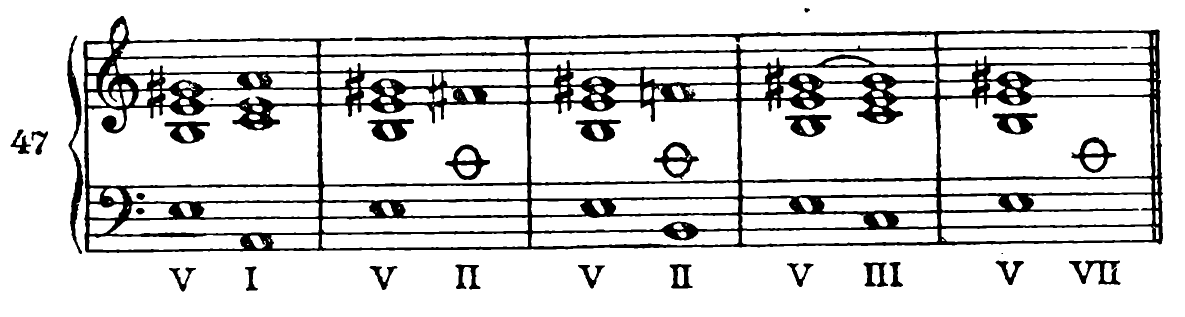
Unraised V cannot connect with chords containing F♯ or G♯, for the same reason previously given for unraised IV. Raised V, however, connects easily with I; connections with raised or unraised II and with VII must be excluded. Raised II fails because G♯ cannot move to F♯; unraised II is a diminished triad whose diminished fifth F must be prepared. Connection with III is omitted for now.
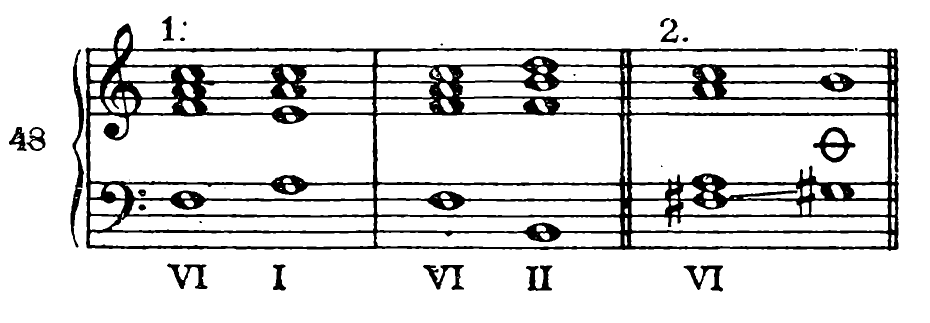
Unraised VI cannot connect with chords containing F♯ or, at least for now, G♯. The diminished triad F♯–A–C on VI is entirely unusable for the present: F♯ would have to move to G♯, whereas the diminished triad requires a fourth motion in the root.
Short passages should now again be planned. In general, raised degrees should be used less frequently than unraised ones. An example containing several of each must necessarily be relatively long, since several chords are almost always needed to pass from one region to the other. It is generally natural to use raised degrees chiefly near the close, since that is really why they exist. A succession of raised chords must always lead into I; placing it in the middle would produce repetition. Moreover, for now raised degrees can be introduced only after I or II. The pupil should place V before the final chord, always as a raised chord, the dominant. Raised degrees are indicated in figured bass by placing a sharp or natural beside the number denoting the raised interval: for example 3♯, 5♯, and so forth, or in C minor, 3♮, 5♮.
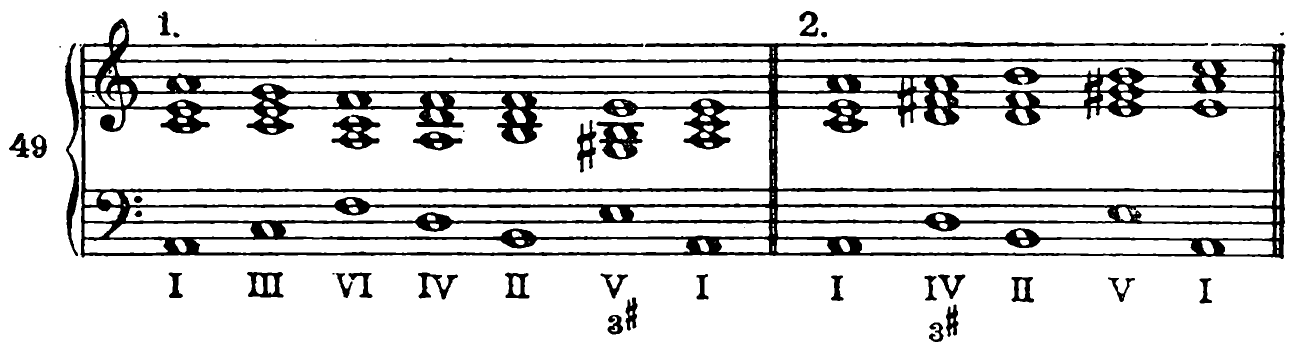
Example 49, no. 1, uses only unraised chords except for the closing V. In no. 2, every chord except the two appearances of I is raised. Neither example could have been much longer unless one wished to continue after I. No. 1 might perhaps be extended after II by unraised V; but then another succession would be needed to reach the close—for example II, V, III, VI, II, V, I, which, as can be seen, almost entirely resembles the preceding succession and would hardly be favourable. It would, however, be permissible to close quite differently by placing I immediately after VI. The pupil must never close after III, since it contains G, which cannot move to A, and we introduced the leading tone G♯ precisely for closing purposes. IV–I would also be possible. But the pupil may use this close, like VI–I, only if the example would otherwise become too long—only then. Otherwise V should always be sought as the penultimate chord. These means generally allow neither very many nor very varied examples; the pupil should therefore practise the few that result in as many keys as possible.