 Playable Books
Arnold Schoenberg · section 22 of 66
Inversion of triads in minor
Read and hear this section in the playable edition →Using sixth and six-four chords makes some previously impracticable connections possible. Otherwise there is nothing new to say about inversions. The same applies as in major: the sixth chord is entirely free, and the bass note of the six-four chord should be neither approached nor left by leap.
Examples 50–55 contain connections that were impracticable before inversions were used. The pupil will be able to find more. He must, however, observe the turning points exactly and remember that diminished fifths must still, for now, be prepared and resolved, and therefore must not be doubled. For example, one cannot leap out of the sixth chord on raised IV because F♯ must move to G♯. Yet raised II could still be introduced by placing F♯ in another voice in degree II and letting that voice take over its continuation to G♯ (53a). This would satisfy the harmonic need, but not the melodic need from which these instructions arose. Naturally, the pupil will later be able to handle these matters much more freely. I think it better to wait until a secure feeling for the characteristic form of the minor key has developed, and meanwhile to forgo such evasions. I have shown why exceptions must not occur in a theory. But I would have to establish exceptions if I wished to broaden what is held too narrowly here. It will soon become apparent how these restrictions cancel themselves once the viewpoint from which I have considered the minor scale is fully exploited. The superfluous will then fall away of itself, while what is customary will prove usable. One can therefore wait patiently for that stage; the freedom will then be all the greater.
Sixth and six-four chords may now also be used in examples.
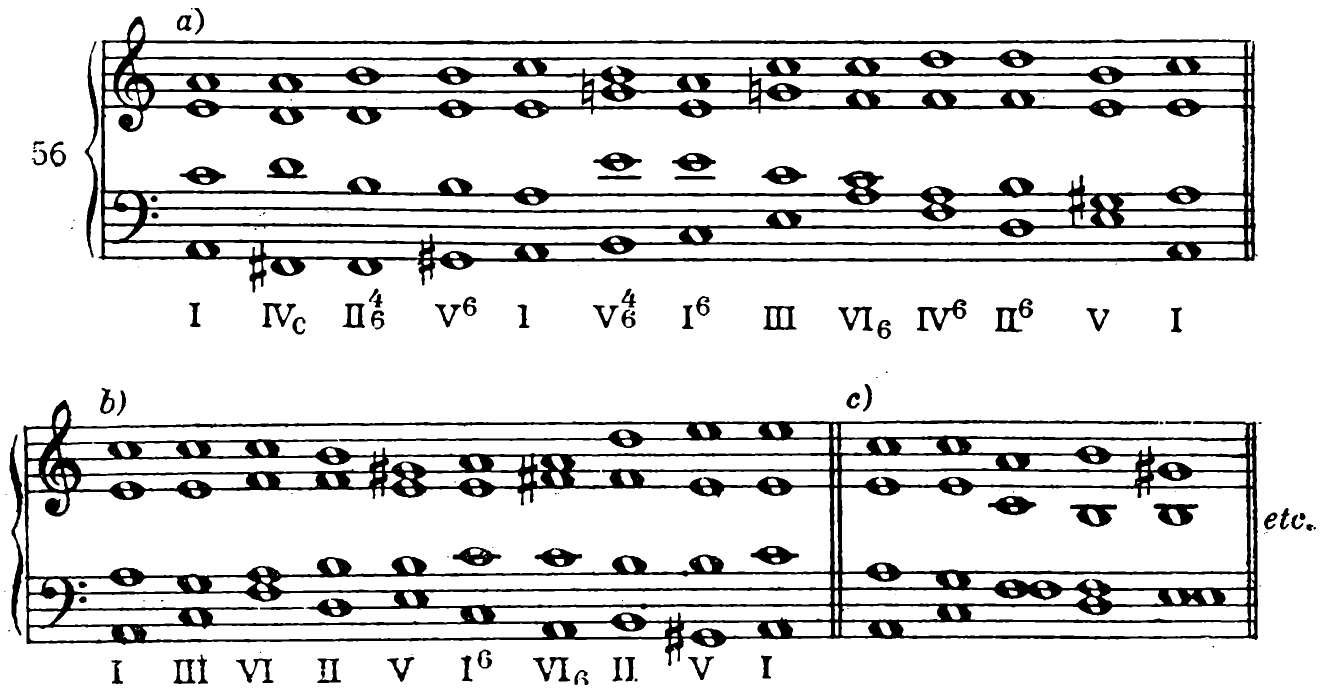
Examples 56a and b exploit some connections made possible by inversions. For instance, the sixth chord on raised IV can lead, through the six-four chord on raised II, into the sixth chord on V, the dominant, followed by I. But the example need not end there: the bass melody can continue quite well in the direction already begun, and the melodic strength developed through this continuation can conceal even the repetition it entails. It therefore does no harm if the sixth chord on V is followed here by I, then the six-four chord on V, then I again as a sixth chord. The bass line G♯–A–B–C improves the overall effect quite adequately.
In 56b, the sixth chord on raised VI is connected with raised II. Notice the tenor: from G in the second chord it moves to A in the third. Since G♯ soon follows, this is felt as a lack of smoothness. It is therefore better to lead the tenor as at c; G has then resolved, and the following G♯ does not disturb. The alto’s motion from F♯ to E in the penultimate chord is likewise impermissible. Later, under different conditions, this may be disregarded, since otherwise the sixth chord on V could not be connected.
The augmented triad on III in minor may now also be introduced into the examples. Much remains to be said about this chord later, since it greatly influenced the development of modern harmony. As a diatonic chord in minor, its treatment is fairly simple. Its augmented fifth requires dissonance treatment; but since, as the first turning point, it cannot descend, resolution occurs here for the first time by ascending. Preparation, however, can proceed as before. Strictly speaking only V is eligible for it at present, but, as will soon appear, VII is also possible. For resolution, I and VI are available.
A peculiarity of this chord should be mentioned here. The distance from C to E is four semitones, from E to G♯ also four, and from G♯ to the repetition of the root, the octave, another four. E and G♯ therefore divide the octave into three exactly equal parts. The construction of this triad has the curious property that the distance between successive notes is always the same, so inversion does not change their relationship to one another. This distinguishes it fundamentally from every chord considered so far. This property, to be discussed further later, permits us already to allow something we shall very soon—in the next chapter—do with all other chords: connect it with chords with which it has no common note. And something else: we can dispense with preparation of the augmented fifth. This creates many possibilities that will greatly benefit our short passages. The turning points must, of course, be carefully observed. We treat this chord more freely already, while so many restrictions still apply to others, because the formulation of those restrictions fits the augmented triad only very imprecisely. I would have to formulate them differently, and I do not wish to do so at this stage, when we are about to loosen the other restrictions too.
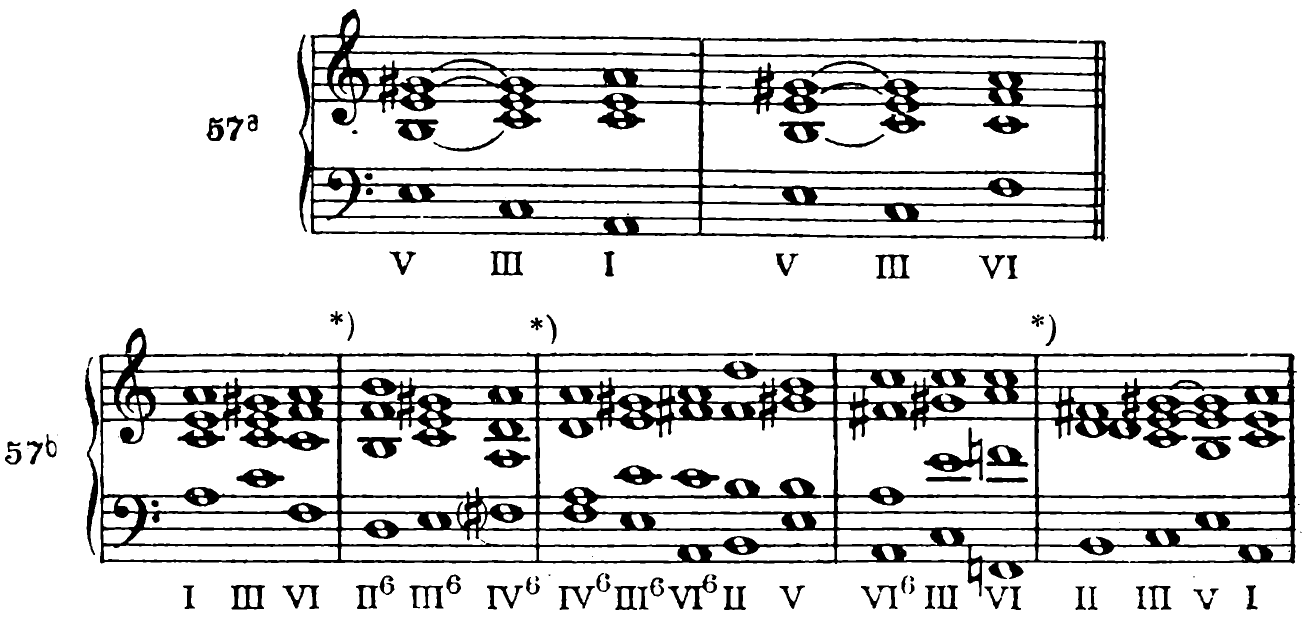
The connections shown in 57a and b are therefore possible. Preceding chords: I, II, IV, VI, and, as 58 shows, VII. Following chords: I, IV, VI, and V. II cannot follow because G♯ must move to A.
The diminished triad on VII, being diminished, should be prepared by IV or II and resolved into III.
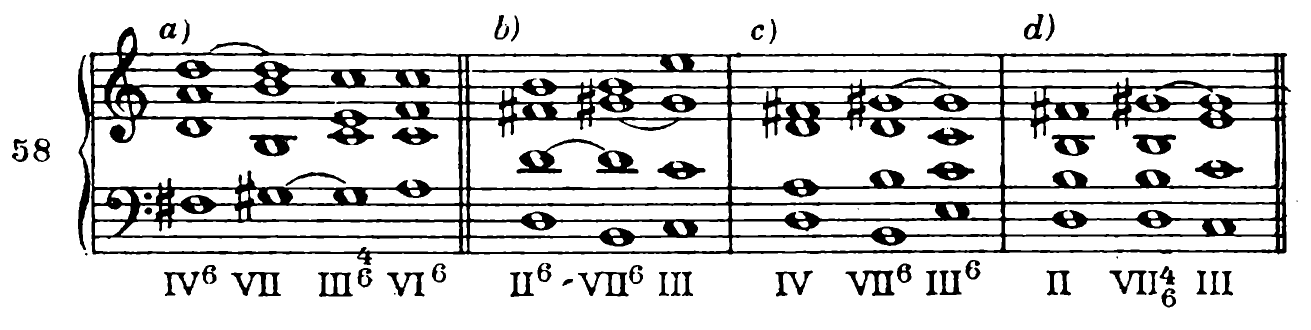
Naturally, neither the diminished fifth nor the root can be doubled: the diminished fifth must descend and the root, as leading tone, must ascend. Only the third can therefore be doubled.
Discussion of these two chords had to be postponed because only triad inversions make them usable for us. There was no other reason for the postponement.
*) Connecting neighbouring degrees is discussed in the next chapter. The use of VI in the fourth example of 57b, without resolving the diminished fifth, likewise anticipates later material and is included only for completeness.