 Playable Books
Arnold Schoenberg · section 35 of 66
Secondary Dominants and Modal Chords
Read and hear this section in the playable edition →
I have already mentioned the peculiarity of the church modes of bringing variety into the harmony by means of accidentals (that is, signs of alteration which incidentally and temporarily change the diatonic tones of a scale). Most textbooks usually try to replace this wealth with a few directions about chromaticism.*) But that is in itself not the same thing, nor is it of equal value for the student, since it is too unsystematic. What went on in the church modes happened without chromaticism, as diatonic, so to speak, just as we can still see in our minor, whose raised sixth and seventh tones in ascending are just as diatonic as the lowered ones in descending. If one applies this to Dorian (the church mode that begins on the second tone of a major scale, thus in C major, say, on d), the result is, ascending: a, b, c-sharp, d; descending: d, c, b-flat, a. Phrygian (starting from the third tone, e) would give b, c-sharp, d-sharp (which was not customary in this form) and e, d, c, b. In Lydian (fourth tone, from f) the perfect fourth (b-flat) could be used alongside the augmented one (b), and in Mixolydian (from the fifth tone, g) the seventh tone (f) could be raised (f-sharp). Aeolian, our present-day minor, gave e, f-sharp, g-sharp, a, g, f. The characteristics of the seldom-used Hypophrygian are for the time being of no significance for us. If our major and minor are really to contain the whole harmonic wealth of the church modes, then these peculiarities must be incorporated in accordance with their meaning. It thereby becomes possible to use in a major key all the nondiatonic tones and chords that occurred in the seven church modes formed from its natural tones. In what follows, those most important for us for the present are listed for the C-major series. They are, from Dorian:
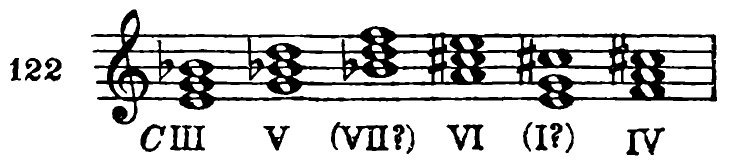
From Phrygian:
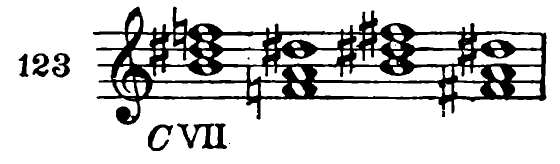
which occurred rarely. From Lydian:
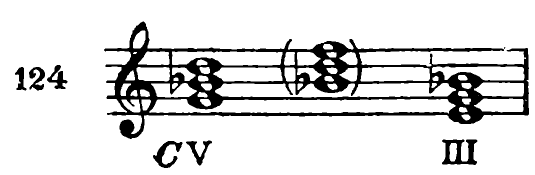
which are also contained in Dorian. Mixolydian:
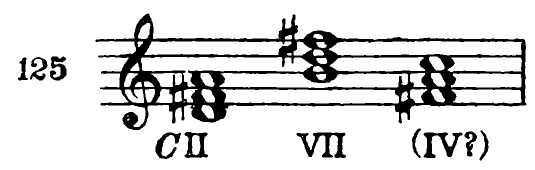
From Aeolian, those familiar from minor.
Naturally the seventh chords as well.
*) I see just now in Riemann’s “Simplified Harmony” [Vereinfachte Harmonielehre] that this thinker, so rich in ideas, has also hit upon opening up the wealth of the old church modes, by introducing concepts such as “Dorian sixth,” “Lydian fourth,” etc. But by giving the individual phenomena names, he makes them into special cases and at the same time cuts off their further development. They are then merely archaizing reminiscences of the church modes, through whose use, as in Brahms’s procedure, certain peculiar effects are obtained. I, however, adopting the concept of secondary dominants, etc., as one that embraces all of this, take the position that major and minor had lost this peculiarity—the use of nondiatonic chords—only by chance, during a short epoch of music. For if one adds up the peculiarities of the church modes, one obtains major and minor plus a number of nondiatonic phenomena. And it is in this way—the nondiatonic events of one church mode having spread to the other church modes—that I also imagine the crystallization of our two present-day modes. Accordingly, major and minor already contain within themselves all those nondiatonic possibilities, since these grew into them historically. They were merely used less, or not at all, in the age of homophonic music, when one generally confined oneself to three or four degrees. They fell into oblivion. But they are in there, and so need not first be introduced as special cases, but only brought out.
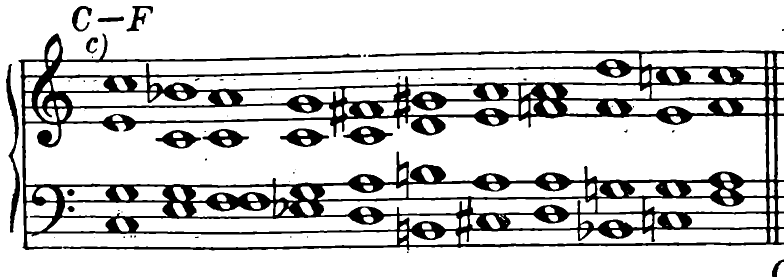
Heinrich Schenker (Neue musikalische Phantasien und Theorien) makes an attempt—admittedly a far more systematic one—to open up these harmonies by speaking of a process of tonicization. This would be the desire, or the possibility, of a secondary degree to become tonic. This desire would have the consequence that a dominant is sent ahead of it. That is indeed rather similar to my idea. Only I find it inexpedient and incorrect to present the matter in this way. Inexpedient, because much could thereby not be explained at all, or only in a very complicated way; which may well be the reason why Schenker does not arrive at so far-reaching a synthesis as I do. According to my presentation, for example, a deceptive cadence made from a secondary dominant is explained without strain, as will be seen; since one cannot speak of a process of tonicization here—for the second chord (e.g., III–IV) is not the tonic of the first, nor is the first the dominant of this second—one would have to speak, following Schenker’s view, of something like a tonicization process postponed by a deceptive cadence. Which would indeed be possible, although it is complicated, but it still has the fault that this tonic, which gives the whole process its name, perhaps does not appear at all. But—apart from the fact that these chords are in fact the dominants of the old church modes, a fact which, strictly speaking, cannot be set aside—I consider it incorrect—although Schenker is certainly thinking here of the fundamentals of the old church modes—I consider it incorrect to lend these secondary degrees, by linking them with the term tonic, a significance they do not have: within a key there is only one tonic; f–a–c is in C major nothing but a IV degree, and only someone who unjustifiably calls it F major can regard it as tonicized. And that no such significance belongs to all these degrees is shown by the following example:
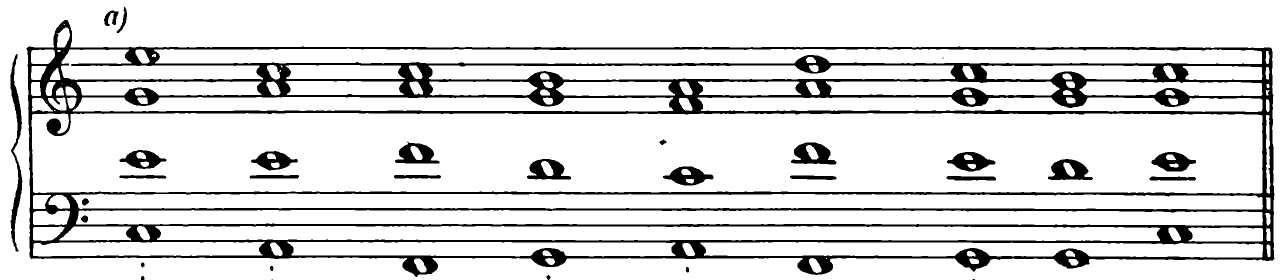
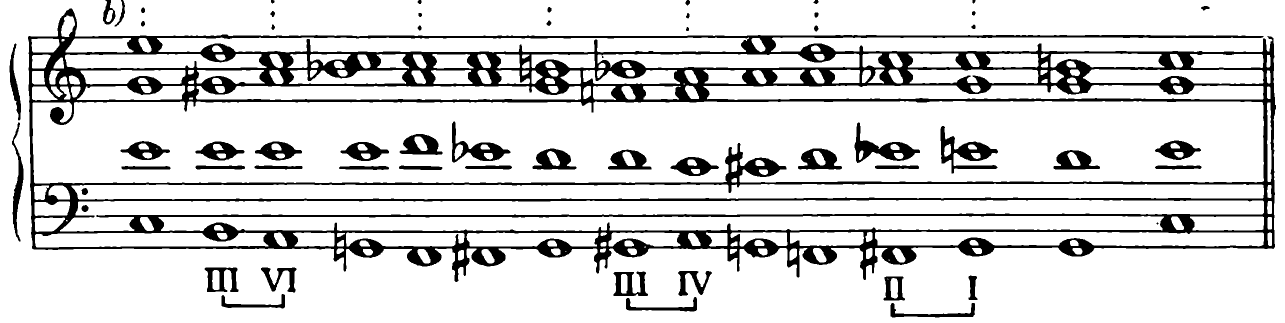
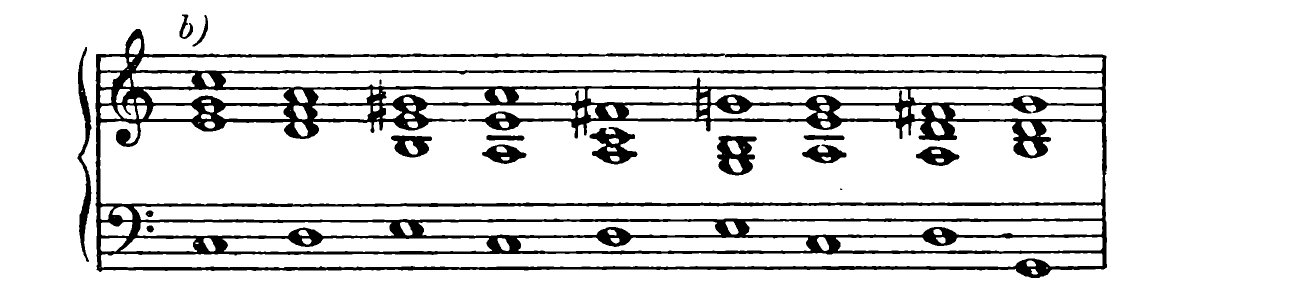
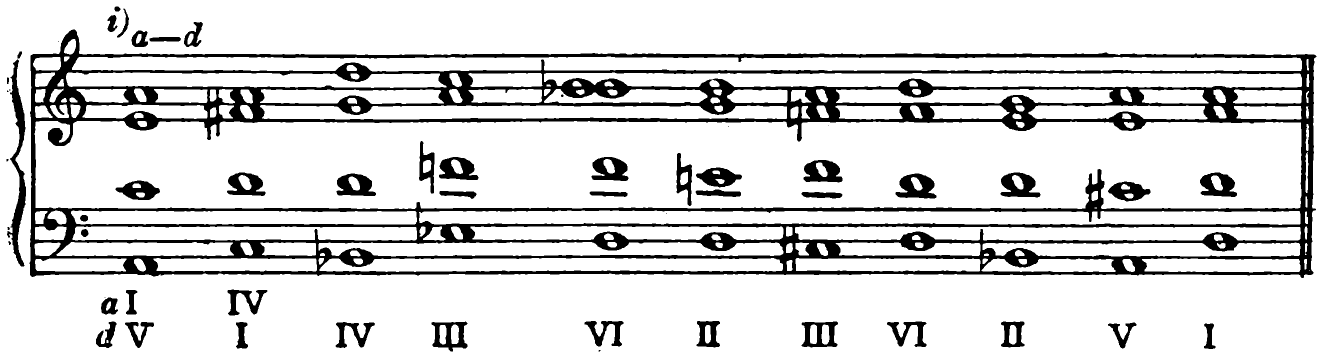
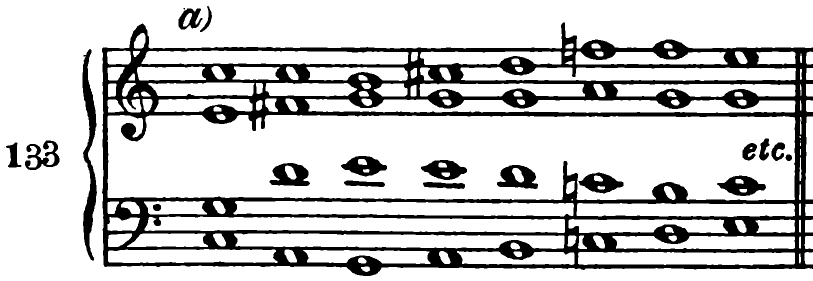
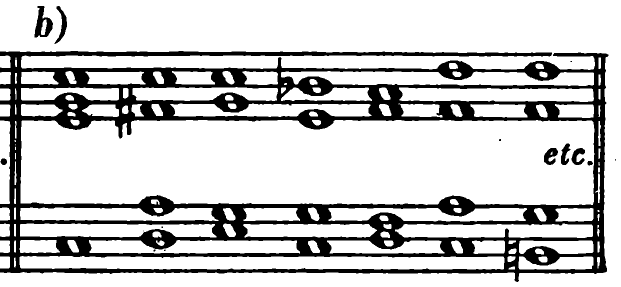
where in a) the chords lying between beginning and end surely stand, beyond doubt, entirely in the function of secondary triads—which the variation-like elaboration in b), using secondary-dominant seventh chords and the like, certainly does not change.
In proceeding thus, we follow the historical development, which took a detour when it arrived at the church modes. The reader will recall my hypothesis, which named as the cause of this detour the difficulty of fixing the fundamental of these series. We can reach by a direct route what the historical [path] will lead us to, if we start from the striving of a bass tone to assert its overtones, to become the root of a major chord. That alone would already sufficiently justify the nondiatonic major triads on the secondary degrees. Likewise, the other, often-mentioned psychological explanation suffices by itself to produce them systematically: the principle of imitation, of copying, which leads one to transfer the peculiarities of one object tentatively to others and which, for example, produces the raised seventh tone in minor. We shall follow this principle, too, when, as we go on, we again and again transfer to the other degrees what is possible, for example, on the II degree. The minor and diminished triads introduced through the reminiscence of the church modes could likewise be derived in this way. Here one must not overlook that these chords, artificial as they seem, may nevertheless be regarded as relatively natural insofar as models for them are indeed found in the overtone series. Thus among the overtones of C there is a sonority e–g–b, which admittedly lies far off, and one e–g–b-flat, which is out of tune; but both may be drawn upon for a natural explanation. If, however, despite the possibility of such explanations, I prefer to take the path of history, the chief reason is that the analogy with the minor mode, still alive for us, is very well suited to serve as our guide in handling these chords.
Of course one can (and we shall do so later) achieve all this through chromaticism as well, that is, by progressing by semitone from a diatonic tone to a nondiatonic one. The effect on the student’s skill might be the same; but, apart from the fact that these connections also occur in the form shown here, that would be less clear, and the insight into the development and into the interrelations of harmonic events would be smaller. For now we take the path of the church modes and exclude chromaticism for the time being; we therefore introduce these nondiatonic tones and chords as we would introduce them if they belonged to a minor key; that is, we observe, so to speak, the laws of the turning points and transfer them to those series that we raise or lower. From this it follows as a matter of course that a triad c–e–g, say, will not be followed by a–c-sharp–e, nor by e–g-sharp–b. Only provisionally, of course; for the first exercises.
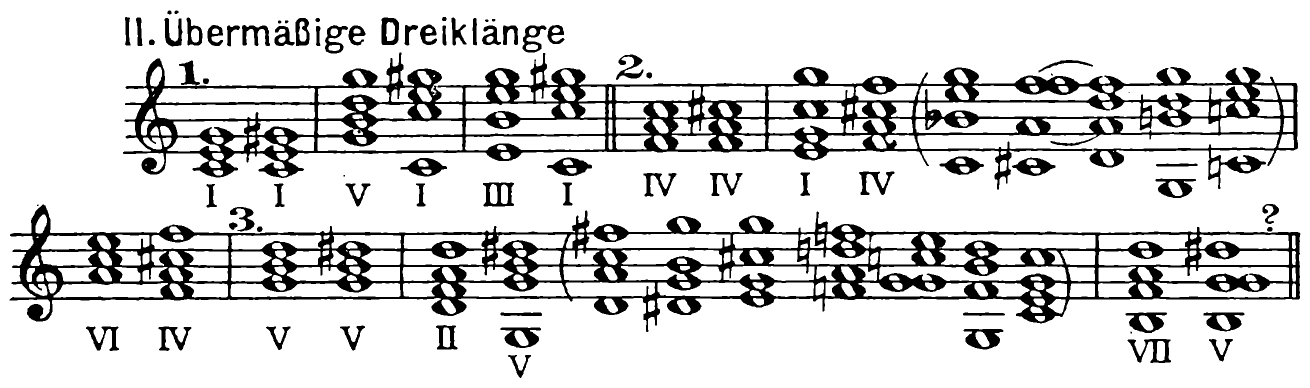
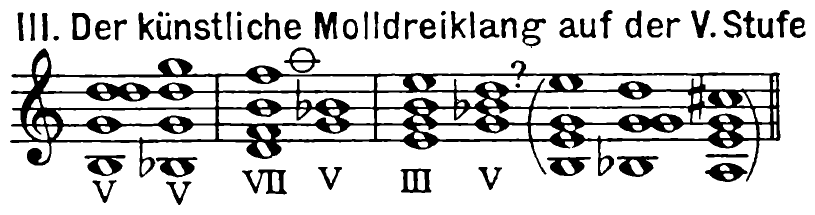
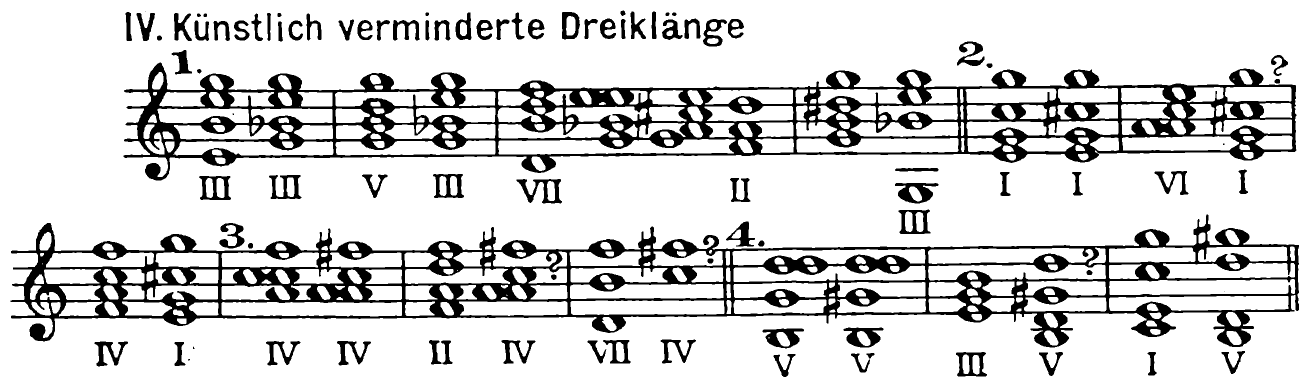
The use of these accidentals gives rise to the following chords (the two augmented chords of 123 derived from Phrygian being left out for the present):
1. Triads with a major third (as a substitute for the leading tone of a church mode) on degrees that diatonically have a minor third. These are the II, III and VI degrees. (The VII more rarely, for diatonically it is a diminished triad and would therefore have to raise two tones.)
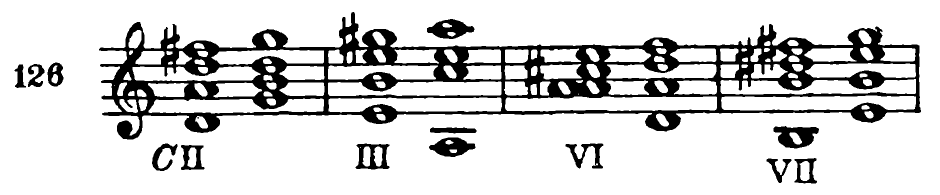
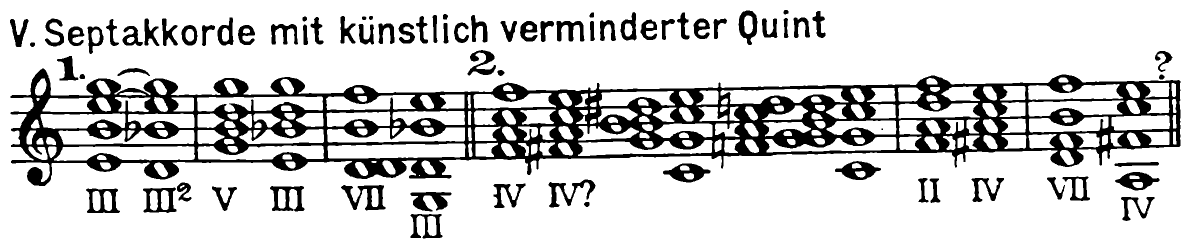
These are the dominants of the old church modes. They contain the raised (altered) seventh tone, the leading tone to the eighth (the fundamental). Specifically: the II degree contains that of the Mixolydian, the III that of the Aeolian, the VI that of the Dorian, and the VII that of the Phrygian (this last form was seldom used, since it can easily cancel the relation to the fundamental). Because these chords occurred in the church modes as dominants on V degrees, but in our keys stand on secondary degrees, we call them secondary dominants [Nebendominanten]*). They can of course also be used as seventh chords, which gives occasion for an extension: to gain also the dominant seventh chord of Lydian as a secondary dominant for our IV degree (127).
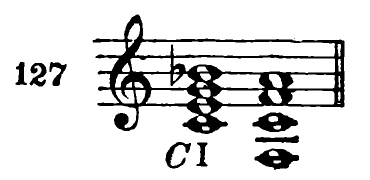
2. A major triad which, however, does not have dominant character, b-flat–d–f (from Dorian or Lydian), from which perhaps the Neapolitan sixth, still to be discussed later, derives;
3. a minor triad g–b-flat–d (from Dorian or Lydian);
*) The expression “secondary dominants” [Nebendominanten] is probably not mine; rather (I can no longer quite remember) it probably arose in conversation with a musician to whom I was presenting the idea of erecting dominants on the secondary triads. Which of the two of us first uttered it I do not know, and I therefore assume that it was not I.
4. a series of diminished triads;
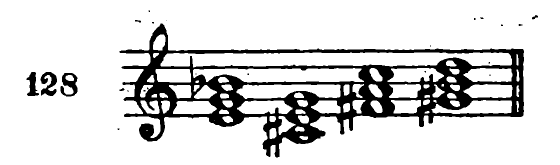
5. finally, augmented triads as well.
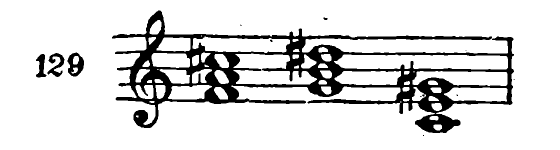
The use of all these chords is very simple if the student at first keeps to the laws of the turning points. That is: every nondiatonic tone is regarded either as the sixth or as the seventh tone of an ascending or a descending minor scale. Raised tones belong to the ascending scale, lowered ones to the descending. According to whether the tone is the sixth or the seventh, it is followed by a whole-step or a half-step. So that, for example, an f-sharp could be regarded as the seventh tone of a g series, in which case g should follow it (and possibly e, but in any case not f, should precede it), or as the sixth tone of an a series, in which case g-sharp should follow it. But it is also admissible to let such a tone arise as a sixth and then (through reinterpretation) treat it as a seventh. The f-sharp could, for example, be introduced as the sixth tone of an a series and then nevertheless be resolved into a triad g–b–d, which would correspond to its Mixolydian descent.
In order not to disturb the balance, the student should not use too many such nondiatonic chords, especially at the beginning. At the very least, the placing of many such chords would have to be followed by an equally rich and extended cadence. For that, the means do not suffice. And then one thing more: if the student wants to bring these altered chords into modulations, he can place them only where they do not, say, work against the goal in the sense of the chords to be excluded. Thus, for example, bringing about a chord f–a–c by means of a secondary dominant c–e–g–b-flat could have a disturbing effect if the modulation is to go from C major to G major. Certainly one could master this disturbance again if one were, say, to attach to this f–a–c an e–g-sharp–b, which leads to a–c–e (II degree of G major). But all the same, as long as the student is not able to feel these relations of weight precisely, he will do well to use only those chords which, if they do not further the attainment of the goal, at least do not hinder it. Above all, however, he will be able to use them best in the cadence, when the key is already sufficiently established.
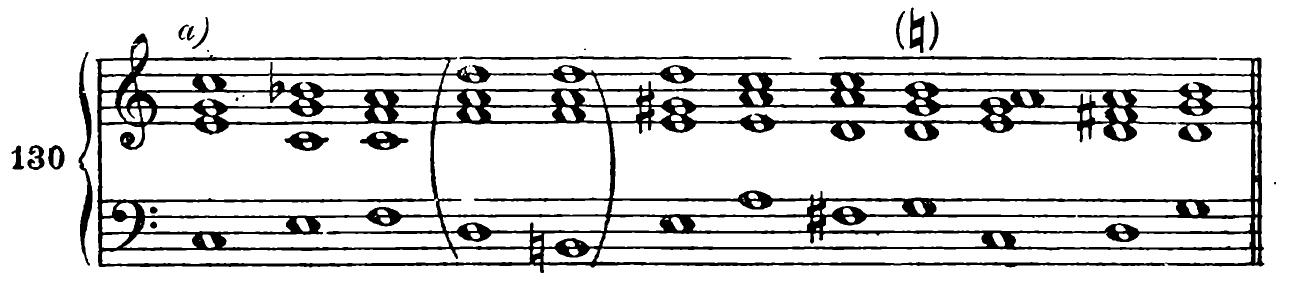
In example 130a an unevenness is decidedly to be felt. The b surprises; one would almost rather have expected b-flat; and yet we had resolved that our modulations should glide gently and lead across clearly.
Solution 130b is better. But if we look at it closely, we notice that we could actually have done this already following one of the earlier suggestions, namely the suggestion to choose intermediate keys (here that would be A minor). I gave this explanation with intermediate keys only reluctantly, for it is wrong to distinguish keys within so short a phrase. Just as we do not call a secondary triad, say, E minor, but III degree, so here too we prefer to speak not of keys but rather of degrees elaborated by secondary dominants. A degree may possibly even be elaborated in an outright key-like manner. But it confuses the picture, and obstructs the view of the whole and its interrelations, if one gives the name of a key to every degree that is preceded by a dominant. In musical example 131 some modulations with such altered chords (that is, chords using nondiatonic tones) are presented.
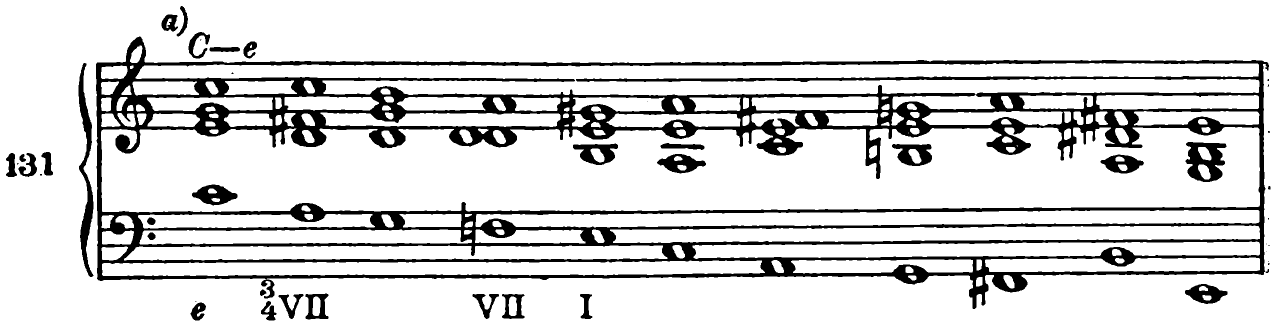
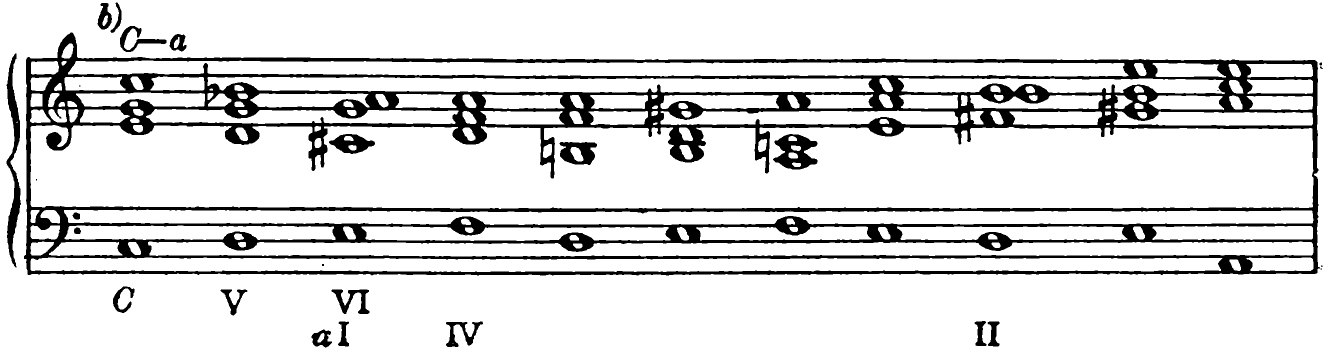
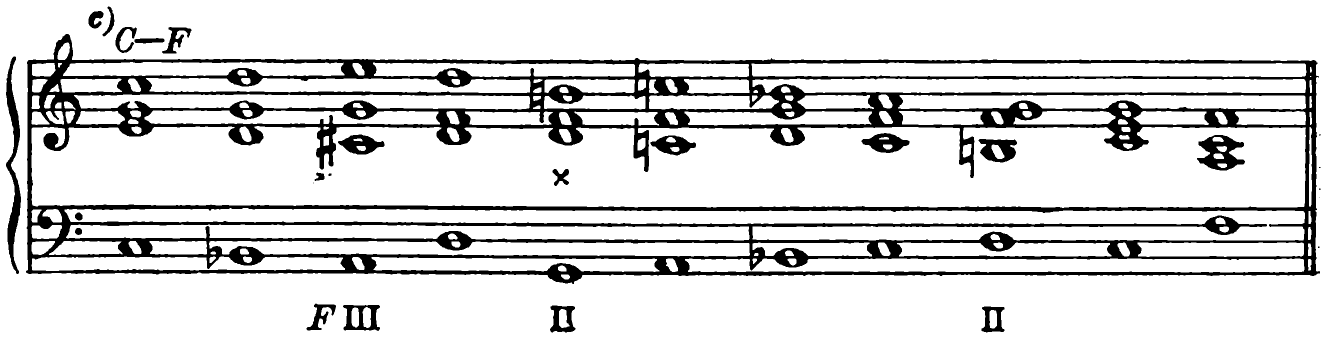
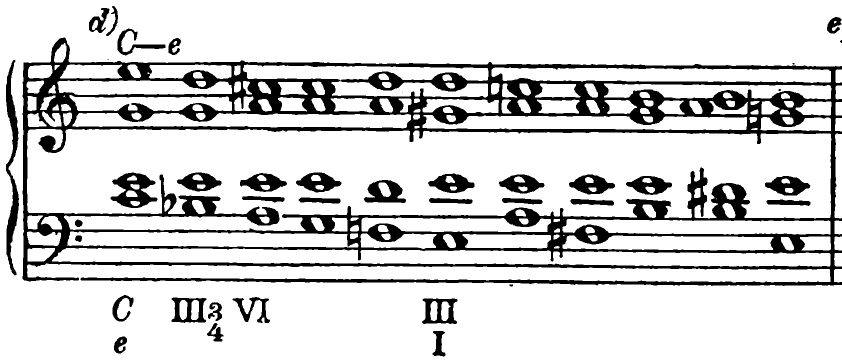
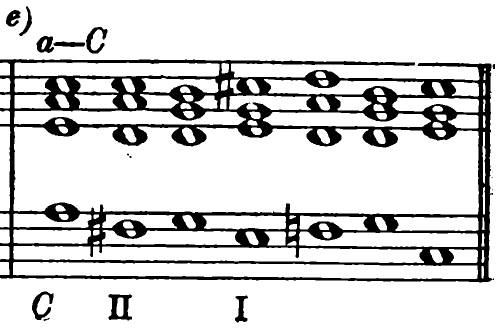
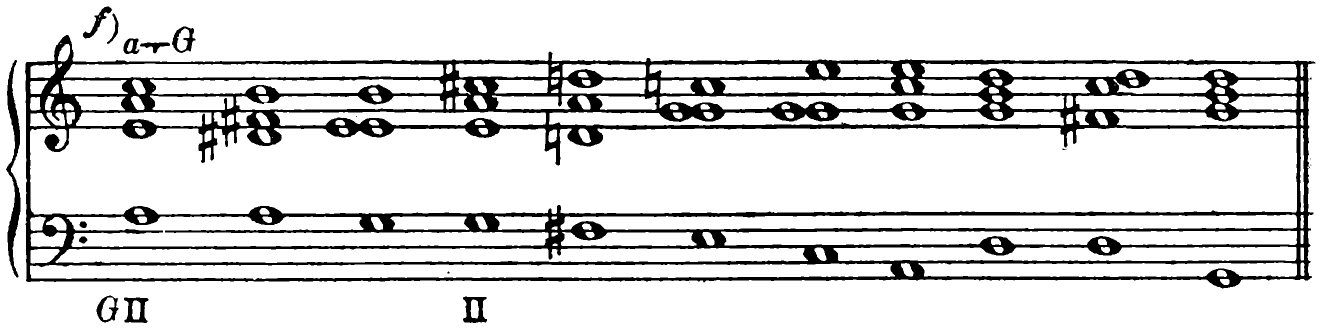
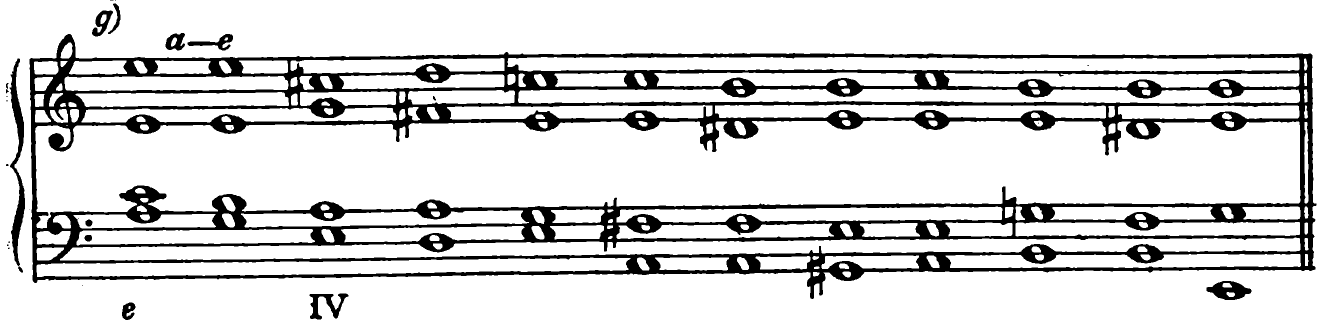
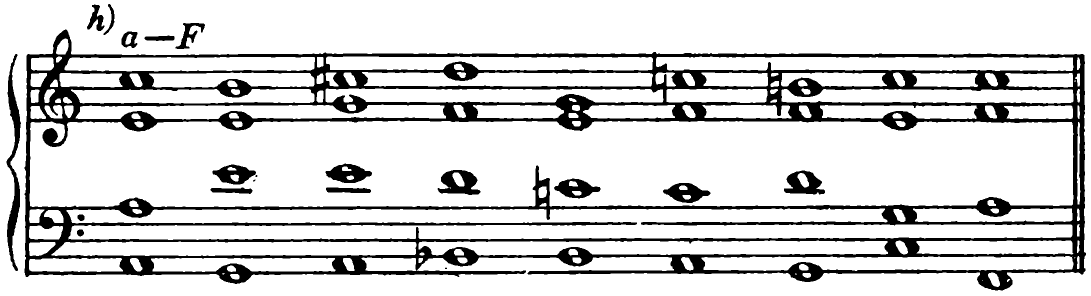
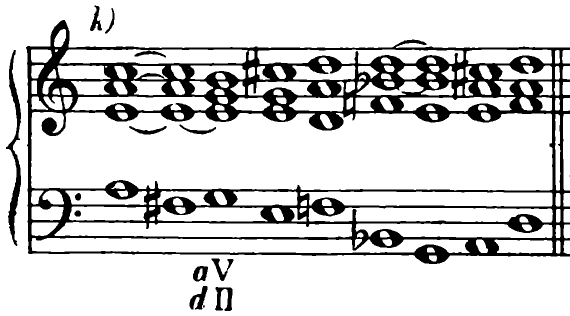
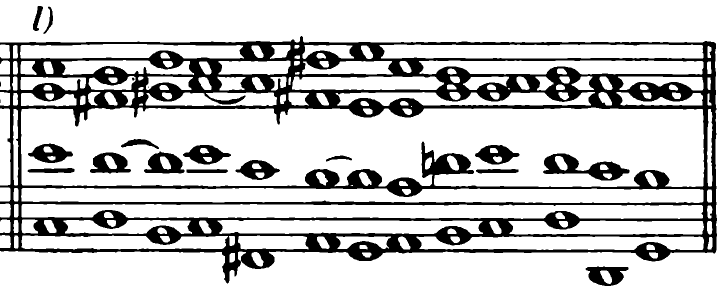
In 131c, at ×, a secondary dominant (on the II degree of F; here, of course, the reference is already to F major) is resolved deceptively. This secondary dominant on the II degree bears the name Wechseldominante [“changing dominant”]. It is unclear to me where the name comes from and what it means*). But its function is to stand in for the diatonic II degree in the cadence—mostly in such a way that the succession of degrees is II–I⁶₄–V–I; yet the Wechseldominante is also often enough followed directly by V–I.
*) An explanation might be found as follows. Wechseldominante has a counterpart in the word Wechselbalg [changeling]. This can, to be sure, be understood as an exchanged child. But since it is always a misshapen child that has been foisted on the parents by witches or the devil, it occurred to me that Wechselbalg is connected with vexieren, that is, to plague, to hoax, to tease. A Vexierbalg would then be a child foisted on one by the plaguer, the hoaxer, the teaser. If one looks for further synonyms, one finds: to annoy, to delude, to deceive (trügen), the last of which also occurs, as Trug [deception], in connection with ghostly apparitions. Accordingly one might believe that wechseln [to change, exchange] and vexieren are altogether the same word. Whether, then, the money-changer (Wechsler) and the bill of exchange (Wechsel) were deceptive transactions, or whether the creditor, by possessing the bill, has the right to vex the debtor, to plague him with the demand for payment, need not concern us, since both plague and deception may well be correct translations, and the word may have profited from the connection of the two by gaining its double meaning. Likewise the question whether exchanging money for other money is called wechseln because of the annoyance at the loss one suffers in doing so, or, as I assume, because the dealer from whom one bought bills of exchange to pay one’s foreign debts, with whom one exchanged money for bills, and who verwechselte it [exchanged it, or mixed it up], was called a Wechsler also in the case where he sold foreign money—a Wechsler, whether he exchanged for bills or for money. Since, as is well known, only forgetting helps against unavoidable annoyance and plague, the deception that annoys us in changing money could here too, in the end, best be forgotten, and the questionable word could rise to be a synonym of the unquestionable (“not thinking about it”) “umtauschen” [to exchange].
Now this is contradicted by the circumstance that Fux’s Wechselnote is called cambiata (from cambiare) in Italian, and that cambia valute (exchange office) and changer (to change) testify that in the Romance languages, without recourse to vexieren (to annoy, deceive, plague), the same concept, wechseln, is also used in both meanings. But even though many words of our language come from Latin and Italian, because we learned the name along with the activity, the first money-changer need not necessarily have been a merchant of Venice; it may also have been one from Nuremberg. Indeed, it is not even impossible that he was one from Holland, since Amsterdam is still considered a world money market today. And even Fux’s Wechselnote could be a Netherlandish one, dating from the period of Dutch hegemony. The Romance peoples would then have learned the use of this expression as a musical term from the Germanic peoples, without becoming conscious of the deception that lies in wechseln.
What interests us in the connection between vexieren, annoying, plaguing and wechseln is, in particular, the meaning: deception. Then our Wechseldominante would be called a Vexierdominante [“teasing dominant”] and would be a deceptive dominant (Trugdominante), that is, one that carries out a deceptive cadence (II–I).
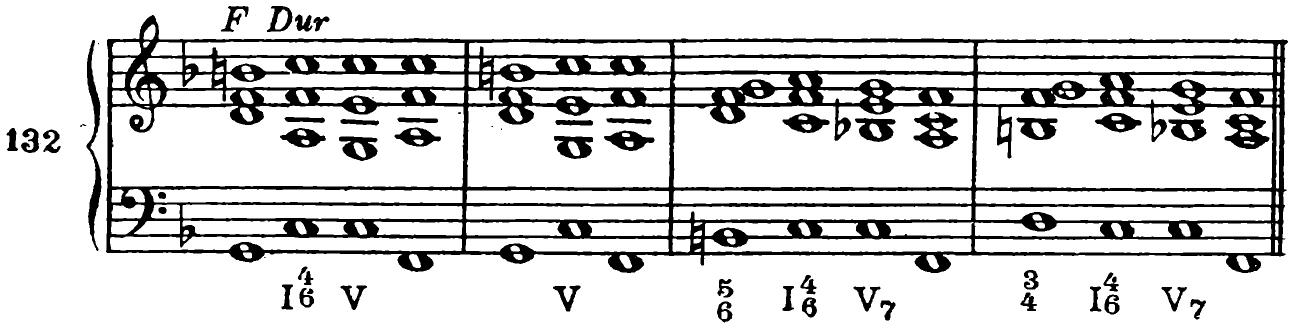
It is most often set as a six-five chord or as a four-three chord. But root position also occurs often. The only thing new to us in this case is that here a step resembling a deceptive cadence (II–I) is made from a secondary dominant. Such connections are naturally possible from other secondary dominants too. But the student will do well to be sparing with them, for otherwise he could easily write many things which, without being unusable, are unusual and contradict the style of the whole. It holds true perhaps only on average, but it hardly goes much too far to say: deceptive cadences after secondary dominants will sound mild if the modulation is not accomplished by the deceptive cadence. They will sound harsher if the modulation they bring about was not prepared. Now mildness is certainly not what we strive for in the first place, nor harshness what we avoid in the first place. They are only the means by which we recognize what is customary and what is uncustomary. What is customary sounds mild because it is customary; and what is uncustomary sounds harsh, mostly only because it is uncustomary. Naturally it cannot be our intention to write uncustomary connections. That would serve little purpose in harmony exercises, since we cannot thereby bring it about that they become customary. The time in which they could have become established is past. Should they still become established now, that could only happen through composers taking them up. But that is unlikely, for we have other, stronger means. And then, too: the secondary dominant was introduced in order to obtain for every degree a dominant chord to precede it (a leap of a fourth upward in the root). The deceptive cadence, however, makes steps of a second, and so leads somewhere other than corresponds to the purpose for which the secondary dominant was introduced. Of course the combination is justified in applying the function of a dominant (to connect deceptively) to the secondary dominant as well. But that is somewhat more far-fetched, and perhaps for this reason alone less customary. These deceptive cadences do occur, but caution is necessary: being too far-fetched, they can easily lead too far away as well. Example 133 shows what efforts such connections require to secure the key.
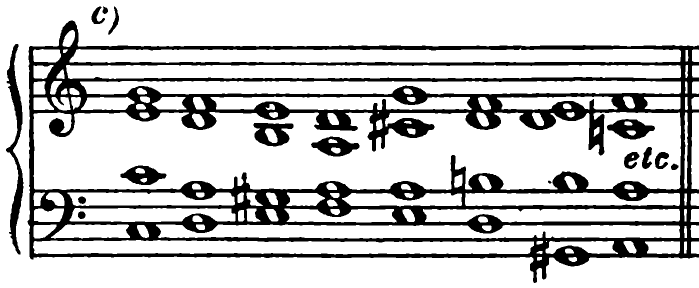
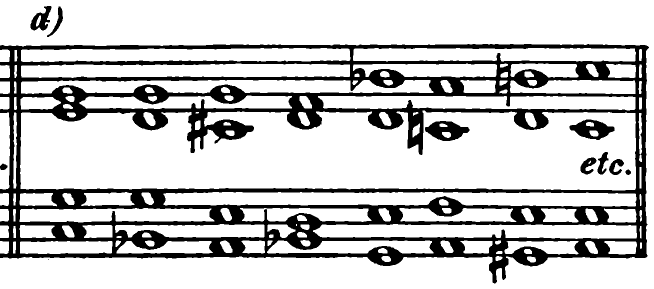
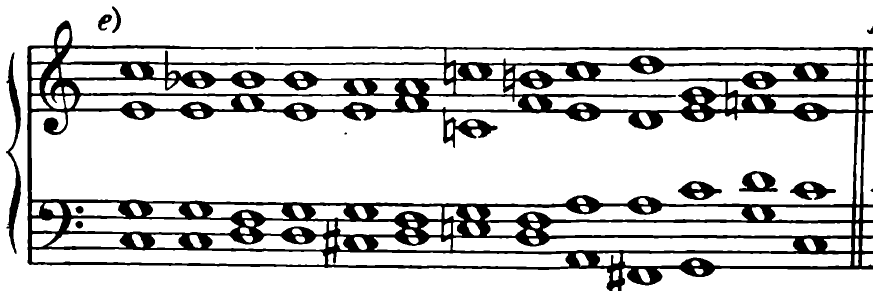
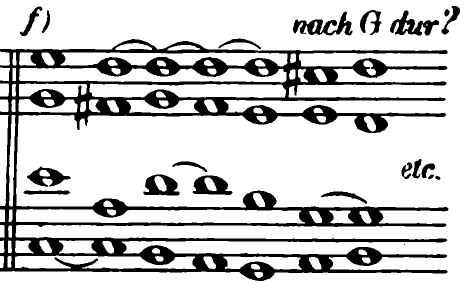
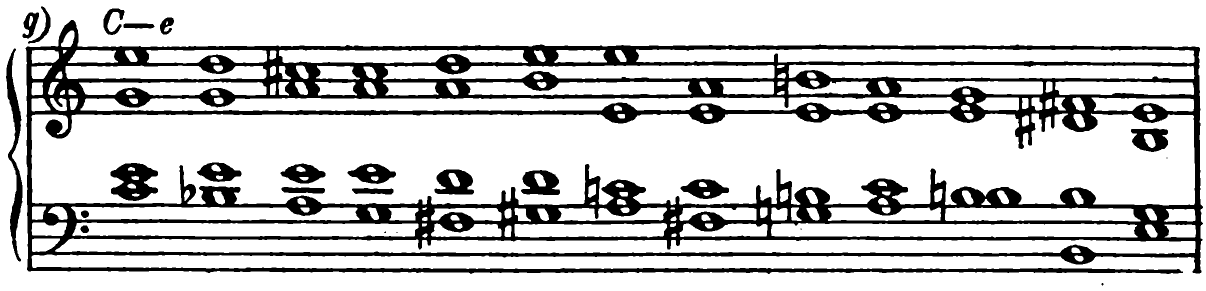
In example 131a one can regard the second chord (four-three chord over A) as a Wechseldominante (II degree of C). Then the following chord, over G, is V of C. But it could also be I (of G); in that case a modulation would already have taken place here, and the preceding chord would be the V degree of G, that is, a dominant and not a Wechseldominante. Correspondingly, the fourth chord would have to be regarded as a V degree with lowered third, the fifth chord as a VI with raised third. G would thus be an intermediate key here—an assumption that proves inexpedient. For with the same right one could regard the sixth chord (sixth chord over C) as A minor. That would then already be the second intermediate key. It is therefore better to drop the explanation by intermediate keys and to refer the secondary dominants to the initial key as long as no series of chords has occurred that has decided in favour of the goal key. In 131d, for instance, it would be harder to determine such intermediate keys. The second chord, a four-three chord over B-flat, could be referred only to D minor. The sixth chord F–A–D that follows as the fifth chord does, to be sure, correspond to this; but F-sharp–A–D could just as well come (133g), and then the determination of intermediate keys would be possible only through very complicated reinterpretation.
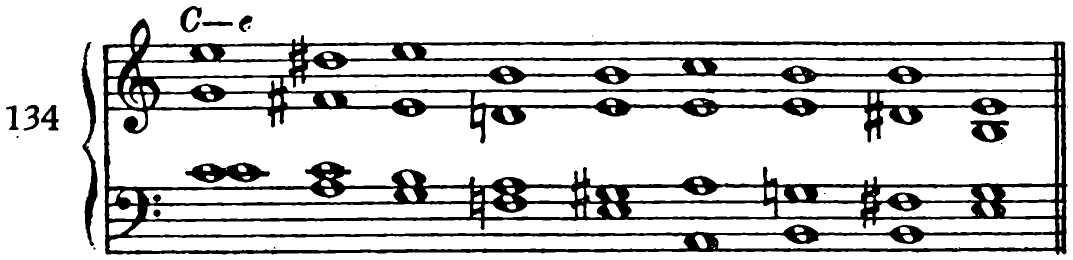
The secondary dominants are very well suited to extending the cadence (134).
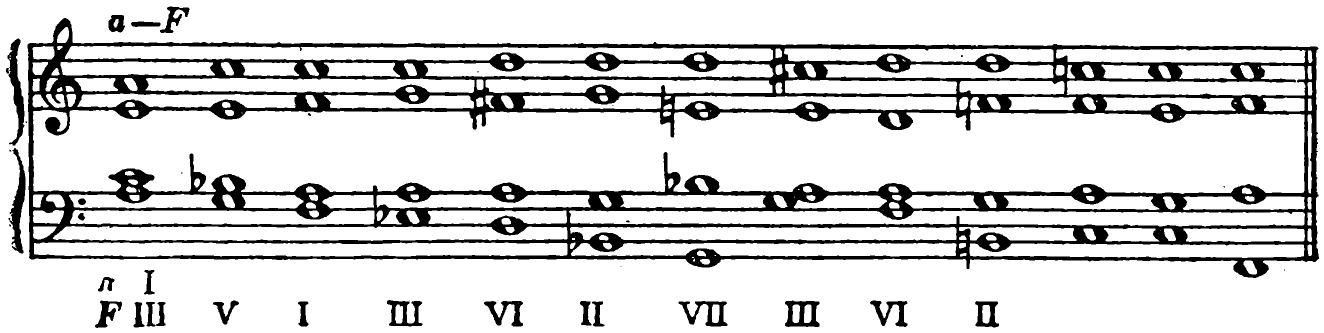
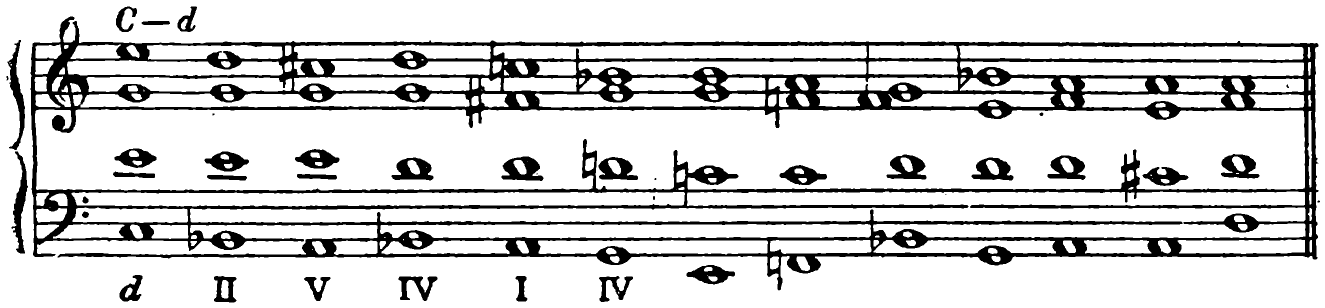
The modulation is then better made briefly, with a quick means. That the secondary dominants are likewise to be used in minor, and that no new laws arise in doing so, is clear. Only one thing should be said here in more precise form, which also holds for major and explains why no secondary dominant is to be erected on the IV degree in major either. The secondary dominant exists chiefly because of the upward step of a fourth in the root, as an imitation of the step V–I. But from the IV degree (in C major, F) this step would be an augmented fourth (F–B), or would lead into a nondiatonic note (B-flat). For the time being we would not yet know what to do with the chord on B-flat, and the connection with B would not correspond to the sense of this device. For the same reason, in minor one will for the present erect no secondary dominant on the unraised VI degree (in A minor, F), for it too would go to B-flat. But on the raised VI and VII degrees, too, the secondary dominant will not be applicable. For a chord F-sharp–A-sharp–C-sharp–E (or even G-sharp–B-sharp–D-sharp–F-sharp) leads too far away from the key for us to dare that yet.
I do not want to omit warning the student once more against excessive use of the secondary dominants. We are, after all, not yet so rich in means with them that unevennesses could not easily arise, and it would in any case be less favourable to sacrifice the smoothness of the exercises merely in order to accommodate a great many altered secondary chords. In general I recommend placing hardly more than three or four secondary dominants (etc.) in an example of ten to fifteen chords.
One can also connect several secondary dominants with one another and with other chords foreign to the key. Only one must take care not to move too far away from the key. The bad results to which excessive use can lead are shown by 135d.
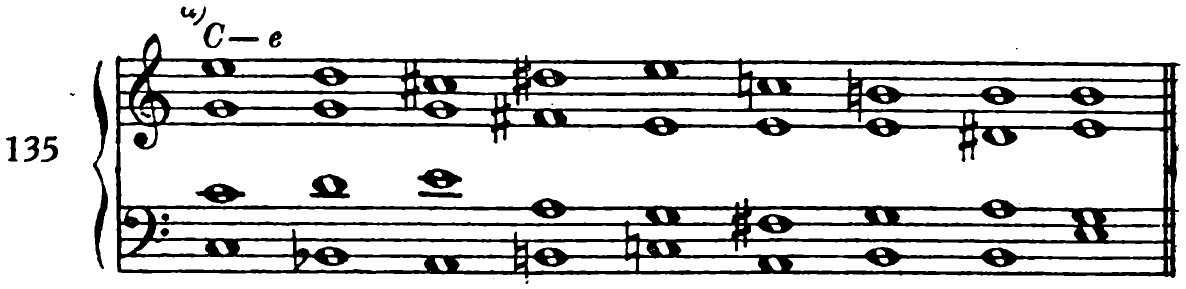
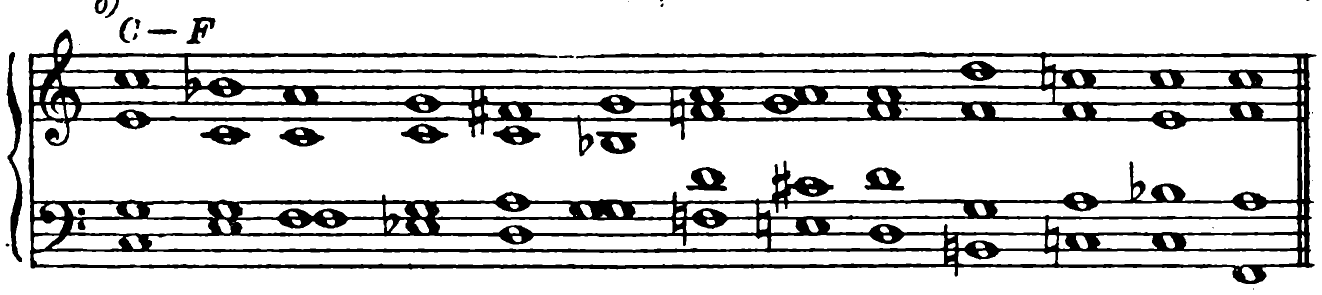
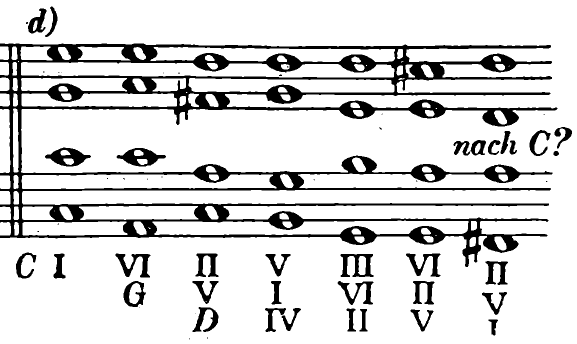
All seven chords of this example can in themselves be degrees of C major. But from the third chord on (if not already from the beginning) one can readily refer them to G major, and from the fourth on they are diatonic chords of D major. Three mistakes have been made here: 1. Both secondary dominants used here lead (as the degree numbers show) into V degrees (of C major and of G major). 2. Both, the third as well as the sixth chord, are moreover themselves introduced as if they were V degrees; the third is preceded by a chord that can be understood as II of G major, the sixth by one that can be understood as II of D major: that is how one modulates or establishes a key. 3. In connecting two secondary dominants with each other there is a danger in both chords being major triads; the second, as the result, can thereby easily recall a tonic. A major chord, as the more perfect imitation of what is given by nature, has a greater tendency to assert its position as tonic than a minor chord, which through its imperfection naturally bears the mark of the provisional. This deficiency becomes remediable only through the chromatic introduction of secondary dominants discussed further below. Let the following serve as a guideline for avoiding such mistakes: if one has come too close to the dominant region by means of secondary dominants, it will be well—since elaboration by secondary dominants easily has the effect of establishing a key—to seek out the subdominant region quite soon. Thus, for example: had one pushed the V or III degree too much into the foreground, one will lead over through the VI to the II or IV. And conversely, if one has come too close to the subdominant region (II, IV), one will have to try to return to the dominant region.
After the student has first brought in the secondary dominants without chromatic steps, that is, as it were in conformity with the key, in minor, he can proceed to produce them also by chromatic progression. This also makes their possible uses much greater. Here the following is to be kept in mind: the purpose of such a chromatic raising is to bring about a leading tone, a rising or a falling one. Consequently the raised note should always rise, the lowered note always fall. Only when bad voice leading can be avoided or a complete chord obtained, and the note in question is in an inner voice, would I for the present allow a leap away from it. Otherwise the purpose of such an alteration should still be evident in the voice leading at this stage. For the same reason, however, the raising or lowering should also make itself recognizable as such by the raised or lowered note following directly on the preceding unaltered one—that is, the raising or lowering takes place in the same voice. If in the preceding chord two voices have the note in question, then of course the alteration in one voice suffices; the other may leap away. This gives us, to a certain degree, the possibility of circumventing the turning-point laws in minor. The rich means we have in the secondary dominants and the like permit us to restore the balance in the cadence.
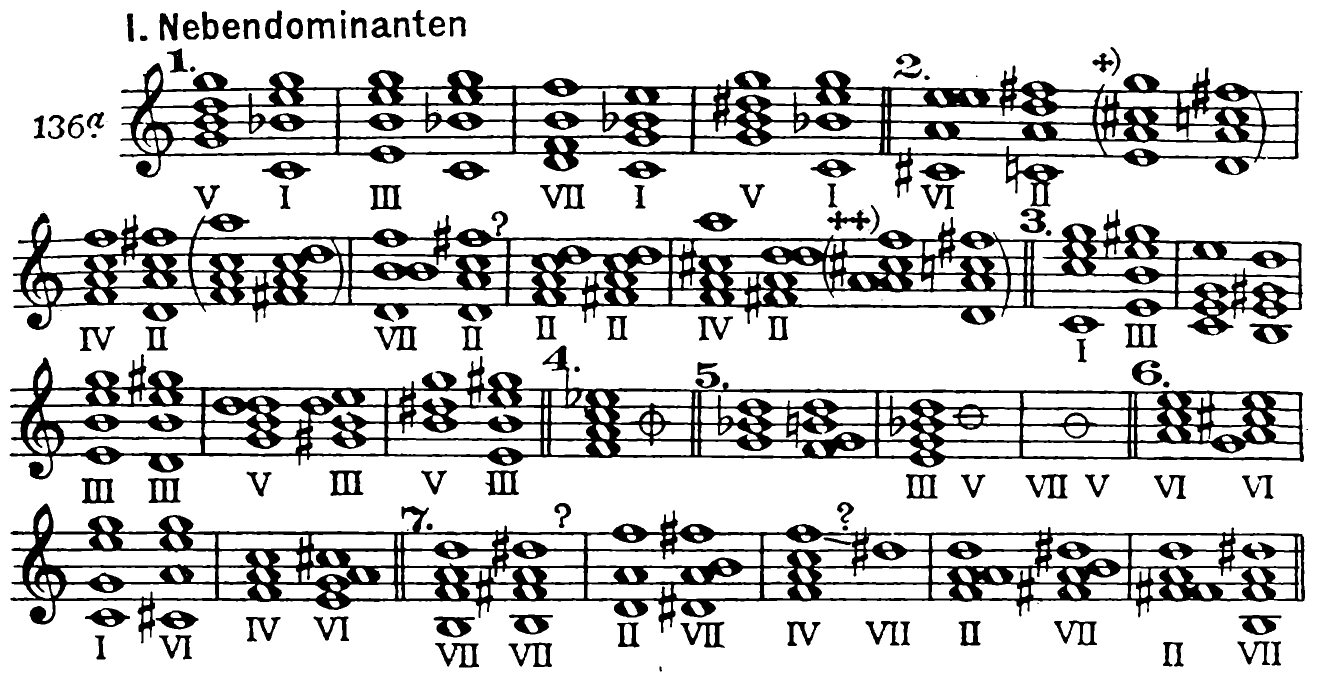
In 136a the chromatic introduction of the nondiatonic chords is shown. It presents no particular difficulties. Connections such as those at *) and **) we shall leave out for the time being. The following guidelines are recommended: I. Melodically clear presentation of the chromatic successions as rising or falling leading tones, in the form of segments of the chromatic scale. II. Since they have melodic force, it will be advisable to place them in an outer voice, soprano or bass. The bass in particular will be able to profit from this, since it would otherwise often remain stationary. To avoid this one can also help matters by exchanges (other inversions) and changes of position. III. The purpose of chromatic introduction is no other than that of the treatment first taught, the turning-point-like one. But chromatic introduction offers the advantage that the danger to the key is smaller, because notes reached in this way can hardly count as diatonic—something we already took into account when we stated that a dominant should never arise chromatically. Thus the C-sharp of a VI degree of C major, arising chromatically from C, will prevent one from understanding the following II as a tonic (modulation to D minor). Indeed, even if this II degree then also has a major third, at worst it would first have to be a dominant. A danger such as the one shown in 135d is thus easily averted.
![Plate A1 [to page 231 ff.] 137 A) Secondary-dominant seventh chords a) a fourth upward. I IV · II V · III VI · IV · VI II · ? VII III b) a second upward I II ·](/schoenberg-harmony/images/sh-042-plate-a1-ex137.png)
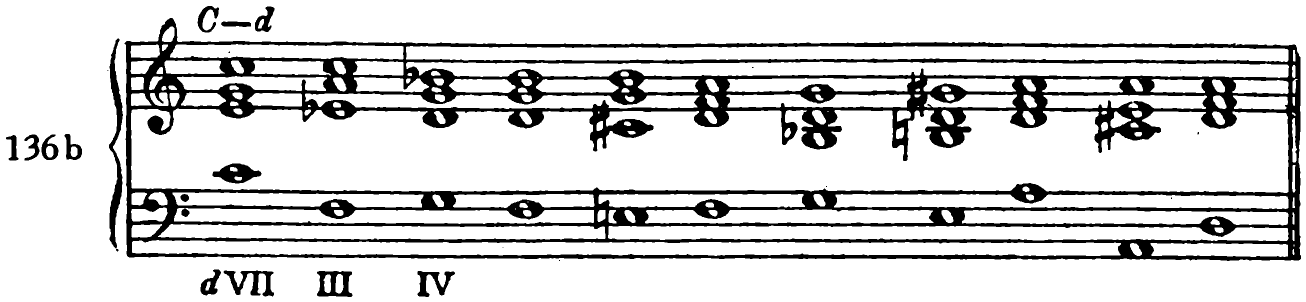
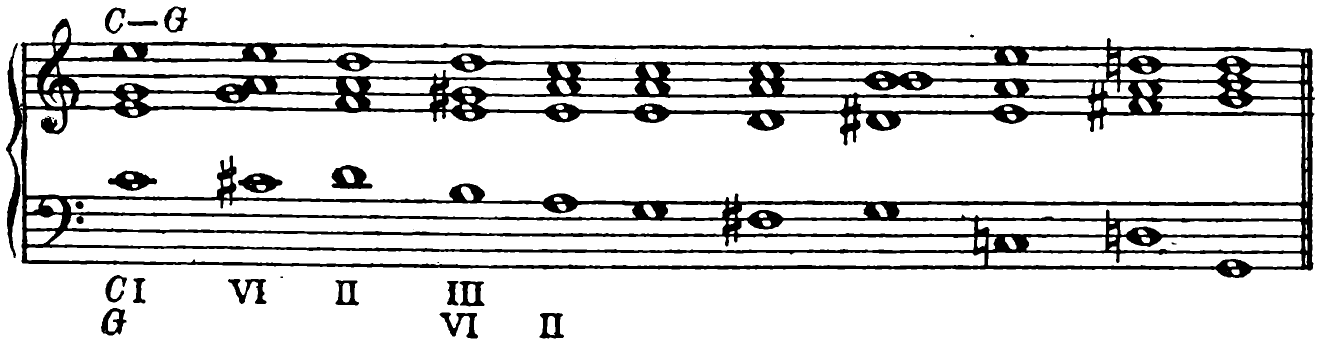
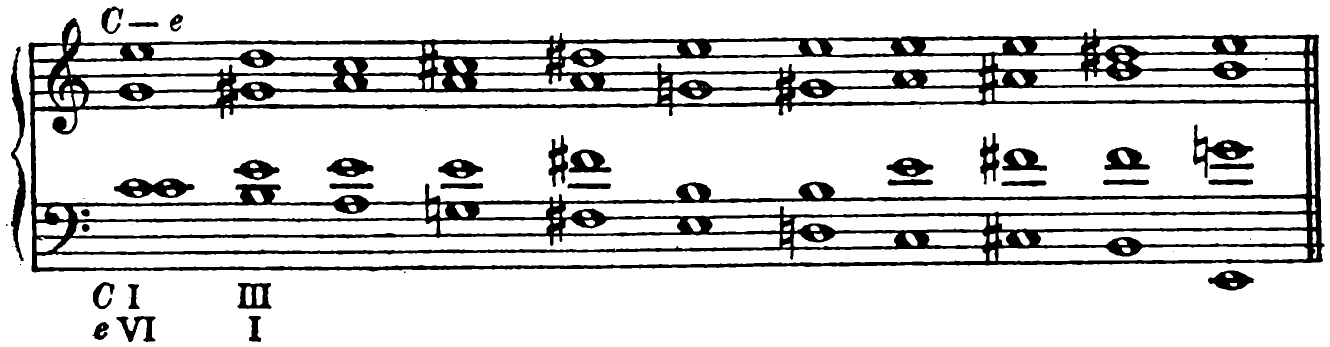
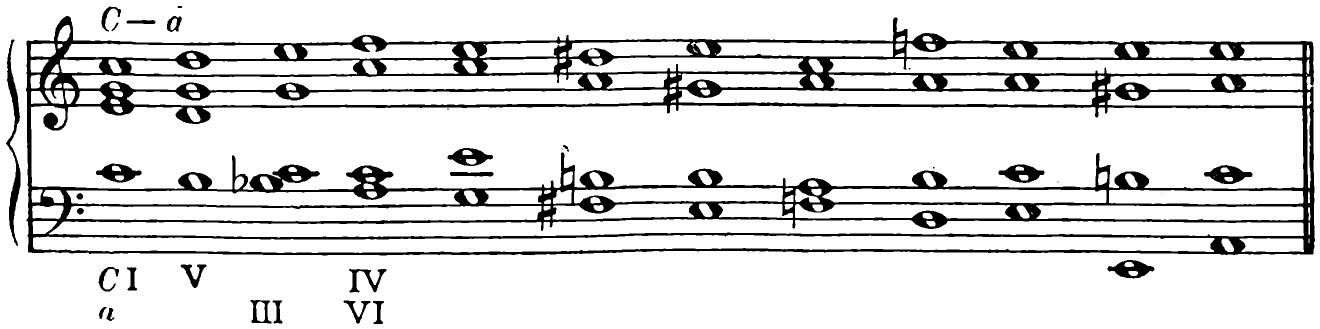
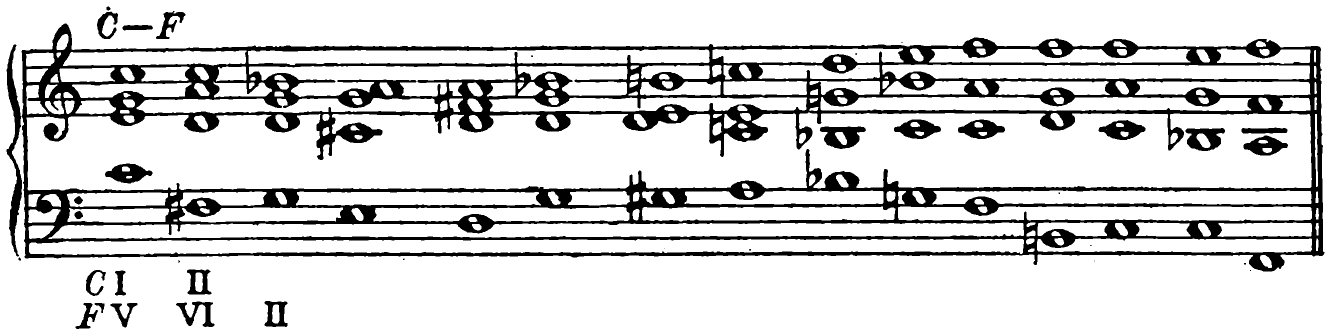
Here too the student will do well not to overreach himself through too much. Used sparingly*), these means are very effective, but to be lavish with them would be unfavourable, since they, too, cannot yet offer sufficient variety.
*) In this sense the accompanying musical examples are not to be taken altogether as models, since they were written with the aim of showing as much as possible in the smallest space. On the basis of the rules of conduct given to him, however, the student is in a position to judge them critically.
Of the other chords taken over from the church modes, the diminished ones in particular are very effective. For example, E–G–B-flat (or, better still, the seventh chord E–G–B-flat–D) as III degree in C major recalls the II of D minor. That is why it is readily followed by A–C-sharp–E (V of D minor), which is VI of C major. One of the minor chords can have the same effect. For example, G–B-flat–D recalls IV in D minor; it is followed by V of D minor, or VII, which can lead into I—which, however, is II of C major. The student should not, however, take this to mean that other keys are really present here. I only wanted to show the aptitude of these chords for introducing secondary dominants (here it was A–C-sharp–E).
For the use of the new means now placed at our disposal, there follow here summarizing instructions as a supplement to those given on page 149: