Playable Books
Arnold Schoenberg · section 34 of 66
Modulation
Read and hear this section in the playable edition → Practical Manual of HarmonyNikolai Rimsky-Korsakov · modulation
 Treatise on HarmonyJean-Philippe Rameau · modulation
 Guide to the Practical Study of HarmonyPyotr Ilyich Tchaikovsky · modulation
 Supplement to the Theory of ModulationMax Reger · modulation
 Exercises in Elementary CounterpointPercy Goetschius · modulation
One may assume that tonality is a function of the fundamental tone; that is to say, everything that constitutes it proceeds from that tone and refers back to it. But whatever proceeds from it, even though it refers back, has an individual life of its own—within certain limits; it is dependent, yet to a certain degree also independent. What lies nearest to the fundamental has the most affinity with it; what lies farther away, less. If one roams through its territory following the traces of its influence, one easily arrives at those borders where the attractive force of the centre is weaker, where the power of the ruler slackens, and where the right of self-determination of the half-free can, under certain circumstances, bring about upheavals, changes in the constitution of the whole structure. Of such regions, which behave neutrally at one time and revolutionarily at another, two are to be distinguished: the dominant region and the subdominant region. It is not possible to draw their boundaries narrowly, for their relationship to the fundamental, which is after all a strong one, together with the effect of their own drives, which also create relationships among themselves, displays conditions that could not be represented graphically in two dimensions. At any rate such a representation would yield a line returning upon itself, but one with branches, forming arteries of traffic from every point in all directions. Roughly, however, it can be put like this: to the subdominant region belong IV and its substitute, II; to the dominant region, V and III, which resembles it. Relatively neutral in behaviour are VI and VII, which can belong alternately to either region or lead over from the one into the other. Thus, for example, the succession III–VI creates the possibility of passing to IV or II, and II–VII the possibility of passing to III. And II, which is the substitute for IV, leads into the dominant region when it is followed by V. But V would rather go to III or I than to II or IV, and IV would rather go to II or VII than to V. IV and V, the two chief representatives of their regions, have the strongest aversion to each other and, relatively speaking, next to I, the strongest will in the whole district. To fix boundaries in a district where there are so many transitions may be a futile effort, for the differences in tendencies and effects are perhaps too subtle. Yet despite all the transitions they are there, even if finely drawn; and recognizing them is useful, as will be shown later. What matters to us for the present is to recognize how the slackening of the secondary triads' affinity to the fundamental makes possible certain harmonic successions whose relation back to the fundamental requires the application of special means. It is important for us to recognize that there are regions within the tonality which remain neutral as long as they are held under constraint, but which are ready to succumb to the enticements of a neighbouring tonality the moment the rule of the fundamental slackens even for an instant. Even if one does not wish to regard every chord that follows the first degree as an incipient departure from the tonality (albeit with a relation back to it), it must still be stated that the strong will of the relative rulers of the dominant and subdominant regions, and the tendency of the neutral chords to adapt themselves to that will just as readily as, perhaps, to the will of some other neighbouring tonality, favour the danger that the bond will loosen. From this, and from the tendency of every degree to become a fundamental, or at least to win a more important position in another district, there arises a contest, a game of struggle, which makes up the charm of harmony within the tonality. The appetites for independence of the two next-strongest powers in the territory, the mutiny of the more loosely bound elements, the occasional small victories and conquests of the contending parties, their eventual submission to the principal will and their gathering into a common function—this movement, a mirror image of our own human bustle, is what makes us feel as life what we create as art.
Every chord, then, that is set beside the principal tone has at least as much tendency to lead away from it as to return to it. And if life is to arise, if a work of art is to arise, this motion-generating conflict must be taken up. The tonality must be put in danger of losing its sovereignty; the appetites for independence and the mutinous strivings must be given the opportunity to assert themselves; one must let them win their victories and occasionally grant them an enlargement of their territory, because a ruler can take pleasure only in ruling the living; and the living want to plunder.
Thus the rebellious strivings of the subordinates perhaps spring as much from the tyrant's need to rule as from their own inclinations; the one is not satisfied without the other. And so the digression from the principal tone is explained as a need of the principal tone itself, in whose overtone series, after all, exactly the same conflict is contained as a prototype—on another plane, so to speak. Even the apparently complete abandonment of the tonality turns out to be a means of making the fundamental's victory all the more brilliant. And once one recognizes how every other chord, placed beside the principal tone, favours a modulation even if it does not actually bring one about, it becomes clear that digressions into more remote regions may also be organic to the fundamental: more remotely organic. To relate them to the principal tone is more difficult, but not impossible. The means the principal tone must employ to seize its dominion over them simply have to be stronger, more violent, corresponding to the more violent nature of those who lust for emancipation. And the greater the head start the fundamental grants to those who withdraw from it, the more tempestuous the seven-league-boot stride with which it will have to strive to catch them again. The greater this effort was, the more overwhelming the effect of the victory.
If, then, one rightly follows the tendencies of the satraps, one recognizes the necessity and the possibility of digressions, of modulation. These are without limits, provided the power of the tonality is without limits. Were this power limited, it would be of no use to suppress the tendencies of the secondary chords; they would burst the union all the same, for they have no limits. The question, then, is this: is it strong enough to master everything, or not?
Both. It can be strong enough, and it can also be too weak. If it believes in itself, then it is strong enough. If it doubts its divine right, then it is too weak. If from the outset it comes forward autocratically, believing in its destiny, then it will win. But it may also be sceptical; it may have recognized that everything described as the welfare of the subjects is merely its own welfare; it may have recognized that its supremacy is not absolutely necessary for the prospering and growth of the whole. That it is admissible, to be sure, but not indispensable. That its autocracy can indeed be a bond that holds things together, but that the removal of this bond would favour the spontaneous functioning of other bonds; that if the laws proceeding from it, the laws of the autocrat, were abolished, its former territory would not for that reason have to sink into indiscipline, but would automatically, following its own drive, give itself the laws that correspond to its nature; that what would ensue would be not anarchy but a new form of order. But it may add that this new order will soon come to look like the old one, until it once again resembles it completely: for this order is as much willed by God as is the change that leads back to it again and again.
From the nature of the chords and their relationship to the fundamental, then, insights can be derived that lead to establishing the following functions:
1. The departures from the fundamental and its appearance are such that, despite all the new formations of the secondary tones that are brought to bear, however remote, the tonality ultimately wins. That would then really be an extended cadence, such as basically serves as the harmonic plan of every piece of music, however large.
2. The departures lead to the attainment of a new tonality. This is the case that occurs continually in the course of a piece—there, however, only apparently, for in a closed piece this new tonality has no independent significance, but is merely a more fully worked-out form of the drives of the secondary chords, which in a piece that is closed in key nevertheless always remain secondary chords.
3. From the outset the fundamental does not appear as unambiguously decisive, but allows the rivalry of other fundamentals to arise beside it. The tonality is kept suspended, so to speak; victory may then fall to one of the rivals, but need not.
4. From the outset the harmonic layout is not inclined to let the supremacy of a fundamental arise. Structures come into being whose laws do not seem to proceed from a centre—or at least this centre is not a fundamental.
We shall consider the first two functions first; the third and fourth, insofar as any instructions can be given for them, only much later. The first we shall practise as an extension of the cadence, as soon as richer harmonic means are at our disposal. The second, which is called modulation, is to be our next task.
The cadence was the means of establishing the key; modulation aims to leave it. If with the cadence it was necessary to string together, in a definite order, certain chords that closely delimit the key, then to achieve a modulation one will have to do the opposite: to avoid these chords, or rather to form such chord progressions as do not delimit the initial key, and further even such as delimit another key. Once the fetters of tonality have been loosened by the absence of those elements that express the initial key, the goal key can be brought about by the same means with which the initial key was stated; only one must now transpose them to serve the purposes of the goal key. These means of modulation will lead, either directly or by shorter and longer detours, to the point where a cadence takes care of establishing the goal key. The little phrases in which we present modulations will thus fall into three parts:
1. Expression of the key and introduction of such (neutral) chords as permit the turn (these need not be many chords; sometimes degree I of the initial key suffices, which is often both at once: a key-expressing chord and a neutral one);
2. the modulation proper: the modulating chord and, if need be, those chords that are necessary to introduce it;
3. the establishment: cadence in the goal key.
Which chords are suitable—although they do not yet leave the key—for turning the phrase so that the modulating chord can bring about the decision follows from the same consideration by which we earlier arrived at the chords fit for the cadence. If the point then was to fence the key off against those relatives into which the tendencies of the diatonic degrees would too easily have let it slide, here the point will be, on the contrary, to yield to these tendencies. The simplest modulations thereby made possible are then: to the relative minor key, to the upper and lower fifth, and to their relative minor keys.
Thus from C major: the relative key A minor; G major, lying a fifth higher (with E minor); F major, lying a fifth lower (with D minor). Major keys that, like these, differ from C major by only one accidental in the key signature each (the relative minor keys, as we have recognized, are merely special forms within the major keys), and that stand in this relation to an initial key (fundamental a fifth lower or a fifth higher), are called keys of the first circle of fifths. (The minor keys are referred to their relative major keys, and their degree of relationship is named after the relationship of the relative major keys.)
The expression “circle of fifths” comes from the practice of writing the names of the keys on a circle in such a way that the equal distances between adjacent points corresponded to the fifth-wise distances between such closely related keys. The keys then follow one another at intervals of fifths: C, G, D, A, etc., and by this path return to the starting point. This return resembles the line of a circle (which also returns into itself). If one goes in one direction around the circle (C, G, D, A, etc.), that is the circle of fifths—or, as I prefer to say, the circle of fifths ascending, because these are the fifths built up above the starting point. If one goes in the opposite direction around the circle, one obtains C, F, B-flat, E-flat, etc., which some call the circle of fourths; but that makes little sense, for C–G is a fifth up or a fourth down, and C–F a fifth down or a fourth up. Therefore I prefer to call the opposite direction the circle of fifths descending*).
*) At certain points of the circle of fifths a so-called enharmonic change must take place. This rests on the fact that in our notation, as is well known, every pitch can be expressed by two or more written symbols. Thus C-sharp equals D-flat, F-sharp equals G-flat, F equals E-sharp or G-double-flat, and so on. The same holds for chords (D-sharp–F-double-sharp–A-sharp equals E-flat–G–B-flat; B–D-sharp–F-sharp equals C-flat–E-flat–G-flat, etc.), for whole keys (G-flat major = F-sharp major, A-flat minor = G-sharp minor, D-flat major = C-sharp major, etc.), and also for successions of tones (a line D-sharp–F-sharp–E–C-sharp–D-sharp, for example, reads, enharmonically changed, E-flat–G-flat–F-flat–D-flat–E-flat). The purpose of these enharmonic changes is in the first place to aid legibility through the simplest possible notational picture, and only in the second place the so-called orthography. Where, in the course of a piece (with us the need for it cannot arise for the time being), too complicated a notational picture comes about, it is best to use for the enharmonic change a turning point where an ambiguous chord permits a different spelling. I find that one need not be overly anxious about so-called orthography. The most essential thing seems to me to be the simple notational picture. When it is asserted that the purpose and meaning of orthography is to show the derivation of the chords, I find on the contrary that in simple processes the derivation is clear even without a convoluted notational picture; but in complicated ones, where the sense of the process discloses itself to the reader rather than to the player, I find consideration for the player more important, and therefore unconditionally prefer the simple notational picture. The player has no time; he must keep in time! Yet it makes an equally confusing impression when, in rapid changes of harmony, ♭, ♯, ♭♭ and × stand too harshly side by side and alternate too often. It is therefore good, whenever possible, always to refer a larger passage to the average key signature of a key—if possible, to the one prescribed for the whole piece. In any case, however, preference should be given to the notational picture that contains fewer ♯ or ♭ and, if possible, no ♭♭ and ×. In very complicated cases it is often scarcely possible to find anything truly simple. That is due to the inadequacy of our notation, which proceeds from the C-major scale instead of from the chromatic scale, which does not regard C-sharp (D-flat) as an independent tone but as derived from C (or D), and therefore also gives it no position of its own in space and no name of its own.
These are, of course, difficulties that will not concern us for a long time yet. I mention them only because I have just read somewhere that the expression “circle of fifths” is not quite apt. The names of the keys ought really to be recorded on a spiral, because C-flat major and B major are not the same, neither by origin nor by vibration numbers; the line therefore does not return exactly into itself. That is remarkable: in the whole book scarcely an observation is made that is really founded on the natural tone—or at least (I have not read it all the way through, it is too dull for me; I only leafed through it) the conclusion correctly thought through to the end is never drawn from it. But precisely here, where the question concerns the musical relationship of the keys—please note: the musical one, that is, of the tempered keys—indeed, strictly speaking, not even that, but only its written notation! Precisely here the natural tone is supposed to come into question, when in the tempered scale the octaves—above all the octaves—are pure, and B major is thus really assumed to be identical with C-flat major? In that way it is easy to be a theorist! I can, to be sure, really compose, but I am no theorist; I merely teach the craft of composition.
The circle of fifths expresses, to a certain degree, the relationship of two keys. But not entirely. It is clear that two keys differing by only one accidental in the key signature can readily be more closely related than those differing by five. That is, B-flat major and E-flat major are more closely related than B-flat major and A major. Accordingly, C major and D major ought also to be more closely related than C major and A major or E major. But that is not quite right. For in the matter of relationship it is not only the one circumstance of the key signature that comes into consideration, but still others, to be discussed more closely later. Thus, for example, C major and A major have, through A minor, a relationship which, as will be shown, is stronger than that of C major with D major. We shall therefore use the circle of fifths not so much exclusively for determining the degree of relationship, which would be a valuation, but rather for measuring the distance, so that we can better remember the means that have been recognized as appropriate for the case in question.
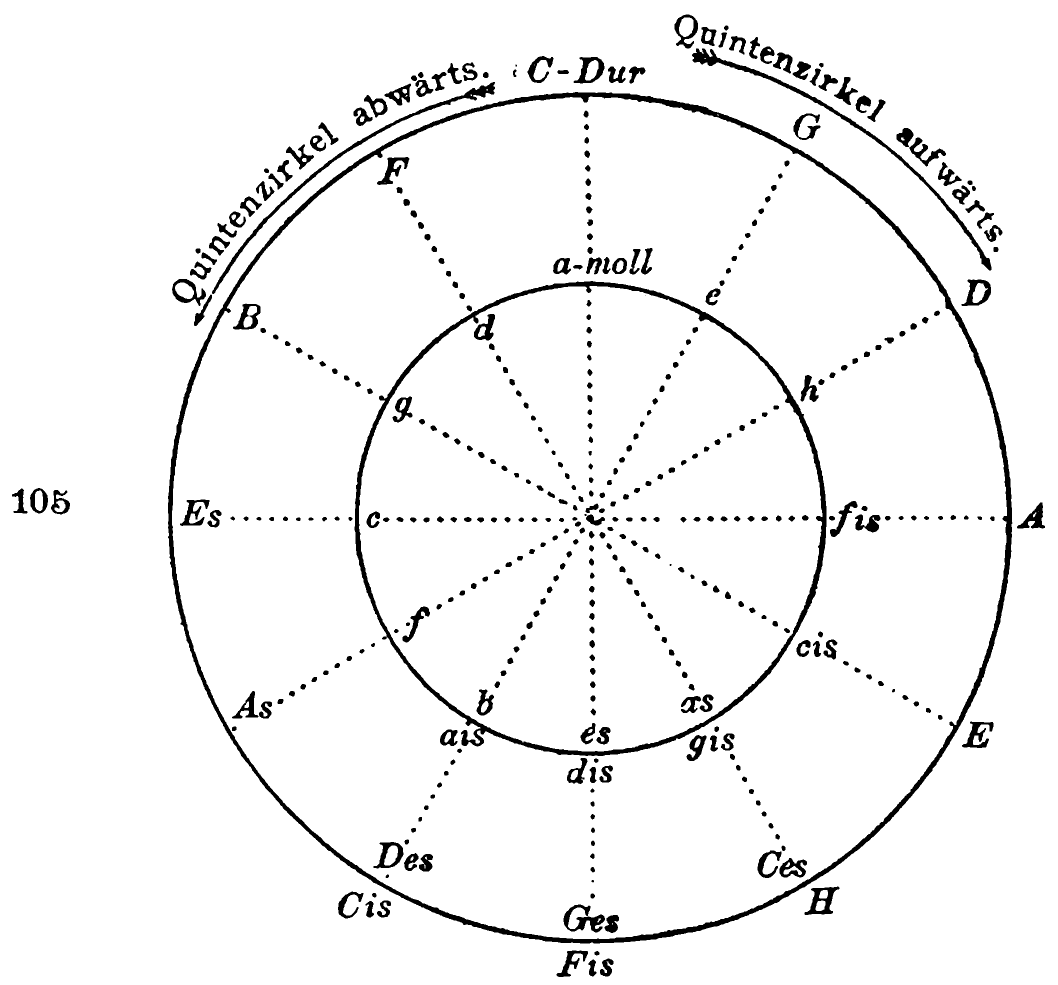
It could be seen from our circle of fifths, for example, that B major and A-flat major lie nine fifths apart, namely when one starts from A-flat major (or from B major in the opposite direction, descending in the circle of fifths), but only three fifths when one goes from B major clockwise or from A-flat major descending in the circle of fifths. In general one will let the shorter distance decide the choice of modulatory means; often enough, however, one will choose the apparently longer way, which, as will be shown, is often the nearer one. This becomes easier to imagine if one remembers that, as mentioned, the keys of the third circle of fifths are more closely related than those of the second. One will be able to derive from the circle of fifths that F minor and F major lie three fifths apart, F minor and D minor likewise only three fifths, but F minor and D major six fifths.
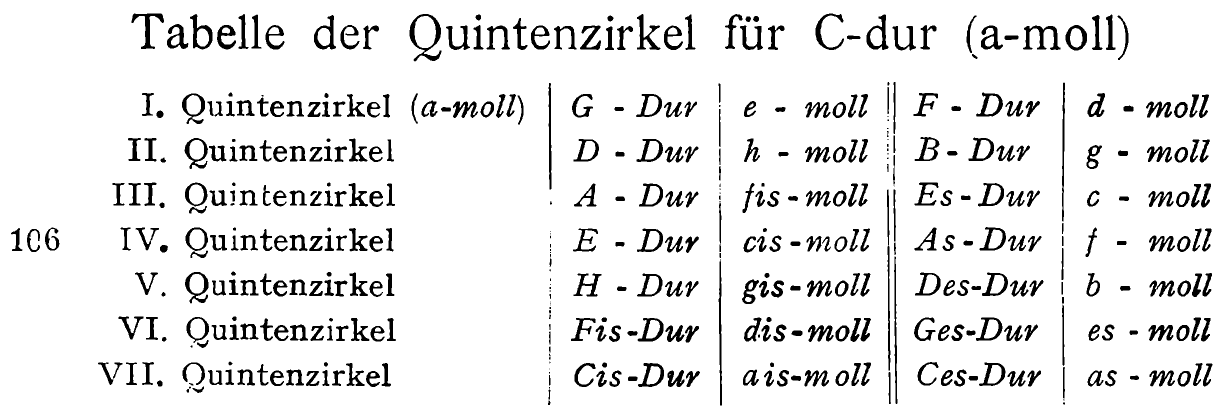
Example 106 gives a table of the circles of fifths for C major and A minor. The pupil should transfer these relationships to the other keys.
Since the keys of the first circle of fifths, as we have recognized, actually coincide with the closest relationship, we deal with them first and choose as our first example the modulation from C major to G major. (As before, I shall always give the examples starting from C major, since this makes it easier to survey what has been learned. The pupil must of course practise all the other keys besides C major, which causes no difficulty if one always does it in good time. But if one neglected it, one would stand insecure before the keys that had remained unfamiliar.)
The chords that firmly define C major are those containing f and b: namely degrees IV, II and VII (for f), and degrees V, III and VII (for b). It is clear that the chords containing b will not hinder us in our intention of reaching G major, but that those in which f occurs would not serve this purpose. So if degrees III and V can be regarded as neutral, degrees II, IV and VII must on the other hand be left out. But besides V and III, still other degrees are neutral with respect to G major: I and VI. This can be put another way. One can say: because of the similarity of their series, C major and G major have a number of chords in common. If one of these chords is set up by itself, detached from its surroundings, it cannot be determined whether it belongs here or there. It can belong just as well to C major as to G major. Where it is to be counted depends on what precedes and what follows. A triad c–e–g can be degree I in C major or IV in G major. It depends on the chords that follow whether it becomes the one or the other. If f–a–c follows, then it is certainly not G major, probably C major, but perhaps also A minor, F major or D minor. But if d–f♯–a (degree V) or f♯–a–c (degree VII of G major) follows, then it will presumably be G major or E minor, or at least can become so.
These two ways of putting it characterize the first two principal means of our modulation. The one: the use of such neutral chords as mediate between starting point and goal; the other: the reinterpretation of chords common to both keys. Mostly both work at the same time; thus one creates the possibility of reinterpretation by bringing in neutral chords, or at least by avoiding those others that are decisive for the starting key. And conversely: the neutral chords are forced by reinterpretation to turn. Whether one reinterprets or uses neutral chords, one always arrives sooner or later at the point where the turn to the target key must be brought about by an energetic means. What this means can be is clear from the outset if one thinks of the cadence: in the first place degree V. Then, more generally: all those chords that contain the leading tone of the target key, hence often degrees III and VII as well. Naturally degree V is the most favoured. But the other two are also suited to bringing about a modulation, especially degree VII. To make the appearance of the target key clear and definitive, one adds a cadence to the whole. The length of the cadence depends, naturally, on the length and difficulty of the modulation. If the modulation was simple, a short cadence suffices. If it required richer means, the cadence too can hardly be short. Sometimes, however, it may happen that a short cadence suffices for a long modulation which, precisely through its thoroughness, has been very convincing; and conversely, a somewhat too terse version of the modulation sometimes requires a stronger confirmation of the goal by a longer cadence.
To survey the means of modulation it will be good to proceed systematically, beginning with the shortest and simplest forms and letting more complicated ones follow.
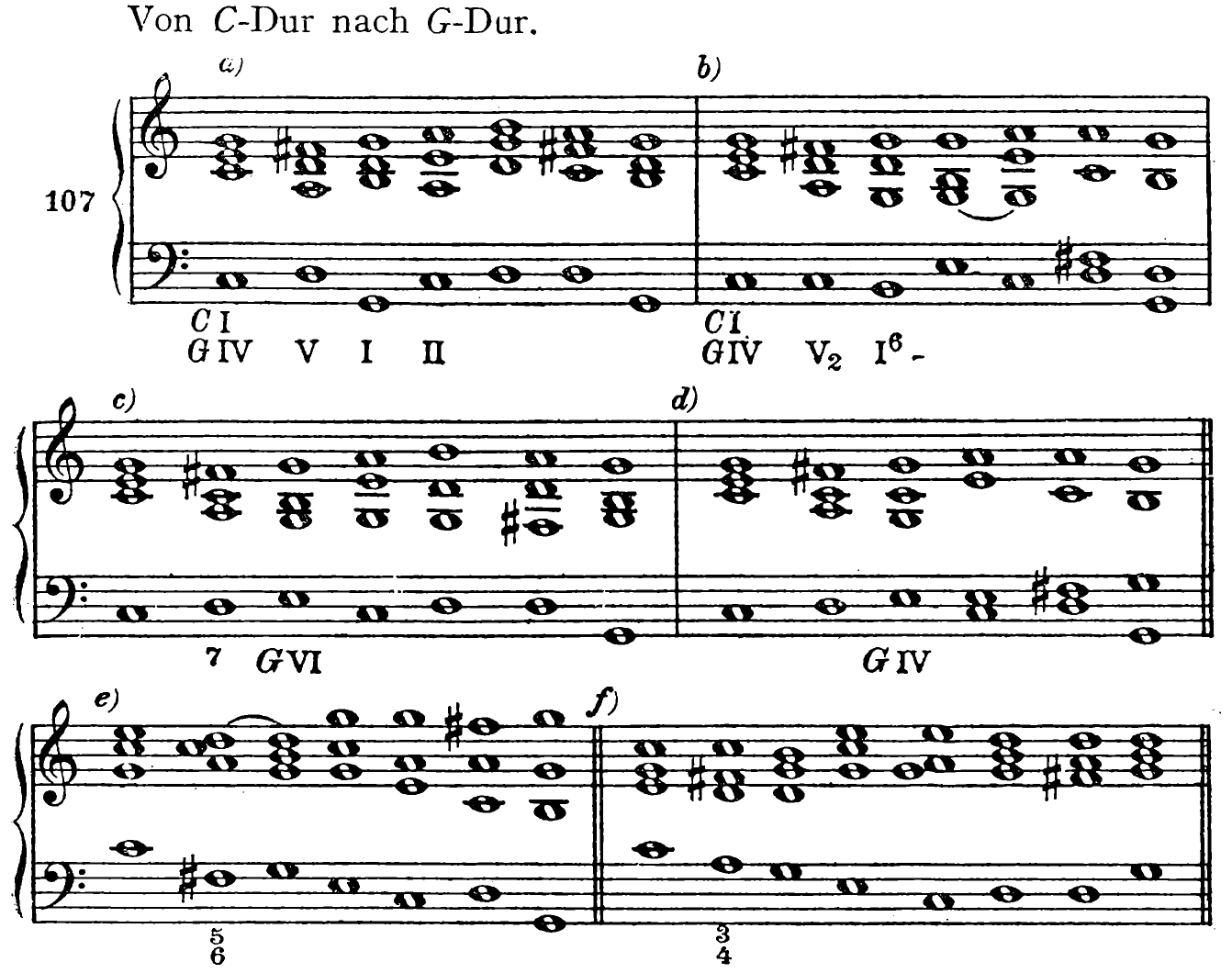
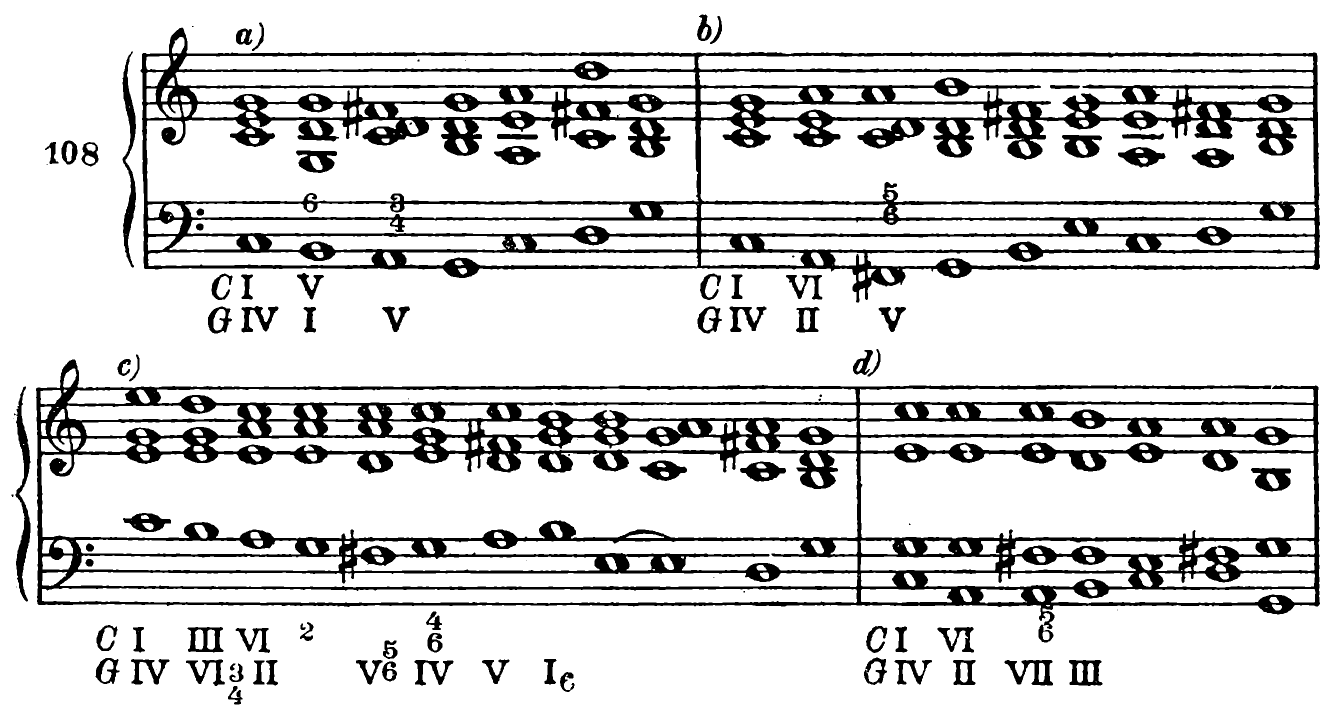
The key of C is assumed to be established. Degree I of C major is (a neutral chord) degree IV of G major. The reinterpretation can begin right here. So chords from G major can follow, both indifferent and decisive ones. To be brief for the time being, the decisive one at once, that is, degree V of G major: the modulating chord. The simplest thing is for degree I of the target key to follow it at once, whereby the modulation is complete except for the cadence (107a). This cadence can be short, because the modulation was short and clear. If one wishes to avoid the drawback arising from the twofold repetition of degree I of G major, then after degree V of G major one will bring either the sixth chord of degree I of G major or a deceptive cadence (107b, c, d), or V as an inversion (⁵₆, ³₄ or 2), by which it is sufficiently distinguished from the cadential V.
Mediating chords can be placed between the starting chord and the modulating chord. The neutral ones: III, V, VI of C major (that is, VI, I, II of G major).
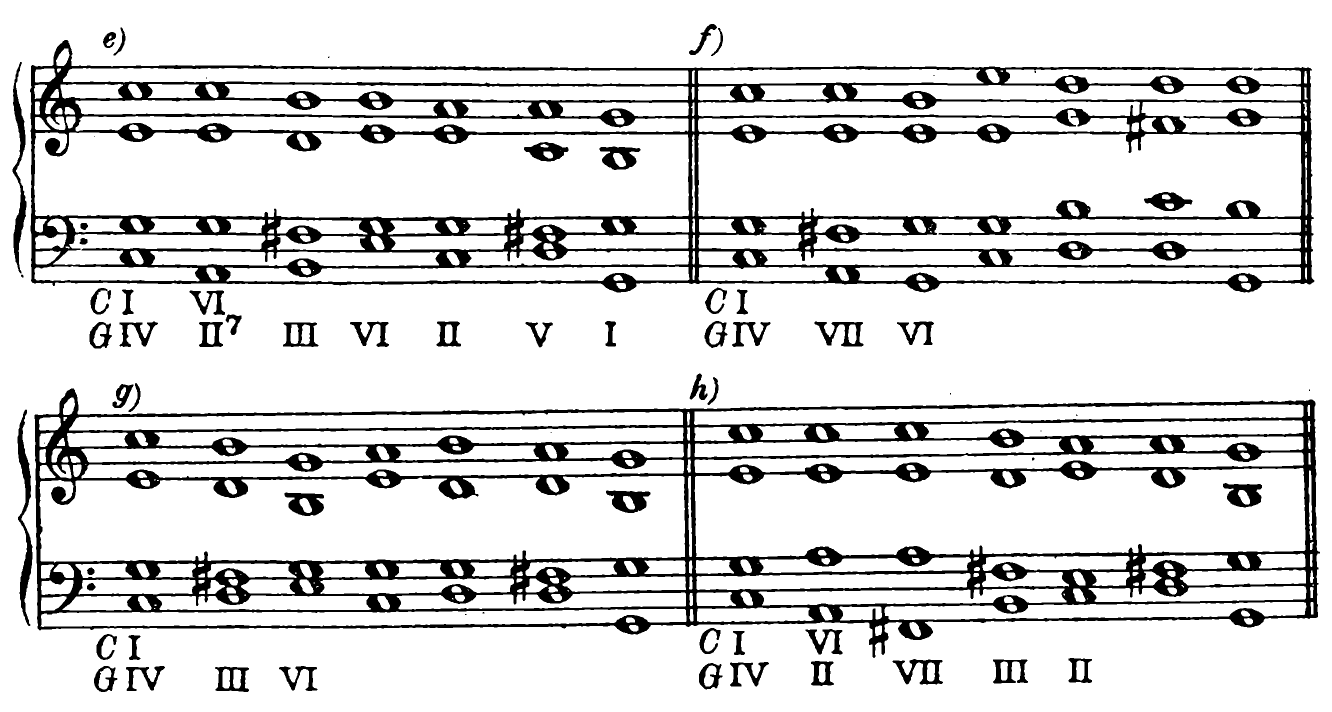
Example 108a brings degree I of G major as the neutral chord, as a sixth chord for the sake of the bass melody and to avoid repetition, and the modulating chord (degree V) as a ³₄ chord*). 108b, after VI of C (II of G), brings V of G as a ⁵₆ chord. The cadence is worked out somewhat more richly, in order to blur the repetition of degree I. 108c brings III of C (VI of G) with a passing seventh (doubled third!) to introduce VI of C (II of G), then likewise goes with a passing seventh (2 chord) into the ⁵₆ chord of V, afterwards makes a deceptive cadence by means of a passing ⁴₆ chord, which leads to a repetition of V of G and flows into the sixth chord of I. Such a repetition of the modulating chord (I call this: passing through the chord once more) often works very well. Here we hardly need this device yet, but later (since repetition is reinforcement) we shall use it to help out where the modulation was not strong and unambiguous enough. In 108d the seventh chord of VI of C, or II of G, was led into the ⁵₆ chord of VII of G. This serves here as the means of modulation, and the III of G following it can, since g occurs in the example only at the close, be regarded as a substitute for degree I, from which the cadence begins. This case is noteworthy because it shows us that the modulation need not necessarily go to degree I, but that the cadence can begin on a degree that is characteristic in the same sense, that is, perhaps III or VI, possibly also IV or II. Fundamentally this is not much different from 107c, where a deceptive cadence took place after the modulating chord. Only, the modulating chord in 107c was V, and here it is degree VII. In 108e, III of G was used as the modulating chord. Here too I was left out and VI takes its place. In examples 108f, g, h, VII and III likewise brought about the decision. Here too the deceptive cadence is highly recommended, since it veils the intention without making it unclear. Of course still other neutral chords, and in other (but good) successions, can be inserted in between. Here the pupil has ample opportunity to practise combining.
*) G: IV–I–V: these are descending root progressions. But the I lying between IV and V has an effect similar to that which the ⁴₆ chord of degree I otherwise has. One immediately feels the transitory character of this chord, and that it is there only to bring about degree V. Once one has perceived this and leaves out degree I (here merely passing, that is, melodic), what remains is IV–(I)–V–I: ascending progressions.
Strictly speaking, one ought to prefer modulations which, like these, are able to avoid the repetitions of degrees I and V. But since there are enough means of combating what is disturbing in such repetitions, and the repetitions in themselves are not very bad either, there is no sense in making evaluative distinctions here. After all, they state twice what is meant to stand out: degree I.
With the same means, the modulation to A minor and E minor is accomplished just as simply.
A minor (109). The means of modulation here is in the first place degree V. But II and VII can also be drawn on. It will be simplest to regard the first chord (I of C) as III of A minor. Here, if one wants to make the modulation really smooth, it is advisable to observe also the turning-point laws concerning the unraised sixth and seventh tones*). So g and f, treated as the third and fourth turning points, must be removed by being resolved downward, before tones of the ascending scale can appear. Later we shall be less sensitive in this respect and will calmly write an f♯ even after a g (once the means opened up in the chapter “Secondary Dominants, etc.” are available).
*) On this occasion I must forestall a misunderstanding: the modulating chord should never arise chromatically here, for instance by leading the g of I of C to g♯. That really goes without saying. First, we had not yet spoken of chromatic alterations; second, we said expressly that neutral chords should come before the modulating chord. Now in A minor, of course, chords containing g are not neutral chords. One must remember that the minor key consists of two series: the ascending and the descending. Here, naturally, the ascending one is to be used, since we are dealing with a cadential, a closing effect; and the descending one does not contain the neutral chords, or at most those of more remote neutrality: those in which, obeying the turning points, the seventh (or sixth) tone must first be removed in order to permit the appearance of the raised tones. Certainly they are relatively neutral in this sense, but still less so than those that do not present this obstacle. And only in this sense is the citation, further below, of V of C as relatively neutral for E minor to be understood.
The II of the minor key renders good service in modulating to minor keys, especially as a seventh chord (or ⁵₆, ³₄, 2 chord). On the one hand it gives the opportunity to lead the sixth tone (the diminished fifth) into the fifth. On the other hand V likes to follow it (II–V); but even when it makes a deceptive cadence (II–I, or II–III into the augmented III), it has a very characteristic effect.
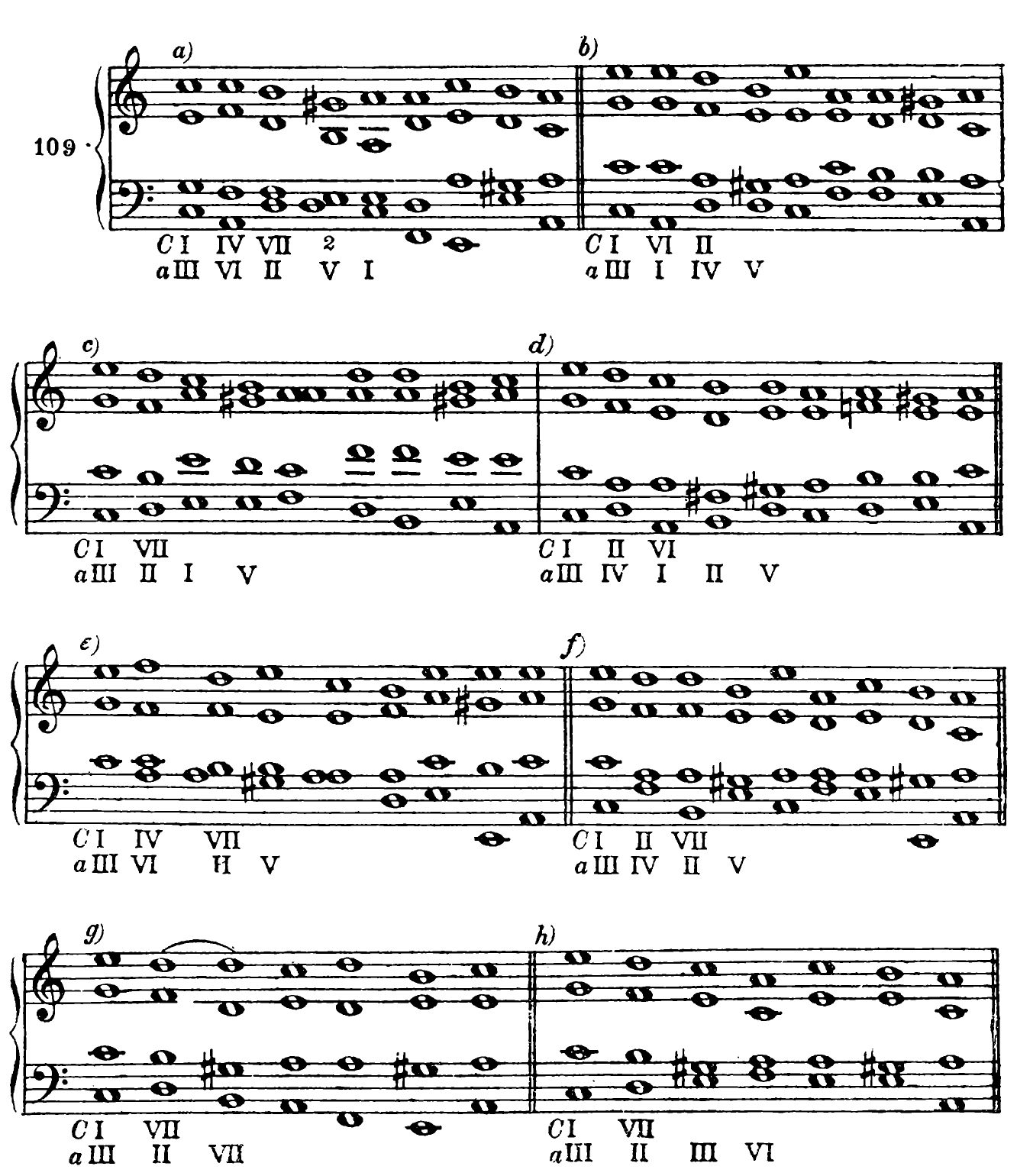
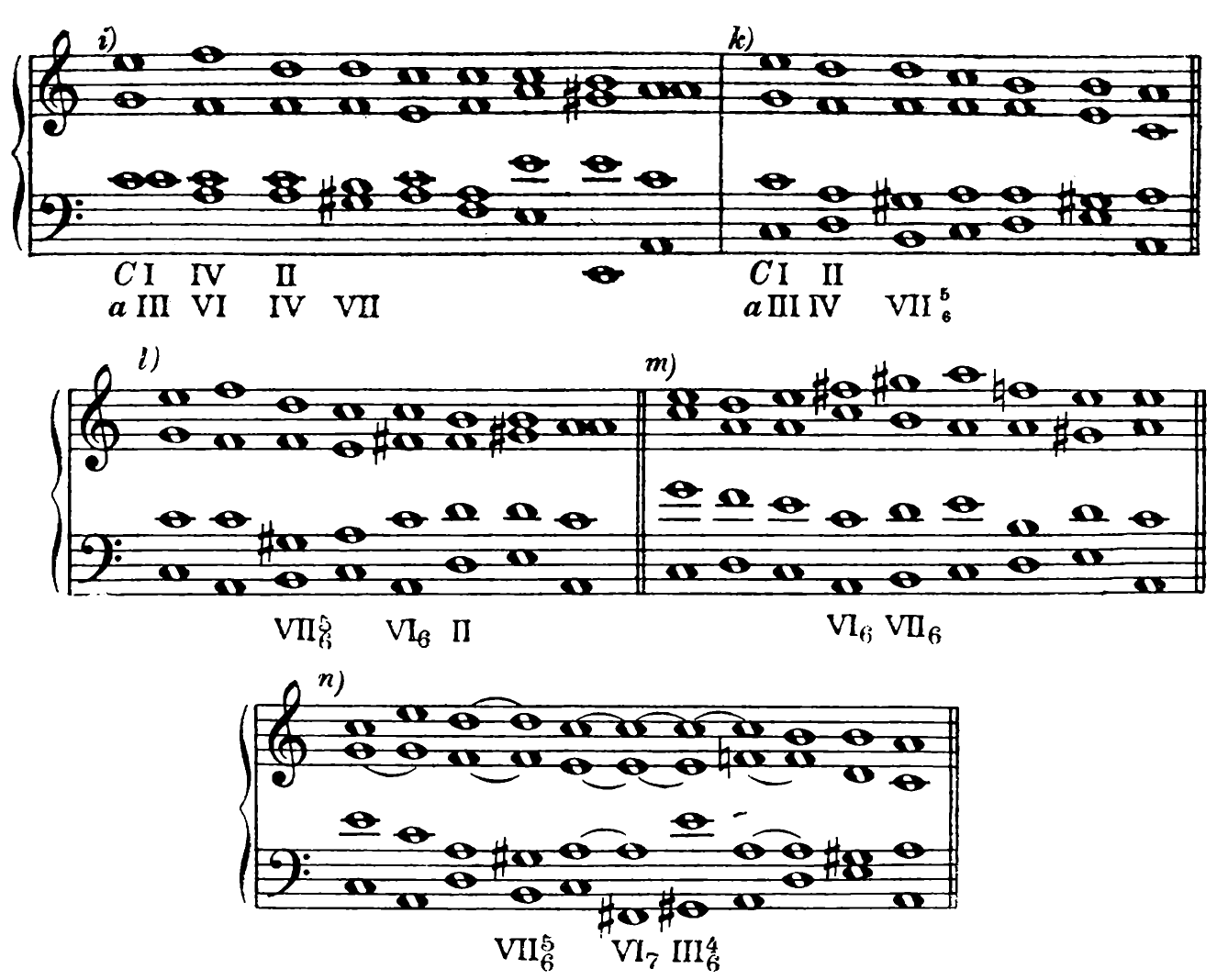
A great deal of variety is obtained by using the raised III (augmented triad), VI (triad and seventh chord) and VII (diminished triad and diminished seventh chord). The removal of the seventh (and sixth) tone, however, requires great attention.
E minor (110). Neutral chords are I, III, VI, and possibly also V of C. The means of modulation are again V, II and VII. Especially effective here too, as in A minor, is degree II of E minor, which can be taken immediately after I of C (110d). It need not necessarily be followed by V; I or III may also come, whereby repetition is avoided. The forms of the raised II, III, VI and VII already used for A minor in part connect better here. But the raised IV is also usable.
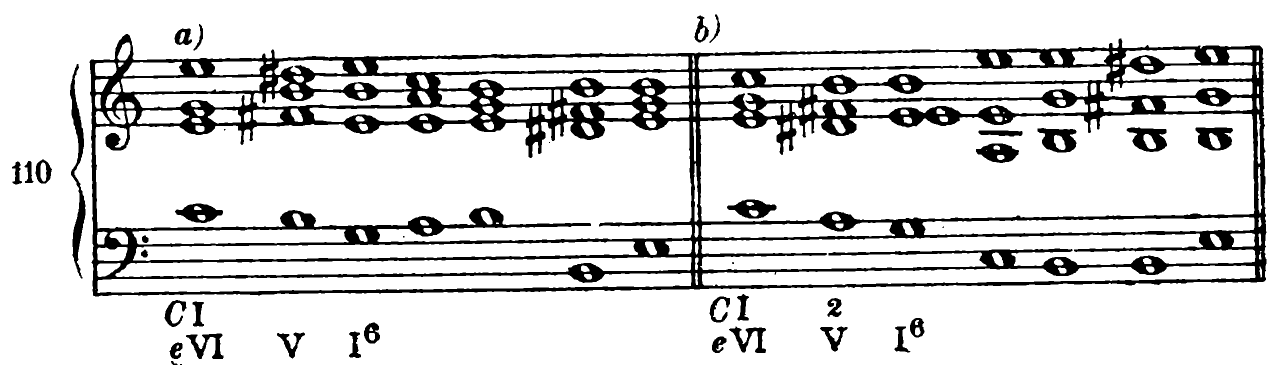
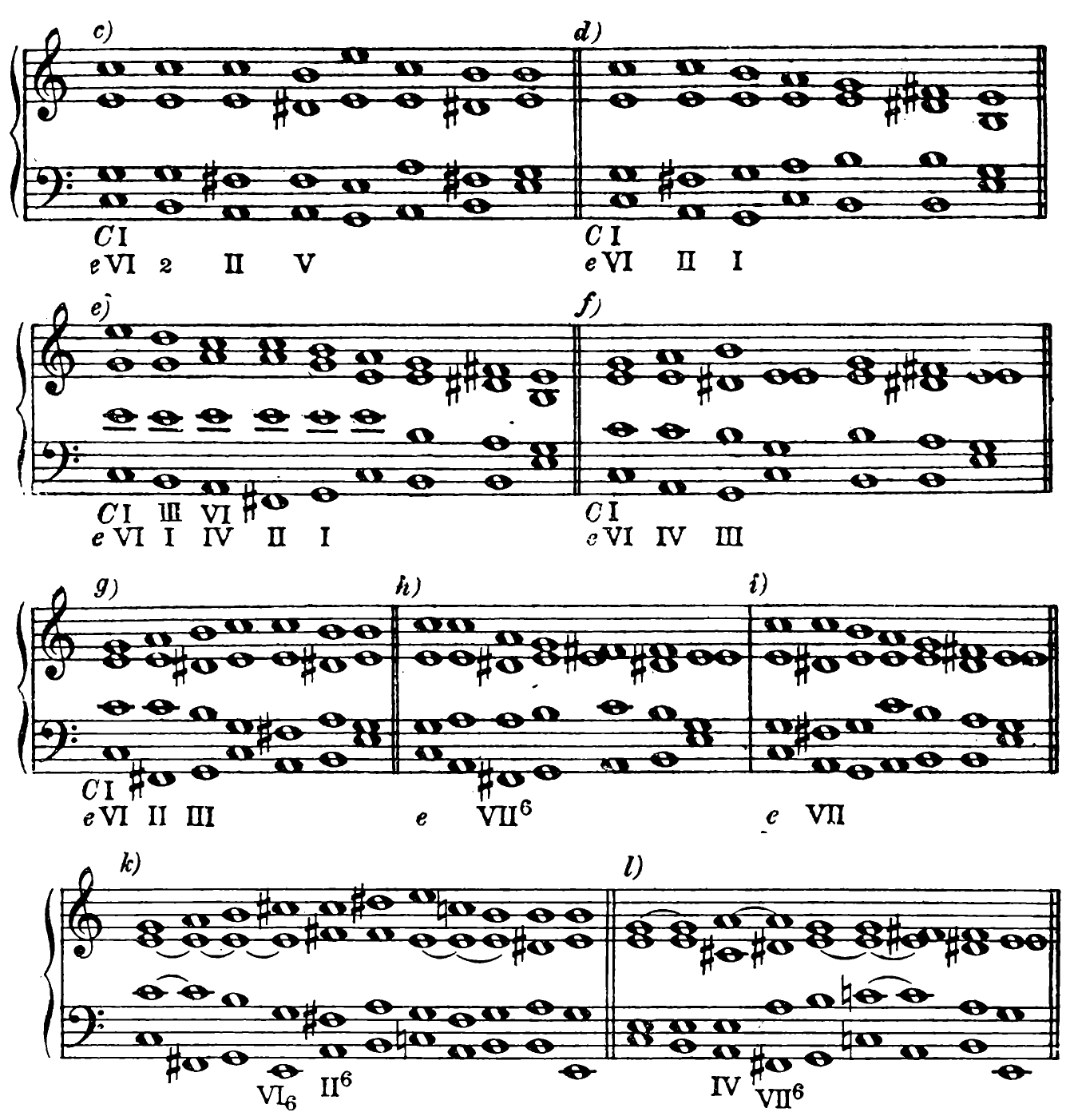
As in all these modulations, a deceptive cadence should often be used after degree V. As before, in sketching the little exercises the pupil will always first write down the degree numerals and then determine the positions and inversions. Beneath the degree numerals of the first chords, which still refer to the starting key, those corresponding to the reinterpretation in the target key are noted in a second line. From the modulating chord onward the numbers refer only to the target key. In doing so, however, the pupil should account with the utmost precision for the root progressions and not depart from our instructions on this point; otherwise he might write much that is unusual, and neglect to make all the means familiar to himself through practice. Nevertheless, both in sketching and in some decisions, he may let his feeling for form and his taste have a say. But only for checking and correcting — not in order to improvise.
As can be seen, I treat the chapter on modulation in great detail. In most harmony textbooks this is not done, or at any rate not as it ought to be done. Nothing is accomplished by teaching the pupil how to avoid fifths, octaves and cross-relations and how to realize figured basses. But just as little by showing him in how many keys the diminished seventh chord can be resolved. And not much more by discussing, in the same way, still other altered chords, however highly or lowly altered. Nor with those well-known harmonic analyses in which numbers and letters, lacking any deeper sense, are written beneath an example from the literature. That is why they are so confusing. And never was the lack of culture in modulation greater than today, since these analyses have been “enlightening” the pupil about how one simply sets side by side C♭ B V–IV! a: V – C: V – (IV!) b♭: V – a: IV V – I b♭: V – a: IV V – A: I. There remains the hope that the pupil does not understand this secret script. After all, I do not understand it either. But unfortunately: it is precisely this nonsense that they do understand. It is precisely from this that they learn; precisely this “simply” (“ohne weiteres”) suits them. And no one tells them that there is no such thing as this “simply”. That in art everything is “with more to it” (“mit weiterem”).
When a piece prepares to modulate, this is the consequence of a series not only of harmonic but also of melodic-rhythmic events. There is no room in a harmony textbook to consider the latter. Very well! But then at least the former, the harmonic ones. And there it is surely ridiculous merely to show: “the diminished seventh chord can also …” or “the augmented ⁵₆ chord is derived in such and such a way” or “these eight bars modulate from C-flat via a minor and C to b-flat minor …” and so on. The analysis ought rather to show why (please: why!) a piece turns in that direction. And since the method of the harmony textbook is synthetic, the instructions for using the means of modulation must start from the “therefore”!
A modulation comes about like this: first the fundamental is stated. Then come its nearest relatives, its nearest consequences; these lead away from it, but are bound to it by relationship. By natural and by artificial relationship. If the piece now goes further, the more remote consequences come. The bond is looser. But if the whole is to become a unity, then this bond must finally grow tighter again, and that is possible only if the consequences really let themselves be recognized as the consequences of the initial event. That would be a fine kinship indeed, if the grandson did not still show features of the grandfather! Of course, a changeling like the diminished seventh chord turns up “just like that”. But it has nothing to do with the grandfather.
People will be surprised to hear these “old-fashioned views” in a textbook whose purpose is presumed to be the explanation of the newest harmonies. But these views are not fashionable; they are old. And therein lies their value. In them lies that which will perhaps be eternal, or at least of such long duration that we may safely say eternal. This eternal element, however, will not be the laws. Not that one must modulate gradually because it is better understood that way. Not that one must bind the consequences through the relationships. Not that our intellect demands logical presentation. Perhaps not even what is general in these laws. But in any case this circumstance: that the work of art will always be a mirror image of our way of thinking, of our capacity for comprehension, of our sensations and feelings. That, therefore, when we analyse, we must always look for these in it, and not, say, that one “can also still [use] the diminished seventh chord . . .”
An example: when Brahms, in his Third Symphony (F major), brings the second subject in A major, this does not happen because one “can bring” the second subject in the upper mediant as well. Rather, it is the consequence of a principal motive: the bass melody (a chord connection!) F–A♭ (third and fourth bars); its many repetitions, derivations and variations finally compel, as a provisional climax, the expansion of the step F–A♭ into the step F–A (F the initial key, A the key of the second subject), so that the basic motive is stated by the initial key and the key of the second subject. That is a psychological explanation. But here a psychological explanation is, after all, a musical one. And every musical explanation must at the same time be psychological. It goes without saying that in this sense it is also a natural one. Natural according to the nature of man. Our way of thinking is in it; our logic, which alongside regularity not only permits variety but downright relentlessly demands it, and cannot imagine that there are causes without effects. A logic which therefore wants to see an effect from every cause, and places the causes in its works of art in such a way that the effects visibly proceed from them.
Unfortunately I too cannot go into everything that happens in every modulation in such detail. But I do believe that, by trying not merely to describe the individual means but also to weigh them, I achieve in this respect something different from what is otherwise considered sufficient. And then also: by gathering together as many forms as possible of the effects of the same cause, I place a rich material at the disposal of observation. Synthesis, even if it takes place only by way of combination, must thereby certainly yield a better result than where individual features are mentioned without system, or according to a false system, with no regard for the essential characteristics.
There is, for instance, a very popular harmony book in which the modulations are made almost exclusively with the dominant seventh chord or the diminished seventh chord. And the author shows only that after every major or minor triad one can bring, directly or indirectly, one of these chords, and can thereby go into any key. If I wanted that, I could be finished even sooner; for I am in a position to show (with “certified” examples from the literature!) that after any triad one can bring any triad. If that really is then any key, and a modulation has thereby been accomplished, this procedure would be simpler still. But when someone makes a journey in order to have something to tell, he surely does not choose the straight line as the crow flies! The shortest way is here the worst. The bird’s-eye view from which events are seen is a bird-brain’s-eye view. When everything blurs, anything can be anything. Differences cease. And then, to be sure, it makes no difference whether I have made a bad modulation with the dominant or with the diminished seventh chord. For what is essential in a modulation is not the goal but the way.
Ways that we must travel daily should be well-kept roads which, taking into account everything that comes into consideration, fulfil their purpose: to connect places with one another, and in doing so to be as comfortable as the means at hand permit. Only he makes things uncomfortable for himself who cannot make them comfortable, or who, out of a feeling of strength, finds pleasure in mastering the uncomfortable. But that is pleasure in the mastering, not pleasure in the discomfort. A way on which one must leap over ditches, climb walls and pass by sheer precipices does indeed also lead to a goal: for the practised, for the mountaineer, for him who is adequately equipped. But not for the inexperienced, the unpractised.
And of course: one reaches the street faster by jumping down from the fourth floor than by going down the stairs—but in what state! So it is not a matter of the short way but of the expedient way. And only that way can be expedient which carefully weighs the possibilities of connection between starting point and goal and then chooses wisely. These modulations with a universal means such as the diminished seventh chord are the leap out of the window. Of course both are possible. And why, then, should one not jump? Especially if one can jump. Yes: but one would first have to be able to jump! And then: it is not important to me that the pupil can jump. It is not important to me to put into his hand a universal means of composing. A “guide” to composing without inspiration, without vocation. But it is important to me that he should recognize the essence of art, even if he learns “only” for pleasure. Why should one not, for once, find pleasure in the good and the true as well?
These means of modulation, as most textbooks present and arrange them, do not aim at the correct solution of a harmonic problem. Rather, they merely want to equip the pupil with that barest minimum of knowledge which qualifies him to pass an examination. But that, after all, is not enough for me. I should like to set my goal somewhat higher! That is why the way matters so much to me. And that is also why I have so much time, so that I can look around calmly along the way.
The modulation into the first circle of fifths downward (from C major, A minor to F major, D minor) is, strange as it may sound, somewhat more difficult. This may come from the fact that the pull toward the subdominant, which, as I have often mentioned, every tone, every chord seems to have, is almost stronger than the means we want to apply in order to arrive artificially where that pull leads naturally of its own accord. I mean: it is harder here to do anything to bring it about, because it happens almost by itself, without one's doing anything to bring it about. The fundamental itself, its inclination to be absorbed into a subdominant, is indeed already a means of modulating into the subdominant. This degree I (of C major) is indeed already the V (of F major) with which one wants to modulate. If, then, the passage into the subdominant happens almost by itself, the person who wants to bring about this modulation has the feeling of having done something only to a lesser degree. It will therefore be necessary later to shape this modulation more artfully, since one also wants to feel that one has done something, since one does not want to fall down but to step down. For the present, therefore, these modulations look simpler, but they are naturally not bad on that account.
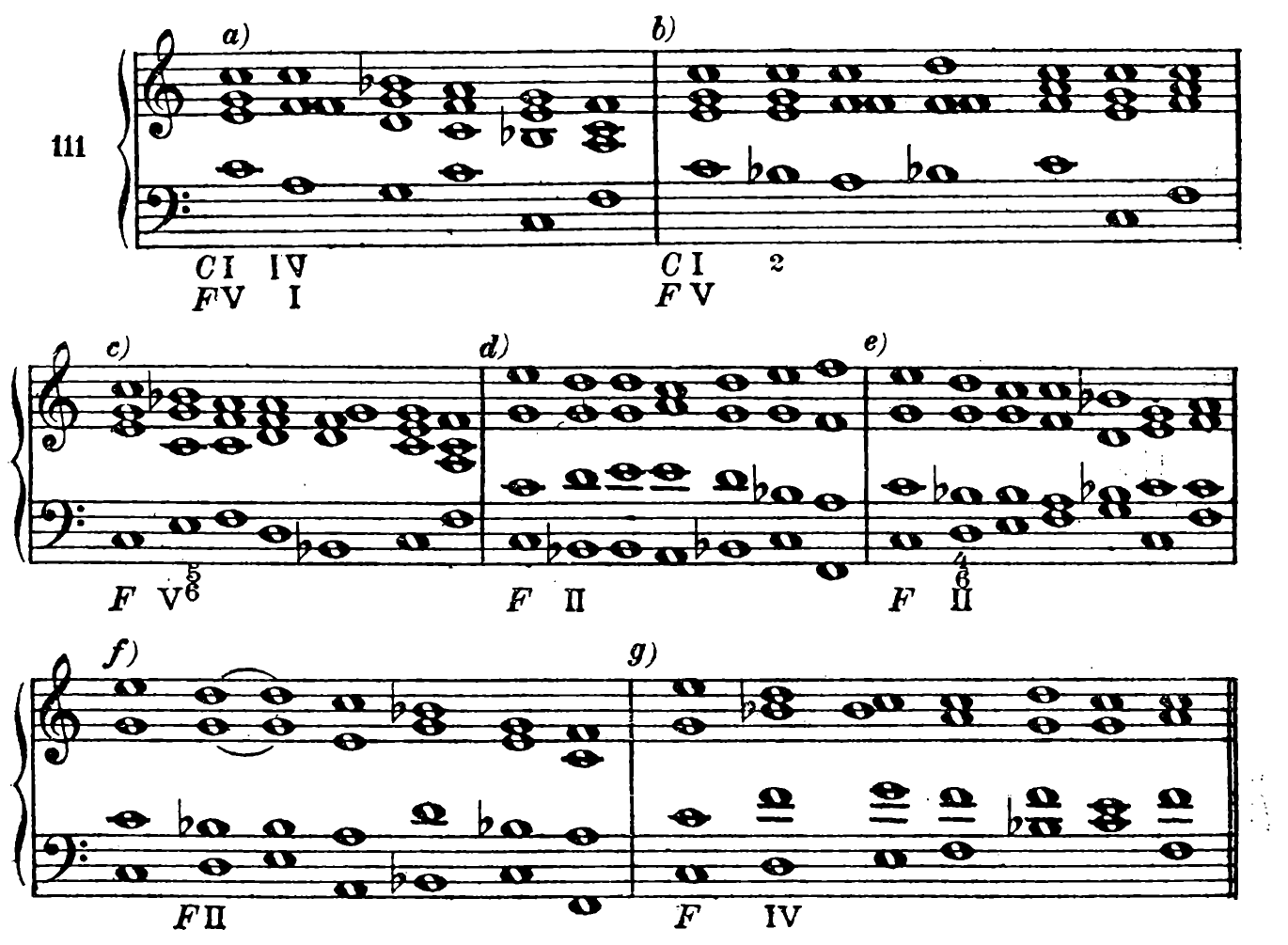
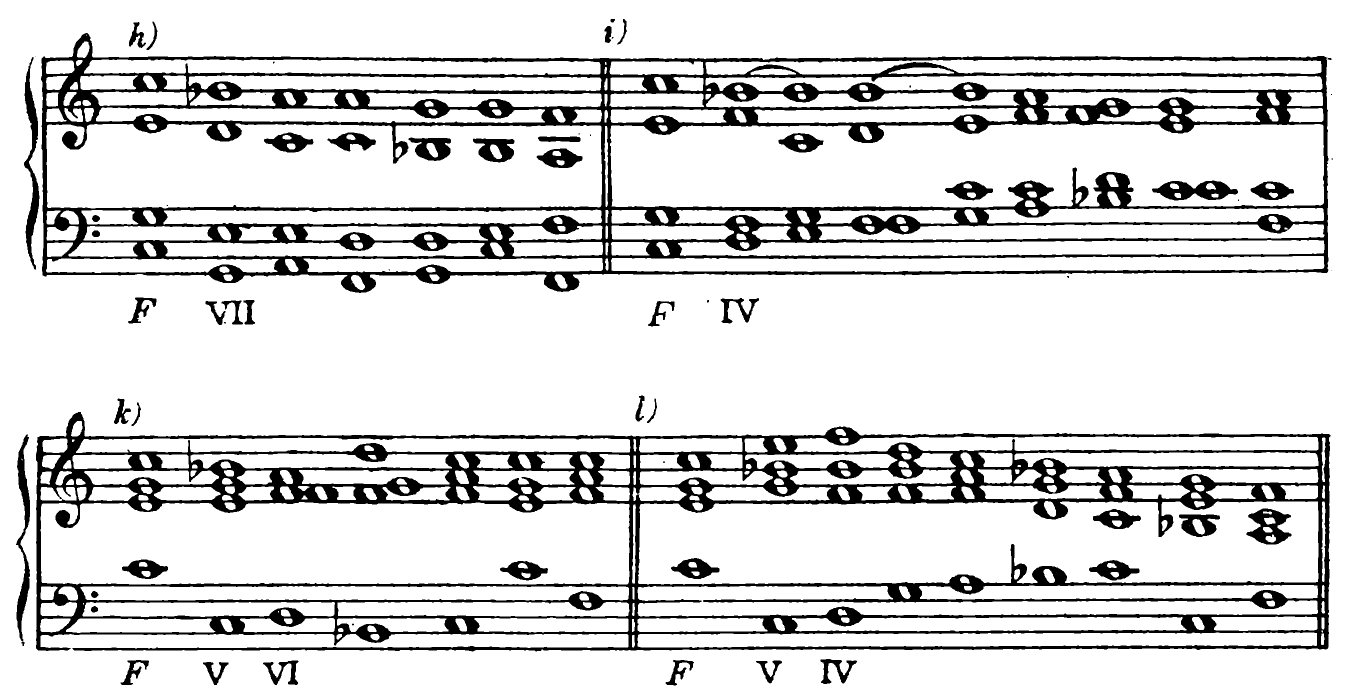
After I of C (which is V of F), I of F can be brought at once. Since that is not very compelling, it is advisable to insert the seventh chord on V of F (111 b). In root position or in an inversion. If one wants to use a chord other than the dominant seventh chord (which, after all, introduces the b-flat), then degrees II, IV and VII of F major come into consideration. These degrees make the modulation somewhat more varied, if only because I and V can often be bypassed and other chords can become their substitutes. Here, too, deceptive cadences should not be forgotten.
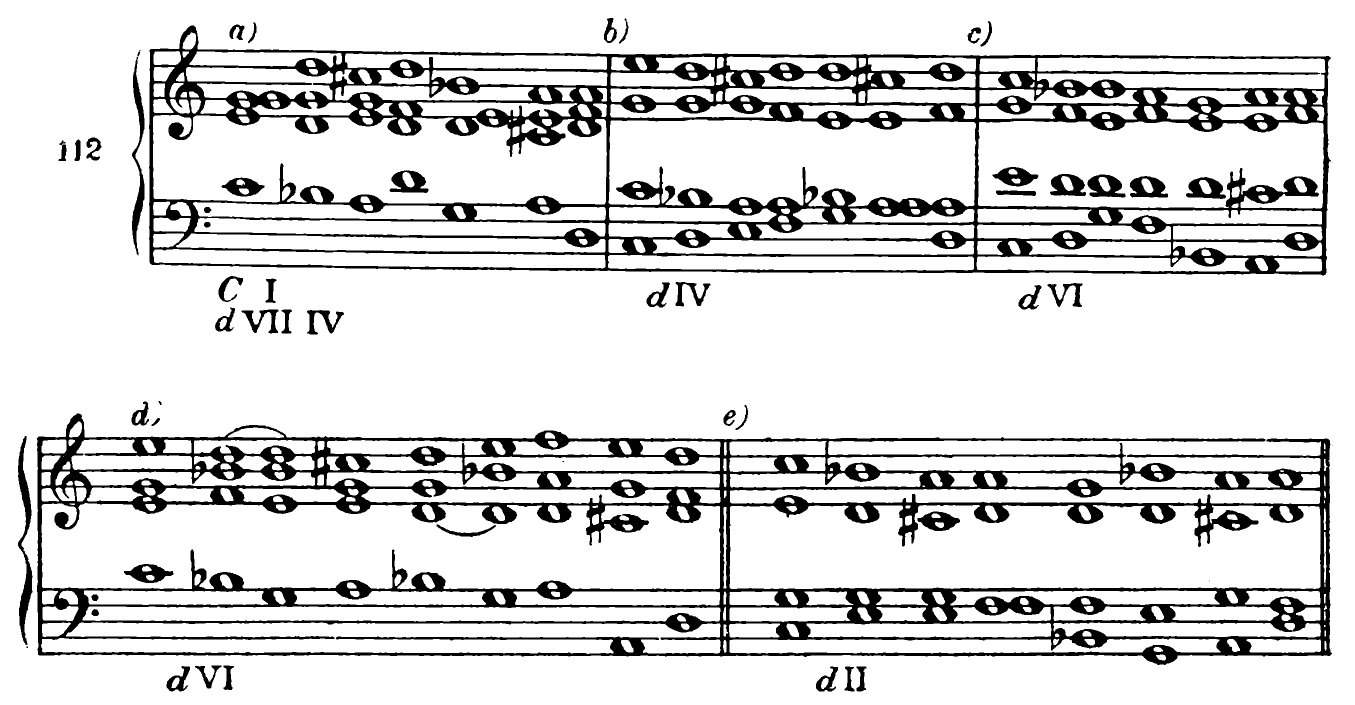
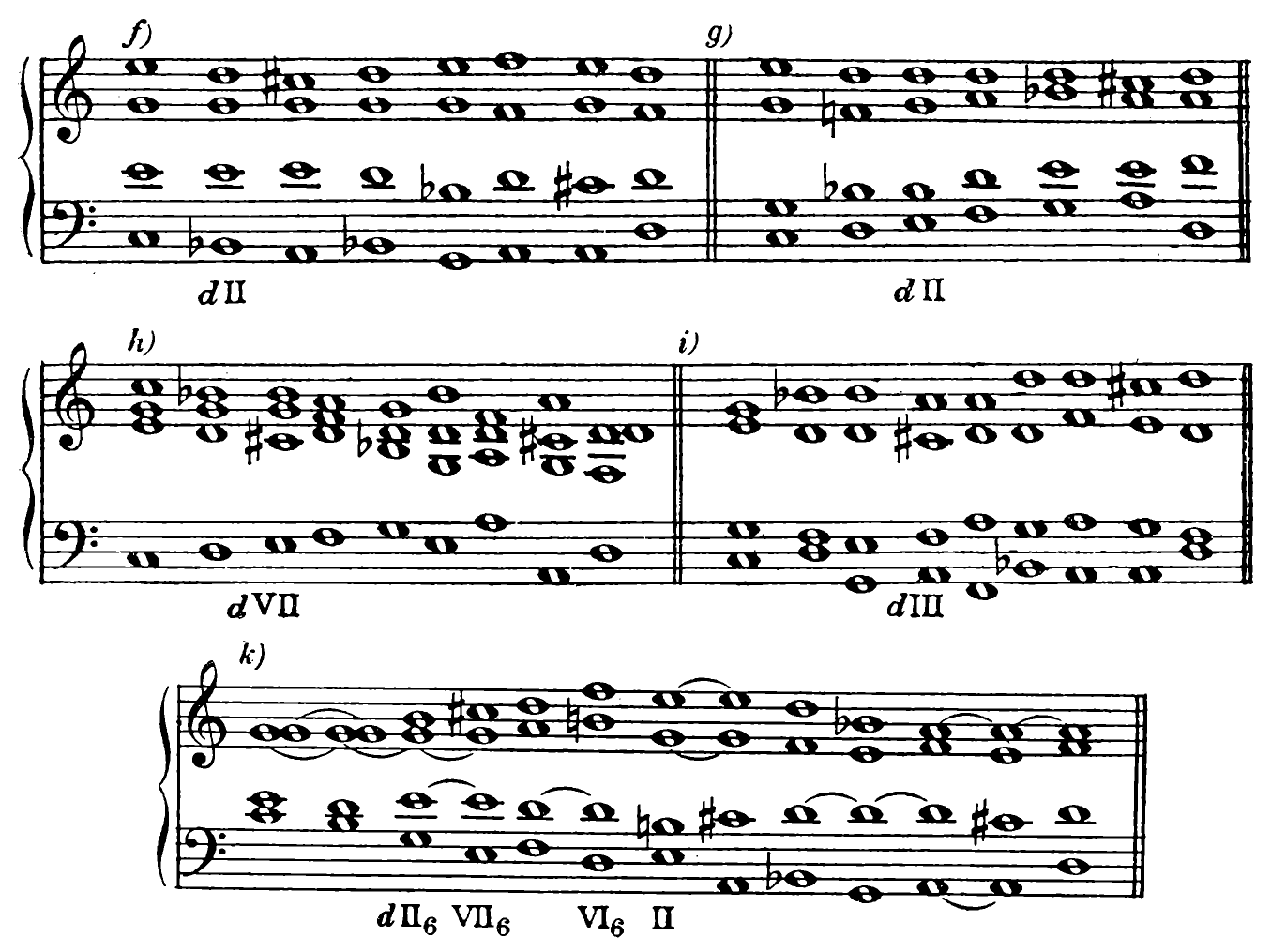
In the modulation from C major to D minor it will first be necessary to remove the c, the turning point, before chords with c-sharp can be brought in. Suitable for this are IV, II and VI of D minor. These are, after all, already modulating chords, and the cadence could begin immediately after them. But if one wants to bring in V, III or VII, then, once one or more such chords have prepared their entry, the procedure is otherwise exactly the same as in the earlier modulations. Since the c of the bass, as the third turning point, must first be eliminated before raised seventh tones appear, some of the examples are not admissible (thus 112 b, e, h), while others, in which the c-sharp comes only at the end, can at any rate be tolerated. The use of the raised degrees also causes difficulties, and to show these can only be the real purpose of the examples. Doubling the 5 (112 a) or the 3 (112 f) in place of the 8 is to be recommended.
Now the modulations of the first circle of fifths starting from A minor as well: A minor to C major, to G major and E minor, to F major and D minor. A minor is a C major that begins on a. The a can therefore be regarded at once as degree VI of C, and the modulation then made in the same way as before.
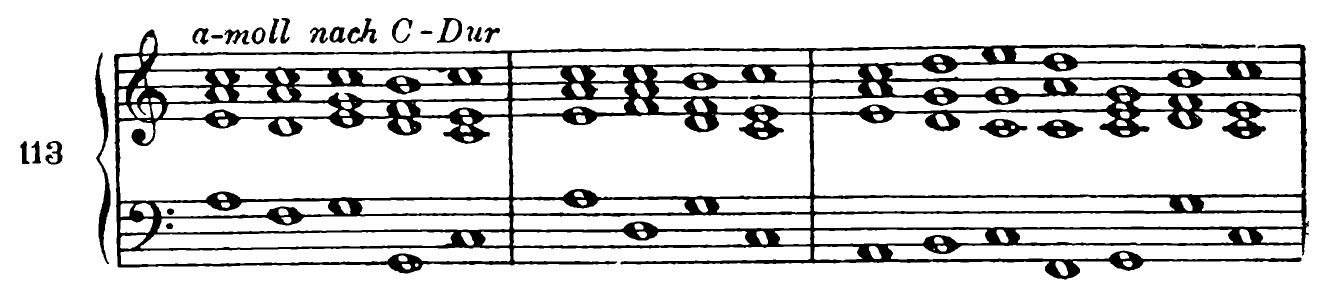
The modulation from A minor to C major is hardly anything essentially different from a cadence in C major that begins on degree VI of C major. It would be difficult to apply any special means of modulation.
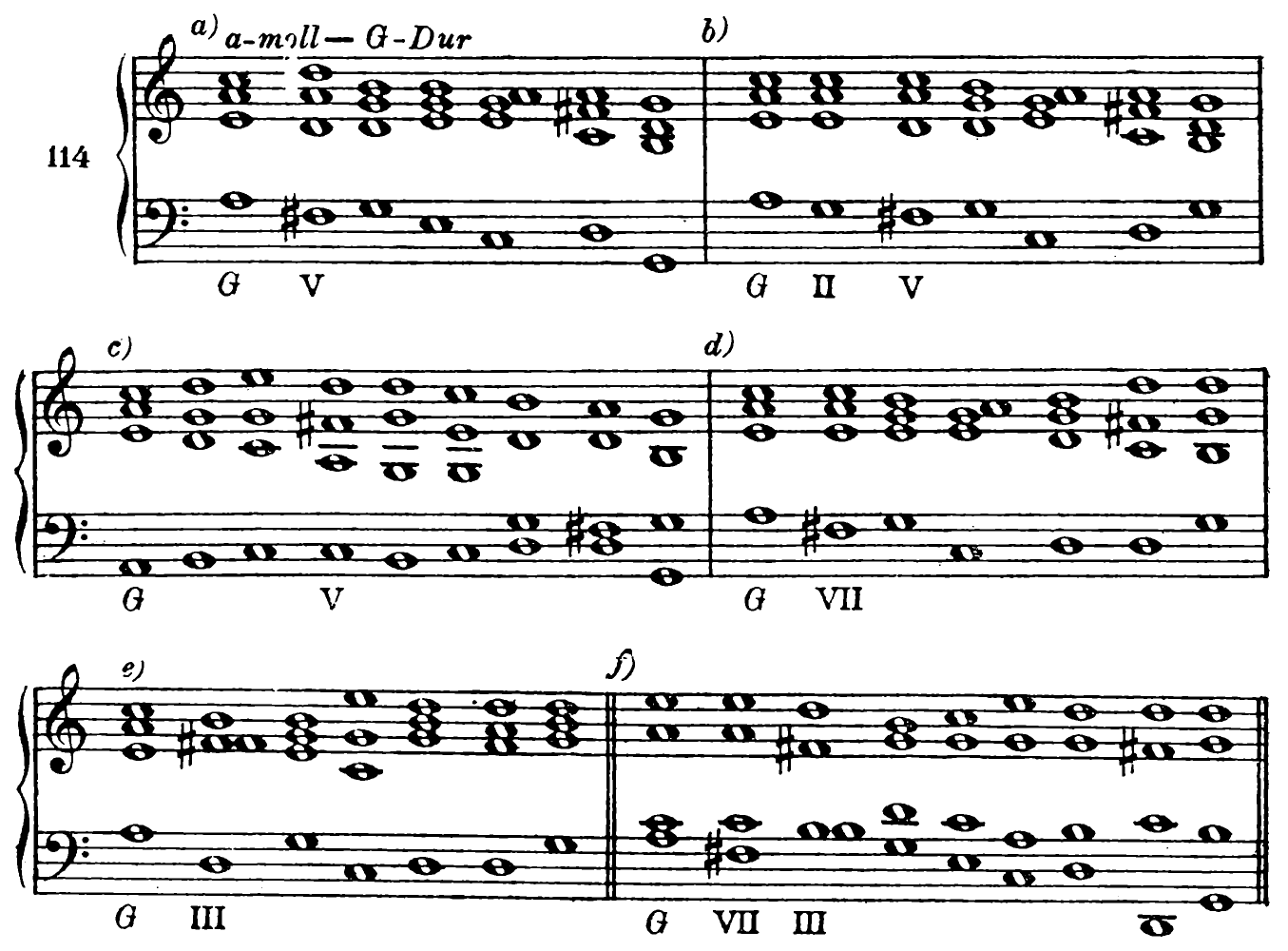
The modulation from A minor to G major, like that from C major to F major, easily becomes very short, because one of the neutral chords drops out (degree III of A minor), and V of G is best joined directly to I of A minor. But VII or III can also come.
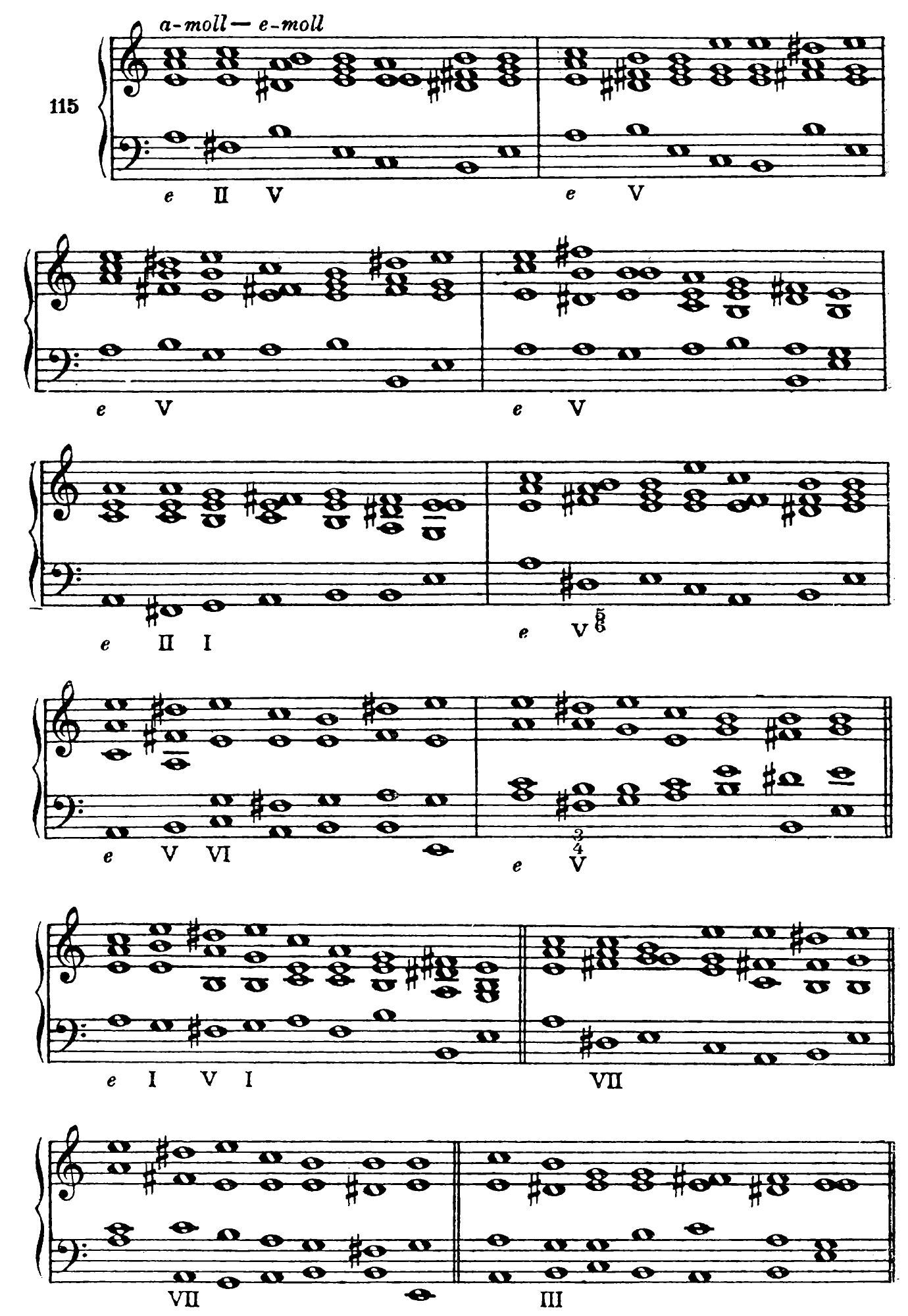
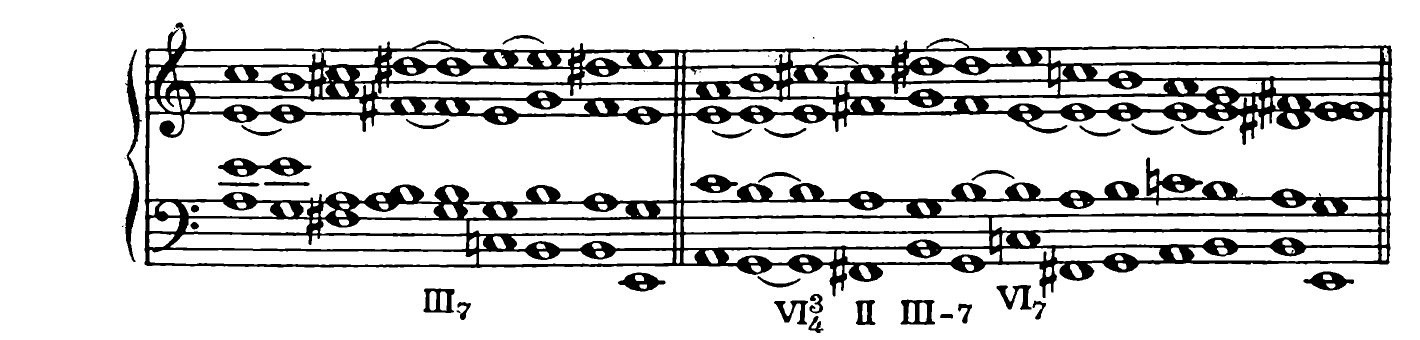
A minor to E minor permits the modulating chord (II, V or VII) to be set immediately.
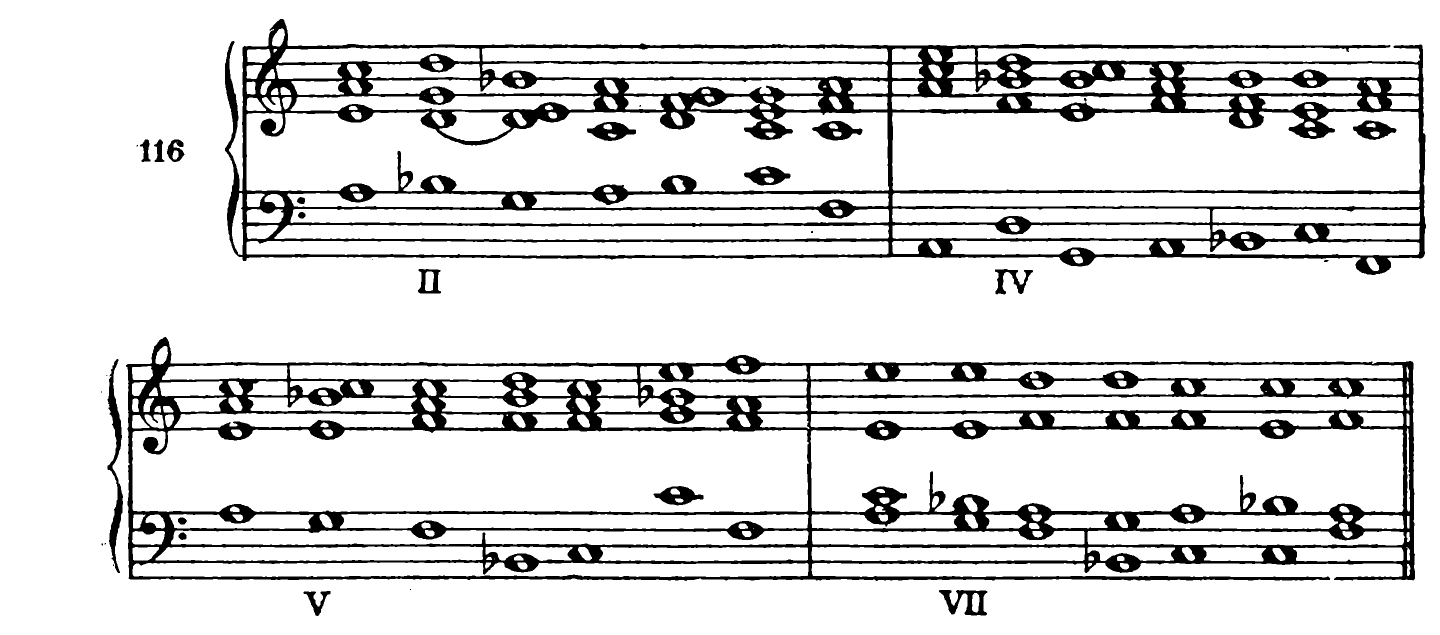
A minor to F major. Either degree V at once, or insert degree II, IV or VII in between.
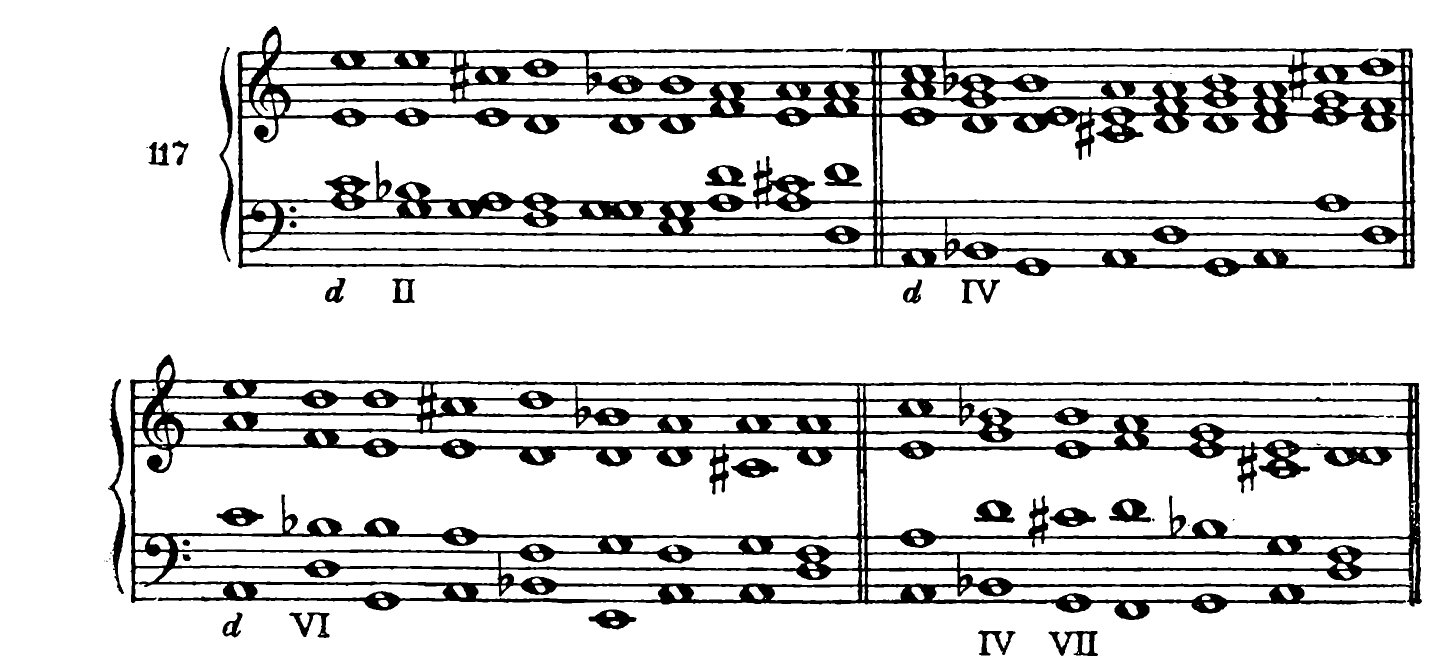
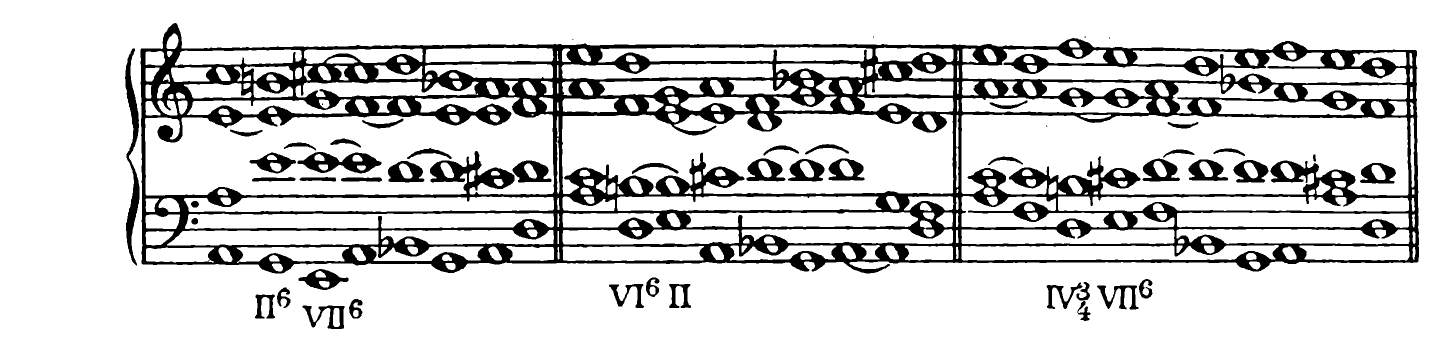
A minor to D minor. First remove the C (turning point), that is, bring in chords with B-flat or B, which are, after all, also modulating chords (IV, VI, II of D minor); then either begin the cadence, or first degree V and then the cadence.
We have regarded the minor key as a variety of the major key, as coinciding with it to a certain degree. This circumstance can also be exploited in modulation. If one says to oneself: A minor, in those parts in which no raised tone is used, differs so little from C major that the two can be confused with each other, then one can use this possibility of confusing them in order to confuse them, and so, when one has to go to A minor, one can go to C major, then call this C major A minor (reinterpret it) and make the cadence in A minor. Or, when one has to go from C major to E minor, go to G major and express E minor only in the cadence. Likewise to D minor: first to F major, then the cadence in D minor. The same means can, however, also be applied in the reverse sense. Namely, when one is to go into a major key, one lays out the modulation, as a feint, into the relative minor key, interprets the tonic triad of this minor key as degree VI of the relative major key, and then goes to major with the cadence. Thus, say, from C major to G major: modulation from C major to E minor; E minor = VI of G major; cadence to G major. C major to F major: by way of D minor, expressing F major only through the cadence.
This, then, is one possibility of making the modulations more varied. However, because these modulations use richer means, the others are not on that account any less good. At one time the one may be more appropriate (or at least sufficient), at another time the other. For compositional purposes one must have at one's disposal both the simple and the complicated possibilities. Whether one uses the one or the other is perhaps sometimes merely a question of taste, but often also a question of construction. In general one will be able to say: when one has to modulate from a major key into a major key, the best intermediate key to take is the relative minor (C major by way of E minor to G major); on the other hand, in modulating from one minor key into another, a major key (A minor by way of G major to E minor). There is less need, in modulating from A minor to G major, to interpose E minor, or, from C major to E minor, to interpose G major. Of course that is possible too. Two circumstances appear essential in this enrichment, and we shall return to them later: 1. the intermediate key, and 2. the possibility of using still other chords than merely those native to the scales of the starting point and the goal.
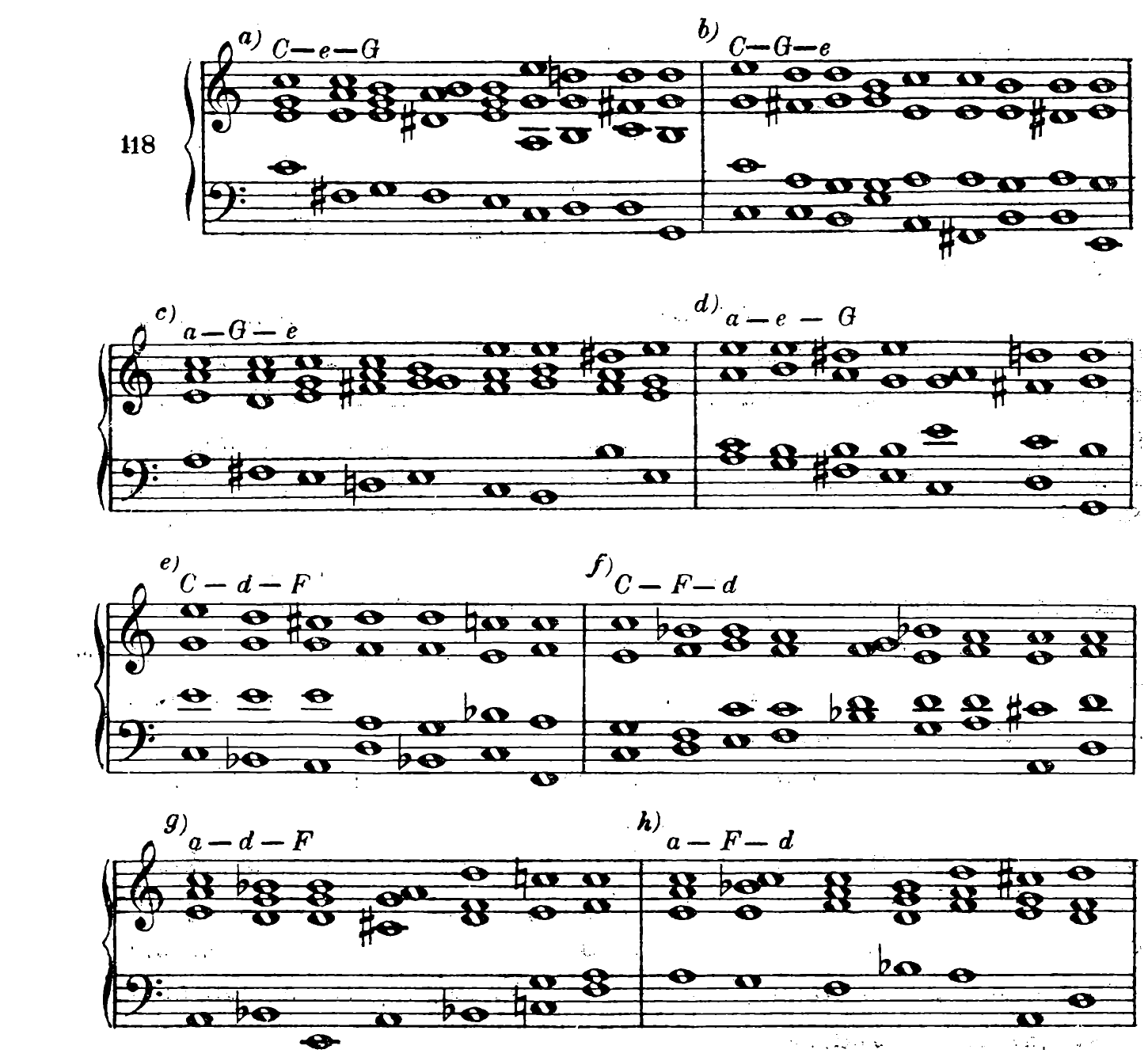
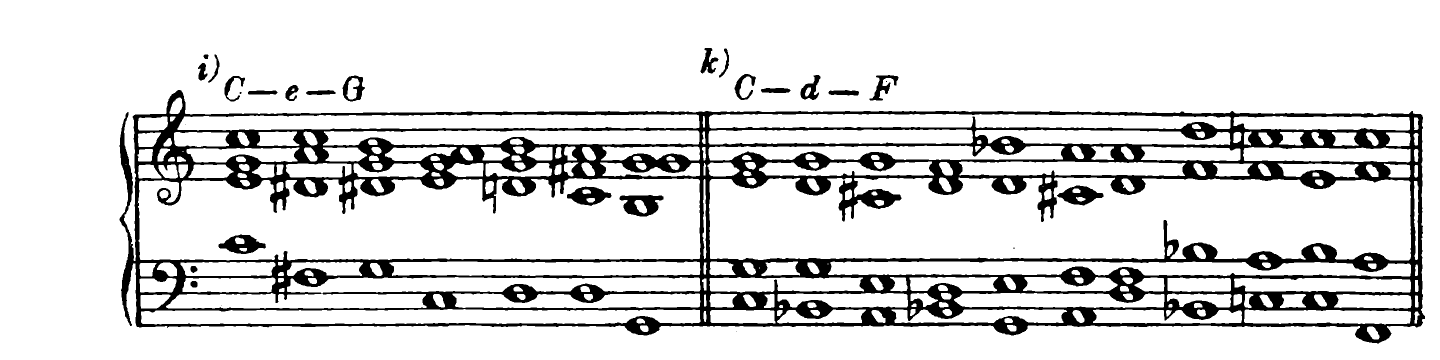
Balance will be achieved only if the intermediate key is not carried out too firmly. Otherwise the cadence would have to become correspondingly longer. In 118 a, for example, degree I of E minor appears twice, in 118 c the dominant of G twice. Both could easily demand a longer cadence. But in 118 a the dominant of E minor occurs only once, and in 118 c the tonic of G not at all. If that could really have become a danger, it is avoided by this means.
The idea of the intermediate key can also be extended to the relative major or minor key of the starting key. For example: C major to G major or E minor by way of A minor. Or: C major to F major or D minor by way of A minor. Or A minor to G major or E minor by way of C major, and A minor to F major or D minor by way of C major.
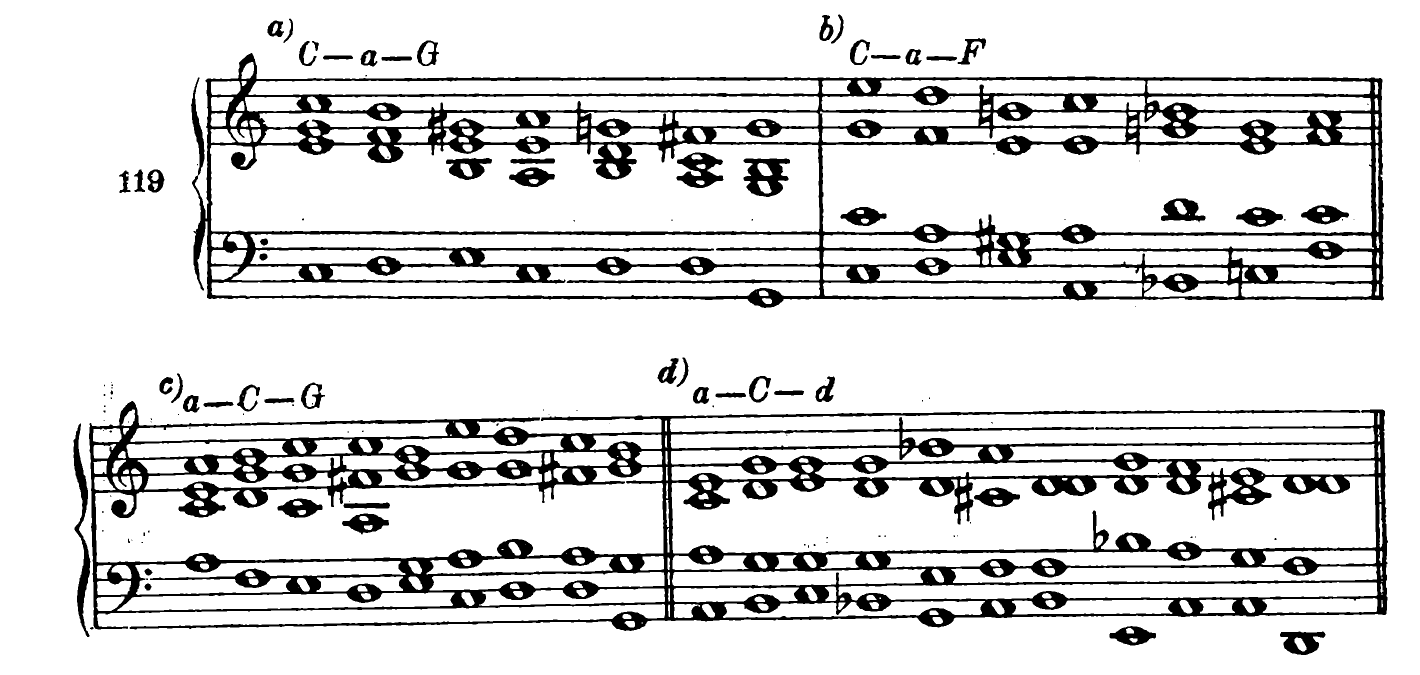
These modulations (especially 119 a and 119 b) are admittedly very short, and the goal, too, is hardly suggested in them. Nevertheless they are certainly not bad. For in place of the striving to reach a definite goal, there appears in these settings the striving to reach a goal at all; perhaps one not yet determined; or indeed a determined one, but by a detour. Thereby such settings have something that must surely be valued as equal to the goal-consciousness of shorter modulations: they are, so to speak, on the move. That is, they show an urge toward forward motion, which will surely find a goal, even if at first that goal should not make itself noticeable quite unambiguously. I must say that I regard this “being on the move” as one of the most important characteristics of a living setting, and that it sometimes seems to me even more important than goal-consciousness. We, too, walk without knowing the goal!
A further elaboration would be to take two intermediate keys. For instance: C major — A minor — E minor — G major. Or: A minor — C major — D minor — F major, etc.
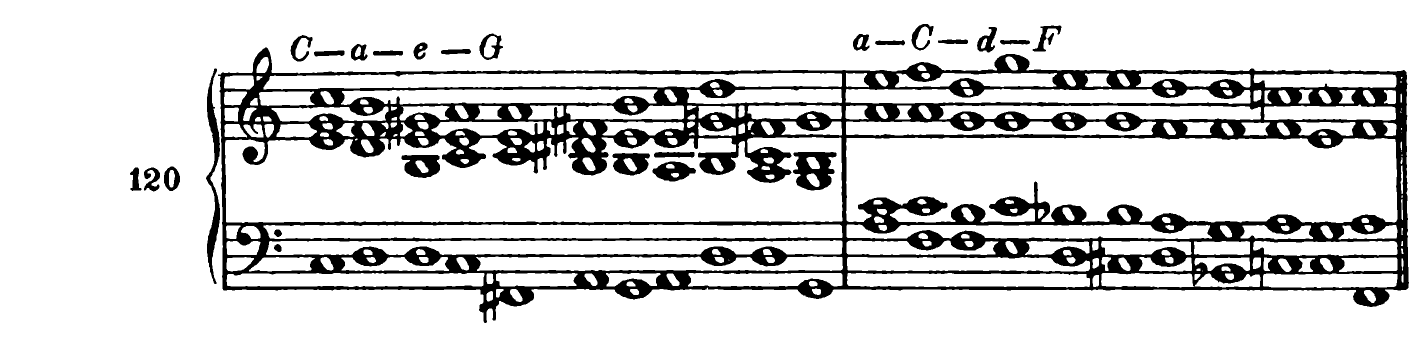
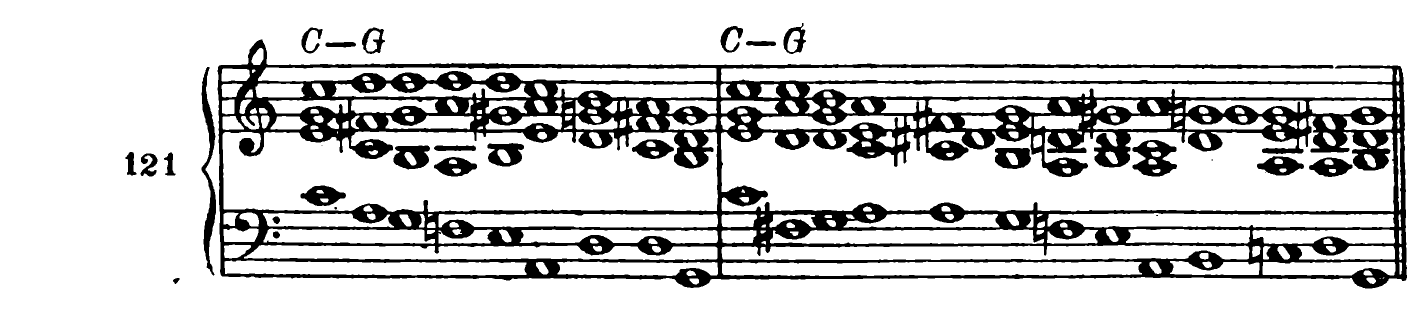
Finally, the idea of the intermediate key can also be transferred to the cadence. For instance: C major to G major, actually reaching G major. But then the cadence at first as if toward E minor or toward A minor, and from one of these points a turn back to G major.