Playable Books
Arnold Schoenberg · section 41 of 66
Up Three or Four Fifths
Read and hear this section in the playable edition →The simplest modulations into the third and fourth circles of fifths upward rest on exploiting the relationship between keys of the same name (A minor—A major, E minor—E major, etc.).**) This relationship is founded on the identity of the tonic and of the dominant chord, and under certain conditions the latter permits reinterpretation. That is: E—G-sharp—B, for example, is the dominant of A minor and of A major. If this chord is struck by itself, minor may follow it just as well as major; and if it now comes from minor (as V of A minor), the task will be to undo the conditions of the minor, to liquidate them, and to present the chord in such a way that it has the freedom to turn either to minor or to major. The possibility of going to major is further supported here by the tendency of every triad—especially dominant-like ones—to resolve, by a fourth-leap upward of the root, into a major triad; in doing so it looks, as was said earlier, as though the chord were overriding the limits of the scale and remembering its natural euphony.
**) This method, especially when a major key is to be reached, is met with so frequently in the classical literature that one must regard it as the most important. There it usually serves to lead into the goal key by a roundabout way, as is the case, for example, in transitions and in the so-called “retransition.” The advantage of this method is this: by visiting the minor key of the same name, the ear is prepared for the tonic of the major key to be introduced, while the major that finally enters is still assured as much possibility of surprise as the change of mode affords. Prepared, yet surprising; expected, and nevertheless new: so the listener’s comprehension and taste demand it, and no artist can wholly escape this. And yet there is a bit of self-deception in it: one wants only what one expects to happen—what one can therefore guess and predict—but then wishes nevertheless to be surprised. Is it pride in the successful prediction, heightened still further by the justified doubts of a self-confidence that is, after all, unsteady, that makes the arrival of the expected feel so surprising? In any case it should be noted that the listener expects the fulfilment of these two demands from the new as well. He wants new works of art, but only such as he expects, and at bottom expects only a new arrangement of old ingredients. Yet not an entirely new one; and the ingredients must not be too old. “Modern, but not hypermodern”—artists who can manage this hocus-pocus will satisfy the public for a short time and lift it out of the dilemma of its conflicting wishes; but after a short time the public has had enough of them, and thereby shows, indirectly at least, some instinct for the good, even though it applies this instinct almost exclusively against the good.
This way of transforming a minor key (A minor) into the major of the same name (A major) can now, as is easy to see, also be used for modulating from the relative key of this minor (C major) and also into the relative key of the major (F-sharp minor). For—the relationship of relative keys has already been discussed several times—C major can be regarded as the region of the unraised tones of A minor, and, by treating the cross-related fifth and fourth tones, in the manner of turning points, as seventh and sixth tones, it can by a short path acquire the characteristic features of A minor: the raised sixth and seventh tones. And in the same way an A major reached after the turn to major can be transformed into an F-sharp minor. Of course a modulation produced in this way from C major to A major or F-sharp minor, or from A minor to F-sharp minor, may also be described as: from C major via A minor to A major, via A minor and A major to F-sharp minor; from A minor via A major to F-sharp minor. But assuming intermediate keys is by no means necessary here, and I recommend, as I explained a moment ago, that the C major or A major preceding A minor or F-sharp minor respectively be understood as an uncharacteristic A minor or F-sharp minor; that attention be directed to neutralizing the turning-point tones; and that the transition from the region of unraised tones into that of raised tones always be carried out as we have done it until now following the model “C major to A minor.”
Modulation into the fourth circle of fifths upward—from C major or A minor to E major or C-sharp minor—rests on the same principle, namely on the transformation of E minor into E major. Here the assumption of an intermediate key, E minor, is more justified; the whole then represents a modulation in the first circle of fifths upward, followed by one in the third upward (1 + 3 = 4). But since the turning dominant triad of E minor occurs as a secondary dominant on VII of C major or on II of A minor, and since, on the other hand, the reinterpretation can begin as early as the opening chord, as we already know from modulating from C major and A minor to E minor (I of C major = VI of E minor; I of A minor = IV of E minor), this auxiliary notion is not strictly necessary here either.
Our task falls into three parts:
1. Introducing the fifth degree of the goal key, at first as V of the minor key of the same name. This may also include neutralizing the unraised tones.
2. Transforming this dominant of a minor key into that of a major key: the preparation for reinterpretation.
3. The exit into the major key and, if desired, the further transition into the relative minor.
Then, as usual, the cadence follows.
First we shall deal with the transformation of the dominant. The simplest way to do this would be to let it stand until its descent from minor is forgotten, for example by means of a fermata. Indeed, this is a device often used in classical works for dissolving earlier obligations. And the effect of the general pause, too, rests on the suspense created by the question: what, other than what came before, will come now? For something different can come. But this device is not usable for us, because we could only outdo its relative artlessness (it is artless today because it is worn out) by the meagreness of the surprise attainable with our means. But also because we want to achieve our effects here not through nuances of performance but solely through harmonies. We make use of two forms of a similar expedient: 1. the held voice, and in particular its special case, the pedal point, in which, as a substitute for holding the whole chord and as its representative, only one tone—the most important one, the root—is held, while the other voices move on in chords suited to the purpose; 2. repeated passage through the dominant.
The held voice differs from the longer or shorter holding of one or more voices, which occurs often enough in the simplest chord progressions, in that here the other voices may also form chords of which the held voice, sustaining its tone, cannot easily be thought a component—thus dissonances as well. Usually it is the root or the fifth of the tonic or of a dominant (hence also of a secondary dominant) that is held, but under certain circumstances it may also be the third. The held voice is called a pedal point when it is the bass tone that is held (usually—and in our case always—it is then the root). The pedal point serves chiefly retarding purposes or purposes of summing up. Where a movement is to be held back before it ends harmonically, for example in expositions, or where one must be clear before a decisive turn, for example before a recapitulation, as the case of “establishing the dominant” shows, it is a legitimate, effective and much-used artistic device. Its drone-like use, on the other hand, unless it is presented as belonging to folk music, quasi as a quotation, is artistically without deeper meaning and usually springs from sluggish harmonic thinking and from inability to write a decent bass line. The laws for held voice and pedal point that matter to us concern, further, their entry and exit. 1. The entry, the beginning of the held voice, should take place on the strong beat, on one. 2. The held voice should be a consonance at its entry and before its exit. 3. The exit should take place on the weak beat. 4. The chords standing in between will of course form progressions reasonable in themselves and must belong to the closest degree of relationship.
The student will have to fulfil the rhythmic conditions named here exactly. For since rhythmic effects are not our concern, rhythmic deviations can matter little to us either, although it is clear that these laws are too narrow not to be disavowed often enough by artistic reality. Within the simple scheme we choose for carrying out this form there is still enough possibility of variation to make full use of our means so far. We shall not write any long-extended pedal point but shall be content with indicating its function. The most important thing for our purpose is the twofold appearance of the dominant that is to be reinterpreted: at the beginning and at the end of the pedal point. By placing it at these two points we best fulfil the condition that the held voice must be a consonance there. This repetition is a reinforcement that makes the descent from minor forgotten, by increasing, so to speak, the dominant’s own weight, which favours its ability to turn to major. Meanwhile the ear does not for a moment lose the sense of what is at issue, for the held voice takes care of that. In general we shall place only one connecting chord between the beginning and the end of the pedal point, so that the whole construct is three half notes long.
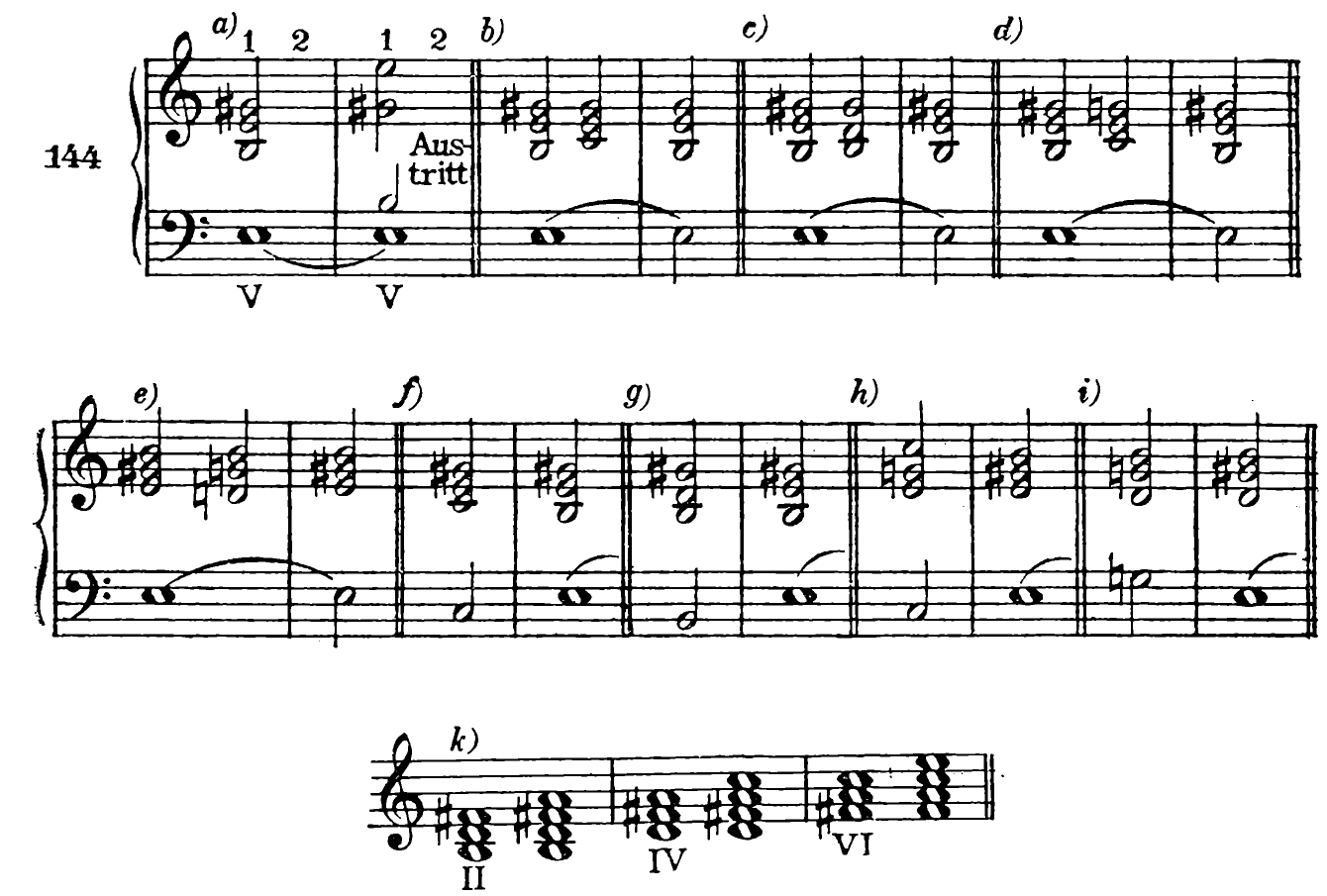
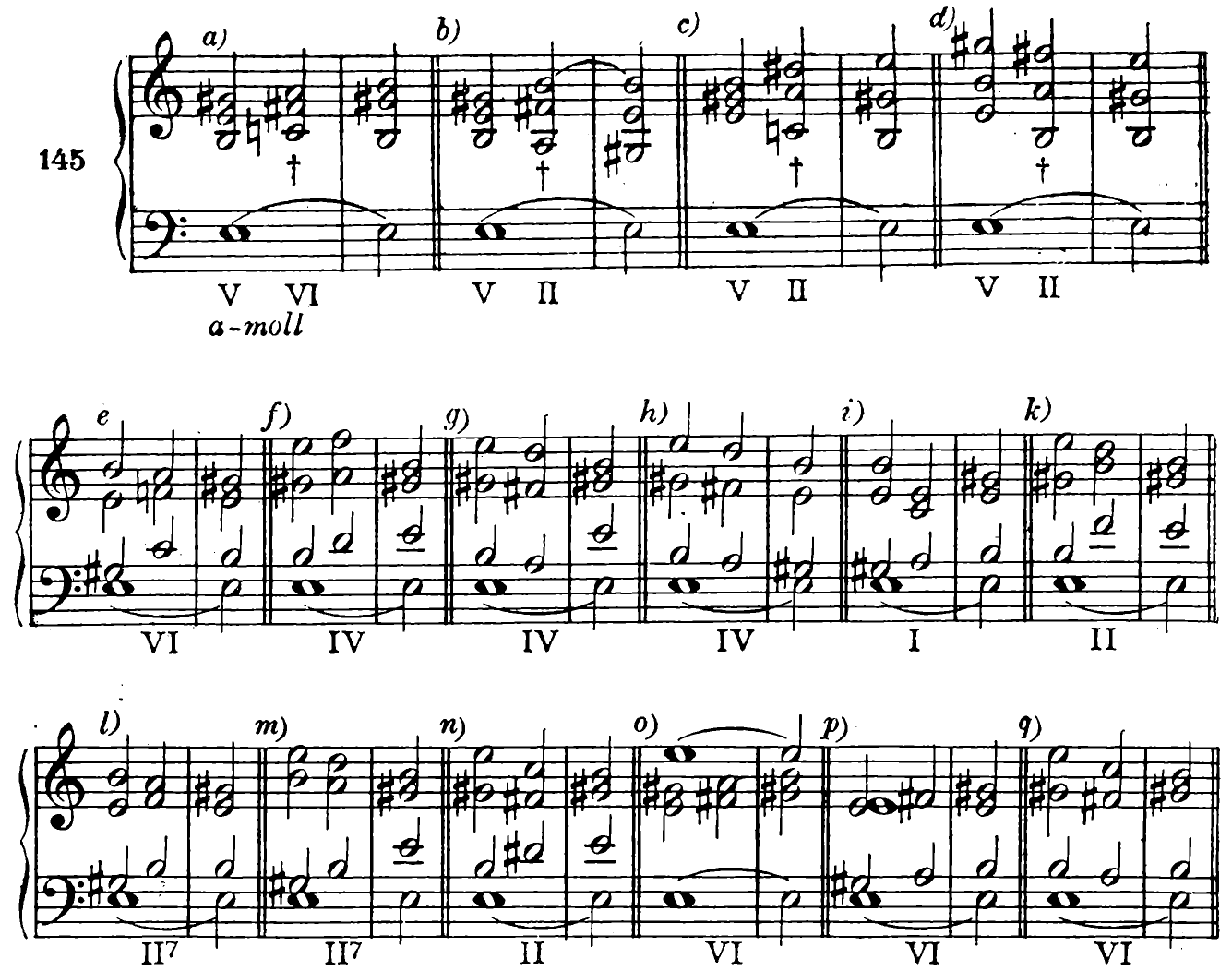
So: on One (see 144) the V, on Two the connecting chord, on the next One the V again, but if possible in a different setting (variation). In considering which degrees are to be chosen as the connecting chord, one must for a start exclude those that make the reinterpretation difficult. These are the ones that resemble A minor more than A major, that is, those containing the minor third of the tonic, the C: I, III and VI of A minor; and those which still belong to the C-major region to such an extent that chromatic steps would be necessary (144 d and e), for a dominant should not arise chromatically.
As the following chapter will show, however, the relation to the minor subdominant is such that it still permits the rule of the tonic; and since the tendency of the dominant to turn to major is strong enough, I and VI will therefore not do much harm either. It is far more favourable, though, to choose chords which, as secondary dominant, artificially diminished triad or artificially diminished seventh chord, belong to both A minor and A major. These are: the II degree as dominant of the dominant (B—D-sharp—F-sharp—A) and as diminished seventh chord (D-sharp—F-sharp—A—C). Here, of course, the minor third C does no harm either. But the chords of II, IV and VI of A minor that contain the raised sixth tone are also suitable, even when they contain the C, because this is a dissonance here and will in any case fall to B (144 k). That 144 b is to be excluded follows from the root progression (III—V); in 144 c (VII—V), VII is a diminished triad, which calls for different treatment.
It now remains to examine the root progressions. The only degrees that yield nothing but strong steps are IV and VI (145 e–h: V—IV—V and V—VI—V), whereas with I and II (VII and III drop out) there is in each case one falling step (145 b, c, d and i), which of course is not bad. Still, I is not very favourable, since at the exit it will appear as major. In 145 e, f and others, voice-leading difficulties arise that make a diminished or augmented step unavoidable. The downward motion of the 7th and 6th tones of A minor (in 145 g and h) is readily explained by the view that A major is already present here, a view that is especially justified when the introduction took place through the dominant of the dominant or the like. The most suitable forms will be those in which the chord tones of V arise through the onward motion that results from the treatment of the dissonance. If the connecting chord is a seventh chord, it cannot be presented completely. One will try to express the dissonance through the characteristic tones: root, seventh, possibly diminished fifth.
For carrying out this procedure of reinterpretation, called “dwelling on the dominant”, by means of a held voice in the upper parts, and for the so-called passing through the dominant, the same considerations are decisive as for the pedal point.
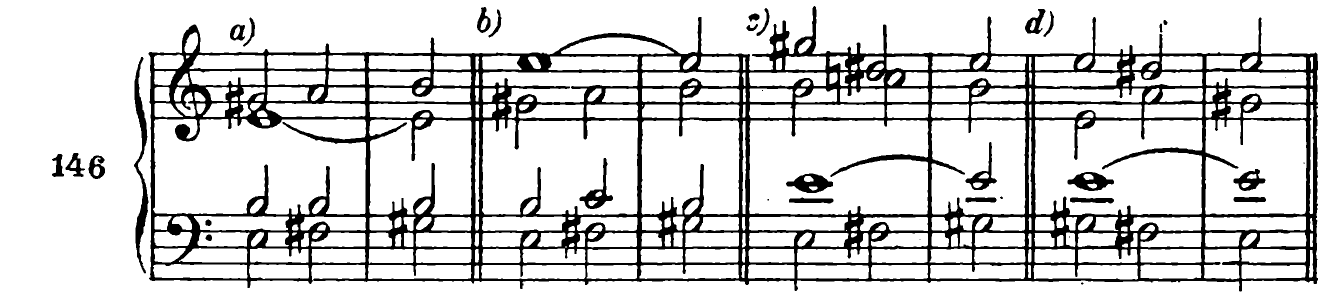
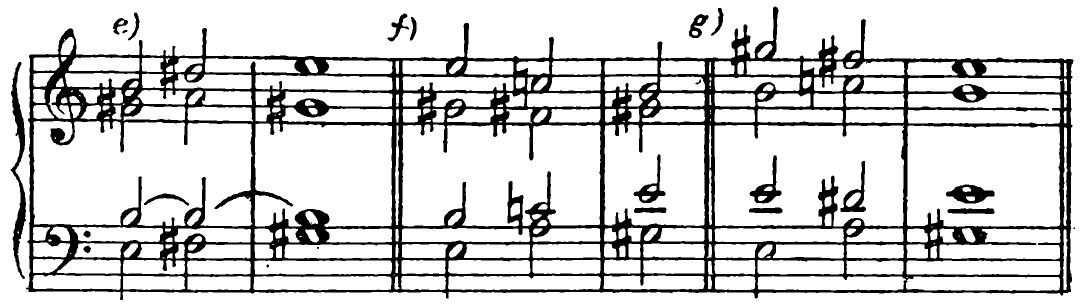
A difference between these forms and the pedal point consists chiefly only in this: with the held voice (146 a, b, c, d, e) a voice other than the bass stays put, which is why one may perhaps avoid excessively harsh dissonant frictions; and with passing through (146 f, g) the held voice may also be missing altogether. The use of scalewise voice leading is to be recommended here, whereby the connecting chord appears justified in part by passing notes, by melodic means. Here V may also stand as a six-chord, both in the first and in the second position. The dominant of the dominant and the further formations based on it will render good service here, since they are able to give the dominant almost the weight of a tonic, which is helpful for many purposes. Especially when, as here, such a chord is to draw all attention to itself, it will be good to present it in this way — I call it: carrying it out as a key.
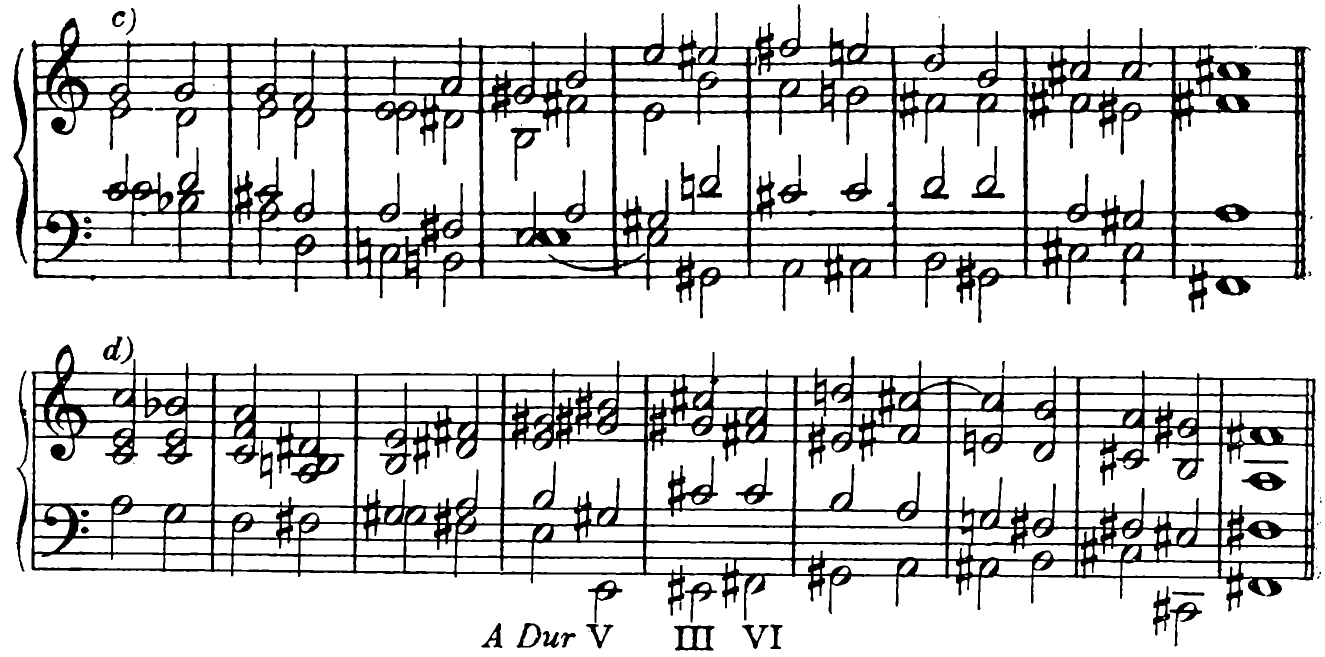
The considerations we have made regarding the second placing of the dominant are of course also decisive for the first: for the introduction, therefore, the same chords are to be used as there. A compilation of such possibilities follows in 147 A. (The unusable chords were already given in 144 f–i, where it is explained why they are not suitable for “dwelling”.)
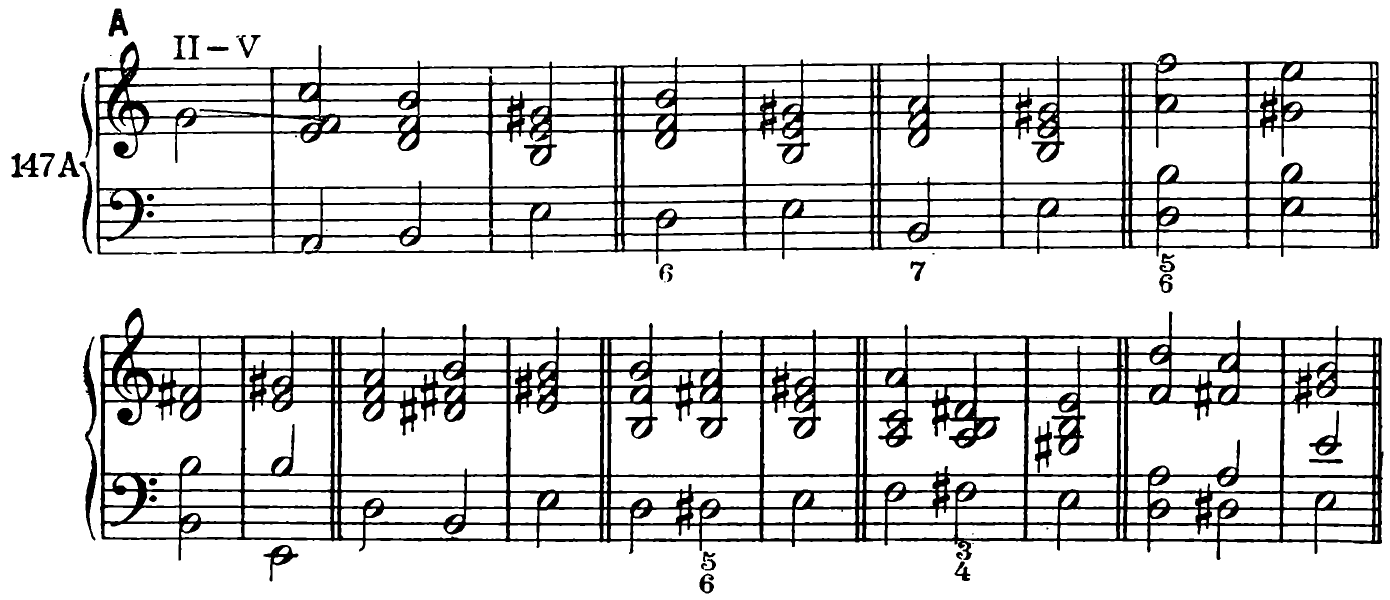
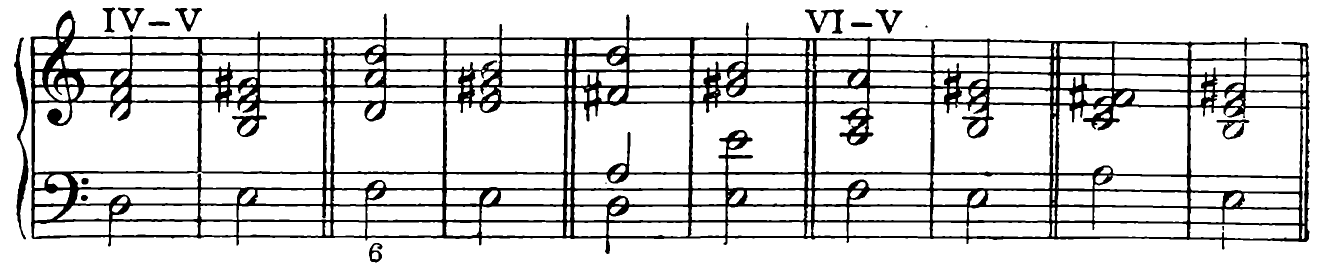
Here — let it be repeated as a reminder — attention to the turning points is important. Whether C major or A minor is the starting key makes no difference. Of course one can also arrive at all these degrees and forms by using secondary dominants and other artificial chords.
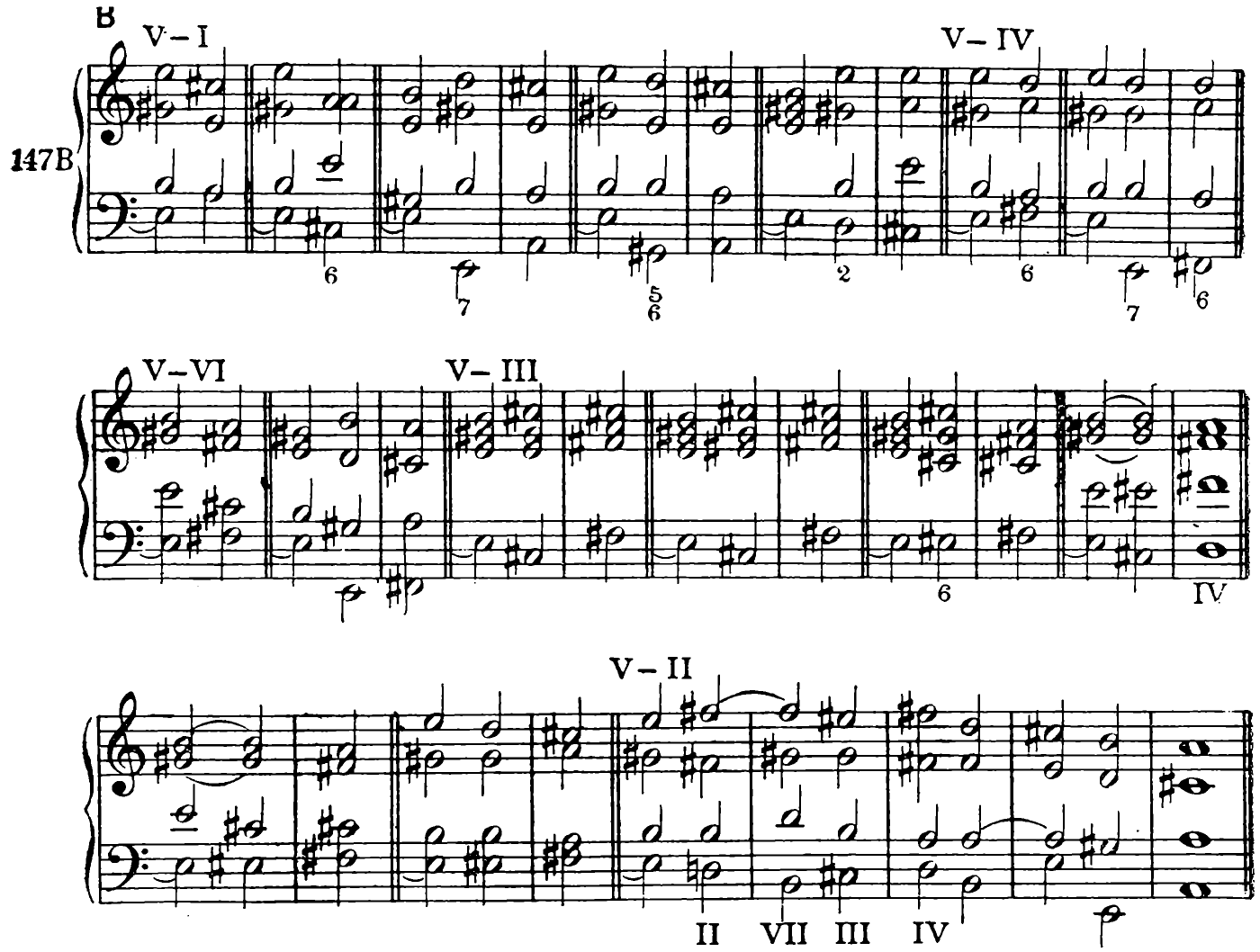
It remains to discuss the exit from the pedal point. One aims for the I degree, but can postpone it in manifold ways (147 B). The rising root progressions come into consideration first of all (V—I, the two deceptive cadences V—VI and V—IV, and V—III, the latter of which, however, is better carried out by way of the secondary dominant on III). But V—II, too, is conceivable if well continued. If possible, a change of position should be made here. The exit chord can be joined on directly, on Two; but one can also insert the seventh chord or the diminished seventh chord on V, whereby the first chord decisive for major comes to stand on One of the next bar.
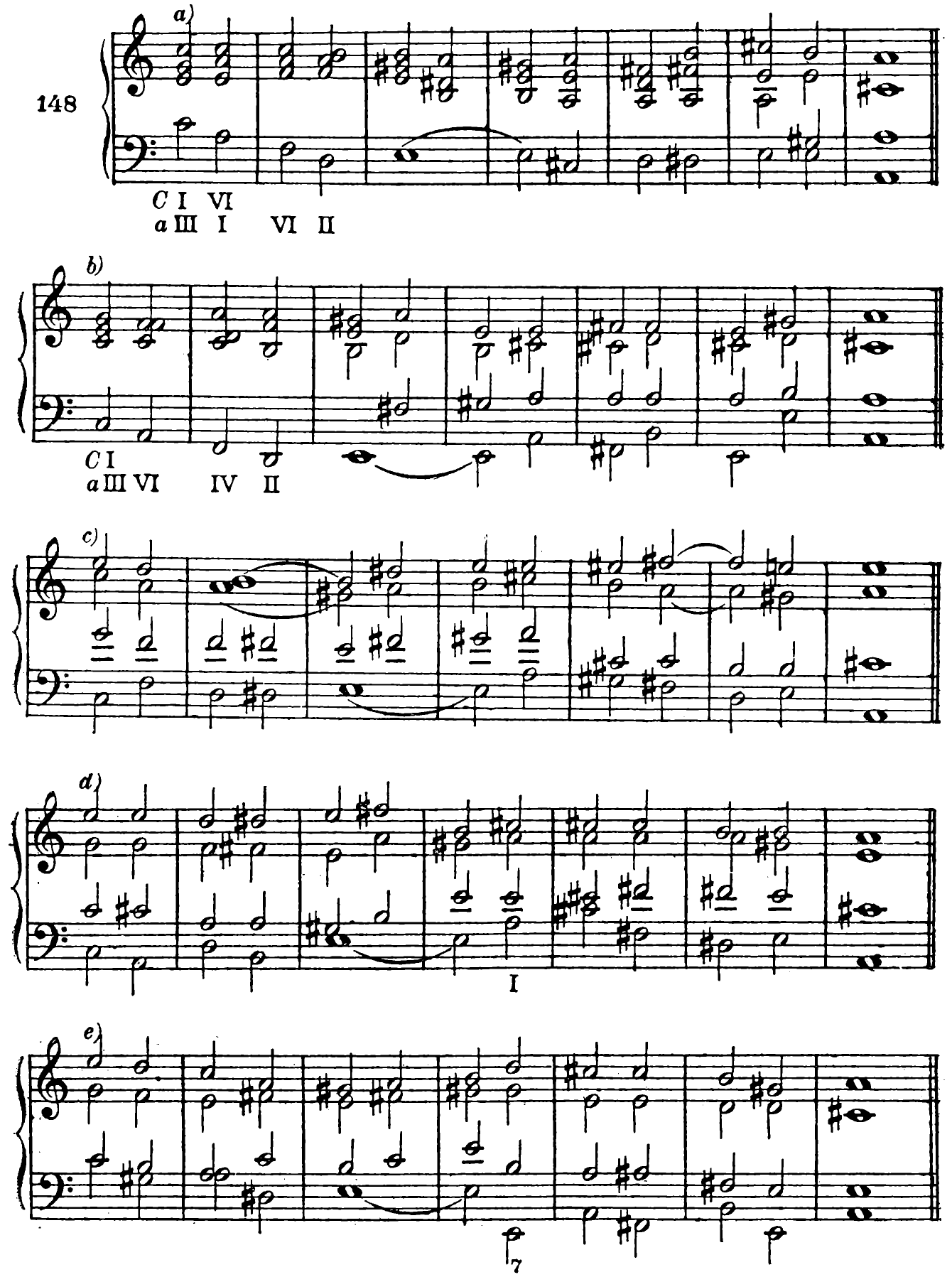
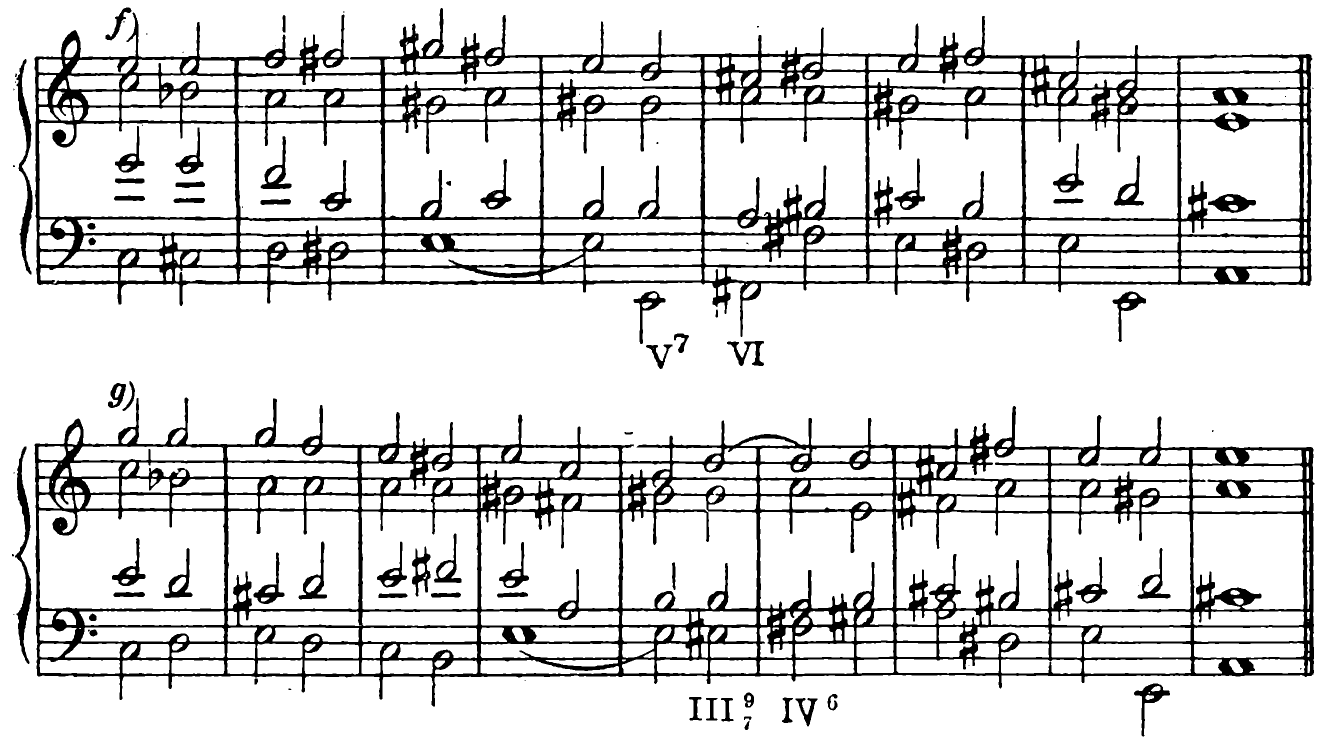
So that the examples do not become too long, it is advisable to use no more than four to six chords at most before the dominant appears.
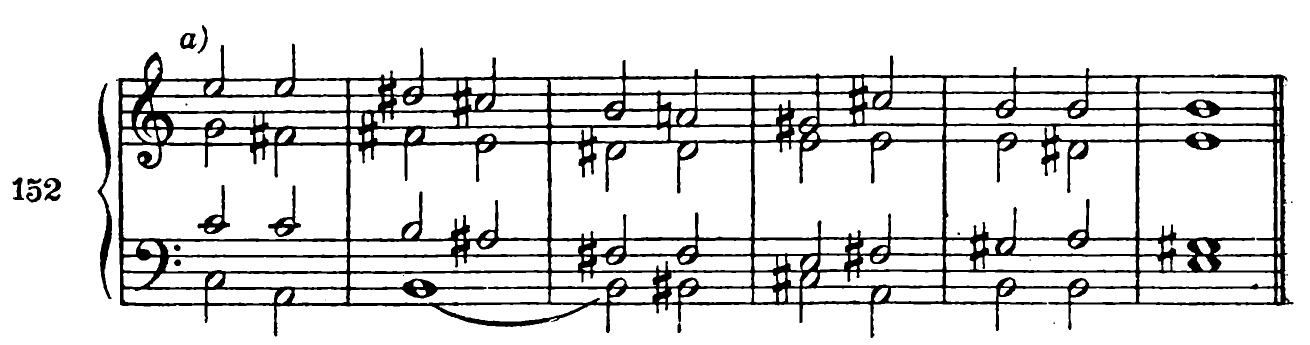
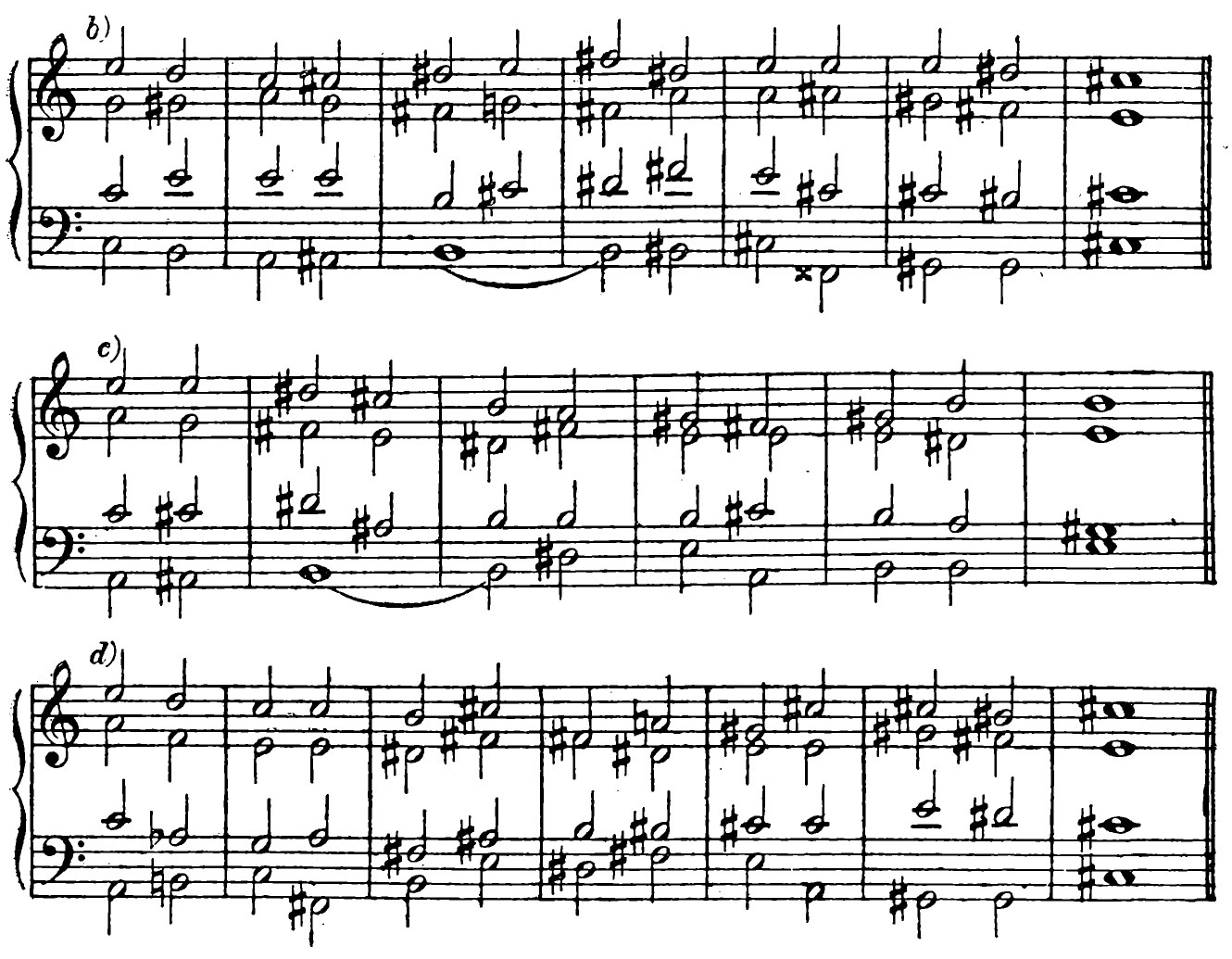
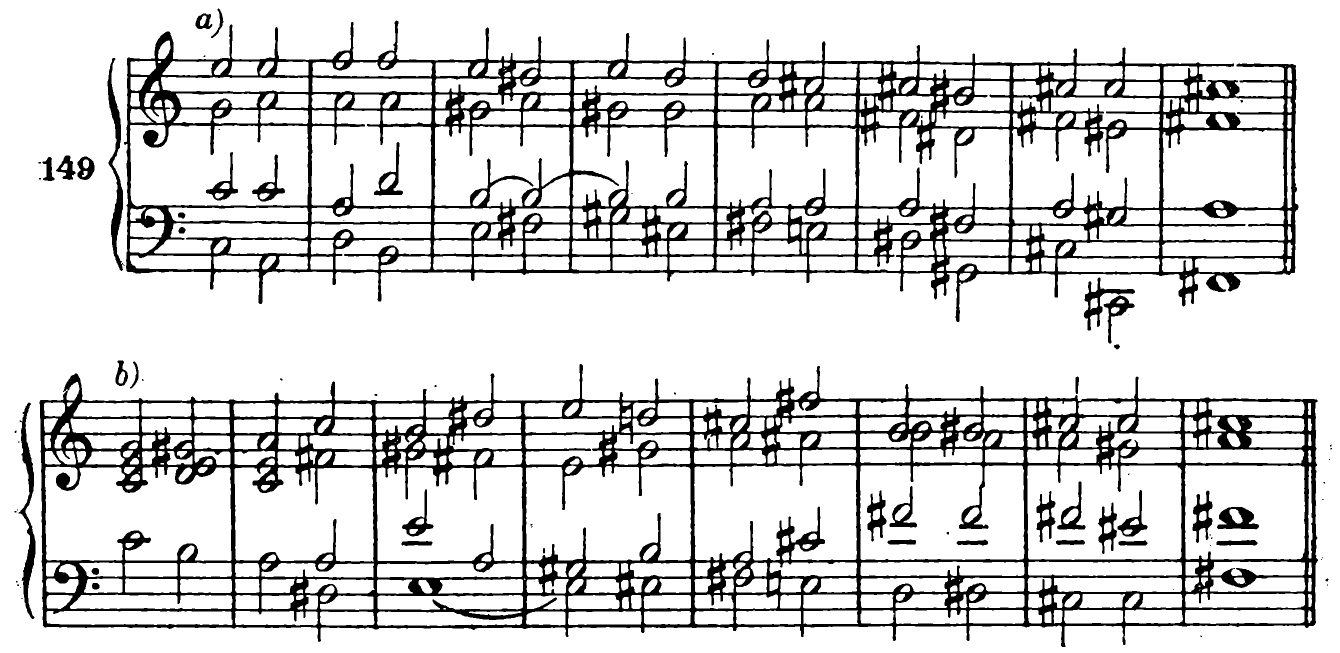
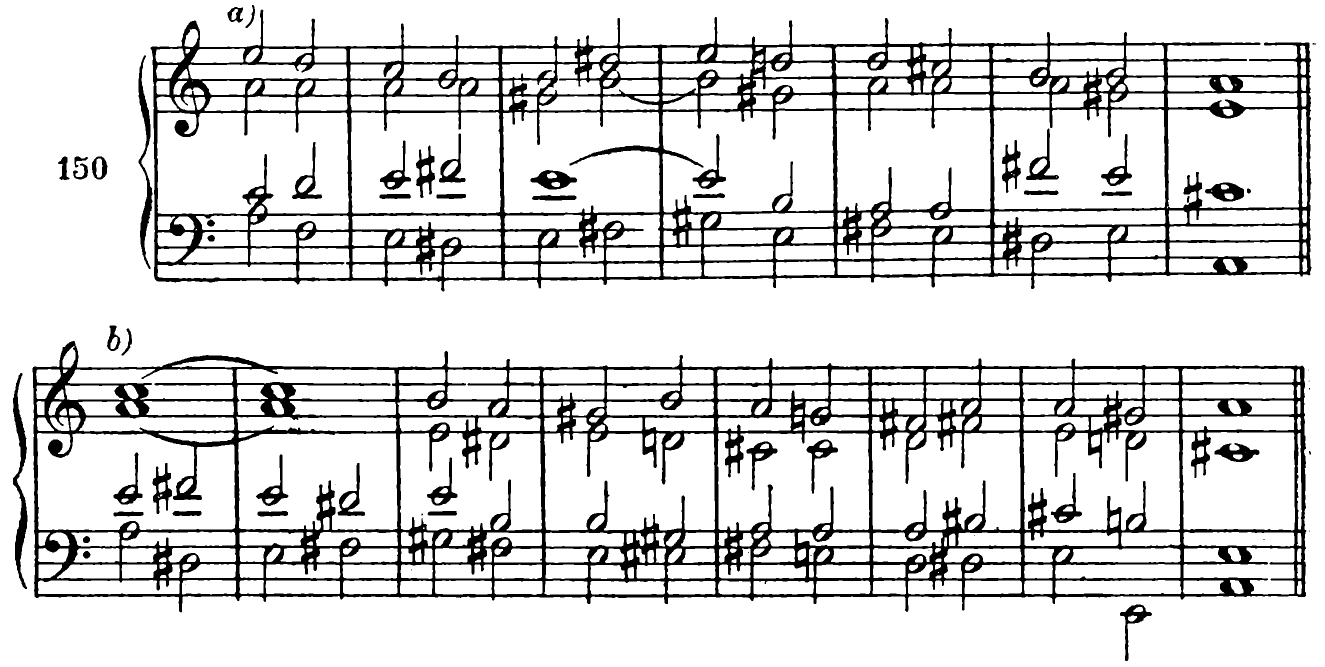
In 149 there follow modulations to F-sharp minor, in which one goes in the manner described first to the dominant as though to A major and then, after dwelling there, to F-sharp minor merely by means of the cadence. Very suitable for the exit here are the secondary dominant and the diminished seventh chord on the III degree of the relative major key (A major).
For practice, the student can turn each of the modulations shown here differently merely by means of the cadence: those in 148 to F-sharp minor, those in 149 to A major.
The modulation from A minor in the same way.
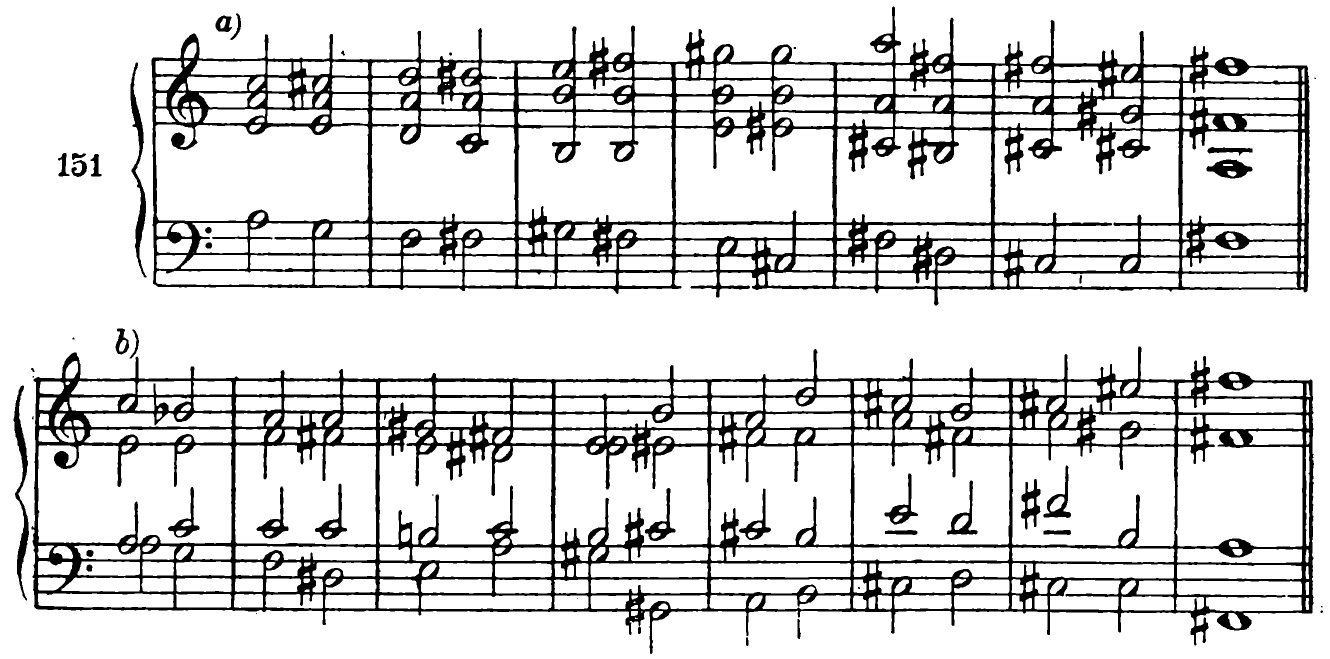
In this modulation the student may already use somewhat more secondary dominants, diminished seventh chords and the like, since they greatly favour the possibility of reinterpretation. It will be advisable, however, for him to carry out the first exercises here, too, without altered chords or with only a few, so as always to keep the sense of the succession of degrees in view. He should never neglect to judge that sense, even when he is already surer in handling the individual chords; even when he believes he no longer needs to check the root progressions.
The student who here writes rhythmicized exercises for the first time will tend to think of every two bars as a phrase belonging together, which is not to be recommended, especially if he wants to shape the upper voice somewhat more vividly. Sequence-like repetitions often create motivic obligations from which it is hardly possible to escape. And so an example laid out too “melodically” usually turns out rather poorly.
The modulation into the fourth circle of fifths upward rests, as has been said, on the same principle. Only here one goes not to the dominant of A minor but to that of E minor. The relations of C major (A minor) to E minor are so close that it is no more difficult to go there than to the dominant of A minor. Instead of regarding the initial chord as the III degree of A minor, one regards it as VI of E minor. Everything else — bringing in the dominant, dwelling on or repeating the dominant, exit and cadence — then remains the same, so that the student can also make modulations into the fourth circle from those into the third circle of fifths upward by transposition (with small changes), and, conversely, modulations into the third from these. I recommend this attempt as a side exercise. Otherwise, however, he should work out the examples through independent reflection.