 Playable Books
Arnold Schoenberg · section 42 of 66
Down Three or Four Fifths
Read and hear this section in the playable edition →From C major and A minor to E-flat major and C minor, and to A-flat major and F minor
For this modulation we use a means similar to, but not so complicated as, the one used for the preceding. There we saw how, after a dominant, although it comes from minor — although, therefore, a minor tonic ought to follow it — a major tonic can come. Here it is the other way round: a I degree of a major key is regarded as a dominant (possibly a secondary dominant), and a minor triad is made to follow it. This has an analogy in the circumstance that the dominants (g—b—d) of the major and minor keys on the same tonic (C major and C minor) are identical, so that the same g—b—d is followed at one time by a major chord and at another by a minor chord. If, then, one regards the I degree of the initial key, C major, straightaway as such a dominant (in A minor this major chord will first have to be brought in as the III degree), a minor chord on F can follow directly, favoured perhaps by a directional seventh (b-flat). Since this C is at one time a dominant (V in F minor) and at another a secondary dominant (I in C minor, VI in E-flat major, III in A-flat major), the minor triad f—a-flat—c that follows it can mean the I degree (in F minor) as well as II in E-flat major, IV in C minor, or VI in A-flat major. One thereby reaches a region that could not be reached with the means used so far. This modulation is extraordinarily simple because, as has often been mentioned, the I degree tends to merge into the tone lying a fifth below it, to become the fifth — that is, the dominant — of that tone. To be sure, it strives towards a major chord. In minor, however, if not its nature, then at least convention admits a minor chord.
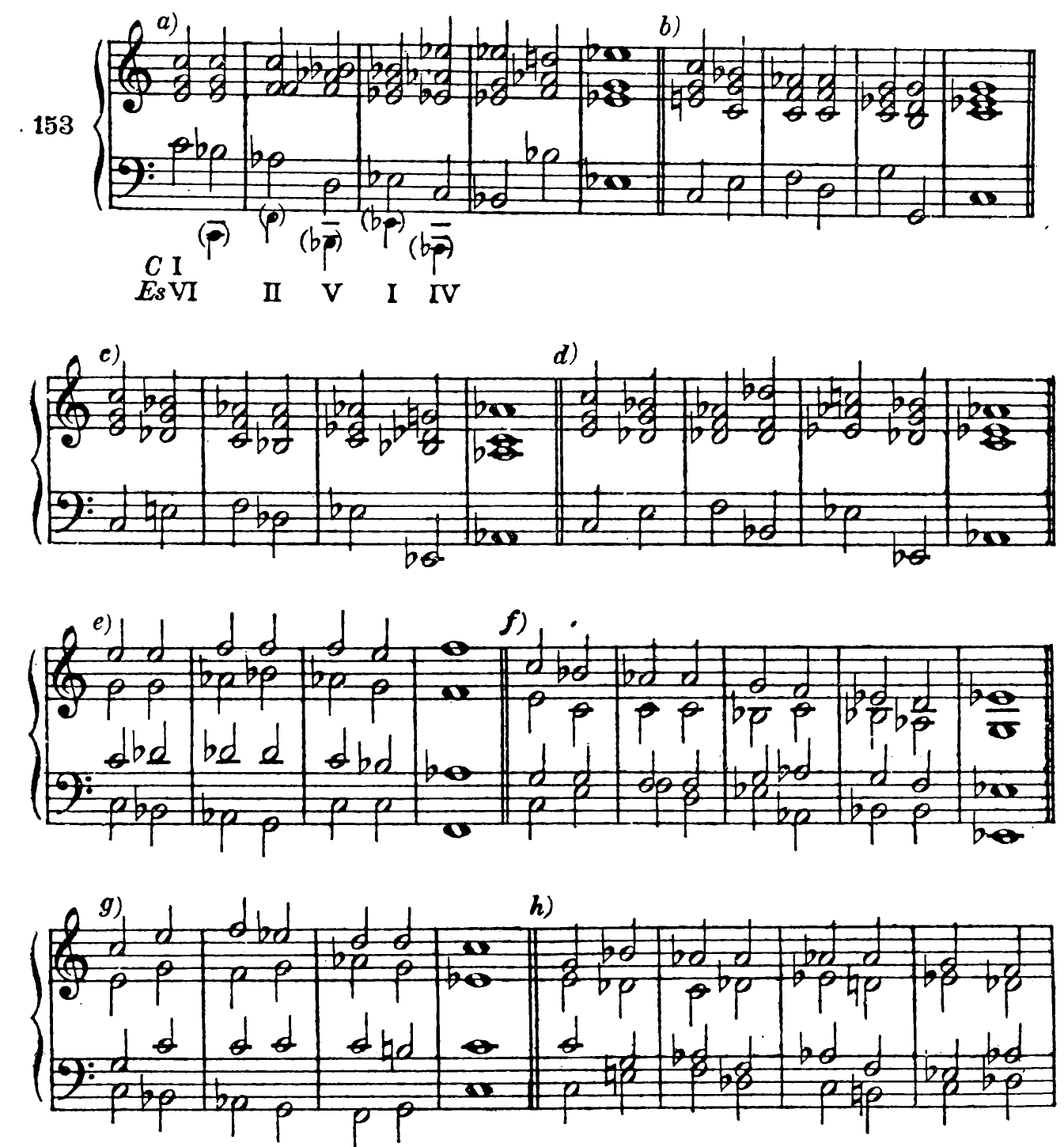
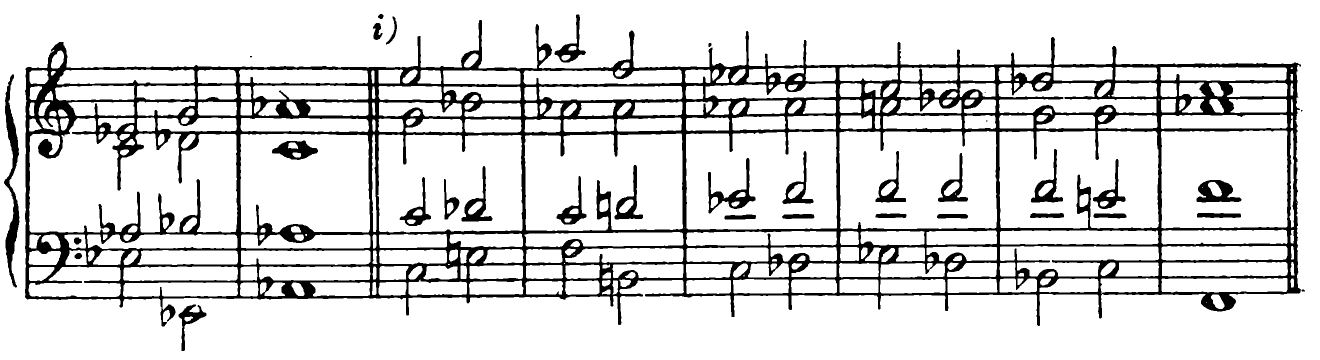
Monotony easily arises here. For if, as in 153 a, the goal key is aimed at by the shortest route (V—I) after the II degree (of E-flat major), the result is nothing but rising fourth-leaps of the root. This is not to be recommended, not only because it is monotonous but, although it is very natural, for yet another reason: perhaps it is too natural, too self-evident, for one to sense any achievement in it. And if such progressions are frowned upon, this happens perhaps rightly because whoever makes use of so self-evident, so cheap a means shows too little imagination. In themselves they are of course good. Too good, even. So much goodness is more than one can bear. The student should therefore strive to avoid such frequent progressions. The use of inversions, seventh chords, even diminished seventh chords, does not help much. One must take care to become more varied through deceptive cadences or through the insertion of other degrees (153 f).
In the modulation into the fourth circle of fifths downward, a deceptive cadence will favour reaching the key (153 d).
The modulation from A minor causes somewhat more difficulty: the a stands opposed to the a-flat that appears soon afterwards (a cross-relation, as one might call it). To dispose of the a smoothly, it will be advisable to treat it, in the voice in which it is most conspicuous (in the soprano or the bass), as though it were the sixth tone of C minor, that is, to let it go by way of b to c (154 a). The diminished seventh chord (b—d—f—a-flat) is very suitable, because, as in 154 b, it allows the a to go by way of a-flat to g. Still better is the solution 154 e, where this step takes place in the soprano, the most conspicuous voice, and the continuation also brings the d-flat, so that preparation was made for the most important elements of F minor.
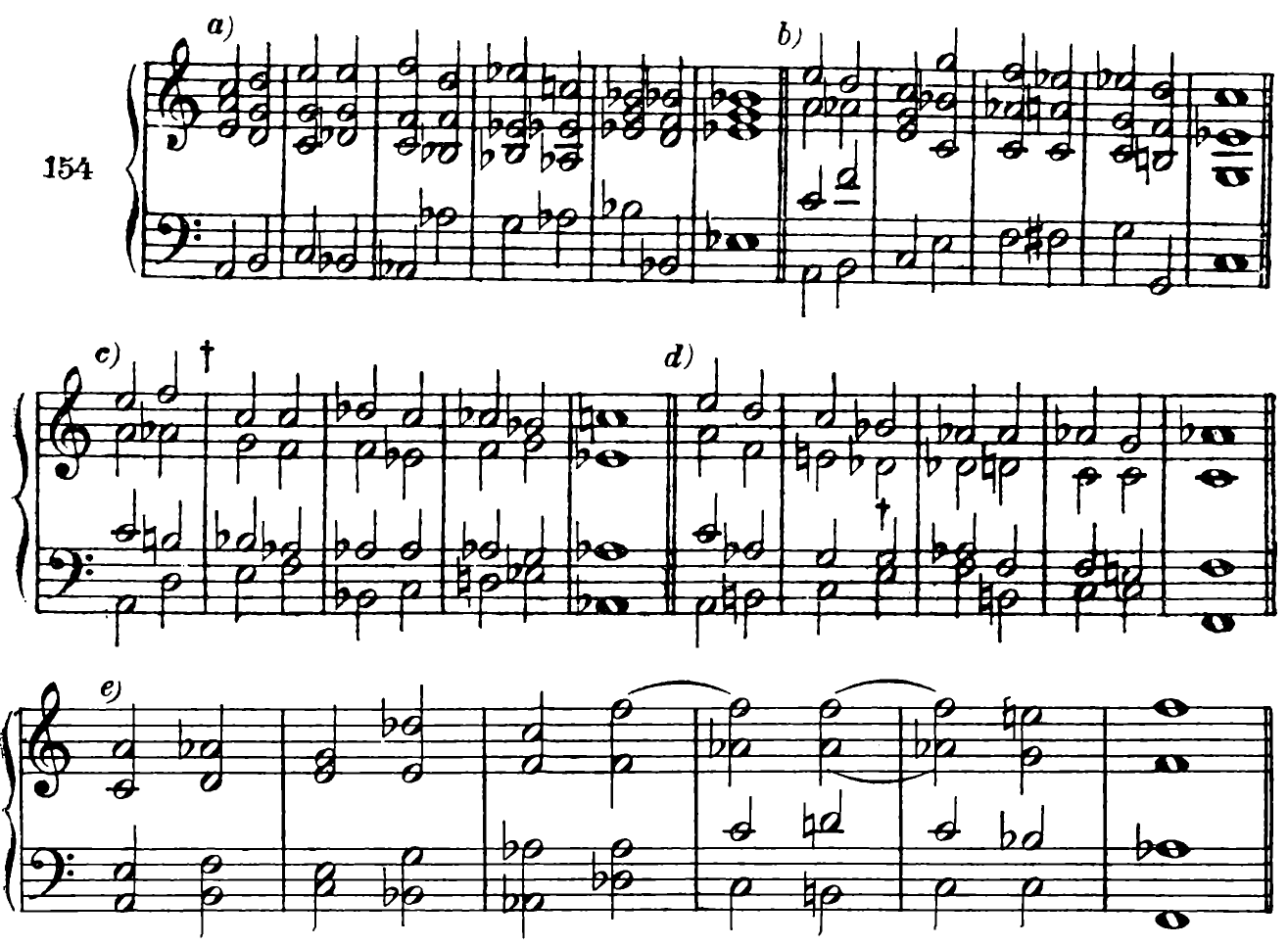
In 154 c the diminished seventh chord is followed by the directional seventh chord on the I degree of C. The tones of the diminished seventh chord need not necessarily arise through chromaticism (154 d). Likewise, we may here already allow ourselves (at first only with the diminished seventh chord) to use augmented or diminished interval steps.