 Playable Books
Arnold Schoenberg · section 60 of 66
6. A Few More Small Matters
Read and hear this section in the playable edition →Something close to what was shown about the diminished seventh chord in the fourth section of this chapter: there the possibility of setting any melody over a diminished seventh chord was demonstrated. Here the converse is shown—how a melody can stand over any diminished seventh chord, or the corresponding ninth chord. This is an old matter, occurring in a similar way already in the classical composers.
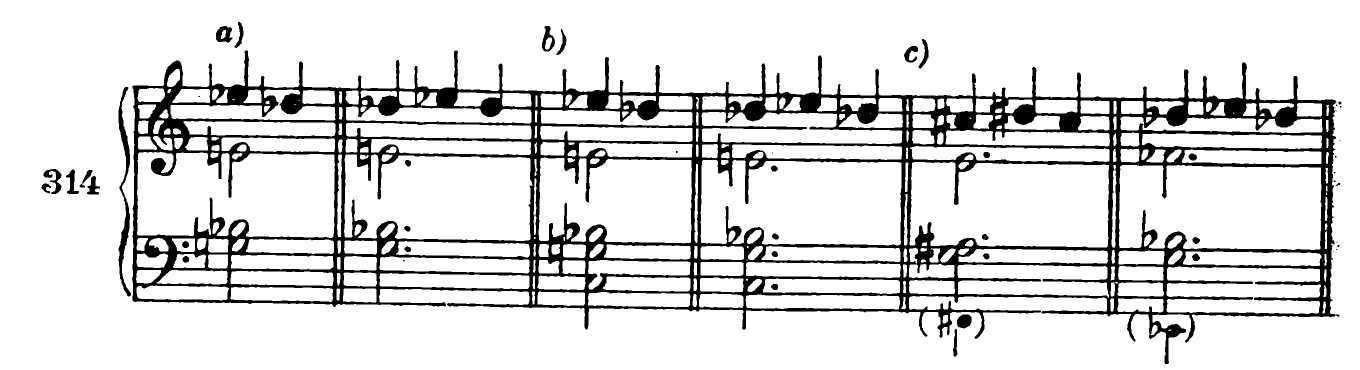
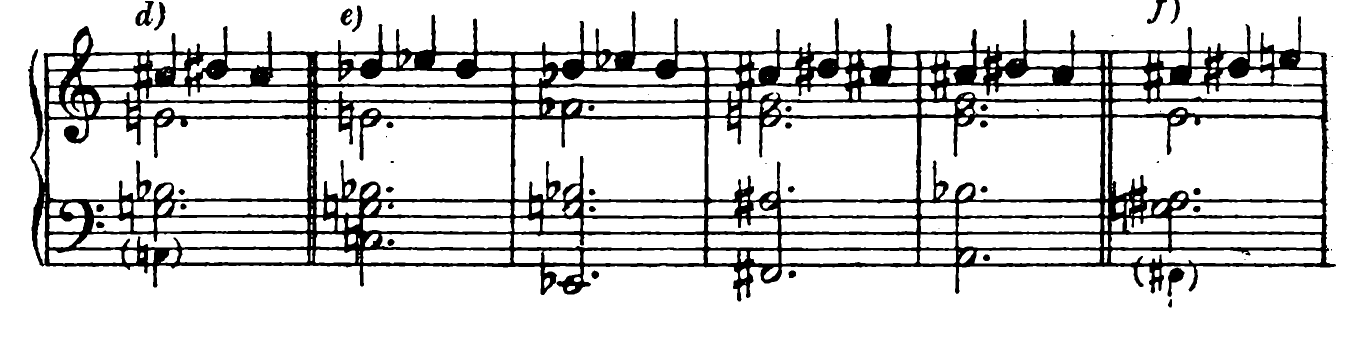
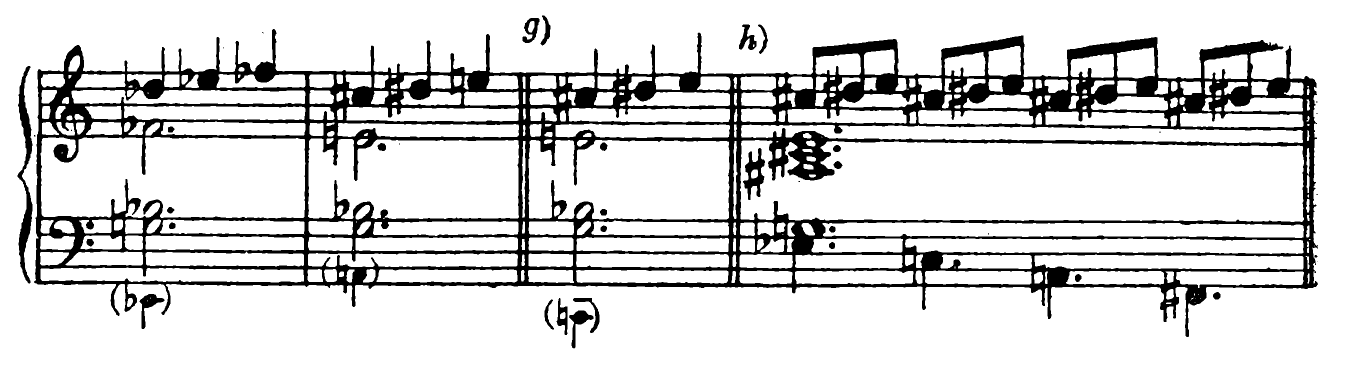
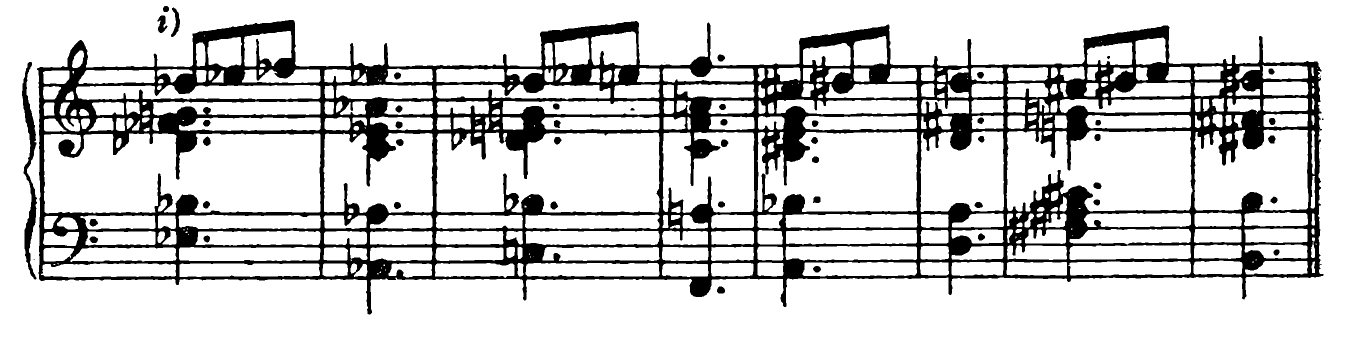
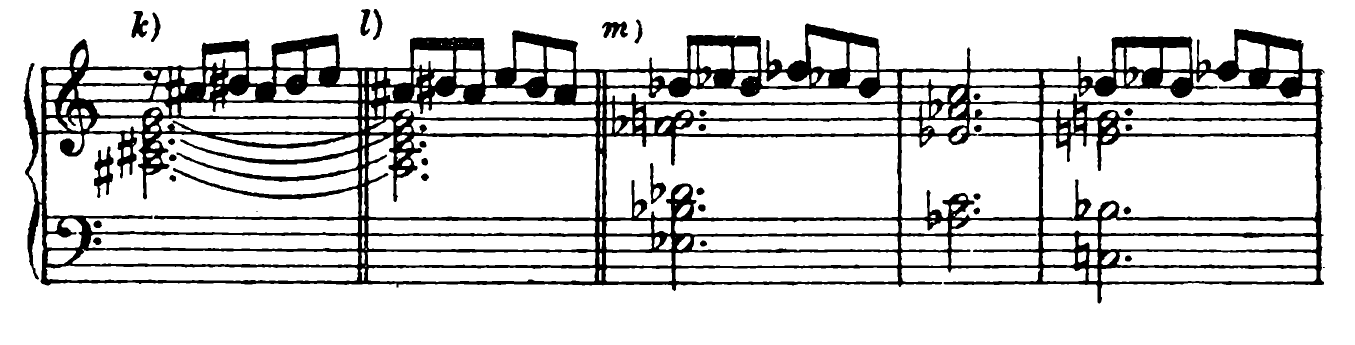
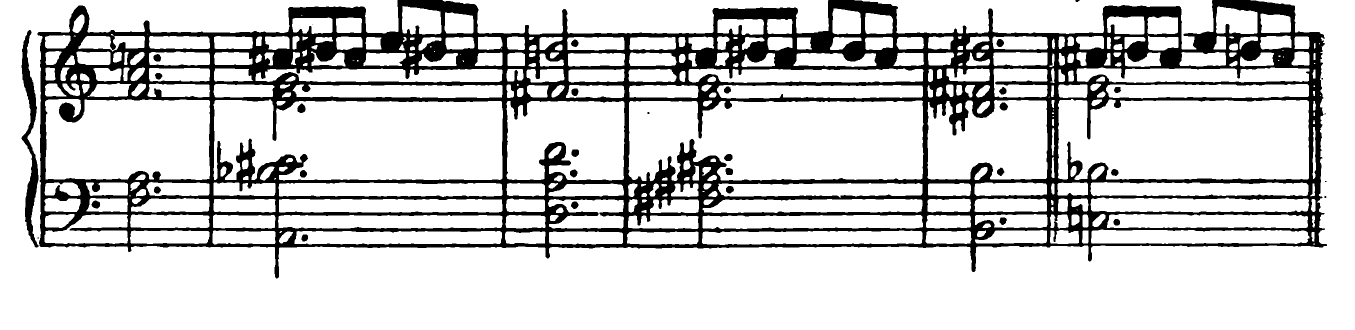
The suspension in 314a, and likewise the “returning” passing motion—a neighboring note—over a diminished seventh chord, are very familiar phenomena. E-flat as a suspension before a ninth chord is nothing new either (314b). Depending on the different roots to which this diminished seventh chord is referred (314c), the melody acquires a different meaning and spelling. Its unproblematic appearance over three roots, C, F-sharp, and E-flat, leads to its appearance over the fourth as well, in classical works, making 314d possible. Combined with the preceding material, this yields 314e, where it stands over all four ninth chords. The same can also be demonstrated with the figure 314f, making 314g possible. This leads to 314h, and in i the relevant ninth chords resolve by an upward leap of a fourth. The two figures can be combined into 314k or l, after which the same possibilities appear for this melody too (314m). Naturally, 314n can be treated in the same way, and one can just as certainly try similar things with other figures and over other vagrant chords. I shall demonstrate one of these possibilities with the augmented triad in the next chapter. Perhaps one will have little interest in placing these four turns directly beside one another as they stand here. But because one could do so, the possibility can serve a better purpose: harmonic variation that opens up a different continuation for a passage.
Something else: a connection that is also not rare and is best understood as an imitation of the diminished seventh chord (315a).
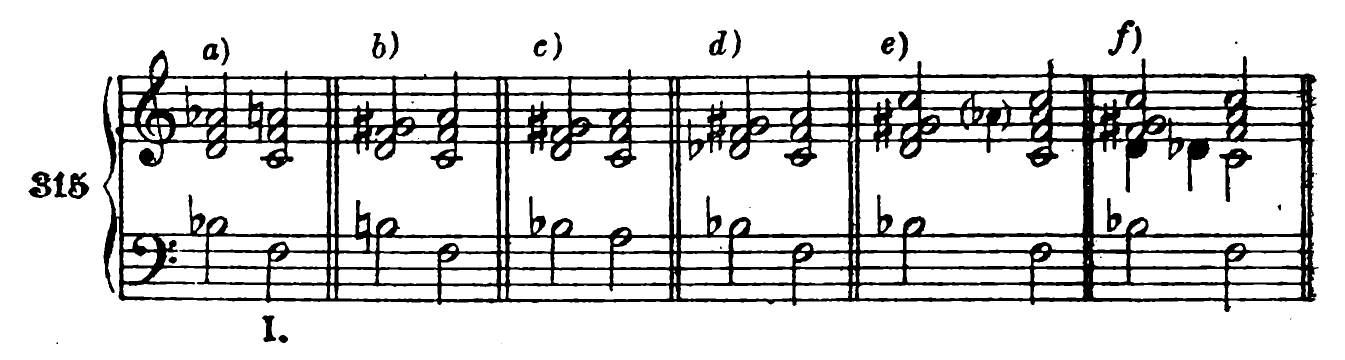
It strongly recalls 315b and is familiar to us as 315c, one of the resolutions of the augmented six-five or four-three chord. It also occurs with the lowered fifth, D-flat (315d), or as a kind of ninth chord in 315e. Even 315f is not unusual. This turn is very suitable for assisting modulations. The first chord here has, so to speak, a dominant character despite the descending step in the bass.
Something more must be said about the six-four chord, especially the one in the cadence. It is probably already treated quite freely today. In general, when it is used at all, its character is usually preserved by introducing or resolving it in a way similar to older music. Most often, however, its character is preserved by placing it at appropriately accented points, thus awakening the customary expectations. But Brahms already handled the departure from it more freely. I do not mean so much a case like the third measure of the Sapphic Ode, where the six-four chord appears as though the bass melody wished to continue—it has already introduced the chord earlier by using its tones—nor the penultimate measure of the same song, where anticipation in the bass produces a six-four chord. Rather, I mean a case like measures 14–19 of “Botschaft,” where a free leap is made out of it.
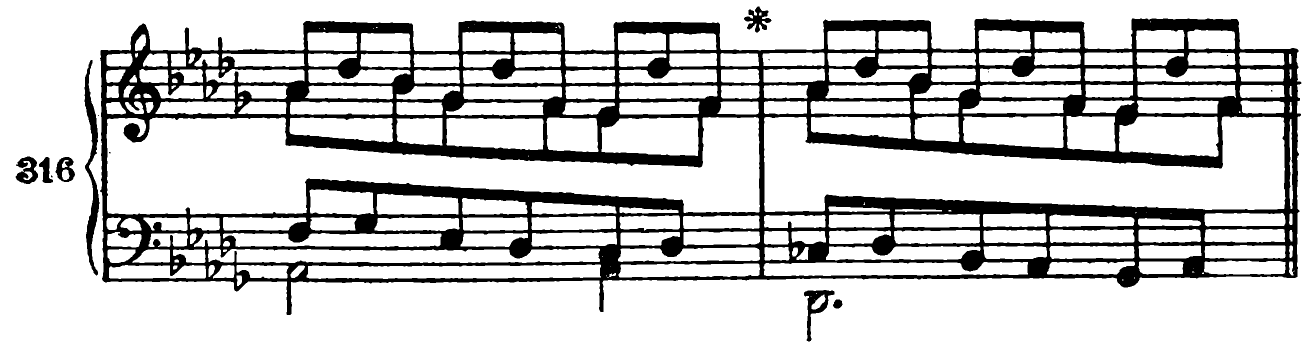
Here Brahms understands the six-four chord simply as another position of the triad, no differently from the sixth chord, which can readily pass into another position, root position. Naturally, newer music treats it still more freely. Thus the principle mentioned at the beginning—that one makes less fuss over dissonances once the ear is familiar with them—is truly confirmed in the development of art.