 Playable Books
Arnold Schoenberg · section 63 of 66
Whole-Tone Scales and Chords
Read and hear this section in the playable edition →For about ten years, a scale consisting of six tones at equal distances from one another has appeared ever more frequently in works by modern composers: the whole-tone scale.

It is said that the modern Russians or the French, Debussy and others, were the first to use it. I do not know exactly, but it seems that Liszt was first. This year* I heard the Don Juan Fantasy, previously unknown to me, and to my greatest surprise heard the whole-tone scale. But one thing I know: I knew neither the Russians, nor Debussy, nor this composition by Liszt when I first wrote it, and my music had long before shown the beginnings that had to lead to it. Some think that the whole-tone scale arises under the influence of the exotic, meaning the music of peoples among whom such and other series of tones are found. For my part, however, I had never known exotic music. My connection with these peoples could at most have been telepathic, for I made no use of other means of cultural communication. Nor do I believe the Russians or French exploited their perhaps closer maritime relations with the Japanese specifically for the duty-free import of this raw material. Rather, I believe that the whole-tone scale arose quite spontaneously in all the musical minds of our time, as a natural consequence of the latest events in music.
* 1910
There was an old composition teacher in Vienna who was employed for examinations for the teaching certificate. Every year he is said to have asked candidates: “What can you say about the augmented triad?” To emerge unscathed from this ordeal, the examinee had to answer: “The augmented triad is used with particular fondness by the New German music.”
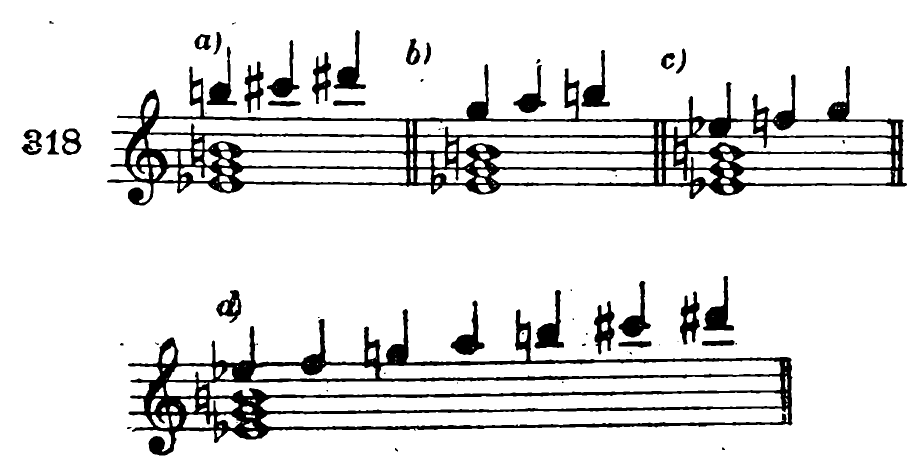
However dreadful this fact was to the old professor, his observation was correct. The New German music really did use the augmented triad with particular fondness, and extensively. It happened like this: the Valkyrie motive and certain other turns in Wagner were the starting point, some altered seventh and ninth chords helped further, and thus, I find, the origin of the whole-tone scale can be shown by a far less complicated route than international spiritual kinship. In modern composers' works, and in mine as well, two precursors of the conscious use of the whole-tone scale can be identified. The first: over an augmented triad, the melody proceeds from chord tone to chord tone, using a passing note that divides the major third into two equal parts and yields two whole-tone steps. Naturally this can occur from any tone (318a, b, c), producing the whole-tone scale (318d).
Passing notes over a dominant seventh chord with an augmented fifth (319a, b) or an omitted fifth (319c) produce the same result.
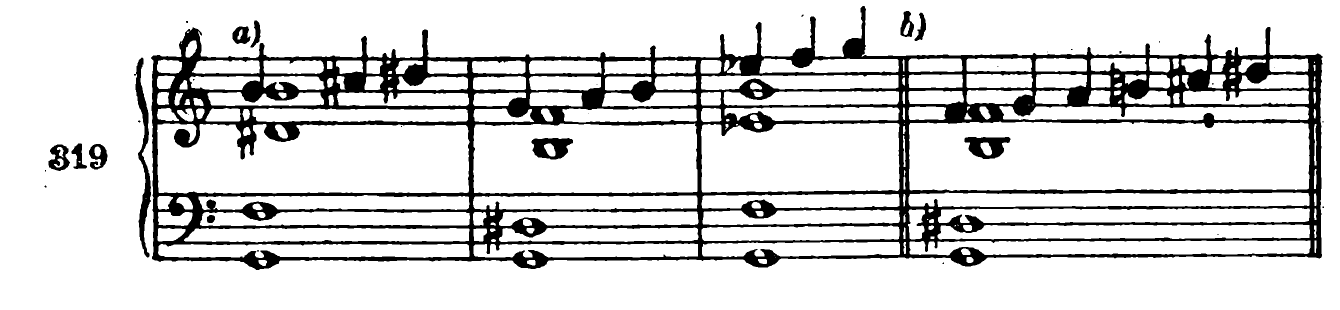
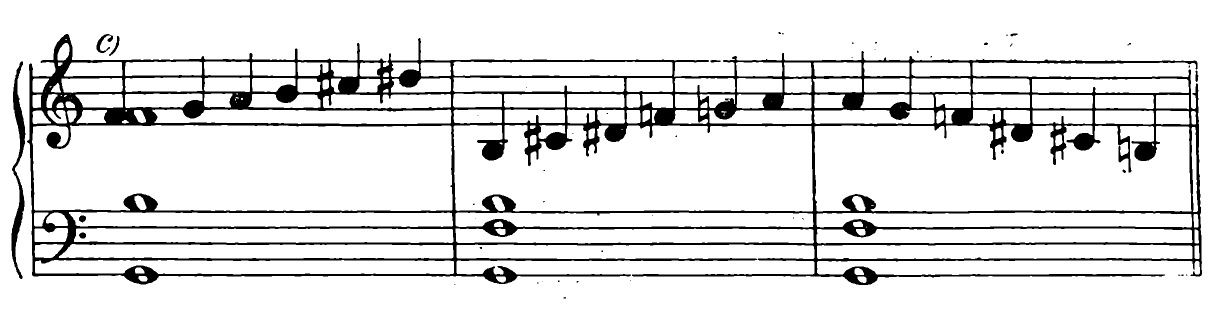
The two derivations are very similar, for the altered seventh chord is fundamentally nothing other than an augmented triad with an added seventh, and the omitted fifth in turn is identical with the augmented one.
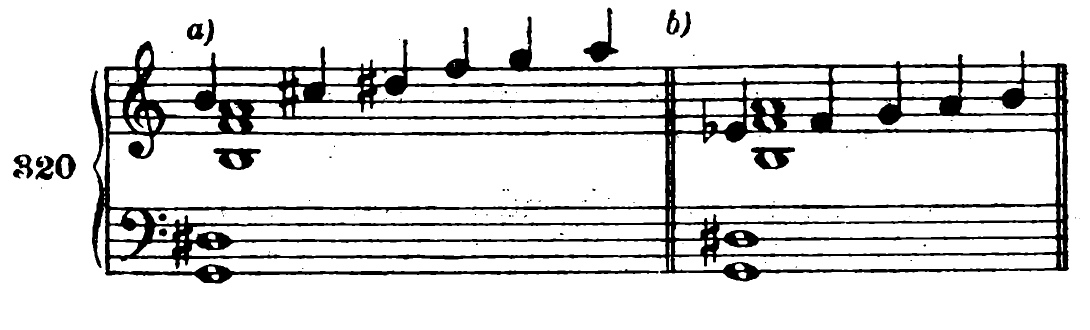
Likewise, 320a is merely a further development of the augmented seventh chord into a ninth chord. This chord contains five of the whole-tone scale's six tones. It is easy to understand that one can risk in succession, in melody, what one risks in simultaneity—for example in 320b, where only C-sharp remains missing to complete the whole-tone scale.
Example 321, however, shows a chord containing all six tones of the whole-tone scale.
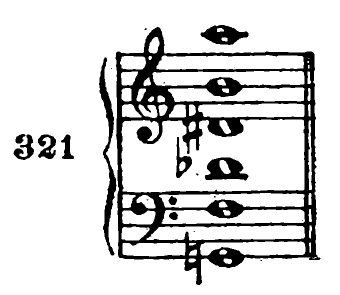
Its resolution is this:
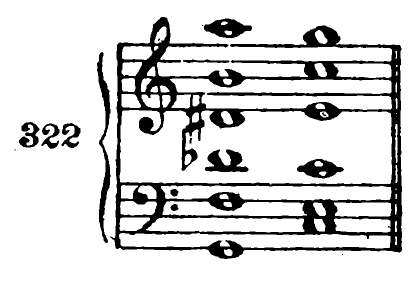
Its origin, this:
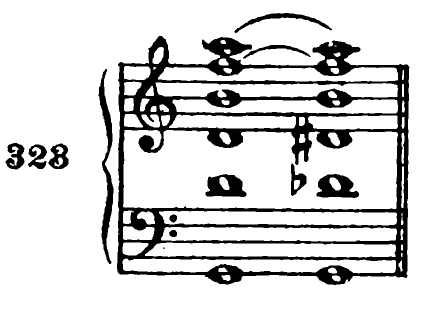
By simultaneously raising and lowering the fifth of the ninth chord, two tones develop that, together with the previous four, make six.
This derivation takes account of the way our ear combines: it connects things of the same kind, places events occurring far apart close beside one another, and superimposes events occurring side by side. Once the three groups of three tones in 318a, b, and c occur, they soon move closer together (318d) and finally sound simultaneously (321). However difficult such concentration initially makes comprehension, it promotes brevity of presentation.
Every modern composer has undoubtedly found himself placing three scalar notes over an augmented triad or a seventh chord with an augmented fifth. Better expressed, he has superimposed two motives or parts of motives—a frequent case in the age of leitmotivic work—one resting on an augmented triad while the other forms a scale segment of three to six tones. This explains why neither Strauss, Debussy, Pfitzner, I, nor any other modern composer was the first from whom “the others got it.” Each found it for himself, independently of the others. For example, I use whole-tone chords in my symphonic poem Pelleas und Melisande, composed in 1902, approximately at the same time as Debussy's opera of that name, in which, I hear, he too first uses whole-tone chords and the whole-tone scale. In any case, it was at least three or four years before I became acquainted with his music. I use them in the following way:
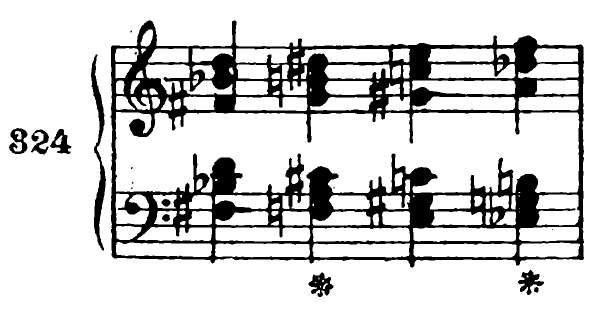
Moving augmented triads in contrary motion produces chords alternating between an augmented triad and, at the asterisk, a whole-tone chord. But even my Gurrelieder and Sextet contain passages pointing toward the whole-tone scale. In the Sextet it occurs in an inner voice, as someone recently pointed out to me. In the very next work I wrote it as a whole-tone scale, without having become acquainted with anything else in the meantime.
Debussy uses this chord and scale more as an impressionistic means of expression, something like a tone color, as Strauss also does in Salome. For me, however, they arose by a harmonic and melodic path; I felt the chords more as a possibility for connection with other chords, and the scale more as a particular influence on melody. I have never overestimated whole-tone chords or the whole-tone scale. However tempting it seemed that two such scales—there can be only two, since the third would already repeat the first—could displace the twelve major and minor scales

in a way similar to the earlier displacement of the eighty-four church modes, I immediately sensed that exclusive use of this series of tones would soften expression until all distinct character ceased.* As stated, there would be much that was tempting in having only three scales: the two whole-tone scales and the chromatic scale. But at the very moment this idea had a chance to cast its fetters around development, it was already obsolete. The recognition that binding oneself to such series of tones was unnatural and superfluous had to put an end to it. For anyone who regards tonality as an indispensable requirement of musical artistic effect, all such series dispose of themselves. At least it ought to be so: if the harmonic possibilities shown here are used in modern works not merely occasionally but almost exclusively, reference to a root must be called a disturbing asymmetry. And if tonality in other cases is an artistic device producing an appropriate effect, here it could easily become one intended to counterfeit an entirely inappropriate effect. I believe it is impossible to flirt with freedom while still bound to unfreedom. Vagrant chords, relationships to every key, whole-tone series, and whatever else happens to be fashionable are supposed to occur; the key's fetters are to be loosened, its stabilizing elements suppressed, its dissolving elements supported. Yet at the end, or occasionally somewhere else, the key is to appear and make us believe it ruled everything that happened! Someone has again “taken a prisoner who will not let him go.” I should not wish to sit on the throne from which tonality's sovereign splendor radiates here. No, I really believe it cannot be done. If tonality is to be achieved, it must be pursued with every suitable means. Modulations must observe certain proportions, as the classical composers actually did; elements that cannot be bound must be excluded, and only those that willingly fit may be used.† Thus anyone who believes in tonality, in series of tones, must exclude such new series from the outset. But what other purpose could establishing a series of tones have than producing a tonality, a specific tonality? Melodic purposes? Does melody need authorization through a special series of tones; is the chromatic one not enough? And what service could it render to chords, when these series were only established long after the chords existed! The series would not even express the chords' origin; indeed, it would exclude some chords. Some things could not be done without departing from it. By contrast, the ancients' series and our major and minor at least corresponded to the average events of a piece. Only someone who wishes to demonstrate mastery within restrictions because he knows too little to master freedom could want to adapt the average events of creation to the unfreedom of new series.
* I do not overlook that this judgment may be as nonsensical as that of our Viennese professor, who found Tristan boring because of its many diminished seventh chords. But because I believe it, I consider the wrong of not saying it greater than the advantage prudent silence would bring me. There is a small difference: I have said this not of completed works but of unwritten ones. And another: the old professor found Tristan boring not because of the diminished seventh chords but because he did not understand it at all. When one fails to understand something, self-respect overreaches itself, becomes self-conceit, and shifts the cause, which lies only in the subject, onto the object. There is another difference too: Tristan does not actually contain so many diminished seventh chords, whereas I oppose the exclusive use of a scale, something I have already seen in pupils and can definitely call poor. So far I have not found it in masters. If it occurs, I shall withdraw this judgment in good time.
† What is said here only apparently contradicts what I said earlier about tonality: that whether it is achieved depends on an author. For I consider it possible to achieve it. I doubt only whether one must still strive for it, or indeed should strive for it at all. For this purpose I drew attention to the formal possibilities of floating and suspended tonality. These too permit the assumption of an operative center, but show that there is no need to help this center outwardly to a power it possesses, at most, inwardly.
This also disposes, for me, of the otherwise apparently very ingenious attempts by Busoni and Georg Capellen. I do not yet know the latter's book, but shall certainly read it.* I like the attractive melodies he published in Die Musik in August 1910. They are expressive, interesting, and warmly felt. But I do not believe that special series of tones must be established to reach such and other melodic turns, that what ought to be invented must be constructed in advance. I know for certain that it can be done otherwise, and firmly believe that one must not compose in this way. Invent, do not calculate! One may think things out, but must not oneself notice how one thinks. One can create freely from within a key only when the feeling for that key exists in the unconscious. I do not understand why someone who can invent such attractive melodies despite a constraint does not prefer to rely on the power within him, which even that constraint cannot entirely paralyze, instead of pursuing theories that do not grow on the same side as the creative act.
* While correcting the proofs now, in 1911, I leaf through his book Ein neuer exotischer Musikstil and gather that, supported by a quotation from Riemann, he combats the “dogma” of independent voices, the prohibition of parallel motion. He then quotes Professor Stumpf, who says it is conceivable and probable “that gradually the ratios 4:7, 7:8, 5:7, and the like will also be elevated to consonances.” At such moments I regret knowing so little. I have to guess all this. If I had suspected that a scholar of Stumpf's reputation held the same view as I! I lack all these sources; I depend on only one: thinking. Progress is slower that way! But it is possible nevertheless. And I was right to resist “Back to nature” instinctively and wonder why a Debussy hoped to find nature behind the paths of art, on stretches already traversed, in that hinterland that becomes a byway of art because it is the gathering place of stragglers and marauders; why a Debussy did not feel that whoever wants to reach nature must go forward, not backward: Forward to nature! If I had a motto, perhaps it could be this. But I think there is something higher still than nature.
And Busoni, that noble and courageous artist: I esteem and revere him greatly. But he could spare himself the trouble of calculating hundreds of scales. With great difficulty I memorized the names of the seven church modes—and those were “only the names!” I shall not be able to remember five of his keys. How, then, am I to compose them if I do not even have them before me? Should I do as Weingartner does, writing them out above in front of him? No, I should not like to do anything as Weingartner does!
What I said earlier about tonality does not go so far that it could be understood as criticism of a masterpiece. In the works of Mahler and Strauss, for example, I still find tonality entirely of a piece with their thematic material. It is therefore important for me to say here that I consider Mahler's work immortal and place it beside that of the greatest masters. Apart from that, a theoretical consideration such as this could not make me doubt the powerful effect I experienced. At various places in this book I have shown that the artist has something else to say besides his technique; and it is above all this other thing that he says to me. I have always understood only in this way and analyzed afterward. My arguments were intended to refute belief in the necessity of tonality, not belief in the effect of a work whose author believes in tonality. An author can outwardly express in his work what he believes theoretically—fortunately, only outwardly. But inwardly, where the instinctive person begins, all theory fortunately fails, and there he expresses something better than his theory or mine. If Goethe's sentence “The master reveals himself in limitation” has any meaning at all—and certainly not the meaning artistic philistines always want to give it; even if Goethe himself intended that meaning, it fits him least of all, for he was far too great for the narrowness of this misguided saying—it can mean only this: within the limitation that our narrow powers of imagination and comprehension would impose on our true life of mind and impulse, the master reveals himself by breaking through the barriers and remaining free even where he thought himself unfree, because external constraint made him wish for it as a means of keeping himself artificially balanced. Thus my criticism, even if it wished to, does not strike the master who strives for tonality, but only his belief, the superstition that overestimates its significance and theoretical necessity.
The whole-tone scale is an artistic means of splendid coloristic effect. Debussy is entirely justified in using whole-tone chords in this sense, for his work is effective and beautiful. But I do not wish to omit demonstrating the harmonic and constructive possibilities of this harmony as well. Regarded as vagrant chords, whole-tone chords have at least the same possibilities of connection as the augmented triad. Depending on what they are referred to, they can be used for modulations and departures.
Each tone can be the root of a dominant; thus six resolutions into major triads result.
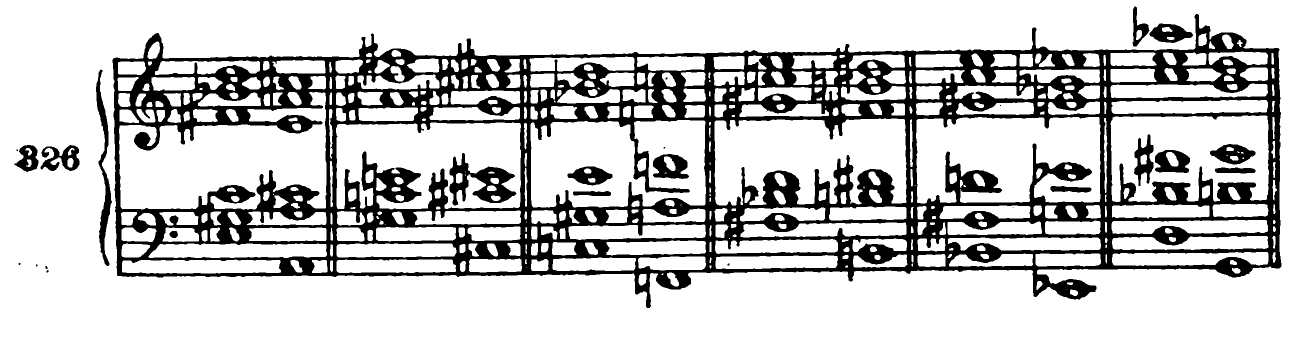
Naturally, every other type of resolution shown will likewise yield six transpositions, one on each of the six tones. Thus there are also six resolutions into a dominant seventh chord (327a), a secondary seventh chord (327b), a diminished seventh chord (327c), two augmented triads (327d and e), a seventh chord with a lowered fifth (327f), a minor ninth chord with a lowered fifth (327g), a major ninth chord (327h), a minor ninth chord (327i), and finally the other whole-tone chord (327k).
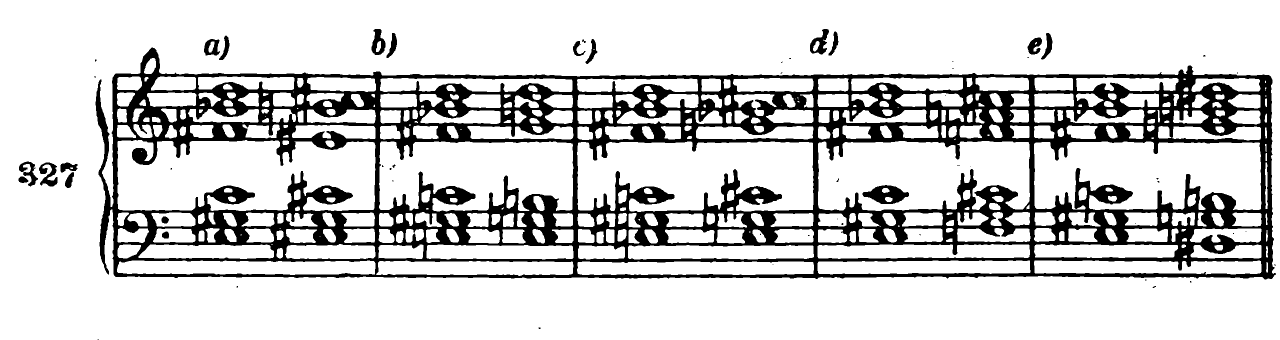
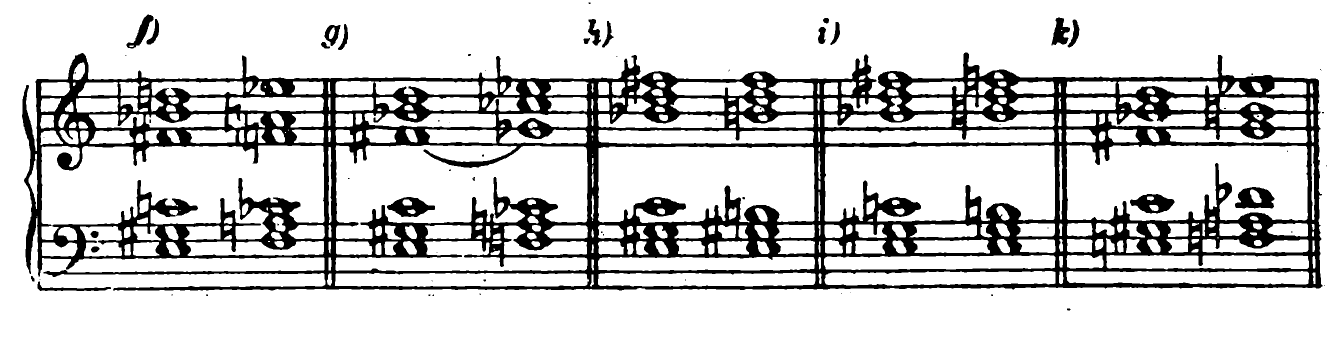
That already makes more than sixty resolutions, even though here we have adhered chiefly to chromatic progression or stationary tones: resolutions entirely in the spirit of strict dissonance treatment. Many others can surely be found by the same path. If strict resolution is replaced by free resolution, as we have often done, the number of possibilities must increase considerably.
I refrain from giving examples in passage form here; for a reason already stated, they could scarcely turn out well. Using such chords will hardly be possible without the melodic voices also showing the influence of this harmony. But such melodies, if one wishes to invent them, cannot forgo being something more in every respect than is sufficient for an exercise example. They would already have to be melodies with motivic force, expression, rhythm, and the like. I do not believe this can be achieved by the dry procedure of an exercise example. The pupil may try. I prefer not to, so as not to contribute unnecessarily, where I need not, to the discouraging examples customary in harmony textbooks. If the pupil examines modern music, he will find what he needs. He understands the case and has a stimulus for exploiting it; the rest will come of itself or never.
I have often said that certain things should be permitted later. This would be the place for that. Yet I do not wish to give this permission without recommending that the pupil make no use of it. In the last chapter I discuss in detail the reasons for this restraint. They are not so much pedagogical considerations—though those too—as artistic ones. Let the pupil wait until he knows his talent!