 Playable Books
Arnold Schoenberg · section 64 of 66
Chords Built in Fourths
Read and hear this section in the playable edition →I have shown that the system of building in thirds has a break, and have exposed the grouping of chords that cannot be fitted into it under the heading “nonharmonic notes” as a poorly disguised attempt to plug the hole in the system with a substantial heap of unsorted waste material—a heap so large that neither the hole nor the system itself is big enough to admit it. Speaking here of chords built in fourths by no means proposes replacing the old system of construction in thirds with one of construction in fourths. Since a system of fourths is identical with one of fifths, it might appeal to nature no less and could present all conceivable chords more uniformly than the system of thirds. But we must not overlook that the contradiction with the reality of present-day music would be considerable: a major triad is simple in the old system, complicated in the new. In the latter a triad would be D–G–C, or C–G–D, which certainly has a natural justification: C, the root, has G as its first overtone, whose first in turn is D. Yet this combination is certainly not as natural as C–E–G. Although nowhere is the tone's will fulfilled as it is in chords of fourths, so that resolution into the tone a fifth below emerges almost as a symbol of the unity of everything sounding simultaneously, indeed of everything sounding at all, the system of fourths would still be forced to seek some explanations outside nature. This would not, however, put it behind the old system, which can dispense with artificial assistance far less easily. Nevertheless, I believe such an attempt, perhaps temporarily supplementing the system of thirds, would open certain new prospects for the theorist. I cannot decide whether everything would become simpler than before, and therefore avoid entering into details, which would merely add new confusion to the old disorder. I confine myself to explaining why I speak of chords of fourths: the form in which these chords appear and from which they derive justifies the name, since, as far as I know, they occur in the literature chiefly as superimposed fourths.
Like probably everything that later becomes a generally used technical resource, chords of fourths first appear in music as an impressionistic means of expression. Think, for example, of the effect of the first use of violin tremolo: one will understand that such things involve not a cold technical experiment, but an idea called forth by a strong need for expression. The true composer writes the new and unfamiliar in a new combination only for such reasons: he must express something new, unheard-of, that moves him. To successors who develop it further, it appears merely as a new sonority, a technical means. But it is far more: a new sonority is an involuntarily discovered symbol announcing the new person who expresses himself through it. Such a new sonority, later characteristic of an artist's entire work, often appears very early. In Wagner, for example, one can see chords already in Lohengrin and Tannhäuser that later became so significant for his harmony. But in the early works they appear only occasionally, placed at exposed outposts, at moments of often strangely new expression. They are expected to do everything, the utmost: represent a world, express a new world of feeling, say in a new way what is new—a new person! In Wagner, still near enough for us to remember what was new about him, yet distant enough for us to gain some overview and understand his development and that of the new in him, this is easy to trace. Starting entirely from what everyone in his time understands as music, his music initially follows only the need to express himself somehow, without the slightest concern for beauty or novelty, style or art. But without his noticing, traits creep in that point toward development. At one time it is merely his failure to accomplish something any ordinary artistic craftsman would have done impeccably. Here he has inhibitions intended to provide a new channel for his current. At another it is something positive: an idea, an immediate, unconscious, often brutal, sometimes almost childish expression of his own nature. But the young artist does not know himself, does not yet feel how he differs from others, above all from the literature. On the whole he still follows what his education gives him, unable to break through it everywhere in favor of his own inclinations. He does not break through; where something breaks through, he does not know it. He believes his work differs in no way from what is otherwise regarded as good art, and suddenly awakens abruptly from his dream when the harsh reality of criticism shows him that something in him does not quite fit—as it must never fit in a true artist: he lacks complete agreement with those average people who could be educated through culture. He begins to notice what different things he loves and hates. The artist who has courage gives himself entirely to his inclinations. Only someone who gives himself to his inclinations has courage, and only someone who has courage is an artist. The literature is cast away, the results of education shaken off, the inclinations emerge, the inhibition gives the current a new channel, the single tone that was only a subordinate color in the earlier overall picture spreads out: a personality stands before us. A new person! This is an example of the artist's development, of art's development.
This is called revolution, and artists who submit to and love such necessities are accused of every imaginable crime gathered from the refuse of political vocabulary. Yet it is forgotten that one may call it revolution only by analogy, and that the comparison need hold only in the compared, similar points, not in every respect. An artist with a good new idea must not be confused with an incendiary or a bomb thrower. A similarity between the emergence of the new in intellectual life and political revolutions exists at most in the fact that the successful rules for a time, and the older, foreseeing this, feels threatened by the newer. But the fundamental differences are greater: the intellectual consequences of a thought endure because they are intellectual, whereas the consequences of revolutions in the material sphere are transient. Moreover, new art has never intended or had the effect of displacing or destroying its predecessor, old art. On the contrary, no one loves his ancestors more deeply, intimately, and respectfully than the artist who brings something truly new, for reverence is consciousness of one's calling and love a feeling of belonging together. Need we recall that Mendelssohn, once new himself, unearthed Bach, Schumann discovered Schubert, and Wagner first awakened true understanding of Beethoven through work, word, and deed? The appearance of the new is far better compared with the flowering of a tree: the natural growth of the tree of life. But if there were trees interested in preventing flowering, they might call it revolution. And conservatives of winter might fight every spring, even if they had experienced it a hundred times and could have observed that it ultimately became their spring too. Deficient memory and limited insight suffice to confuse becoming with overthrow, to believe that when the new sprouts from what was once new, this destroys the old.
This is how I understand the impressionistic character of new artistic means at their first appearance: youthful utterances of something becoming, entirely feeling, without a trace of consciousness; still strongly connected with the germ cell, more intimately united with the universe than our consciousness is, yet already the sign of a particular nature that will later produce an eccentric—one who sets himself apart because he is constituted differently. A sign of possibilities that will later become certainties; a premonition surrounded by mysterious radiance. And because these means belong to what connects us with the universe, with nature, they almost always appear first as the expression of a mood of nature. The brook recalls the spring.
It is remarkable that something so happily found never entirely loses its effect, even if it is only the starting point of a development that will leave its first form far behind. Further development may bring it to its highest artistic unfolding, but will never produce the impression, the impression of this particular kind, made by its first appearance. I am thinking of the horn passage in the final movement of the Pastoral Symphony and the sound of distant hunting horns at the beginning of Tristan's second act. These will probably never lose their charm for any of us, although what underlies them has developed far since then.
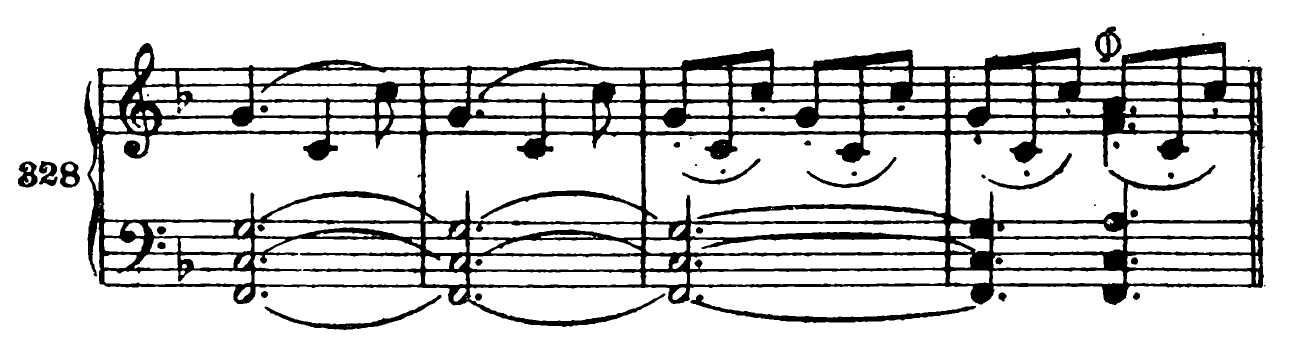
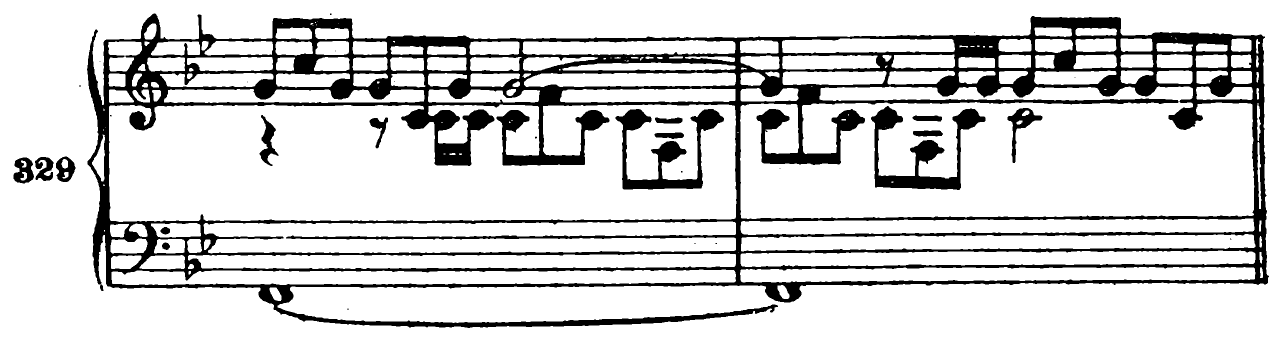
In Beethoven this is not an ordinary pedal point with a melody avoiding the third; in Wagner it is not merely the use of the horn's natural tones, for he has the other horns play tones outside that series as well. One surely senses this without an explanation. That Beethoven fully sensed its particular quality is shown by his sense of form, which urges him to answer it congruently with another particular quality, to resolve it, so to speak: the rhythmically remarkable entry of the tonic harmony in the second half of the measure, at the circle-and-line sign.
I believe these two passages are the starting point for everything modern composers have written in combinations of fourths. Certain successions of fourths in Mahler, the Jochanaan theme in Salome, and the chords of fourths in Debussy and Dukas can be traced to the peculiar effect of untouched freshness that emanates from these chords. Perhaps the future of our music speaks through this freshness. Only those capable of impressions, the impressionists, hear it. The impressionist's organ is an extremely finely tuned mechanism, a seismograph registering the slightest movement. The most delicate stimuli can excite its sensitivity, while coarser ones destroy it. Following these delicate stimuli, which the coarsely constituted person never perceives because he hears only what is loud, strongly tempts the true impressionist. The quiet, scarcely audible, and therefore mysterious attracts him, arousing his curiosity to taste what has never been tried. Thus the unheard-of is as inclined to reveal itself to the seeker as the seeker is to find the unheard-of. In this sense every truly great artist is an impressionist: the finest response to the quietest stimuli reveals to him the unheard-of, the new.
This is particularly striking in Debussy. His impressionism sets down chords of fourths with such force that they seem inseparably bound to the new thing he says, and can rightly be regarded as his intellectual property, although similar things can be shown to have been written before him and at the same time. Their expression of moods of nature may contribute to this, for they do indeed sound as though nature spoke that way. It is understandable that everything else recedes before nature's language.
Like probably many others, I too wrote chords of fourths without having heard Debussy's music—perhaps even earlier, certainly at the same time. As far as I know, first in my already-mentioned symphonic poem Pelleas und Melisande.
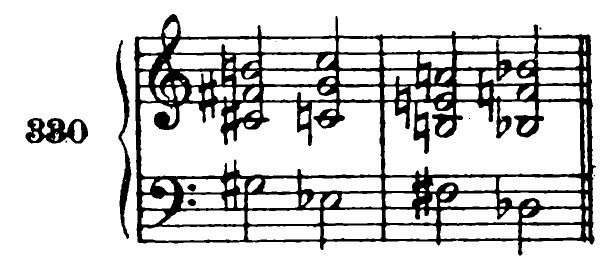
There they occur only once, quite isolated, as the expression of a mood whose particular character made me find, against my will, a means of expression new to me. Against my will: I still remember hesitating to write this sonority down. But the clarity with which it imposed itself on me made it impossible to reject. Only long afterward, in my Chamber Symphony, did I take up chords of fourths again, without recalling this case and without having meanwhile become acquainted with Debussy's or Dukas's music. Springing from an entirely different need for expression, stormy jubilation, the fourths here form a definite horn theme (331),
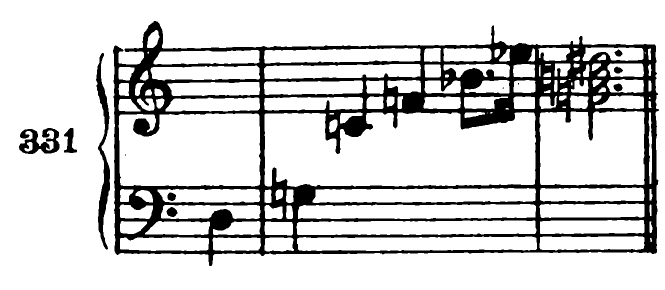
spread architecturally across the entire work, and stamp everything that occurs with their character. Thus they appear here not merely as melody or as a purely impressionistic chord effect: their particular nature permeates the entire harmonic construction. They are chords like all the others.
I must be forgiven for discussing my own work so extensively. I must do so because I do not know whether another composer before me used these chords in this sense, this harmonic sense.* For the harmonic sense includes their use as an impressionistic means of expression. Thus when I speak of myself, I speak of the matter itself, as Karl Kraus says.
* It is possible, indeed even probable, that others besides me wrote these chords—perhaps Mahler, Strauss, or Pfitzner. But I do not know. They have not struck me; perhaps I merely failed to notice them. In no case do I wish to secure priority for myself here. That matters too little to me, for I know all too well that it is not what counts.
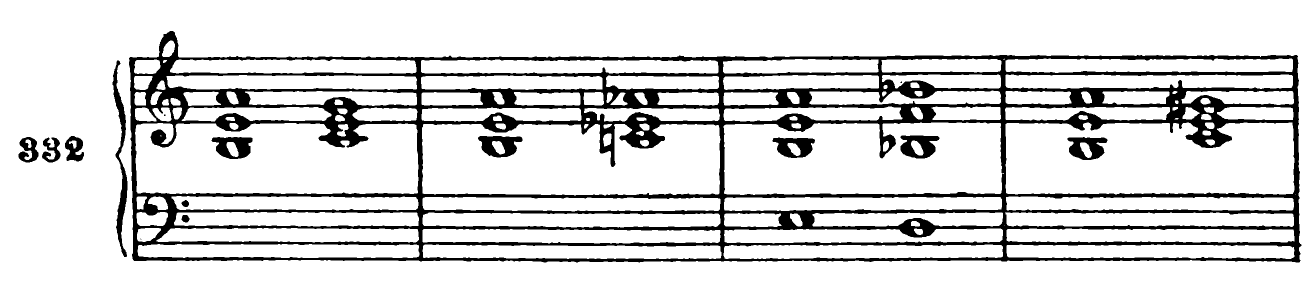
Not all forms of chords of fourths occur in this work and my later works. Some possibilities are presented here.
Three-, four-, five-, six-note sonorities, and so forth, can be obtained. They all allow varied uses:

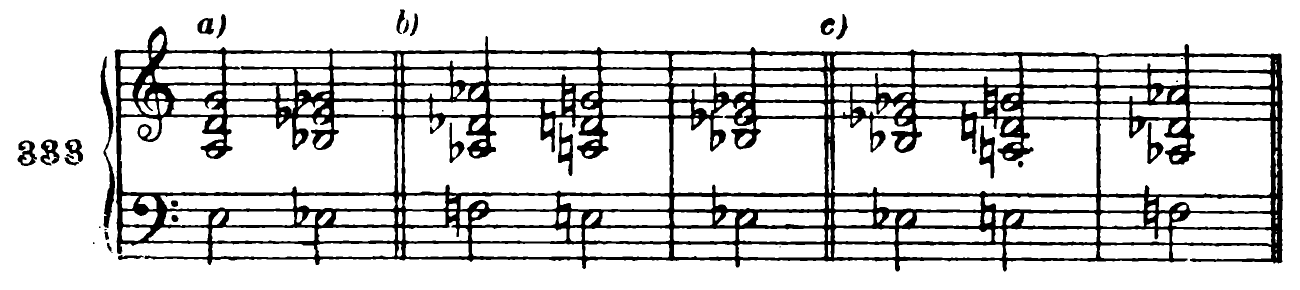
The four-part chord of fourths can even be produced through alteration within the system of thirds (333b and c).
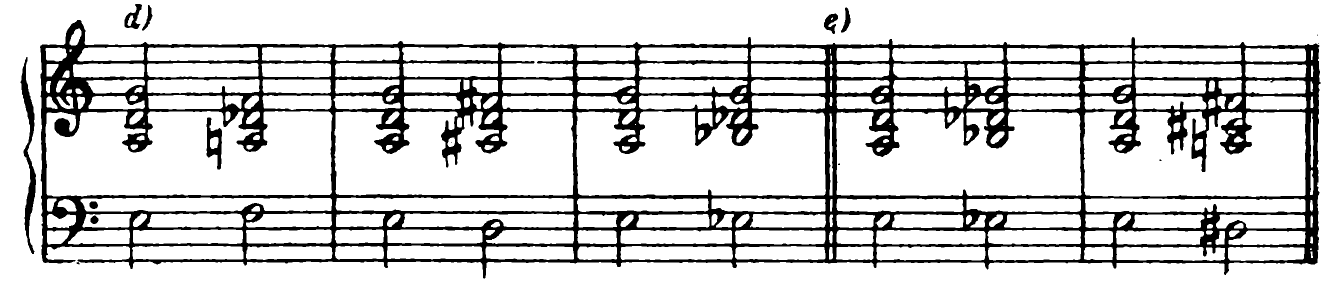
Likewise the five-note chord. Both it and the four-note chord can substitute for a dominant, from which they derive: in the four-note chord of fourths, by lowering the root, if one admits that, the seventh, and the fifth; in the five-note chord, by raising and
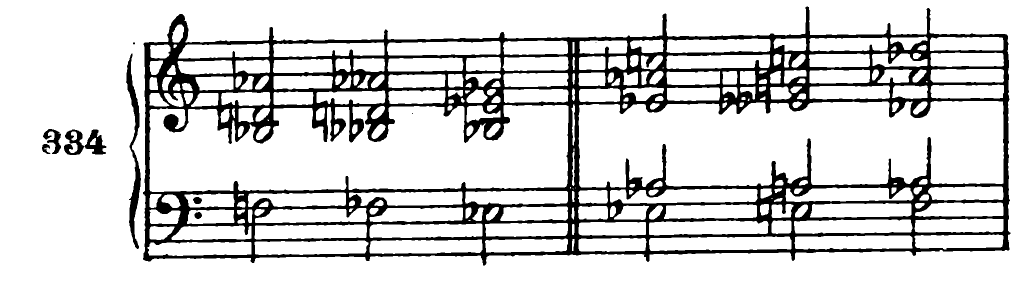
lowering the root—A-flat to A, or B-double-flat, and to G—raising and lowering the fifth—E-flat to E and to E-double-flat—and keeping the third stationary. Inversions were used here. But if one does not shrink from fifths, root positions can naturally be used as well.
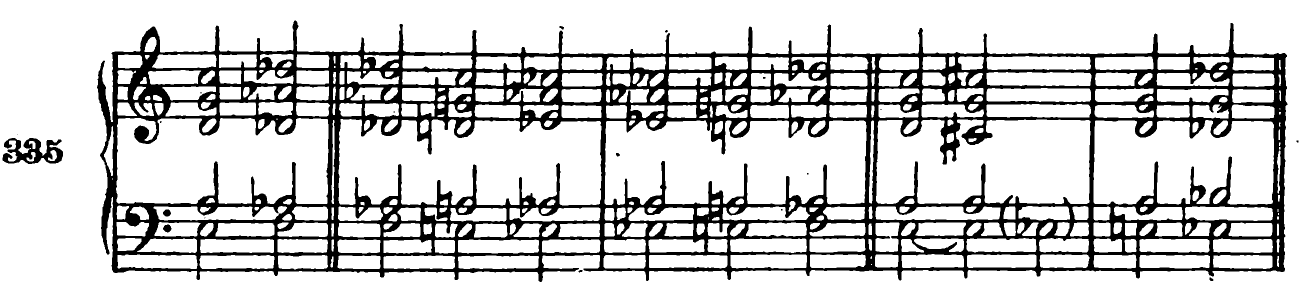
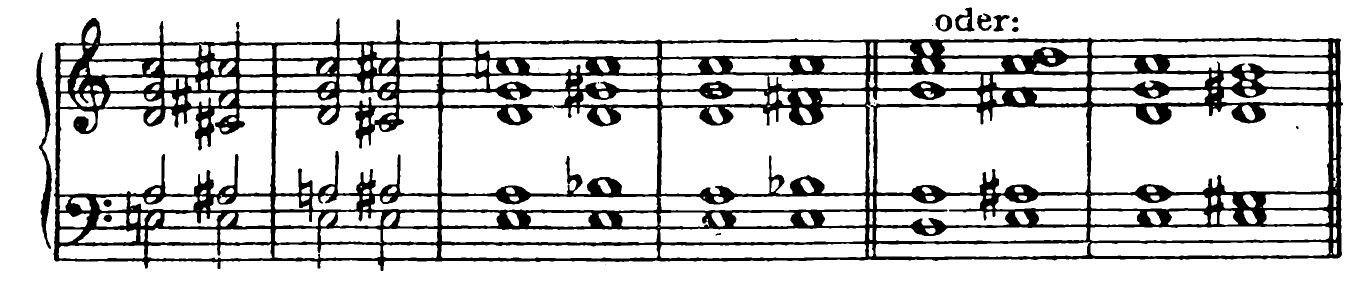
Example 335 shows some connections with customary chords. The six-note chord of fourths contains a minor ninth above the bass and is therefore the first “sharper” dissonance among these chords. One will thus be inclined to deal with this ninth first, resolve it, or the like. I give only connections that resolve the ninth.
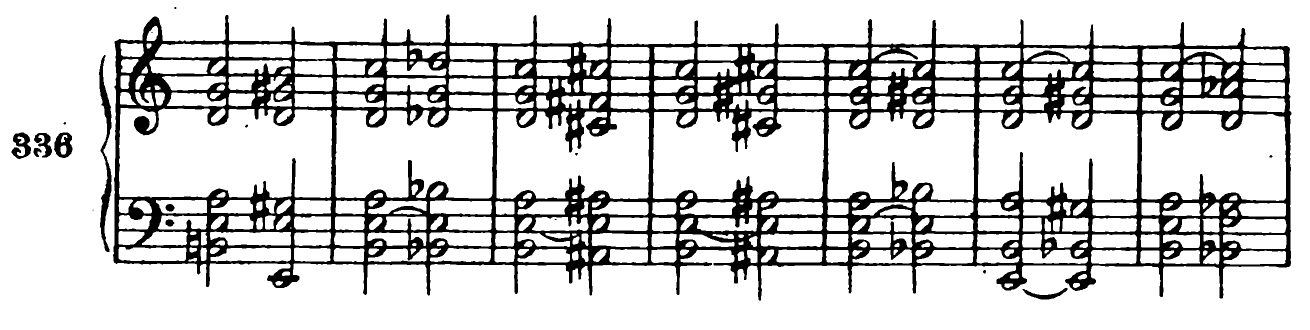
Notice that only resolutions into the most customary chords are listed. Even less customary ones whose use would scarcely provoke objection, such as 337a, have been omitted.
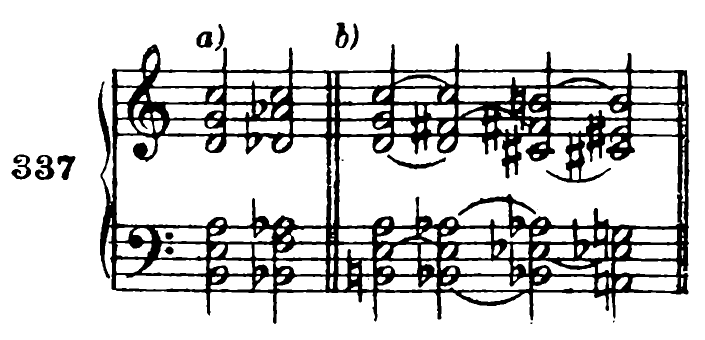
Example 337b shows how lowering three tones—B to B-flat, A to A-flat, G to F-sharp—produces the six-part whole-tone chord, a connection also occurring in my Chamber Symphony; and how lowering the three remaining tones—C to B, D to C-sharp, E to E-flat—turns it back into a six-part chord of fourths.
Naturally, one could also present chords of fourths with seven, eight, nine, or still more parts. Since I do not know them as chords of fourths, although I have certainly written them myself, I refrain from presenting them theoretically. Theory might stimulate here, but, as often stated, it should never anticipate events. One thing could induce me to continue this system: building chords in fourths can lead to a chord containing all twelve tones of the chromatic scale, thus offering a possibility for systematically considering harmonic phenomena already occurring in works by some of us—chords of seven, eight, nine, ten, eleven, and twelve parts.
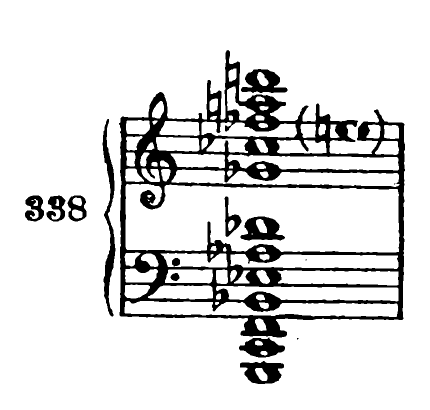
Besides me, my pupils Dr. Anton von Webern and Alban Berg have written such sonorities. But the Hungarian Béla Bartók and the Viennese Franz Schreker, both following a path more similar to Debussy, Dukas, and perhaps Puccini, are probably not far from them either. However much the inclinations of our most gifted young composers seem to favor such chords,* it would have little value to offer a system already today, because our short distance from these events still confuses our vision. But, as stated, construction in fourths permits all harmonic phenomena to be accommodated. If one assumes that tones may occasionally be omitted from the middle, so that a chord could consist, for example, of the first, second, fourth, and tenth tones, the chords of the system of thirds can also be obtained. Construction in thirds, however, whether one strings together equal thirds or chooses a particular succession of unequal ones, does not achieve this result without soon repeating tones. Continually alternating a major third with a minor one, major chords, already repeats the second tone at the ninth tone (339a). Minor chords yield a repetition already at the eighth tone (339b). Nothing but minor thirds
* The list of those using such means today, in 1921, would have to be very long. Yet it cannot occur to me to diminish the value of my book by making it topical through references to current events. Nor does the quantity and quality of my fellow combatants give me unmixed pleasure. For them there is naturally another new “school,” and they call themselves atonalists. I must turn away from that, however, for I am a musician and have nothing to do with the atonal. Atonal could mean only something entirely inconsistent with the nature of tone. Even the expression “tonal” is used incorrectly if meant exclusively rather than inclusively. It can be valid only in this sense: everything arising from a series of tones, whether brought together by direct relation to a single root or by more complicated connections, constitutes tonality. It must be clear that no reasonable opposite corresponding to the word “atonality” can be formed from this only correct definition. Where can the negation be placed? Is atonality to be characterized by “not everything,” or by “not what arises from a series of tones”? A piece of music must always be tonal at least insofar as a relationship must exist from tone to tone, through which tones placed beside or above one another form a succession perceptible as such. Tonality may then be neither felt nor demonstrable; these relationships may be obscure and difficult to understand, even incomprehensible. But no relationship of tones can be called atonal any more than a relationship of colors could be called aspectral or acomplementary. That opposition simply does not exist. Moreover, it has not even been investigated whether the way these new sonorities form a whole is precisely the tonality of a twelve-tone series. Probably it is, and would thus parallel the situation that led to the church modes, of which I say on page 21: “One felt the effect of a root, but did not know which it was, so one tried them all.” Here one does not even feel it yet, but it is nevertheless probably present. If names are absolutely wanted, one might think of polytonal or pantonal. But in any case, first it should be established whether it is simply tonal again. Thus the term is nonsense. And as surely as many among the atonalists would be better occupied with something truly atonal than even with making bad compositions, I believe even they cannot produce anything atonal, at least with tones. I except the Viennese Josef Hauer here: his theories are deep and original even where I find exaggerations; his compositions reveal creative talent even where they seem to me more “examples” than compositions; and his courage and self-sacrifice make his attitude worthy of respect in every way. What is sad is only that the notion “today one may write anything” prevents so many young people from first learning something decent, understanding the classical masters' works, and acquiring culture. For one could write anything before as well; only, it was not good. Only masters must never write everything, but must do what is necessary: fulfill their task. Preparing for that with all diligence, amid a thousand doubts about one's adequacy and a thousand scruples about correctly understanding what a higher power commands, is reserved for those with the courage and ardor to bear the consequences, like the burden imposed on them against their will. This is far removed from the willfulness of a school. And bolder.
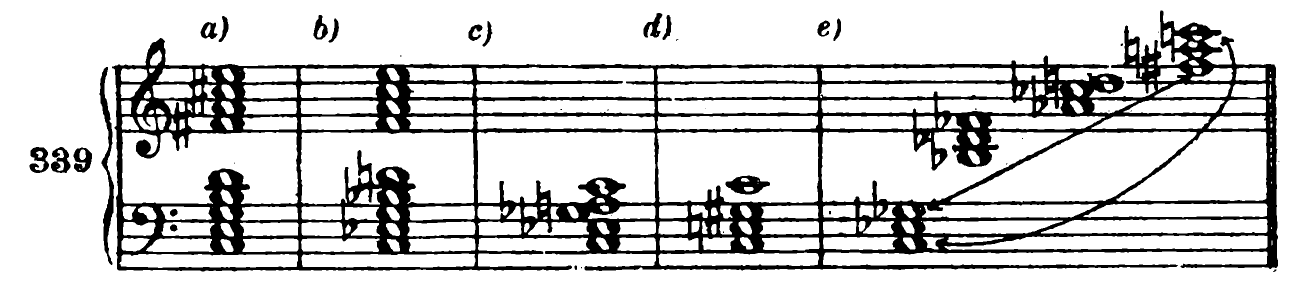
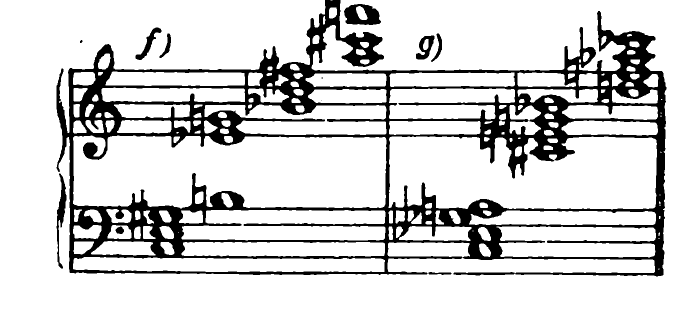
produce only four different tones (339c), nothing but major thirds only three (339d). Taking two minor thirds and one major third would yield ten different tones. But the tenth and twelfth tones repeat earlier tones in this construction, and only the eleventh is new again (339e). Such a system would, incidentally, correspond far less to natural models than the system of fourths, for its basis, two minor thirds, shares with the idea of a major triad only the principle of construction in thirds. The same holds for the two experiments 339f and g. These do produce all the tones. But both the augmented triad underlying one and the diminished seventh chord underlying the other are undoubtedly artificial products of the system.
That the fundamental thesis of the merely gradual nature of dissonance leads me to reject nonharmonic notes, and now to venture to call the system of construction in thirds inadequate and consider the possibility of a system of fourths, will greatly agitate the defenders of older works of art—which I have not attacked at all, but probably understand better and revere more deeply—and still more the textbook authors clinging to an outdated aesthetics because they misunderstand it. Thus I learned that one such person, who through an indiscretion obtained a few sheets of the manuscript and some information about this book's contents, called it a great defense of modern music. I am not especially unhappy about that, but must nevertheless reject it as incorrect. Modern music needs to be performed more than defended, and interest in repelling attacks diminishes as it becomes increasingly obvious that the attackers destroy only themselves when they marshal criticism against the work, impotence against power, sterility against productivity. Their creative inactivity deprives them of all good hope for the future, but becomes wrongdoing when, imitating creative airs yet with breaking voices, they demand the highest recognition for their systems, placing them above actual works. This is not meant to express contempt for systems. On the contrary, without envy and almost to the point of injustice, I admire in others the gift I lack: devising systems. Dr. Heinrich Schenker, for example, though he nowhere reaches complete clarity, deserves my respect and attention simply because he is one of the few who truly strives for a system. Still more, however, because he loves and understands older works of art with the same passion as I, so that although we stand very far apart concerning our art's present and future, we stand all the closer in its past. But if, as I hear, he speaks in a new counterpoint book of the decline of composition and claims that no one today can compose anymore, this stands little higher than an invalid's grumbling about “the good old days.” Certainly one need not be satisfied with one's time. But not because it is no longer the good, past, old time; because it is not yet the better, future, new one. Such unproved attacks do not require us to defend our art on their account. The vehemence breaking through here is psychologically interesting, for it shows that these defenders of old art are quite anxious about the outcome of their defense and our struggle. They sense and fear that old art will win again and secure for new art, its younger sister, a place of honor at its right hand.
Even if, according to sound old military wisdom, every defensive task should be solved offensively, so that a good defense should scarcely differ from an attack: anyone seeking theoretical understanding while basing it on given aesthetic judgments, without examining whether those aesthetics and judgments are correct, produces theories with only one aim—to drag in proofs for those judgments—and those theories are worthless. Here I attack openly and honestly with the will to destroy; I am not the defender, they are. For this is the greatest difference between us: I have asked myself that question, instead of proving things in a vacuum, as Riemann does, proud that his theory can formulate rules more sharply and narrowly, without suspecting that this is precisely why he is overtaken so quickly.
Mayrhofer too, whose book Der Kunstklang I might long ago have read had it not been written so laboriously, seems to stop at the same boundary. He too is about to offer a theory, which would indeed be an achievement, since we have lacked one until now. But he calls dissonance the necessary complement of consonance, thus stressing their opposition, and I therefore doubt whether he will go as far as he might without this compromise between aesthetics and understanding. That would be a pity, for it seems to me that he has approached the matter more correctly, apart from his convoluted terminology, which gives names without awakening conceptions. Yet although he too starts from aesthetics by making a pact with it, he may still find something correct.
In one respect, admittedly, I had it easier than those theorists who are not composers. Their aesthetics was not a given for me because my imagination, ear, and sense of form imposed another one; because the prohibitions and commands they try to justify were from the outset suspended for me by my musical idea, which testified to the opposite. Thus the question whether aesthetics was right was, so to speak, put into my mouth. And it was not my reflection that first decided against it, but my musical feeling. When reflection too brought me to different results, this was not done in order to defend. Rather, I felt as though I were merely telling, reporting, describing how things really are in artistic creation. My ear had said yes—but the ear is a musician's whole intelligence!
In doing so I may have invented things that already existed, but I invented them rather than reading them. I found them out—that is invention—because I experienced them. I experienced my intellect making it impossible to improve a bad idea, and told myself this could not be accidental, that a law must lie here. That law is: the idea. I was thereby led to reflect on the relationship between craft and art. Thus I came to recognize that art and craft have as much to do with one another as wine and water. Wine does contain water, but anyone who starts from water is an adulterator. One may also reflect on water alone, but then the separation must be clean. This led me to see the teaching of composition as nothing other than the pure teaching of craft. The question is thereby solved, since the necessities of a craft are not binding on art. Therefore I, for whom purposelessness alongside expression is the highest thing in art, could base the teaching of craft purely on usefulness. Here it is appropriate, indeed unavoidable. There it does not belong. But the two have nothing to do with each other.