 Playable Books
Arnold Schoenberg · section 65 of 66
Evaluating Complex Chords
Read and hear this section in the playable edition →I do not recommend that the pupil use the harmonies shown here in attempts at composition insofar as they do not also occur in other, older textbooks. Whether he employs more modern or less modern artistic means, his work will be poor or good according to the relationship between his innate talent, having something to say, and his ability to express it. The teacher influences only one component of this relationship, the ability to express. Perhaps not even that: I doubt that communicating technical aids can improve it. The pupil does not learn to express himself by imitating the technique of models. Strictly speaking, the true artist cannot be taught at all. Showing him “how he must do it” and appealing to the fact that others have done it that way may be instruction in art, but it is not instruction of the artist. The ability to express oneself certainly does not depend on the kind and number of artistic means supplied. Inability, however, does depend on them. It can develop only with their help, for it does not exist through what it produces itself, but lives on what others have produced. Yet ultimately the work of the truly gifted shows outwardly only a slight connection with the literature that once served as its model. This is because he attends to himself and, through this self-attention, develops away from his preconditions and models, which may initially have been supports, crutches for his first attempts at walking. Because in the end he writes not what conforms to art, but what conforms to the artist.
The following circumstance seems to contradict this. That Mozart's and Beethoven's styles, for example, differ substantially is still clear to everyone today, yet the differences are not so great that one could claim different laws operate in one than in the other. On the contrary, there are passages, even movements, by Mozart that could almost be Beethoven's, and ones by Beethoven that could almost be Mozart's. Go farther back, to the sixteenth or seventeenth century, and to our eyes the differences become so subtle that confusion is easy. Distance from the object equalizes so strongly that it blurs differences of personality; stylistically, perhaps even in content, one can scarcely distinguish one artist clearly from another, perceiving only what they share, from which conformity to art can be abstracted. From a certain distance, however, one senses only the spirit of the century. Anyone able to stand far enough away senses the spirit of humanity. Individual personalities disappear at this distance, but what they express—humanity, the best in it—becomes visible. The highest peaks, nearest the observer, into which capillary tubes raise the finest and best from the depths, alone represent humanity's spirit. Thus the distance that initially diminished now enlarges again: personalities, the peaks, become visible once more, though differently. One sees that and how they are connected; one no longer sees what proximity showed, that they were sharply separated. But the connections are not those of art, not those of artistic means, but deeper ones.
Admittedly, seen from a middle distance, one can even find, as stated, a line showing the path of artistic means and conformity to art. And if one admits that the smallest part of a curve may be regarded as an infinitely small straight line, such an optical illusion may also be permitted in the network of veins marking the development of artistic means. Neglecting the small deviations, it may indeed be a line. Perhaps it even must be, for the ultimate goal is shared. And something else is shared: our outermost limits.
The eye that wishes to contemplate art must be adjustable to all these distances. The images shown by distance are as important as those of proximity. But from a distance we can contemplate only the past. If we could view the present from afar, all struggle would end. Yet we are not excused from the struggle, although its outcome is predetermined. We know its goal. We know who will win, as in military maneuvers where the victor is also determined beforehand. Nevertheless, the struggle must be conducted as seriously as though one could change its outcome. We must fight with the same passion as though we did not know which idea would triumph, although that idea would triumph even if we did not fight, since its victory is predetermined. Perhaps our struggle too is predetermined; in any case, the passion is justified.
Proximity, the present, which we feel most strongly and immediately, shows the living personality ready for battle, in violent conflict with its surroundings. Personalities differ sharply from one another; it almost seems they have nothing in common, fall completely outside the line of development, and have no connection with the rest of humanity. Just as the side designated to lose in maneuvers must try to turn every known situation to its advantage, the idea that will lose struggles for every patch of its territory. And just as the predetermined victor may not simply fold his hands but must operate as though he could otherwise be defeated, the idea that would win even without contributing anything acts with equal vehemence. Battle position, all muscles tense, every movement with an aim and purpose: this is the state in which proximity shows us the striving personality.
If proximity teaches difference, distance teaches commonality. If the present shows personalities diverging, the middle distance shows the similarity of artistic means. But the great distance cancels both again: it shows personalities as different, yet also shows what truly connects them. It reveals as the most important thing in personality the deepest immersion in one's own nature, which expresses the nature of humanity.
What matters—the ability to hear oneself, to look deeply into oneself—can scarcely be acquired and certainly cannot be taught. The average person seems to possess this ability only in a few exalted moments, otherwise living not by inclinations but by principles. Someone who truly has principles, principles of humanity, lives according to his inclinations. These do coincide with humanity's principles, without his knowing it, though perhaps he senses it.
And what is taken for artistic means, for style—all those qualities the mediocre person thinks he need only imitate to become an artist—prove to be incidental matters, worth at most the value of symptoms. The stylistic similarity of masterpieces from a now distant period is indeed explained by external distance and disappears as we approach. On closer examination, the straight line of the development of artistic means is a complex composite. But everything constituting style is characteristic at most of the time when the living artist still struggles with his contemporaries. It is merely a symptom by which contemporaries should recognize the significant people, but unimportant in relation to what distance shows.
Thus teaching intended to educate an artist could at most consist in helping him hear himself. Technique and artistic means do not help him. If possible, they ought to be a secret knowledge accessible only to those who find their own way to it. Whoever hears himself acquires this technique by a path other than the curriculum, perhaps by detours, but with unfailing certainty. For he hears what everyone shares, and what distinguishes him from others may not be how he hears it, but that he hears it at all. The “how” of artistic means is more likely to lead away from the “what” of art than to bring one closer.
That is why I do not recommend modern artistic means to the pupil. Certainly, he should train his hand so that it can execute something should the mind one day require it. The older means suffice for this too. The newer ones do no harm, but perhaps a property right still rests upon them, a very haughty property right refusing to open the road to those who make no effort of their own. Those who do make their own effort find it anyway, in a manner entitling them to use it. For them it is open; for others who merely wish to train their hand, let it remain closed. Eventually it will become common property, but those traveling it then will at least no longer wish to learn “how to represent a personality.”
Since I do not recommend these harmonies, that reason alone frees me from the need to evaluate them aesthetically. Whoever reaches them independently will need no guide. His ear and sense of truthfulness will lead him more surely than laws of art ever could. But for another reason too I may calmly refrain, without falling short of what textbooks otherwise accomplish. Older theories offer a system containing what experience can call beautiful. Yet it also contains other things, things not recommended and even forbidden. The method is to set out a number of possible combinations and exclude, by exceptions, those cases considered unsuitable. But a system with exceptions is no system, or at least an inadequate one. Moreover, I have proved that the justifications for these exceptions are usually false and—this would matter most to me if someone learned it from this book—that the exceptions merely express a particular artistic taste, related to natural taste only by lagging behind it. They are only imperfect adaptations to the natural, whereas a more perfect adaptation must lead to what this book has set as its goal, and surely to more, surely farther still. Thus rules at best indicate the degree of penetration into what nature gives; they are not eternal laws, but laws always washed away by the next deed. And now I should issue such laws myself, undertake such an evaluation, and make exceptions? No one who has followed my path with agreement can demand that.
I suspect the objection will be raised: how does one distinguish the competent person from the bungler if nothing establishes what is good and bad? First I must say that I care little about distinguishing the competence meant here essentially from bungling. This competence, consisting really only in remembering and obeying all the laws, has little that is impressive. It is indeed hard to distinguish from bungling, and equally superfluous. But the artist's ability has nothing to do with it. The artist does nothing because others consider it beautiful, only what is necessary to him. If others want to apply laws of beauty to his works, it is their business, if they cannot live without such laws, to find applicable ones. But are they truly necessary? Can works of art really not be enjoyed without laws of beauty? What, then, of the artistic impression received by the layperson who knows nothing of the rulebook? Schopenhauer explains the mediocre person's respect for a great artwork as belief in authority. Certainly, that of the broad masses may be. But among laypeople I have found individuals whose organs of receptivity were much finer than those of most specialists. And I know for certain that some musicians are more receptive to painting than many painters, and some painters more receptive to music than most musicians. Anyone unwilling to admit this must at least recognize that, if spreading art has any meaning at all, the layperson's capacity for impression and discrimination is its indispensable premise. If he feels art, he must also be able to evaluate it, if that is necessary! He can do so for himself, so laws of beauty are superfluous for him. For whom, then, do they exist? The critic? Someone who can distinguish good fruit from bad by taste need not express the difference through a chemical formula and does not need the formula to recognize it. But should someone without a palate judge food? Would the chemical formula help him then? And would he know how to apply it, and if so, for what purposes? Does the pupil need laws to know how far he may go? I have just said how far he can go: as far as his nature drives him, which he must strive to hear precisely if he wishes to be an artist! If he wishes merely to be a craftsman, an inhibition will arise somewhere of itself; the same inhibition preventing his becoming an artist will prevent him from going too far. And suppose a young person does once err and go farther than his talent urges him! Whether he becomes nothing special because he went too far or because he did not go far enough may amount to the same thing. But fools always fear being taken for fools—that is, being recognized. They fear being taken in by a charlatan. This insecurity in them demands protection. Since laws of beauty, in this form at least, cannot be an end in themselves, it almost seems to me that their purpose is to protect inferior people from being made fools of, or perhaps secretly to protect them from being overwhelmed by a new beauty. Nothing frightens the mediocre person more than the compulsion to change his view of life. He has even set up an ideal expressing this fear: character. The person of character is, to vary a saying of Karl Kraus, someone whose hardening of the arteries begins in his worldview.
In another form, however, laws of beauty could be an end in themselves: as precise descriptions of effects shared by as many works of art as possible; as an attempt to trace as many effects as possible to as few common causes as possible; as an attempt to order phenomena and provide an overview. That could be an end in itself, but must be content with that and, above all, must never conclude: most artworks are like this, therefore every other artwork must be the same. Enough would have been accomplished—more than one can demand, but the utmost one may permit.
People will ask why I write a textbook of harmony if I wish technique to become secret knowledge. I could answer: people want to learn, and I want to teach, to spread what I consider good, so I teach. But I believe one ought to learn. The artist perhaps only so that he absorbs errors from which he must free himself. The wave of strength that washes away an error then also washes away the inhibitions otherwise contaminating him. An eye catarrh is cured by provoking inflammation in the eye; the healing process cures not only that inflammation but the actual disease as well. But the artist may also learn because not everyone must begin from the beginning and personally experience all the errors accompanying the path of human knowledge. To a certain extent, one must and may rely on predecessors. They have deposited some of their experiences and observations in science; another part—I do not know whether it is more reliable—rests in the unconscious, in instinct. One has the right and duty to doubt. But making oneself independent of instinct is as difficult as it is dangerous. For alongside what is correct and false, the inherited experiences and observations of our forebears, what we owe to their past and ours, instinct may contain an ability still to be developed: knowledge of the future; perhaps other abilities too that humanity will one day possess consciously, which today it can at most sense and long for, but not exercise. The artist's creation is instinctive. Consciousness has little influence on it. He feels as though what he does were dictated to him, as though he acted only according to the will of some power within him whose laws he does not know. He merely executes a will hidden from him, instinct, the unconscious within him. He does not know whether it is new or old, good or bad, beautiful or ugly. He feels only the impulse he must obey. In this impulse old and new may express themselves: things dependent on the past and things pointing the way to the future; old truths or new errors; his musical nature inherited from a musical ancestor or acquired through the literature, but perhaps also the outflow of a force seeking new paths. Correct or false, new or old, beautiful or ugly—who knows, when he feels only the impulse? Who would dare distinguish correct from false in instinct, in the unconscious, or separate knowledge inherited from ancestors from intuition granted by the spirit? The artist must learn whether he wishes to or not, for he learned before he was capable of willing. In his instinct, in the unconscious, lies a treasure of old knowledge that he will raise without willing it. What the true artist learns from a teacher will harm him as little as what he learned in this way before consciousness existed.
And the moderately gifted person, who is not truly productive in that highest sense, should above all learn. For him learning is an end in itself. His task is to take for knowledge what is really only belief. Knowledge makes him strong; belief suffices for the other. He not only fails to find things for himself from the beginning, but would not know how to advance from the middle either. If he really wishes to remain the average person he was born, he must keep his distances above and below equal; as the superior advances, he must follow at the appropriate distance. What he does not need to discover because it is already discovered, and cannot discover because he would otherwise be superior, he must learn. Protecting him from errors is no more necessary than possible. But teaching can lead him to where he must stand if he wishes to be a good average. Since he cannot produce valuable things himself, bringing him at least to appreciate properly what others produce is a purpose worth teaching for. “There are relatively enough people who understand how to produce, but relatively few who understand how to consume,” says Adolf Loos. Guiding consumers could therefore also be the purpose of teaching—not through rules of beauty, but by broadening their horizons.
But there is another, perhaps the most compelling reason: establishing a doctrine can be an end in itself. Without addressing an actual pupil, it can speak to an imagined one. Perhaps the pupil is only the teacher's outward projection. The teacher speaks to himself when he addresses the pupil: “With myself alone I take counsel when I speak to you.” He teaches himself, his own teacher, his own pupil. Letting the public listen while he seeks clarity, clearing away the rubble of old errors and perhaps replacing them with new but more far-sighted ones, is the same case as creating a work of art and handing it to the public. He comes to terms with himself, and the public listens because it knows: this is its affair.
I can therefore calmly refrain from aesthetically evaluating these new harmonies. Such an evaluation will come one day, perhaps not. It may be good, but probably will not. Hopefully it will then be wise enough to observe: these are the cases considered good so far; the others are not yet loved, but will probably also be accepted later. Yet I do not wish to omit recording a few modest experiences and observations arising from my examination of completed works. Naturally, I can do this only by feeling, and my feeling too depends on preconditions, on the innate and acquired culture operating within me. I therefore do not exclude what I may fail to mention. Perhaps I have not yet noticed it; probably I do not yet know it. If I do not write everything that combination must regard as possible, inhibitions of my previous education may be preventing me. In composing I decide only by feeling, by the sense of form. This tells me what I must write; everything else is excluded. Every chord I put down corresponds to a compulsion: a compulsion of my need for expression, perhaps also of an inexorable but unconscious logic in harmonic construction. I firmly believe that this logic exists here too, at least to the extent that it does in previously cultivated regions of harmony. As evidence I can cite the fact that corrections of an idea made for outwardly formal reasons, to which alert consciousness is all too prone, have usually spoiled the idea. This proves to me that the idea was compelling, that the harmonies present are components of the idea that must not be altered.
In general, the use of chords of six or more tones will show a tendency to soften dissonances by widely spacing the individual chord tones. That this softens them is self-evident, for it aptly imitates the image of what dissonances are: more distant overtones. The following passage from my monodrama Erwartung is to be understood in this sense.
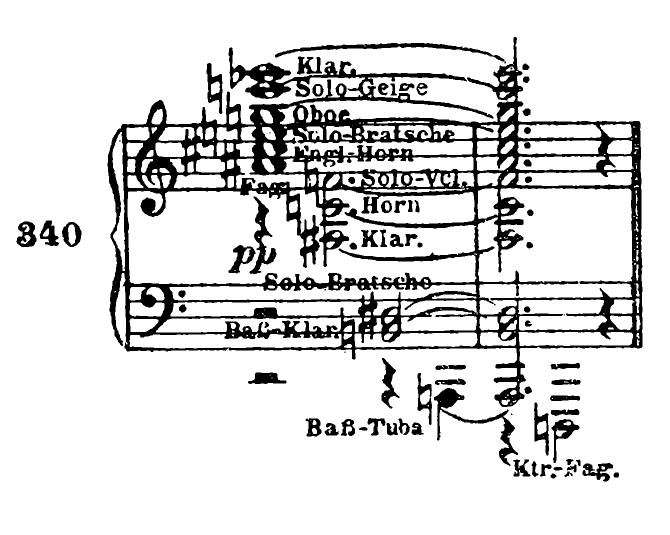
This chord contains eleven different tones. But the delicate instrumentation and wide spacing of the dissonances make the sonority sound very soft. Perhaps something else contributes: the individual groups are arranged so that they could easily be traced back to earlier forms. Take the first entrance, for example. I believe the ear expects this resolution:
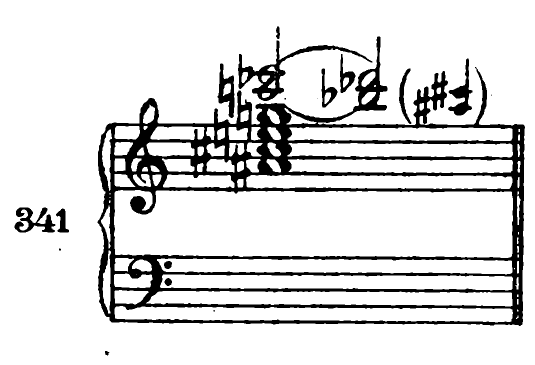
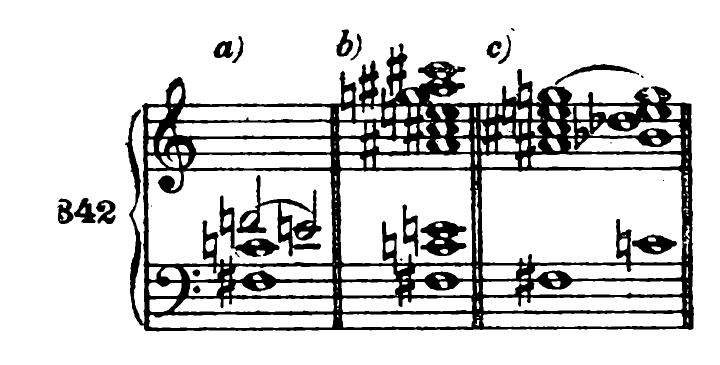
Its failure to occur can do no more harm here than the absence of a resolution in simple harmonies. And the second chord may be understood as follows: combined with a resolution (342a) and the resolved chord above (341) in 342b, it becomes 342c—an addition of two chords sharing a diminished seventh chord that two different bass tones turn into two different ninth chords.
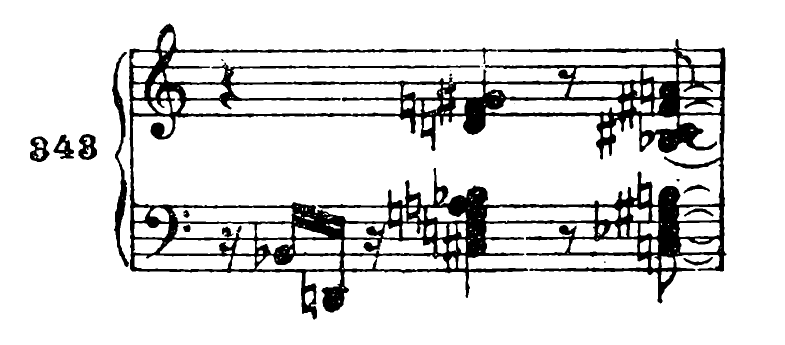
But such a derivation will not always apply; tracing things back to older forms will not always succeed, or will succeed only with a very broad interpretation. For another time I write such a chord in much closer position. And the following passage occurs in a string quartet by my pupil Anton von Webern:
In his opera Der ferne Klang, Franz Schreker writes, among much else:
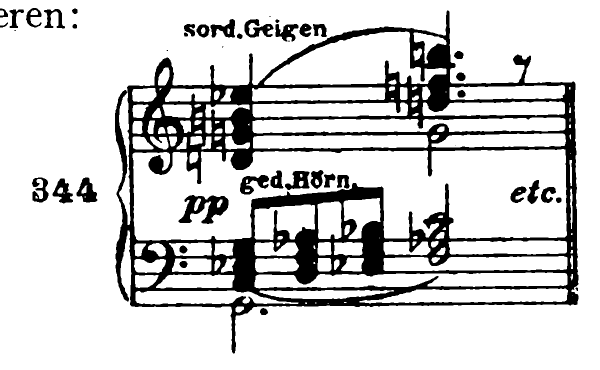
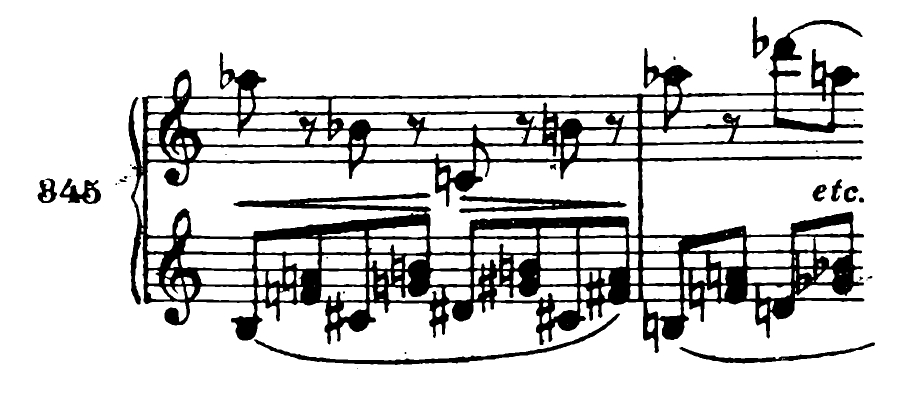
Here much in the combinations must indeed be attributed to moving voices, yet there is also the similarity to the earlier examples that dissonances' ability to form sonorities does not depend on possibilities or needs of resolution. The Hungarian composer Béla Bartók also comes close to these perceptions of sound in some of his piano pieces, as the following passage demonstrates:
The following passage from a composition by my pupil Alban Berg is also an interesting case:
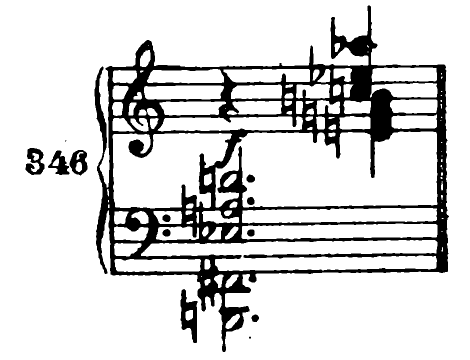
Why this is so and why it is right I cannot yet say in detail. In general it follows as self-evident for anyone who accepts my view of the nature of dissonance. But I firmly believe it is right, and a number of others believe so too. The chromatic scale seems capable of accounting for successions of such chords. The chord succession appears governed by the tendency to introduce in the second chord tones missing from the first, usually those a semitone higher or lower. Nevertheless, the voices seldom appear as minor-second steps. I have also noticed that doublings, octaves, occur rarely. Perhaps this is because the doubled tone would acquire predominance over the others and become a sort of root, which it is scarcely meant to be. Perhaps it also arises from an instinctive, possibly exaggerated aversion to even the remotest reminder of earlier chords. The fact that the simple chords of earlier harmony do not readily appear in this environment seems to point to the same cause. But I believe there is another reason: they would sound too cold, too dry, too expressionless. Or perhaps something mentioned earlier asserts itself here: these simple chords, imperfect imitations of what nature gives, seem too primitive to us. They lack something like what Japanese painting lacks when compared with ours: perspective, depth. Perspective and depth of sound may be what we miss in simple three- and four-note chords. Just as one part of a picture could hardly observe perspective while another neglected it without impairing the effect, these somewhat empty sonorities may be unable to stand beside those full, luxuriant ones, whereas exclusive use of one kind or the other ensures unity and thus the right effect.
A striking circumstance inviting conclusions is that I and those who write similar things distinguish precisely when a five- or six-part chord should occur and when one with still more parts. One could not omit a tone from an eight-part chord or add one to a five-part chord without damaging the effect. The position too is binding: as soon as a tone is displaced, the meaning changes, logic and usability cease, and the coherence seems broken. Laws evidently operate here. Which laws, I do not know. Perhaps I shall know in a few years. Perhaps someone younger will find them. For the present, at most one can describe.
I refrain from further description in favor of another idea I wish to mention in closing. Three properties are recognized in a sound: its pitch, color, and intensity. So far it has been measured in only one of the three dimensions in which it extends, the one we call pitch. Attempts at measurement in the other dimensions have scarcely been made, and no attempt has yet been made to order their results into a system. The evaluation of tone color, the tone's second dimension, is therefore in a far less cultivated and ordered state than even the aesthetic evaluation of these latest harmonies. Nevertheless, people continually dare to string sounds together and set them against one another purely by feeling, and no one has yet thought to demand that a theory establish the laws permitting this. For the present we simply cannot do it. And, as can be seen, it works without that too. Perhaps we would distinguish still more precisely if attempts to measure this second dimension had already produced a tangible result; perhaps not. In any case, our attention to tone colors grows ever more alert, and the possibility of describing and ordering them draws nearer, probably bringing restrictive theories nearer as well. For now we judge the artistic effect of these relationships only by feeling. We do not know how this relates to the nature of natural sound, perhaps scarcely even sense it, yet unconcernedly write successions of tone colors that somehow come to terms with the sense of beauty. What system underlies these successions?
I cannot accept so unconditionally the distinction between tone color and pitch as it is usually expressed. I find that a tone makes itself perceptible through tone color, one dimension of which is pitch. Tone color is thus the larger domain, pitch one region within it. Pitch is nothing other than tone color measured in one direction. If it is possible to create formations we call melodies from tone colors differing in pitch—successions whose coherence produces an effect resembling thought—then it must also be possible to create such successions from the tone colors of the other dimension, from what we simply call tone color. Their relationship to one another would operate with a kind of logic entirely equivalent to the logic that satisfies us in a melody of pitches. This seems a fantasy of the future, and probably is. But it is one I firmly believe will be realized; one I firmly believe can heighten in an unheard-of way the sensory, intellectual, and spiritual pleasures art offers. I firmly believe it will bring us closer to what dreams hold before us, extending our relations with what today seems inanimate by giving of our life to the life that, only because of our slight connection with it, is for the present dead to us.
Tone-color melodies! What fine senses to distinguish here, what a highly developed mind to find pleasure in such subtle things!
Who dares demand theory here!