 Playable Books
Pyotr Ilyich Tchaikovsky · section 2 of 36
Introduction · Intervals
Read and hear this section in the playable edition →While it must be supposed, that the elements of musical science are familiar to everyone about to take up the art of composition, I deem it advisable to preface my treatise on Harmony with a short review of the subject of—Intervals,—as any uncertain conceptions on this ground might easily prove a hindrance to a thorough knowledge of Harmony.
The term “Interval” represents the mutual relation of the tones with regard to their position in the scale. The lower tone of an interval is called the—fundamental tone.—The names of the intervals have their derivation in the Latin Ordinals, designating numerically the steps between fundamental tone and upper tone.

Prime Second Third Fourth Fifth Sixth Seventh Octave 6 7. 8.
The raising or lowering of a tone of an interval causes no change in its name, while the distance between the two tones is widened or shortened.
To obtain a clear view of such alterations of intervals, we will arrange the latter into two groups:
I group comprising: large (major), small (minor), augmented and diminished intervals; (to which belong Seconds, Thirds, Sixths and Sevenths).
II group comprising: perfect, augmented and diminished intervals; (to which belong: Primes, Octaves, Fifths and Fourths).
Minor intervals are half a tone smaller than major intervals; augmented intervals are half a tone larger than either major or perfect ones; while diminished intervals are half a tone smaller than minor or perfect intervals.
All intervals having for their fundamental tone the first degree of the major scale are either major or perfect.
Let us now ascertain the number of whole and semi-tones contained in each of these intervals, thus establishing a scale or medium of comparison for all intervals:
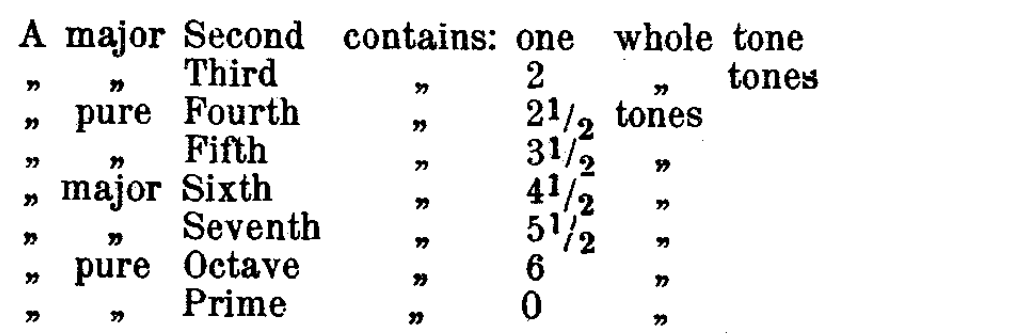
Having then obtained a knowledge of the various kinds of intervals and the means of gauging them, we are enabled to constitute exactly any relation between two given tones.
To illustrate the aforesaid, we will construct a table of all the intervals having C for their fundamental tone.
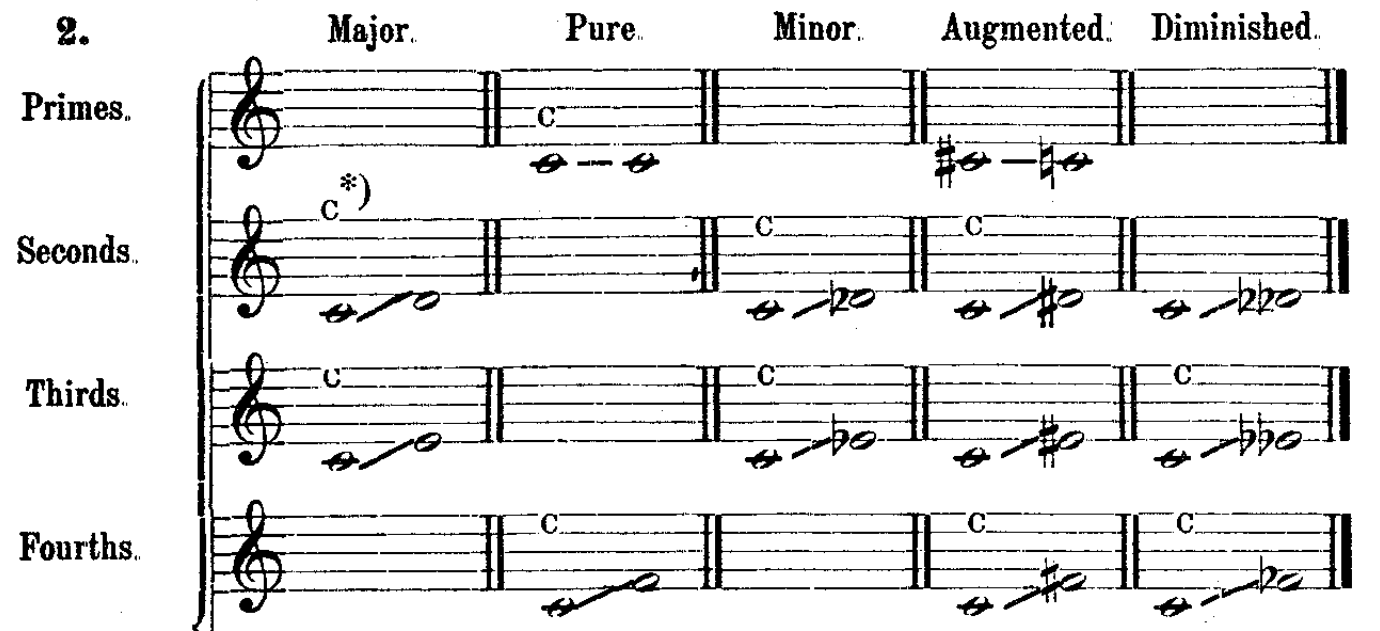
2. Major. Pure. Minor. Augmented. Diminished.
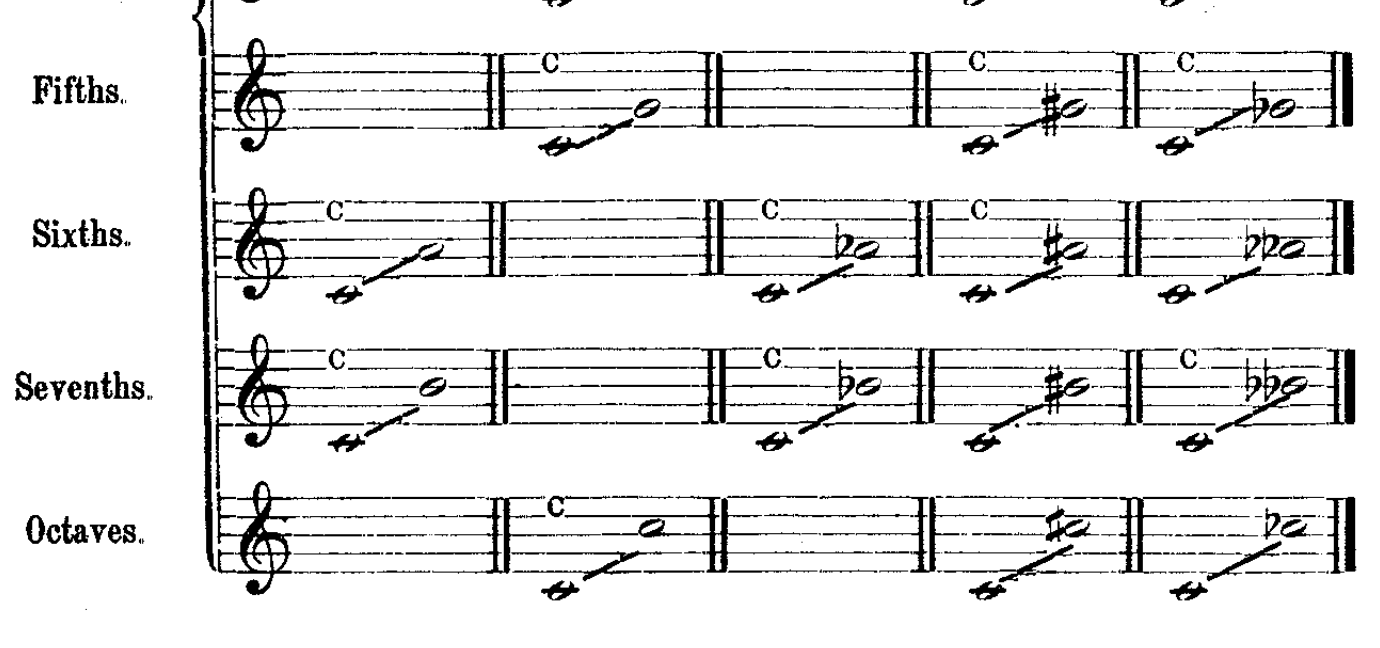
Thus we learn, that a major or a pure Interval is converted into a minor, diminished or augmented Interval by lowering or raising the upper tone—or, the latter remaining unchanged, by raising or lowering the fundamental tone. For instance:

Major Sixth Minor Sixth Augmented Diminished
Intervals exceeding the octave are but repetitions of the relations existing within the limits of an octave; the,,Ninth“ alone has an independant significance in harmony.

Ninth. Tenth. Eleventh. Twelfth. Thirteenth. Fourteenth. Fifteenth.
*) The letter,C* designates the intervals available in Harmony.
The inversion of Intervals is effected by transposing the upper tone into the octave below or the fundamental tone into the octave above. The relations thus arising may be expressed by the following figures:
The inverted Prime becomes an Octave, the Second a Seventh, the Third a Sixth, the Fourth a Fifth, the Fifth a Fourth, the Sixth a Third, the Seventh a Second, the Octave a Prime.

Major intervals become minor, while minor intervals become major; augmented intervals become diminished, diminished intervals augmented; pure intervals however remain pure.

According to the manner in which they affect the ear, intervals are separated into Consonances and Dissonances. The former are complete in themselves, as they express a certain repose; the latter, however, convey the element of motion and demand a goal or solution in the following interval.
Pure Primes, Octaves and Fifths as well as major and minor Thirds and Sixths are consonances, the first three being termed perfect consonances, and the major and minor Thirds and Sixths imperfect consonances. Seconds, Sevenths and all augmented and diminished intervals are dissonances. The pure Fourth partakes of the nature of both consonance and dissonance, inclining rather to the latter class.
§ 1. Musical tones are combined in two different ways: first by allowing them to sound separately one after the other, then again by subjecting them to a simultaneous concordance. The first combination is named,Melody“, the second,Harmony“.
These two elements, together with the element of rythm, (which regulates them in their relation to the time or measure) constitute the Material of the art of music. The subject of this treatise shall be the simultaneous concordance of tones: Harmony.
§ 2. The simultaneous sounding of three, four or five tones, separated from one another by the interval of a third, is called a chord. The simplest and at the same time most important chord is the Triad, which, as its name indicates, consists of three tones. Being composed of two consonant intervals (Third and Fifth) its effect on the musical ear is satisfying, in contrast to that of chords consisting of four or five tones, which contain ‘dissonant intervals and hence cannot appear independently, but must be supported by or resolved into a consonating chord or triad.
§ 3. The triad, or common chord consists of three tones, separated each from the other by the interval of a Third.
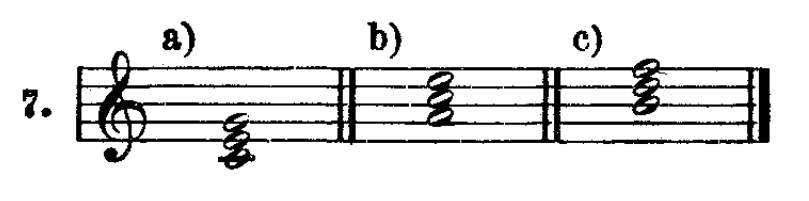
The lowest tone is called: Fundamental tone, or Base—the intermediate tone: the Third—and the highest tone: the Fifth of the triad. Triads are divided, according to the kinds of Thirds and Fifths that compose them. A large or major triad is a chord composed of a major Third and a perfect Fifth (a). Minor Third and perfect Fifth constitute a minor triad (b); minor Third and diminished Fifth a diminished triad (c).