 Playable Books
Pyotr Ilyich Tchaikovsky · section 4 of 36
Chapter II. The Connection of the Triads of the Major Scale
Read and hear this section in the playable edition →§ 8. In music chords are either used in masses, that is with manifold repetitions of one and the same interval—as is the case in compositions for orchestra and Pianoforte—or they are set for several, single, distinct voices. »Four-voiced-writing* is the commonest and most normal form, as it denotes the four different human voices—namely: Soprano, Alto, Tenor and Bass. So, in our study of Harmony we shall keep to this disposition of the voices.
The highest voice—Soprano—and the deepest voice—Bass—are called the two outer voices—the two intermediate voices: Alto and Tenor: the two inner voices.
§ 9. Turning now to the practical application of the above treated chords, we will begin with placing the fundamental tone in the Bass. In the highest voice any of the three tones of the chord, the fundamental tone, the Third or the Fifth may be used. For the two inner voices we will use respectively the intervals of the triad nearest to the Soprano. The C major triad would thus appear as follows:
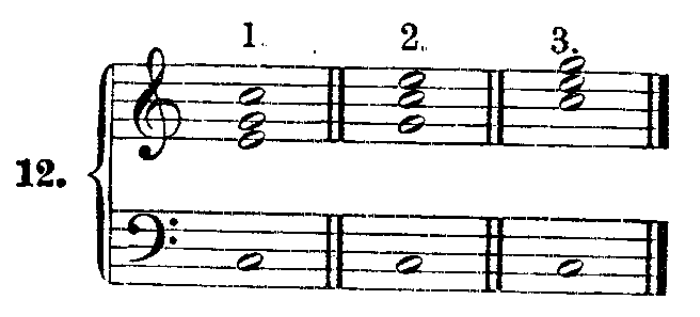
These three cases are called the positions of the chord. According to the interval of the triad which appears in the Soprano, these positions are called the fundamental position or position of the octave, the position of the Third, and the position of the Fifth.
§ 10. From the above example we see that in each of the three positions the fundamental tone is used twice, while the third and fifth appear but once. Shall this always be the case? By no means! In a free leading of the voices the composer may double any tone of the chord at will. For the present, however, we cannot avail ourselves of this liberty, since according to § 9—we must place the inner voices as close as possible to the upper voice. Indeed, the doubling of the fundamental tone will always be the most common, as it is most natural to the triad *).
__, *) This is confirmed by the so called natural scale, which exhibits but two Fifths and one Third against three fundamental tones.
§ 11. We have already mentioned (§ 6) the internal relationship of the triads of the scale. Now, there is still another and purely external connection of these triads, growing out of the tones they have in common. The triads c, e, g and g, b, d for instance have the tone g in common, while the triad f, a, c shares the tone c with the triad c, e, g. In fact each triad has one or two tones in common with every other triad constructed on steps of the same scale, except in the case where the fundamentals are directly succeeding steps. So: the triad on C has no tone in common with the triads on b. and d; the triad on d. none with the triads on c and e, and so on. The mutual relationship of the triads with regard to their external connection is shown in the following table:
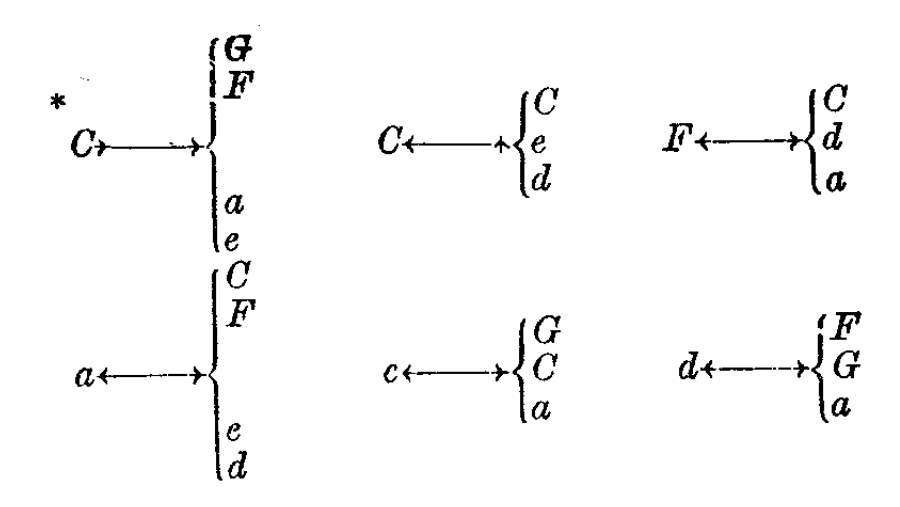
To effect a connection of two triads at once correct and satisfying to the ear, it is necessary to retain the common tone of the triads in the same voice.
Conscientious application of this rule imparts fluency, euphony and unity to the harmony; moreover it enables the pupil to avoid many grave errors, which, otherwise, he would of necessity commit. Take for instance the triad on c in the octave position, and let us connect it successively with other triads containing tones in common with it. Which positions of the new chords must we then choose? Obviously those which enable us to retain the common tone, or tones in the same voice. Consequently the G major triad must appear in position of the third, F major in the position of the fifth, A minor in position of the third and E minor again in position of the fifth.
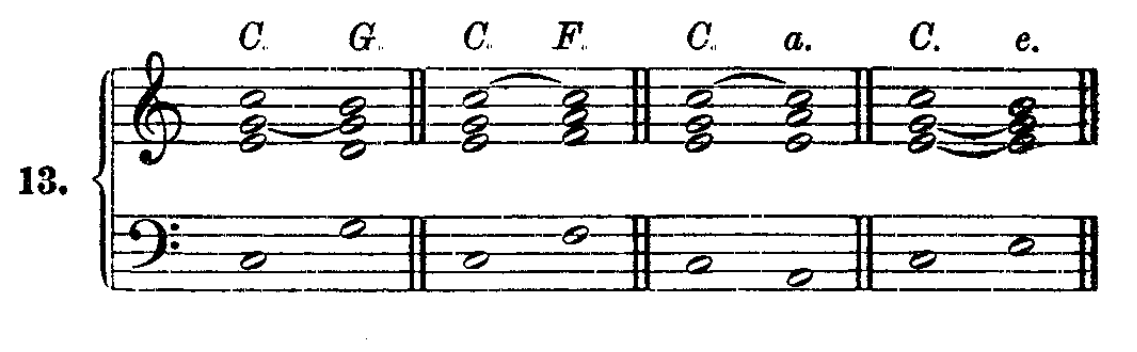
The progression and position, therefore, of the three upper voices is influenced by the common tones. Meanwhile the Bass may progress upward or downward at liberty. Should we have to choose between a skip of a sixth and one of a third, we prefer the latter **).
*) The major triads are indicated by Capital, minor triads by small letters.
**) Having a purely practical aim in this work, we shall avoid minute explanations and justifications of the different rules. It were well for the pupil to search out instinctively, as it were, the justification of the several rules. For this purpose he should thoroughly test them by ear on the piano. A true musical instinct will at once convince, him, that all these rules originated in the demands of his own ear.
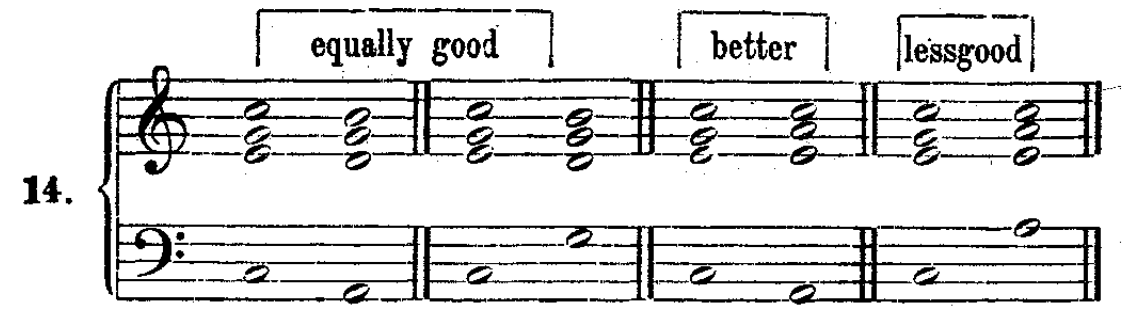
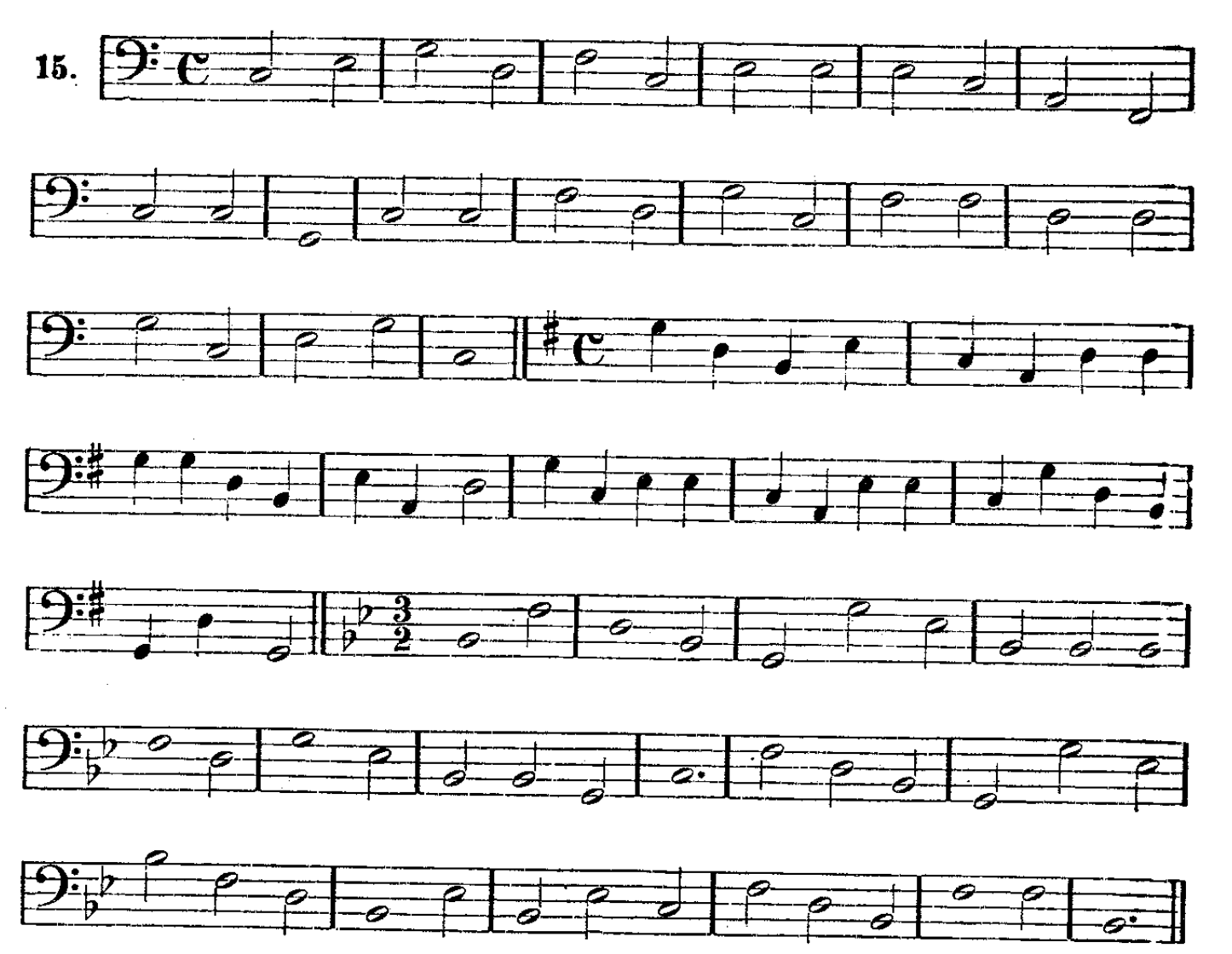
1 Remark. In addition to these examples, which consist in supplying the remaining three voices to a given bass, it is very beneficial to construct a table, which shall contain all the possible connections of all triads with one another, in every position. To this end the example (Ne 13) begun in this paragraph on C should be carried on further. The pupil must not be disheartened, when he finds that at the very beginning of his study.120 chords must be written out in one key alone. In the first place the labor is merely a mechanical one, and in the second place it is important that by thoroughgoing explanations of the rudiments we should dispel at the start the superstitious awe that prevails regarding the so-called,Theory“ or,,Thorough Bass“
Il. Remark: In harmonizing a bass, care should be taken not to lead the voices too high; therefore one must not choose too high a position of the tonic triad at the start.