 Playable Books
Pyotr Ilyich Tchaikovsky · section 5 of 36
Chapter III. Connection of Triads, showing no External agreement
Read and hear this section in the playable edition →§ 12. In the preceding chapter we spoke of the beauty of harmonies connected by common tones. This absolute completeness in chord-connection, however. does not exclude the admissibility of certain connections, which, while perhaps less pleasing, satisfy us by very reason of their sharpness or coarseness. This we can understand if we consider the aim of Music, which is, to picture the many various emotions of the soul: and these cannot always be expressed by dulcet soothing means. For this reason Harmony admits also such chord-connections, which show no outer relationship— though they may bear an inner relationship to one another. (§ 5).
§ 13. Should we not, when connecting two chords not outwardly related chose again those positions, that permit a melodious, fluent leading of the voices? Should we not, to avoid jumps, lead each voice into the nearest interval, a second up or down? For instance as follows:
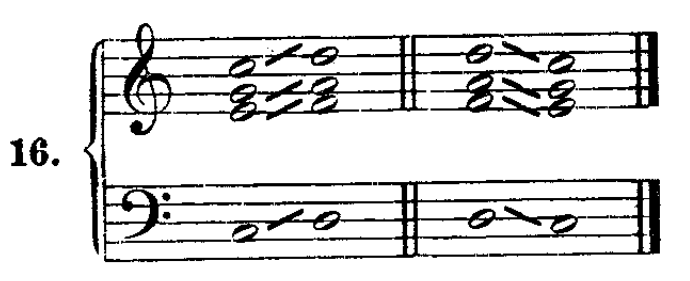
Before answering these questions, however, let us see, what different kinds of voice-motions there are. We perceive the three following kinds:
1) Parallel motion (motus rectus), in which two voices progress in one and the same direction, that is, upwards or downwards.

2) Oblique motion (motus obliquus), in which one voice remains stationary, while the other moves onward:

3) Contrary motion (motus contrarius); one voice progresses upwards, the other downwards.

All these various motions are admissible in every succession of harmonies. Observe, however, the so called Parallelisms occurring in the motus rectus; these are progressions, in which the two voices move not only in the same direction, but also in the same interval; for instance: when two voices progress upward or downward in Seconds or Fourths.

Some of these Parallelisms are indeed very euphonious and, therefore, like the other motions, entirely permissible. Others, however, are to be avoided partly because they do not satisfy the musical ear and again, because they counteract the independent movement of the voices. Such forbidden progressions are Parallel Fifths and Octaves.

Remark.To comprehend clearly the reason for prohibiting parallel Fifths and Octaves, it must be borne in mind that we have to deal not with the massive harmonization of orchestra or piano composition, but with 4 separate independent voices, which do not permit of extensive doubling. Should the question arise whether only parallel octaves and fifths are forbidden, and parallel dissonant intervals permitted, we may add, that for the present we are familiar only with tone-combinations, in which such progressions do not occur. Once for all, then, let it be said that in Harmony progressions of parallel fifths and octaves are prohibited.
Now only are we in a position to answer the question put at the beginning of this paragraph.
lf we wish to connect two triads having no external relationship, we can not lead all the voices a second upwards or downwards, as parallel fifths and octaves would arise.
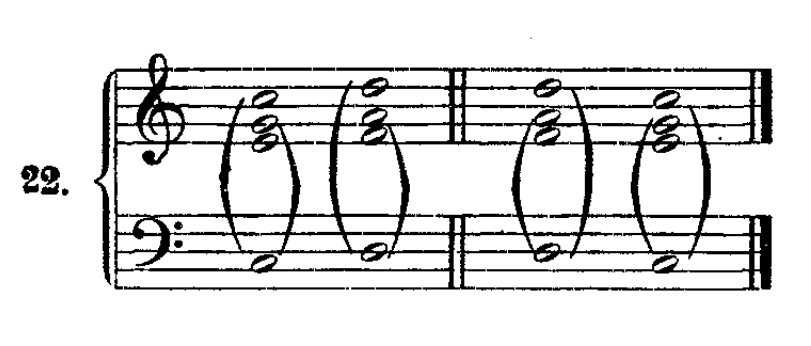
To avoid this fault we must employ contrary motion, without, however, proceeding in great skips.
The fault is by no means corrected, if we replace the step of a second by a skip of a seventh in the opposite direction (contrary motion), as in that case the fifths and octaves really remain.
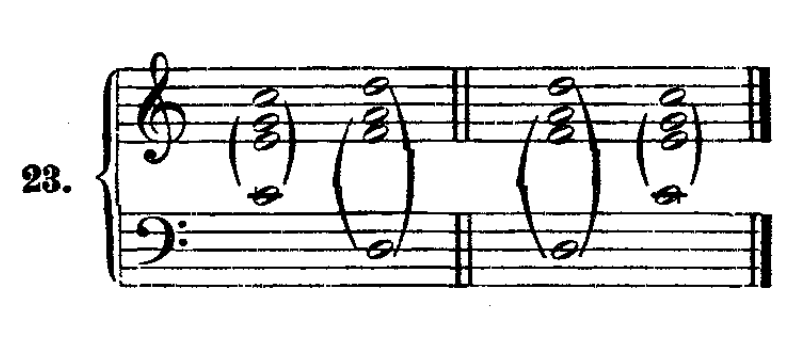
Moreover, we obtain a very unmelodious skip of a seventh in the Bass.
So we will allow the Bass to retain its melodious step of a second, and, employing contrary motion, lead each of the other voices into the nearest interval of the following chord.
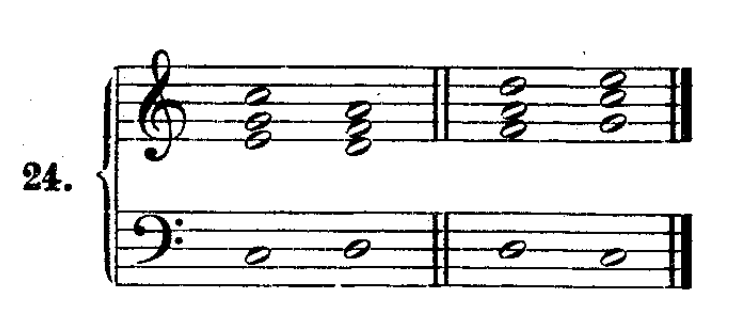
We have now learned, how to connect, within its own limits, all the consonant chords of the major scale in all positions. Besides working out the following written exercises, we should advise the pupil to form at the piano all manners of chord-combinations in all the keys, in order to master them more thoroughly.