 Playable Books
Hector Berlioz · section 4 of 67
The Violin
Read and hear this section in the playable edition →

The four strings of the violin are usually tuned in fifths:
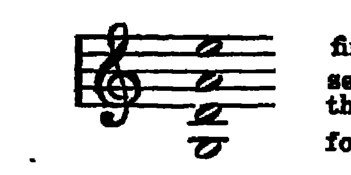
The highest string, E, is generally known as me chanterelle.
These strings are called open strings if the fingers of the left hand do not modify the sound by shortening the part of the string which is set in vibration by the bow. The notes to be, played on an open string are indicated by a zero (0) placed above or below
Some great virtuosos and composers have deviated from this system of tuning the violin. Paganini raised all strings a semitone in order to give more brilliance to the instrument: Consequently, he transposed the solo 2— part, playing for in-
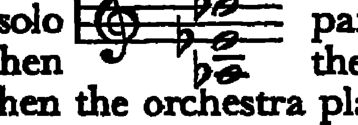
stance in D when be. _ the orchestra played in Eb, or in A when the orchestra played in Bb. Open strings being more sonorous than those stopped by fingers, he could thus frequently use them also in keys in which they would otherwise not be possible. De Bériot frequently raised only the G-string a semitone in his concertos. Baillot, on the other hand, sometimes tuned the G-string a semitone lower for the sake of
tender or somber effects. Winter, for the same reason,
taught as little as the art of inventing beautiful melodies, beautiful chord successions, and powerful rhythmical forms. One can only learn what is suitable for the various instruments, what is practicable or not, what is easy or difficult, what is weak or sonorous. It can also be indicated that one instrument is more appropriate than another for creating certain effects or expressing certain feelings. But as for their blending in groups, in small orchestras or large masses; as for uniting and combining them so that the tone of some instruments is modified by that of others, producing an ensemble tone unobtainable by one instrument or by a group of similar instruments: all this can be demonstrated only by studying the achievements realized in the works of the masters and by analyzing their methods. Their results can doubtless be modified in a thousand ways, good or bad, by composers with similar aims.
. The object of this work is, therefore, to indicate the range of the instruments and certain features of their mechanism; then to examine the nature of their timbre, their peculiar character and range of expression—matters greatly neglected up to now; and finally to study the best known methods for combining - them appropriately. To go beyond this would mean to enter the realm of creative inspiration where only a genius can roam and make his own discoveries.
used even the lower F instead of G. In view of the high degree of skill attained nowadays by our young violinists, the violin may be assigned
the following range in a good and fully staffed orchestra: net

Including all chromatic intervals on Pe’. =a
Great.virtuosos carry the range several tones higher. By means of harmonics considerably higher notes can be reached, even in the orchestra (more about this
In the meantime this range E
has been frequently ‘extended in t+ ‘tehcstra to
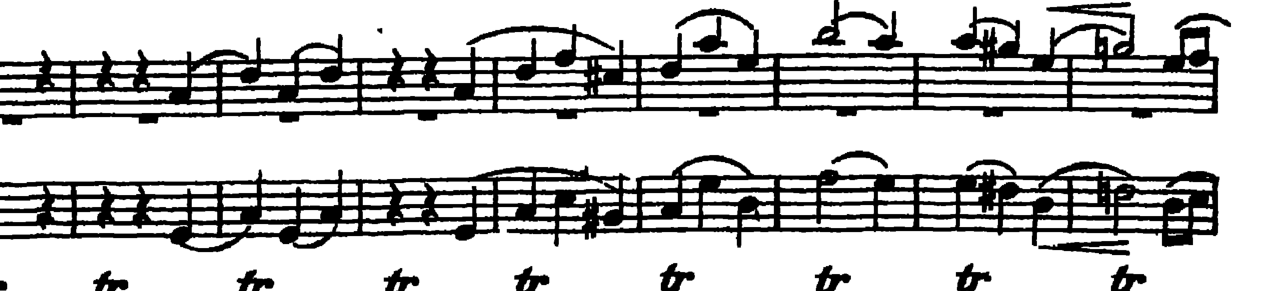
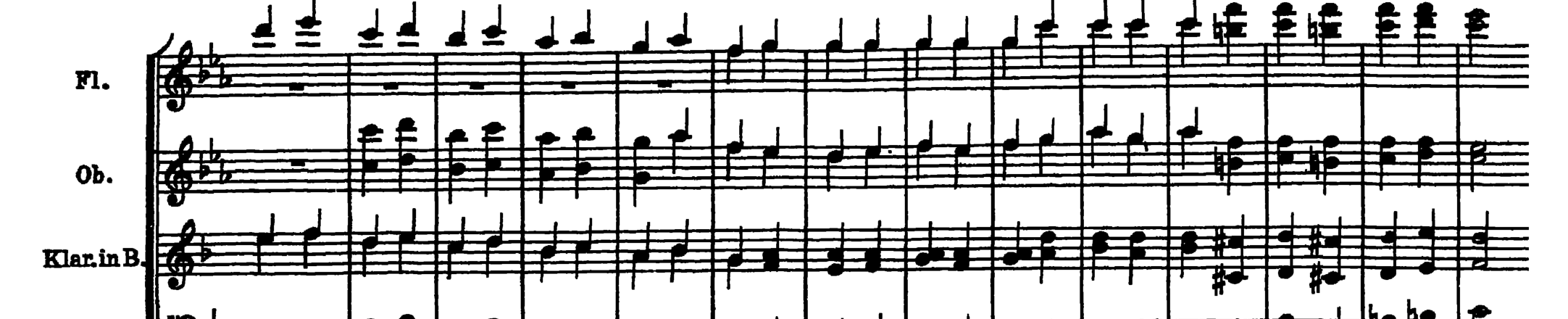
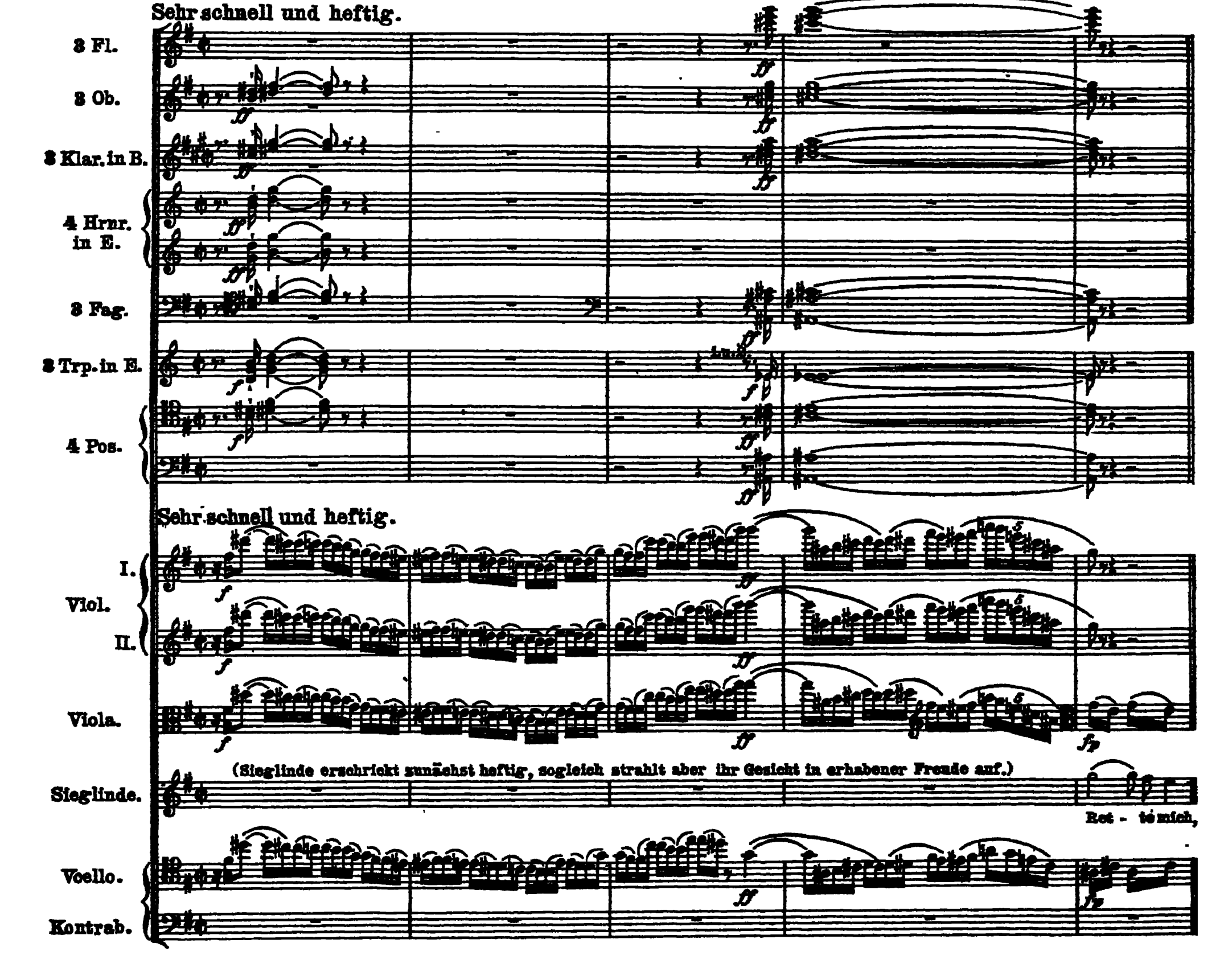
Trills are practicable on all steps of this far-ranging scale of three and a half octaves. But those on the three highest notes, A, B, C, are very difficult; it is advisable not to use them in the orchestra. 3 See the wonderful trill passage in the third act } of “Siegfried” during Bruennhilde’s awakening as
she looks into the light of the sun, enchanted and at the same time blinded by the unwonted radiance (Example 1).
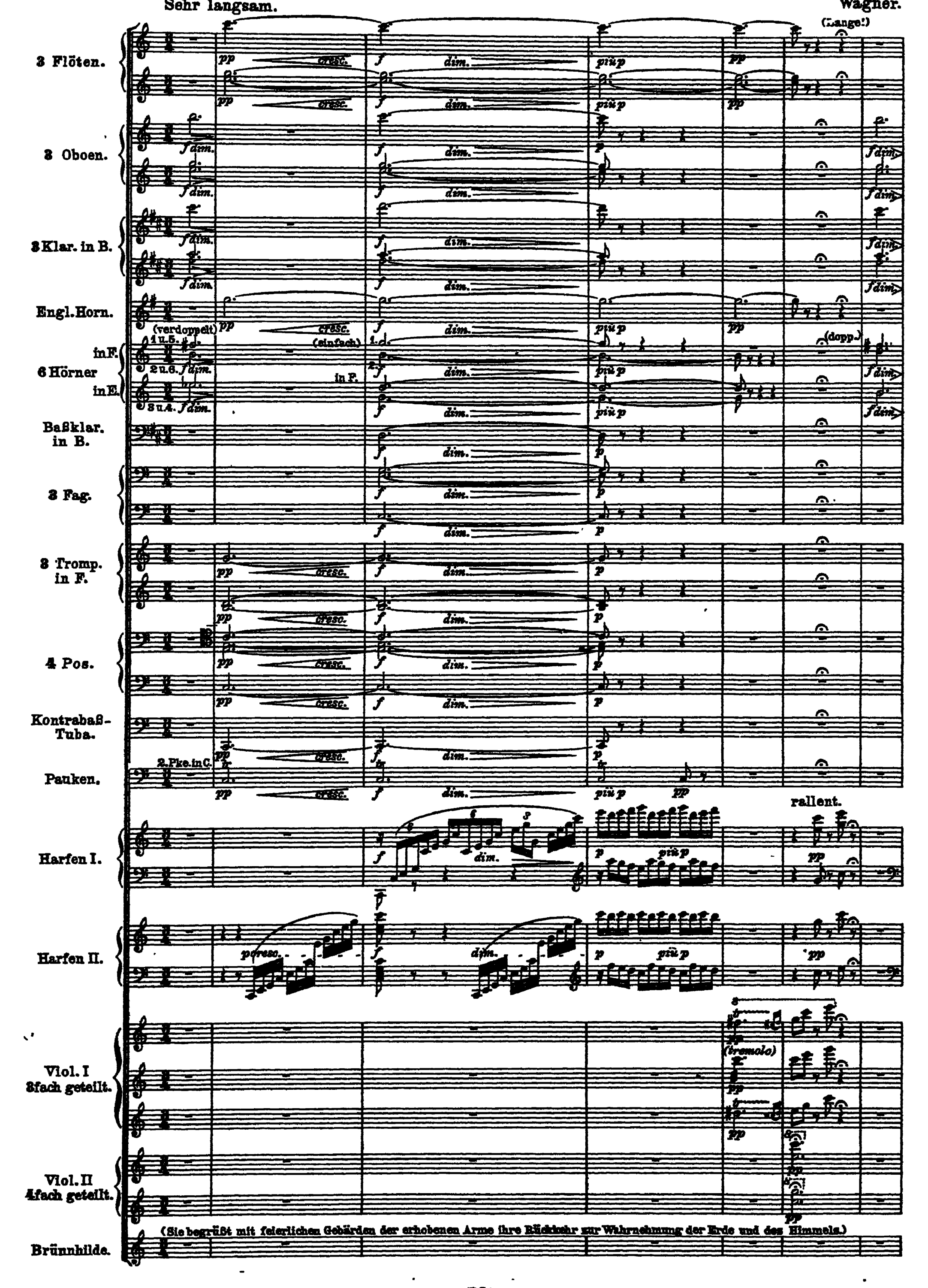
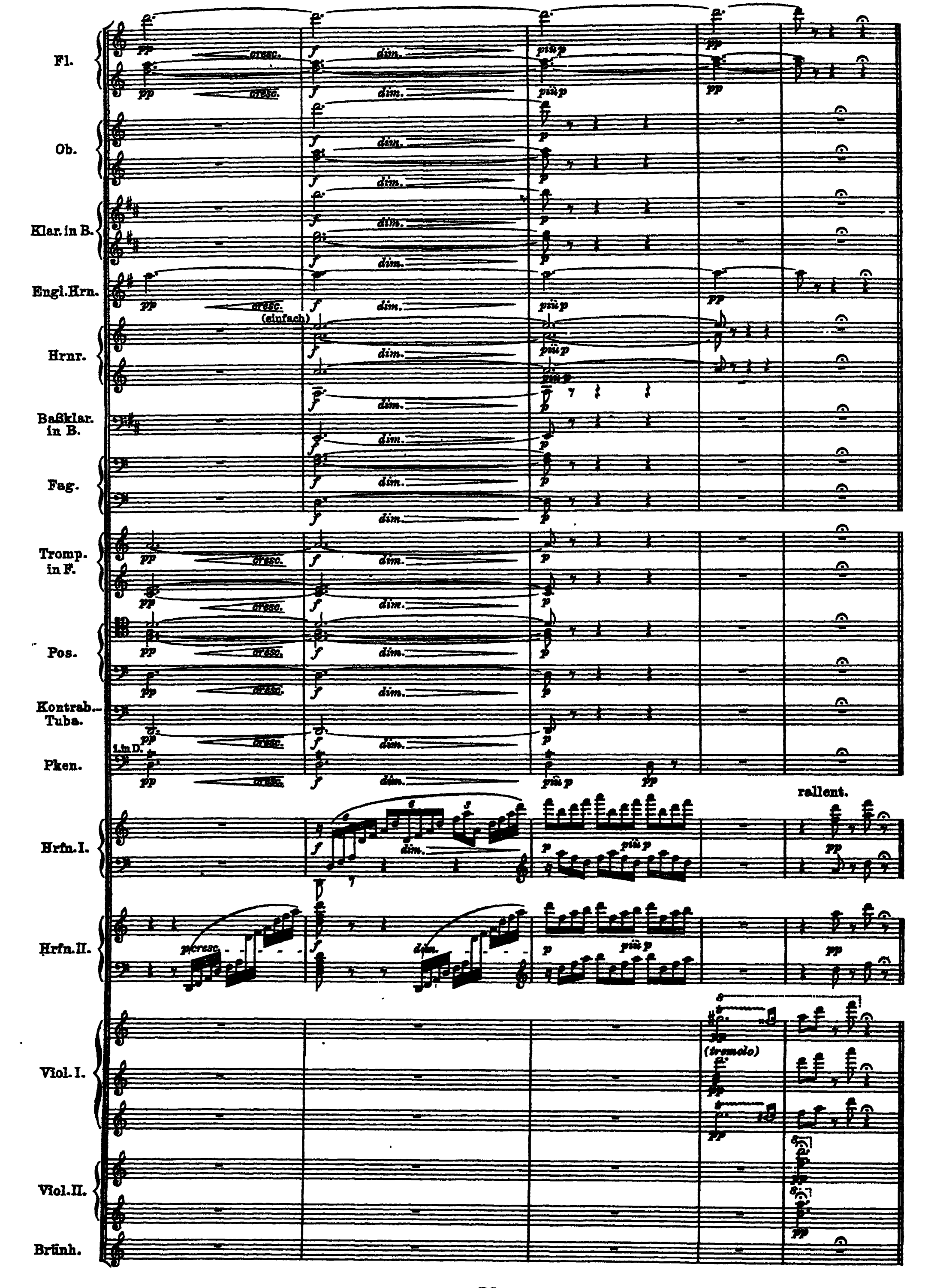
The minor trill on the fourth string between G and A♭ is to be avoided as much as possible; it is harsh and has an unpleasant effect.
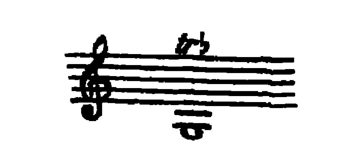
Numerous chords of two, three and four notes can be played on the violin, simultaneously or arpeggio; they vary considerably in their effect.
Chords of two notes, produced by so-called double stopping on two strings, are well suited, both in forte and in piano, to melodic phrases as well as to all kinds of accompaniments and tremolos.
The chords of three and four notes, however, are not of a good effect when played piano. They have vitality only in forte; for then only can the bow strike the strings together and make them sound well simultaneously. It should not be forgotten that in these three and four-part chords two tones at most can be sustained, the bow having to quit the others as soon as they are struck. In a moderate or slow tempo it is therefore useless to write:

for only the two upper notes can be sustained. In this case it is better to write

Of course, between the low G and D all chords are impossible since there is only one string (G) to produce the two tones. Should it be necessary to use chords at this extreme end of the scale, they can be obtained in the orchestra only by dividing the violins. This division is indicated in Italian by divisi or a due, in French by divisés or à deux, in German by geteilt, written over the passage:
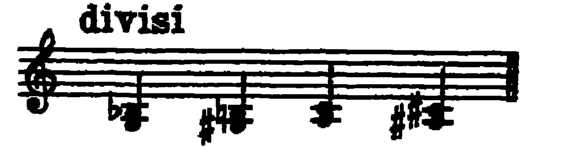
The violins are then divided, one group playing the upper and the other the lower part. Starting from the third (D) string upward, all chords of two notes in seconds, thirds, fourths, fifths, sixths, sevenths and octaves are playable; but they become progressively more difficult on the two higher strings.
Occasionally one note is played on two strings simultaneously. It is advisable to limit this effect to D, A and E. Only these three notes are easy to execute on two strings; they have a different timbre on each and a full tone, due to the open string:
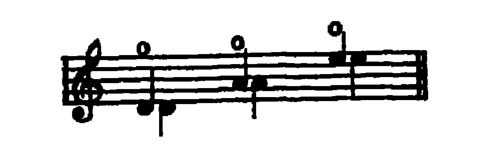
There is no open string in the other unisons:
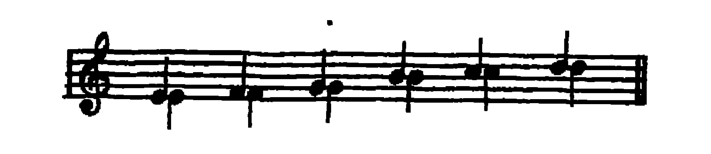
Their execution is rather difficult and, hence, their intonation rarely exact.
A lower string can cross a higher open string if it is given an ascending movement while the open string continues in the manner of a pedal-point:

The D remains open while the ascending scale is played on the fourth string throughout.
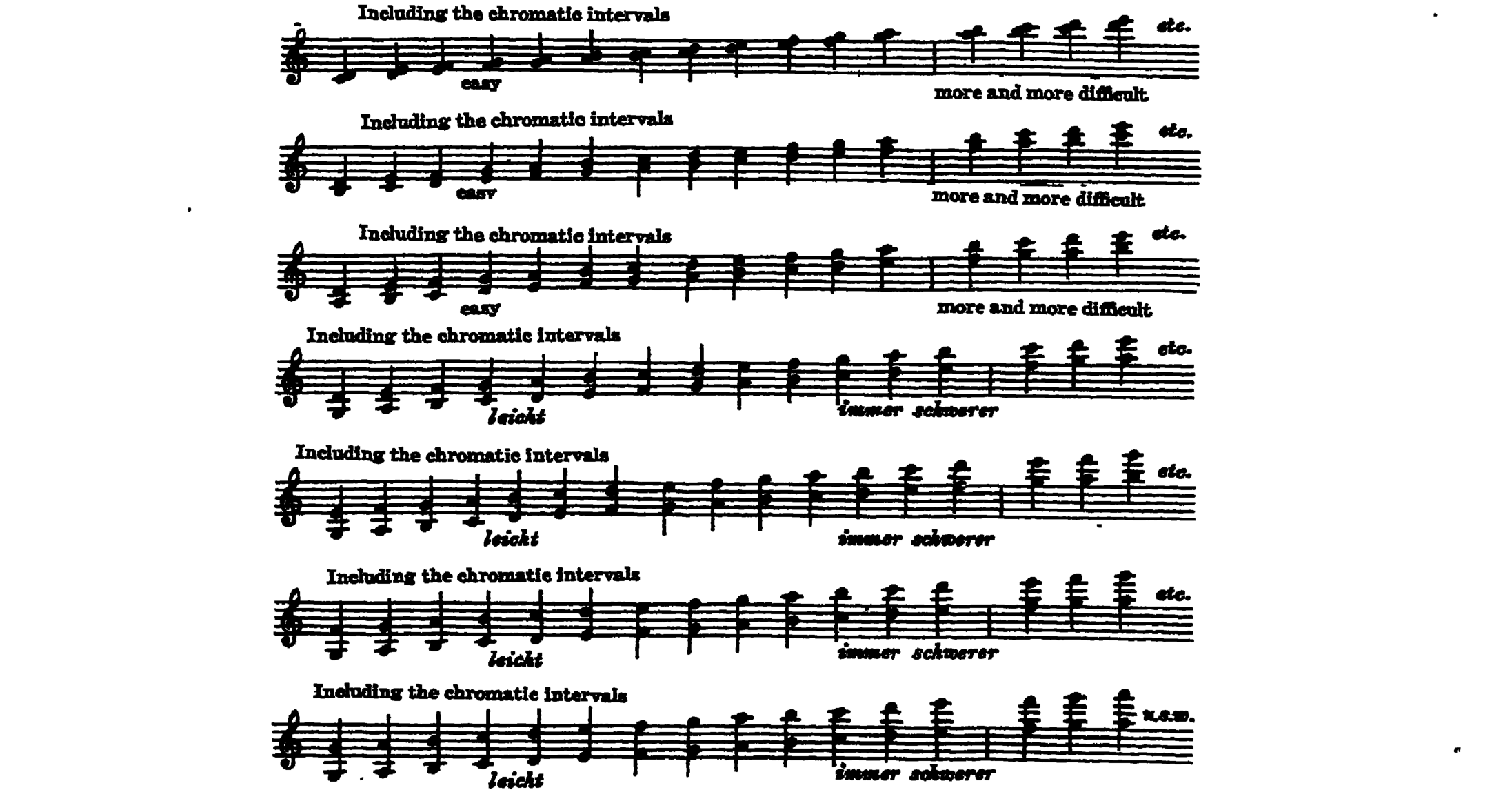
Ninths and tenths are possible, but far less easy than the preceding intervals. It is better to write them for the orchestra only if the lower string remains open; in this case they offer no difficulty:
Including the chromatic intervals
Leaps between double stops are to be avoided because they are extremely difficult if not impossible. They demand too great a change in the position of the hand:
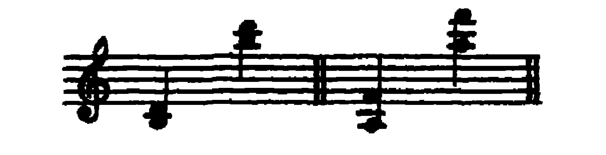
Generally such leaps can be used only if the two higher notes and the two lower notes form one chord which could also be played together, for instance:

In the following example the four notes could be played simultaneously only with considerable difficulty (except in the last chord). Nevertheless, the leap is here easy because the two lower notes are played on open strings, the two upper ones with the first and third fingers:

Among the chords of three and especially four notes those are always the best and most sonorous which contain most open strings. I consider it even better to confine oneself to chords of three notes if no open string is available for the four-part chord.
The following lists furnish a summary of the most frequently used, most sonorous and least difficult chords of this kind:
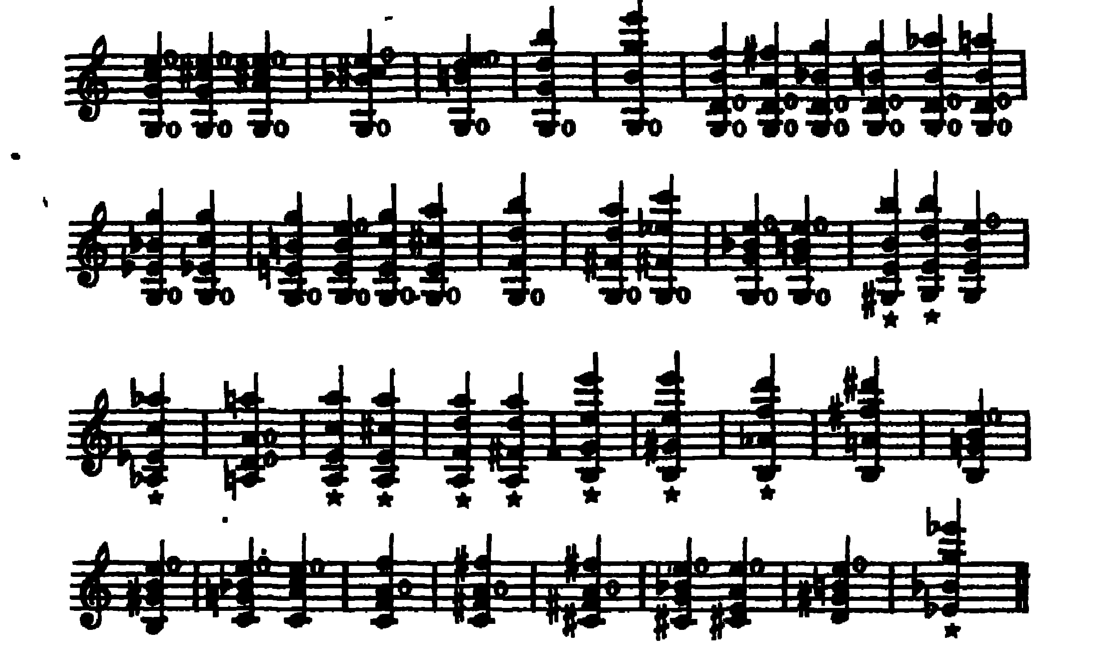
In those marked * it is better to omit the lowest note.

Easy in a moderate tempo:

All sequences of chords combined in this fashion are not difficult. They can also be executed in arpeg-
gio, i.e. consecutively; particularly in pianissimo this often creates the most agreeable effects:

There are furthermore combinations similar to those above, in which the four notes could be played simultaneously only with great difficulty, whereas they are easily executed in arpeggio by means of the first
or second fingers passing from the fourth string to the first in order to play the lowest and then the highest note:

By omitting the lowest or highest notes in the preceding examples, one obtains as many three-part chords. To these are to be added the chords which
result from combining the various tones of the Estring with the two open center strings, or those of the E and A-strings with the open D-string:
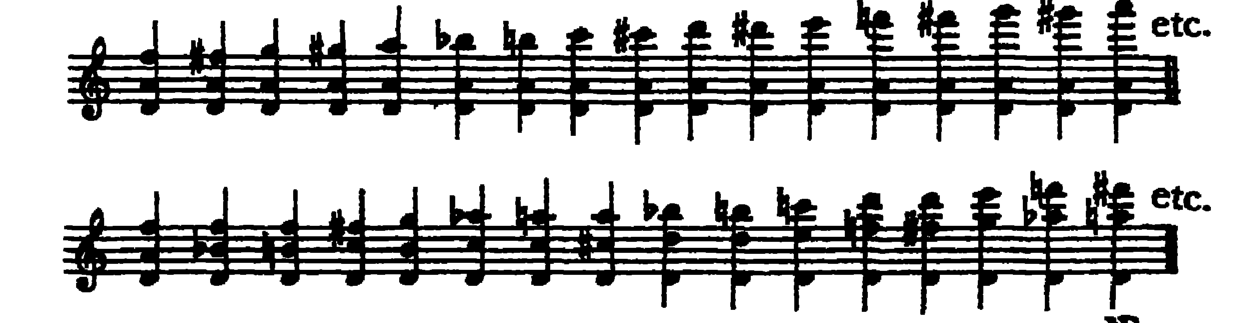
If it is desired to strike one isolated D-minor or. major chord, it is not advisable to choose the position marked NB in the foregoing example because it is too difficult without similar chords preceding it. It 1s better to use the following position, which is easy to play and more sonorous
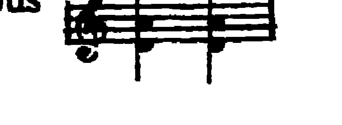
because of the two open strings: =
Sequences of diminished seventh chords are also easy because the fingering remains the same while
The preceding examples show that all three-part chords are possible on the violin if one takes care, in those without open strings, to spread their tones sufficiently to allow intervals of a fifth or sixth between them. The sixth may be placed either above or below, or both.

; the chord changes to the next position: -

Certain chords of three notes are practicable in two ways, and it is better to choose the one containing an open string, for instance:
b = or z
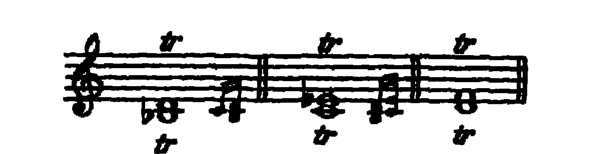
Double trills in thirds can be executed, starting from the low Bb:
No. 2. Walkuere, Act I.’
But as they are mere difficult than simple trills and the same effect can be obtained by dividing the violins, it is usually advisable to avoid them in the orchestra.
The tremolo (simple or double) produces various excellent effects. It expresses unrest, excitement, terror in all nuances of piano, mezzoforte or fortissimo if it is employed on one or two of the three strings, G, D, A, and if it is not carried much above the
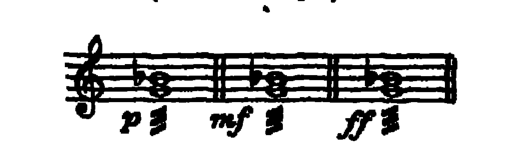
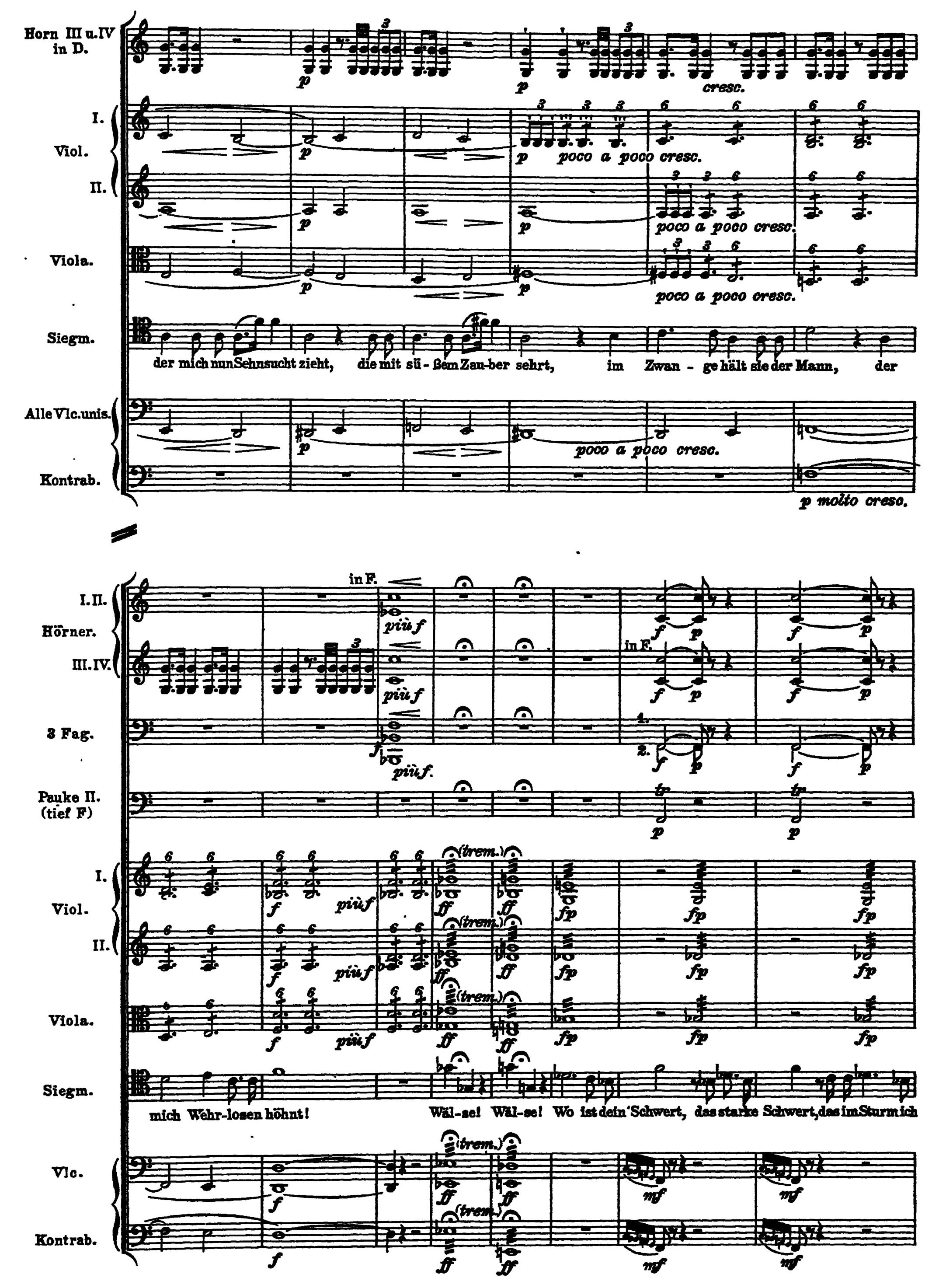
The tremolo was used with the greatest effect by Weber and Wagner, perhaps most significantly in
the first act of ‘“‘Walkuere” with Siegmund’s call, “Waelse, Waelse!” (Example 2.)
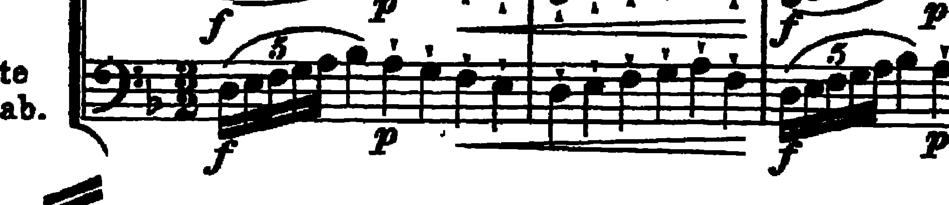
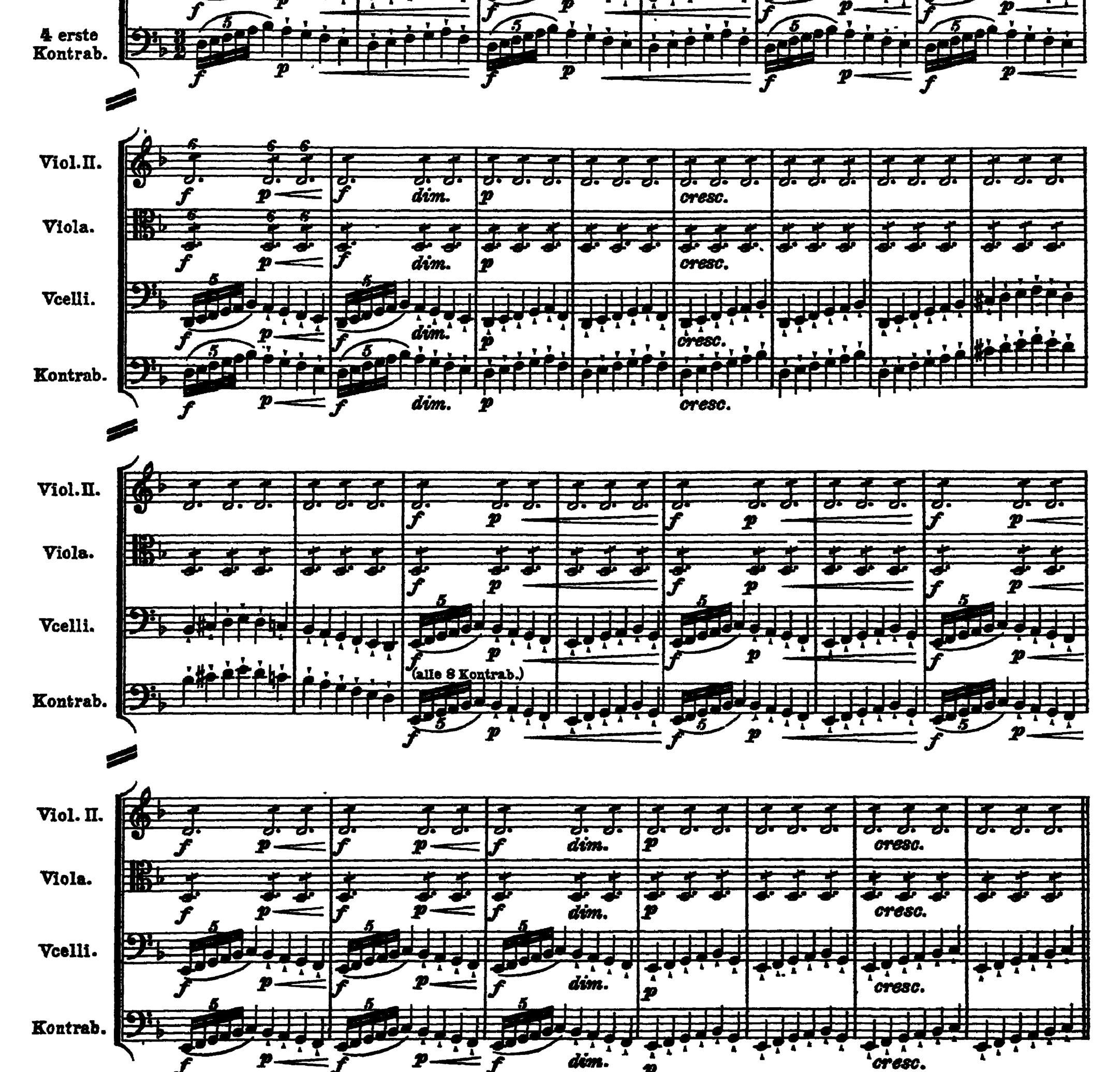
What a magnificent idea is the picture of the ' by the wind is wonderfully depicted by the followmonotonously raging storm a e beginning o ing sound-conception (Example 3). “Walkuere”. The whipping of the rain and hail "s P ( pie ®)
No. 3. Walkuere, Beginning
Sturmisch. Wagner.


a Oss 1 as Os Os Ot eh as es OT Oe os OT
The tremolo has a stormy and vehement character on the medium tones of the E and A-strings in fortissimo.
2 It becomes ethereal and seraphic when
== employed in several voices and pianissimo Lf on the high tones of the E-string:
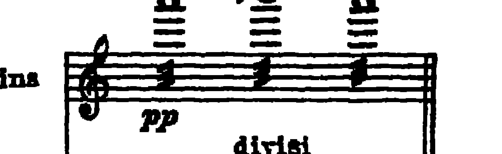
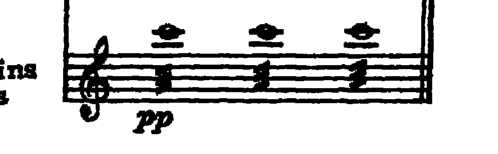
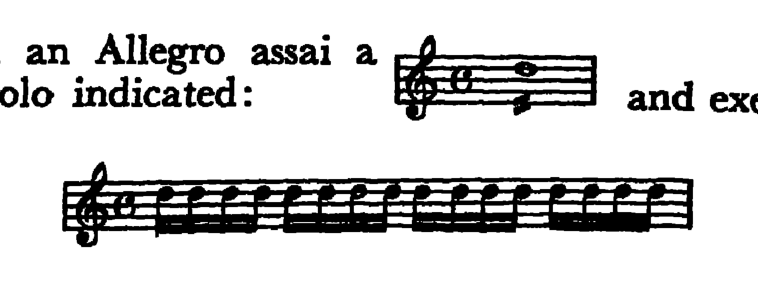
is entirely sufficient. But if in an Adagio the tremolo were also indicated by sixteenths, the performer would, of course, play strictly sixteenths; instead of the quivering one would hear only a heavy
and dull repetition of tones. In this case Fs
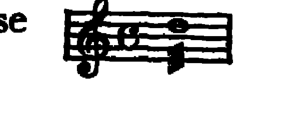
it is necessary to write
and sometimes, if the tempo is still

It may be mentioned here that, while the violins in the orchestra are customarily divided into two groups (First and Second Violins), there is no reason why these groups should not be subdivided again into two or three parts according to the aim the composer wants to achieve. Occasionally the violins can be divided even into eight groups, either by setting off eight solo violins, playing eight individual parts, against the solid mass, or by dividing the complete first violins and second violins into four equal choirs
I revert to the tremolo. To make its effect complete it is essential thaf the movement of the bow is fast enough to produce a real trembling or quivering. Therefore, the composer must precisely indicate its
execution in accordance with the tempo of the piece;.
for the performers are always inclined to avoid any mode of execution which is tiring, and they would not fail to profit by any latitude left to them.
The tremolo on the lower and middle tones of the third and fourth strings in fortissimo is particularly characteristic if the bow strikes the strings near the bridge. In a large orchestra and if executed well by the players, it produces a sound similar to that of a rapid and powerful waterfall. This manner of execution is indicated by sul ponticello..
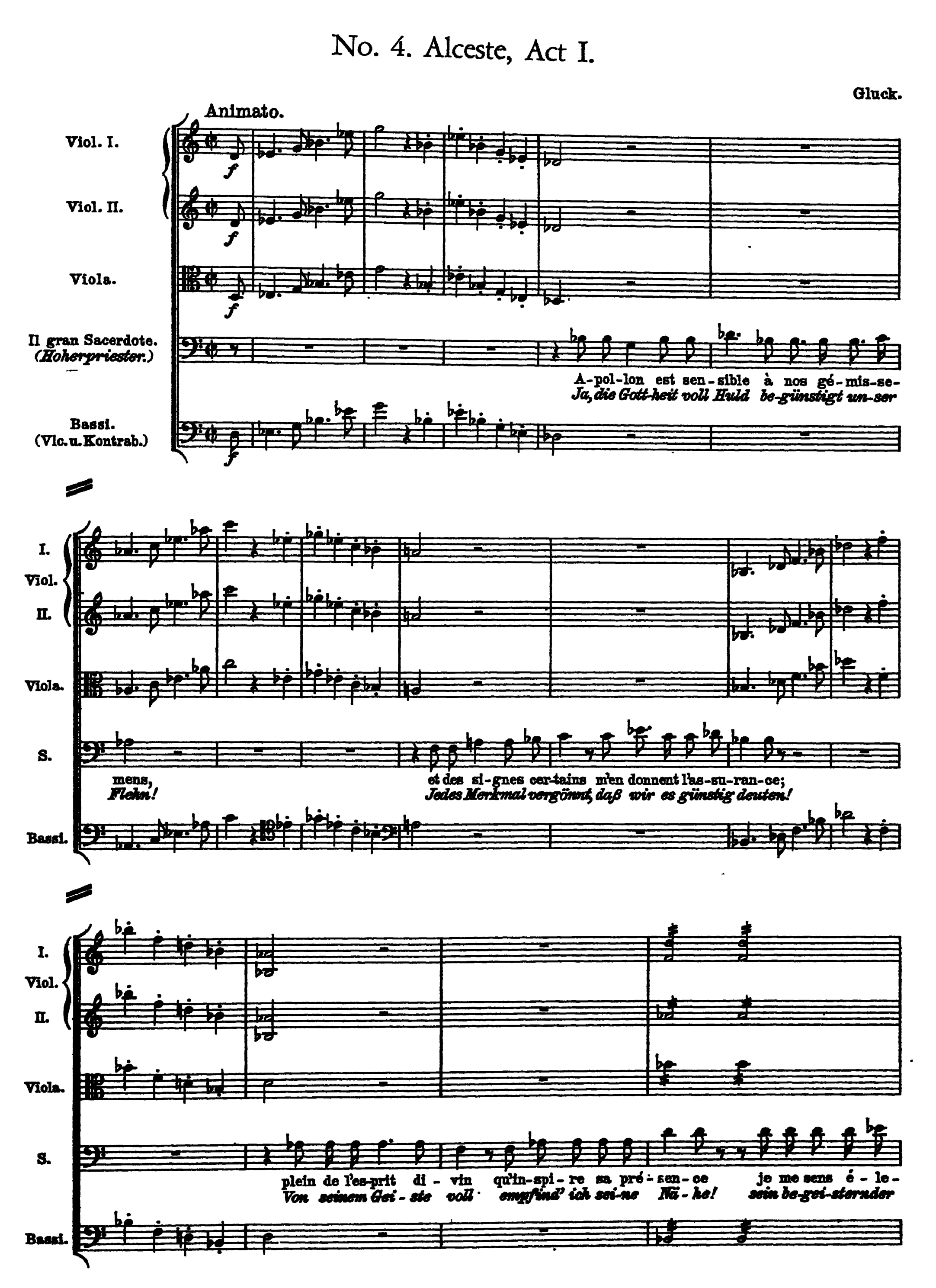
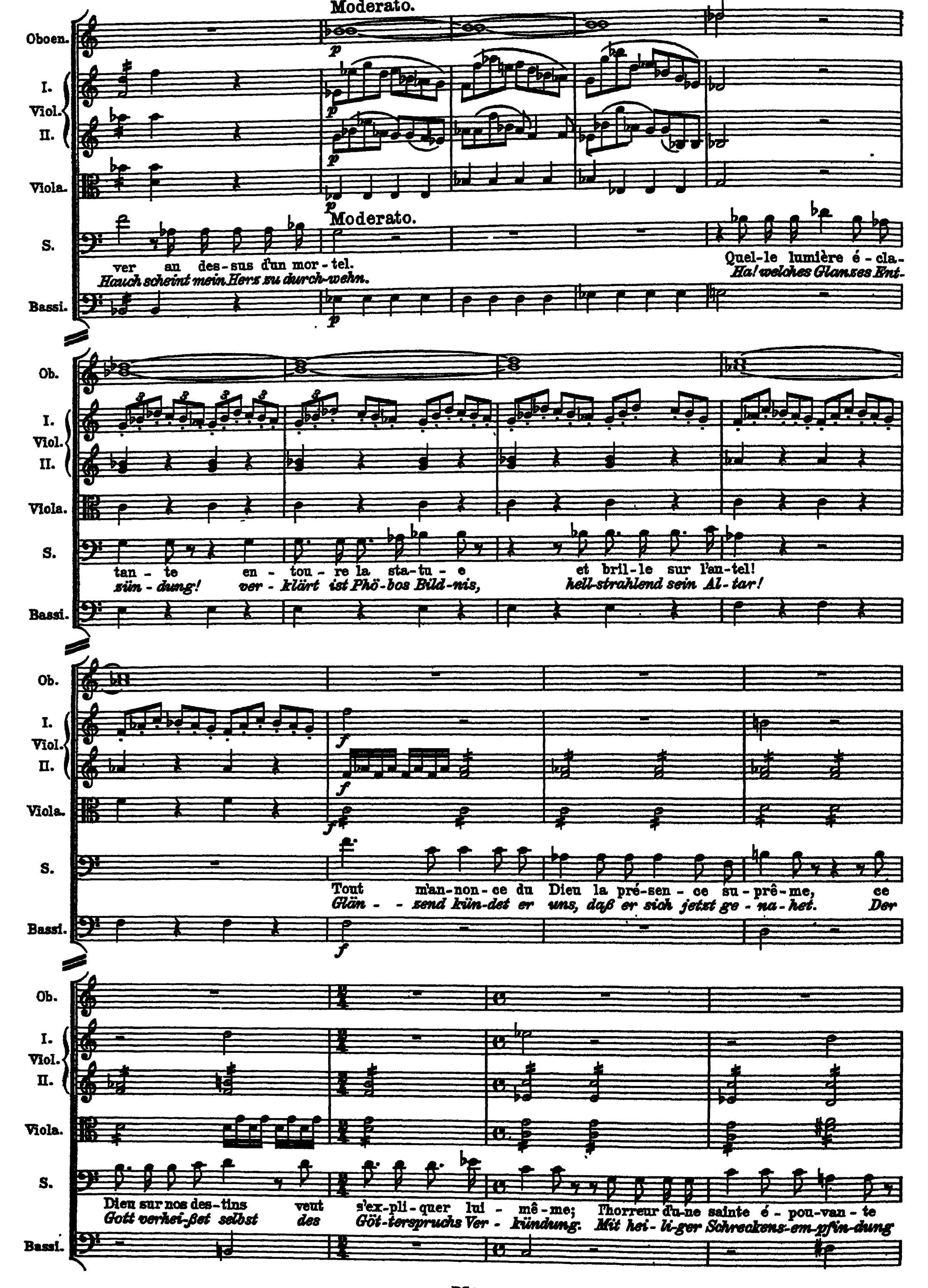
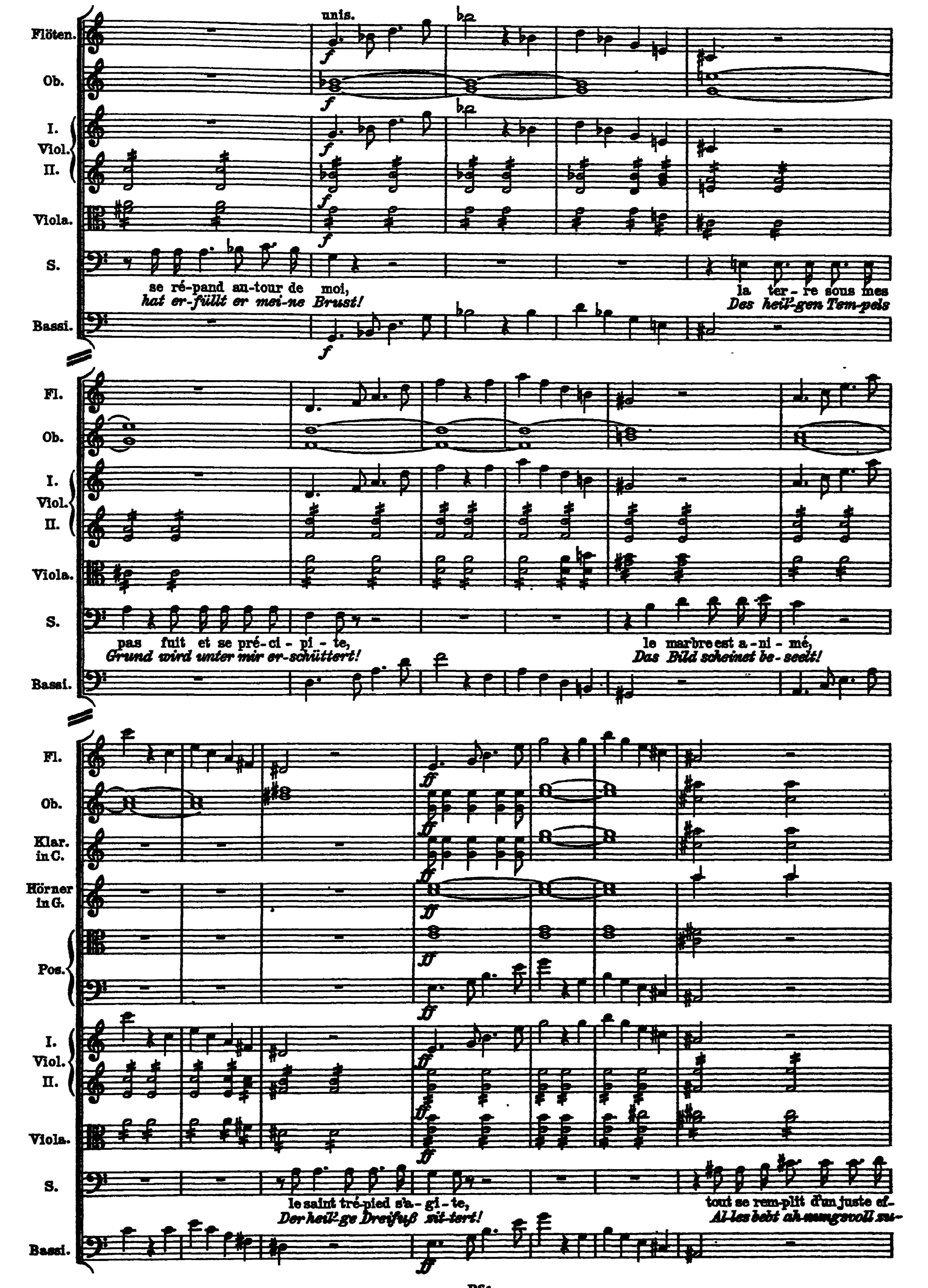
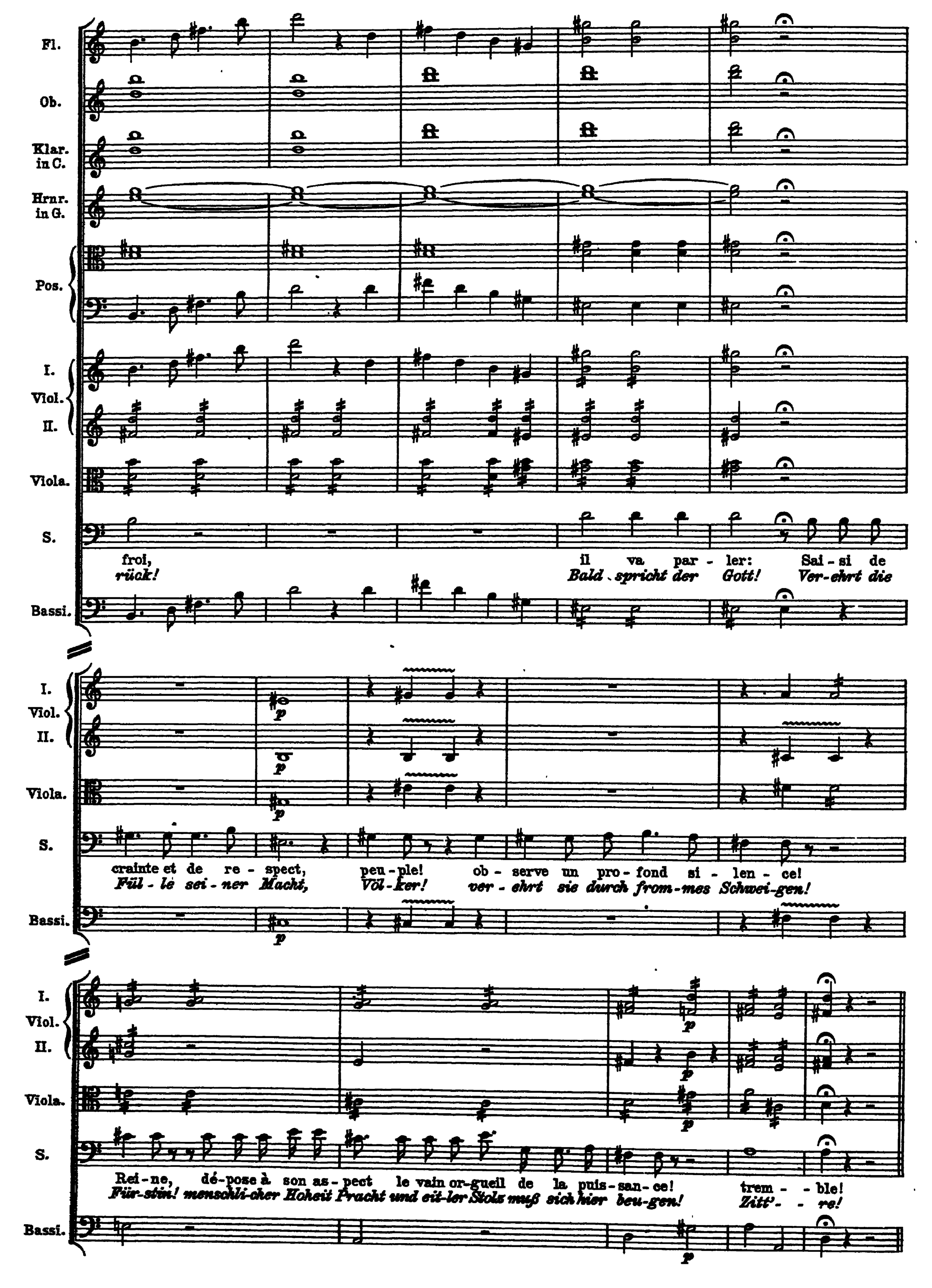
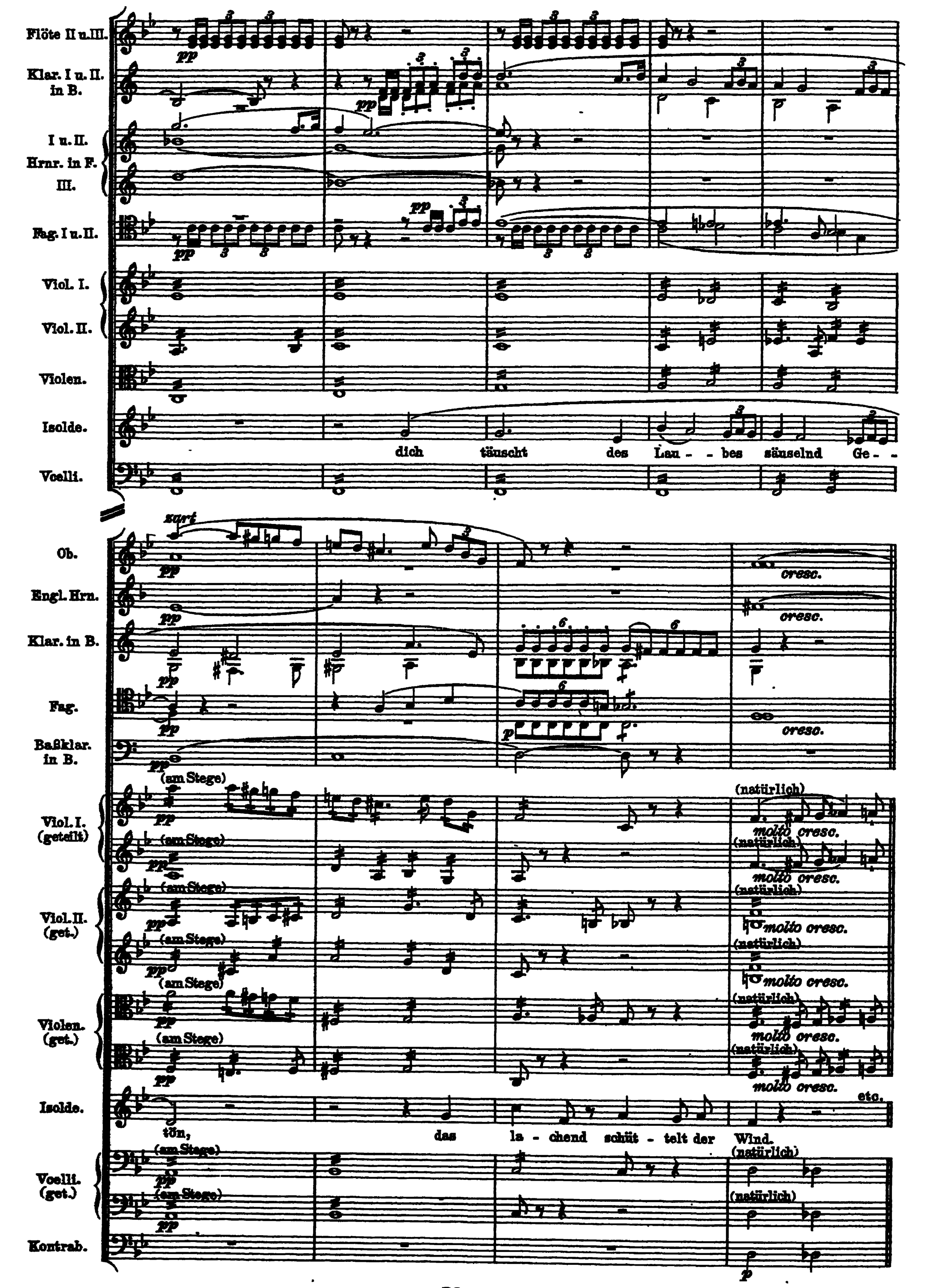
A magnificent example of this effect can be found in the scene of the oracle, in the first act of “Alceste” by Gluck. The effect of the tremolo in the second violins and violas is reinforced by the heavy, menacing steps in the basses, by the blow struck from time to time in the first violins, by the gradual entry of the wind instruments, and finally by the majestic recitative which this turbulent orchestra accompanies. I know nothing of this kind more dramatic or more terrible. However, the idea to execute this tremolo sul ponticello cannot be ascribed to Gluck; it is not indicated in his score. The honor for it belongs entirely to M. Habeneck, who, when rehearsing this wonderful scene at the Conservatoire, had the violins play it in this energetic fashion; its superiority in this case is incontrovertible. (Example 4.)
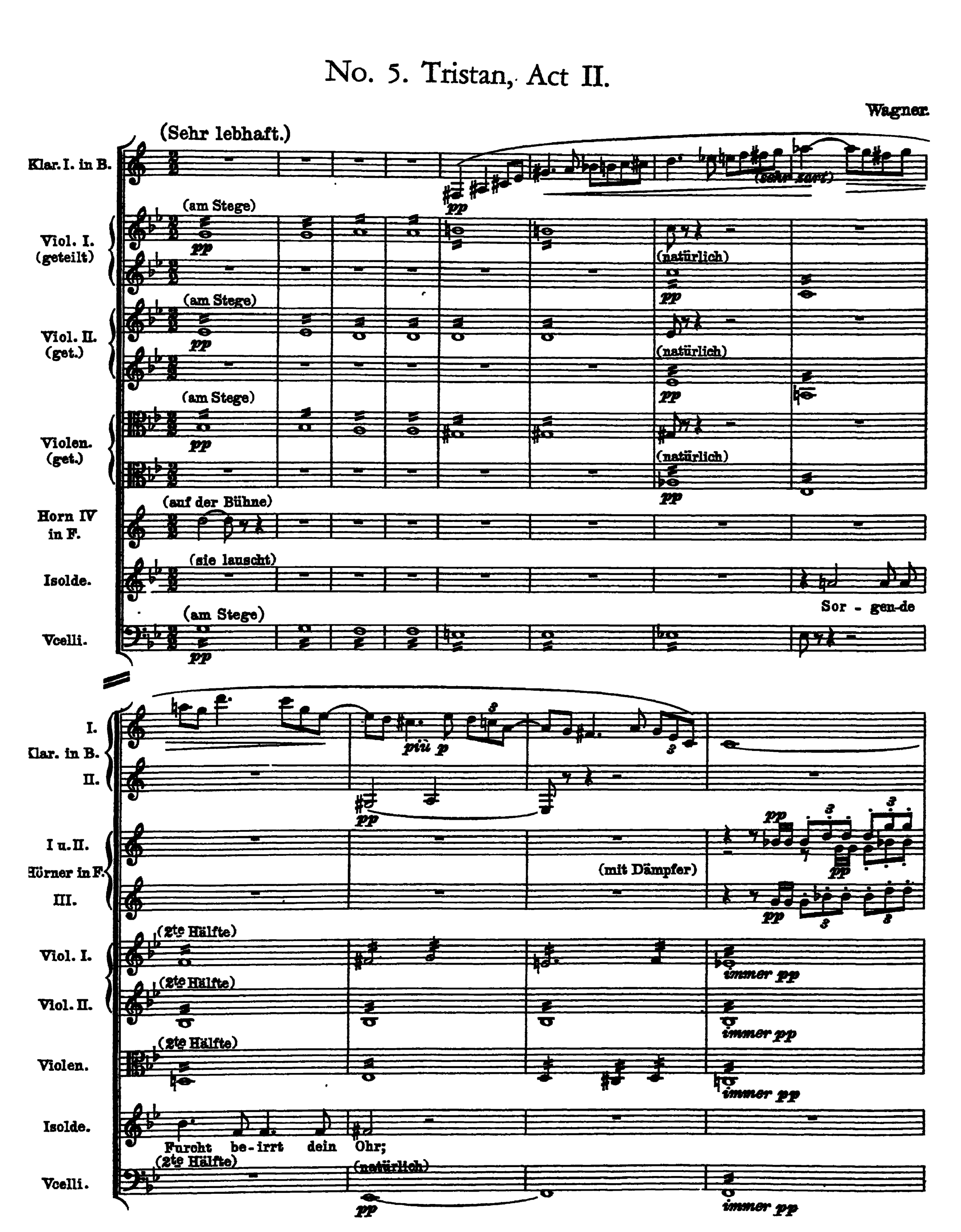
At the begin
of the second act of “Tristan”
this tremolo
effect near the bri
rustling of the leaves and the blo
produces a feeling of awe and apprehension in the
listener. (Example 5.)
For certain accompaniments of a dramatic and agitated character a broken tremolo is sometimes used
with good effect, either on one string:

Finally, there is a kind of tremolo which is no longer used, but which Gluck employed admirably in his recitatives. It may be called the undulating tremolo. It consists in playing a number of slurred notes on the same tone at a slow speed while the bow does not leave the string. In these not strictly meas-
ured accompaniments it is hardly possible for all the performers to play the same number of notes in a bar; some play more and some less. This difference causes a kind of wavering or indecision in the orchestra, perfectly adapted to render the uneasiness and anxiety in certain scenes. Gluck wrote it thus:

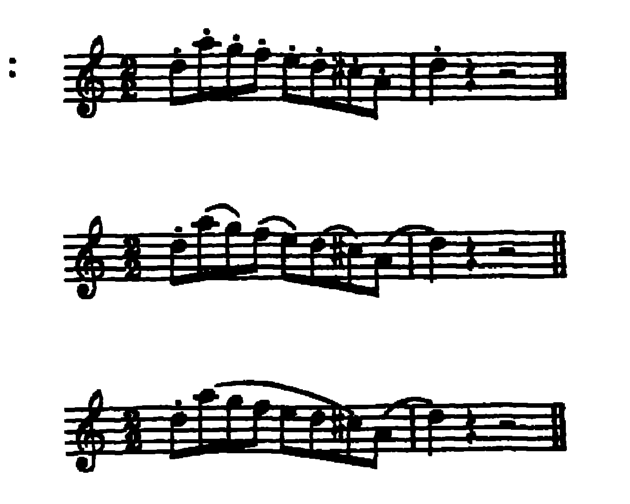
The manner of bowing is very important and greatly influences the sonority and expression of motives and melodies. It must be carefully indicated ac-
For detached tones (le détaché) :
For slurring two notes:
For extended slurs (legato) :
cording to the nature of the idea to be rendered. The following signs should be used:
For the staccato or light détaché, which is executed over the whole length of the bow by a succession of small strokes, moving the bow only a little at a time:

For the grand, broad staccato (grand détaché porté), which is intended to give the string as much sonority as possible by letting it vibrate after the bow
has struck it vigorously (this is particularly suitable for pieces of a proud, magnificent character and of moderate speed).:

Notes repeated two, three or four times (according
to the tempo) give more power and vividness to the
tone of the violins and are suitable for various orches-
tral effects in all kinds of shadings:


However, in phrases of a broad tempo and vigorous
character simple notes in grand détaché produce a
much better effect, unless one wants to employ a real
tremolo on each note.
The following phrase

if played in the indicated slow tempo, will sound much more nobly and vigorously than the following:

I believe composers would be too meticulous if they To curb the different temperaments in bowing
indicated down-bows and up-bows in their scores (as means to destroy the soulful expression in the renit is done in violin etudes and concertos). But if par- dering of a melody. One violinist, in accordance ticular lightness or power or breadth of tone is re- with his feelings and technical skill, may need four quired, the manner of execution may be indicated as strokes of the bow to play a melody expressively; follows: “At the point of the bow’, or “At the heel” another violinist, only two. If the first one is forced (lower end of the bow), or “Whole bow on each to play this melody also with two strokes, his pernote”. Likewise, “Near the bridge” or “On the finger- formance will obviously lose its intensity and beboard” designate the spot close to or at a distance come poor and dull. Furthermore, if a composer
from the bridge where the bow should strike the has indicated one bow for a phrase of, let us say, strings. The metallic, somewhat rough tones produced near the bridge differ greatly from the soft, veiled tones played over the finger-board.
I should like to cite some practical experiences regarding bowing and fingering. It is customary in many orchestras to indicate uniform bowing for the violins (as well as the other string instruments). Of course, the resulting evenness of bowing gives elegance to the playing of the violin group and is restful to the eyes of the audience. Nevertheless, I would not recommend using this device indiscriminately, for the following reasons.
i did not produce the intended impression of serene gaiety with the indicated bowing, but sounded
four or more bars, its broad character would be destroyed if it were broken up uniformly into four to six parts by all violinists. In such cases it is my principle to follow strictly the composer’s phrasemarks (breathing-marks) only at the beginning and end of a phrase; within the phrase I let each violinist change the bow as he wishes.
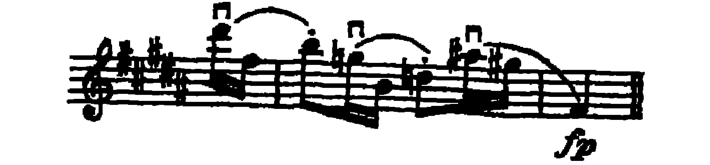
For composers it is very important to consider carefully the problem of up-bows and down-bows when they want to achieve certain nuances. For instance, during the first rehearsal of my “Sinfonia Domestica” in New York the theme
lame and dull. At last I conceived the idea of hav-
ing it played in this way:

At once the theme had the cheerfulness desired by me, the dot on the second and fourth eighths was observed automatically, and the passage, whether in upper or inner parts or in the bass, sparkled through the whole orchestra with the same intensity. I had the second theme of the piece phrased accordingly and obtained the same effect:
Therefore, dear fellow composers, watch the upbow and down-bow! A small bowing-mark at the right place is often more effective than the most elo-
= = eee ee ee
quent expression marks such as “gay”, “grazioso”, “spirited”, “smiling”, “defiant”, “furious” etc. Our worthy instrumentalists and their dear conductors pay very little attention to them.
As to fingering, I found, when rehearsing Berlioz’ “Féte chez Capulet”, that the beginning of the partly chromatic phrase for the violins never sounded quite clear as long as but one violinist played the chromatic scale by sliding up or down with his finger. Finally I prescribed a separate finger for each note. At once the disturbing sounds caused by the shiding stopped and the passage became faultless. This experience gave me the idea to mark this fast violin passage from my “Sinfonia Domestica”
This passage is absolutely unclear and blurred with the usual fingering, which would be more appropriate for the howling of the storm in the Pastoral Symphony.
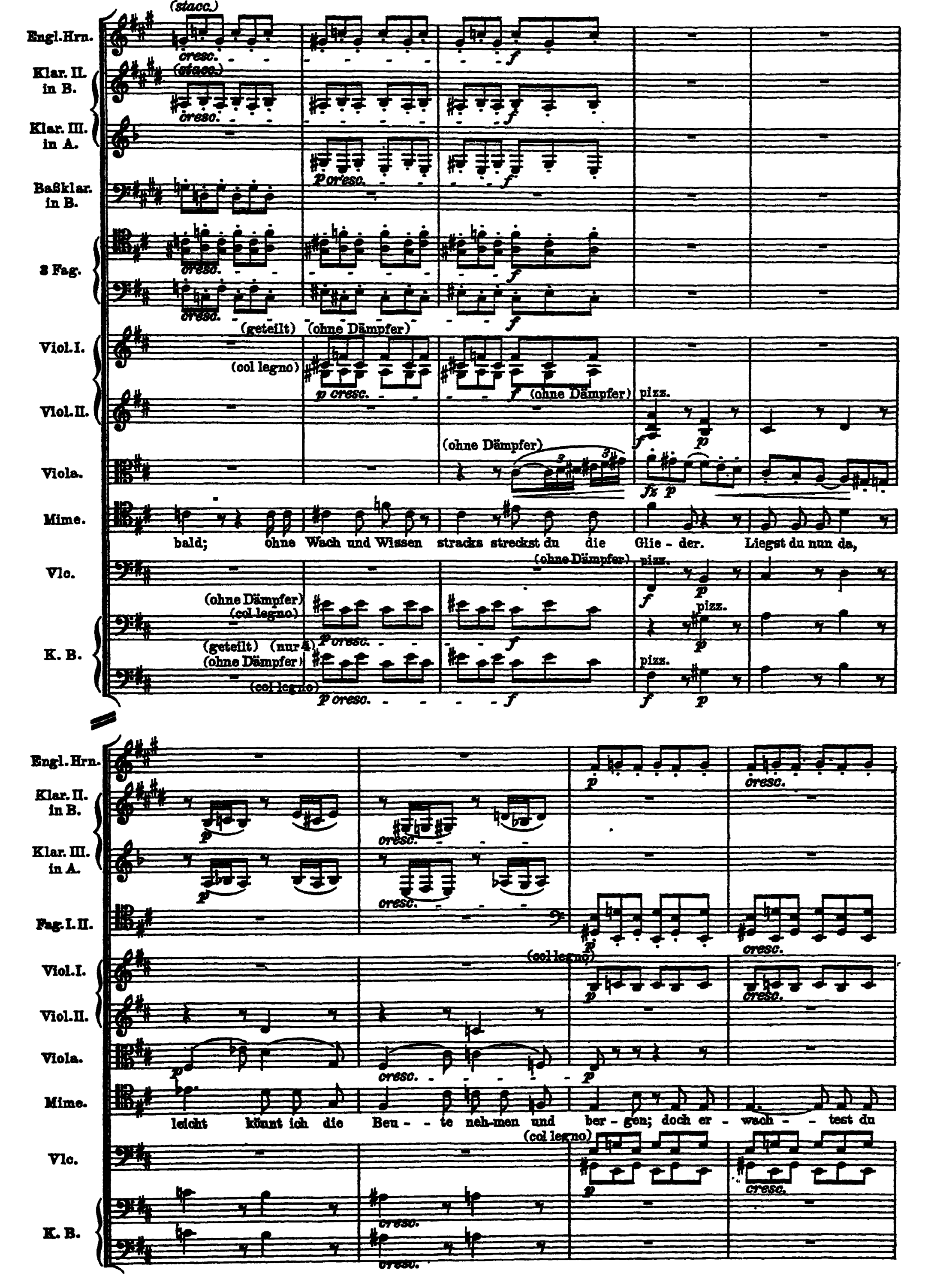
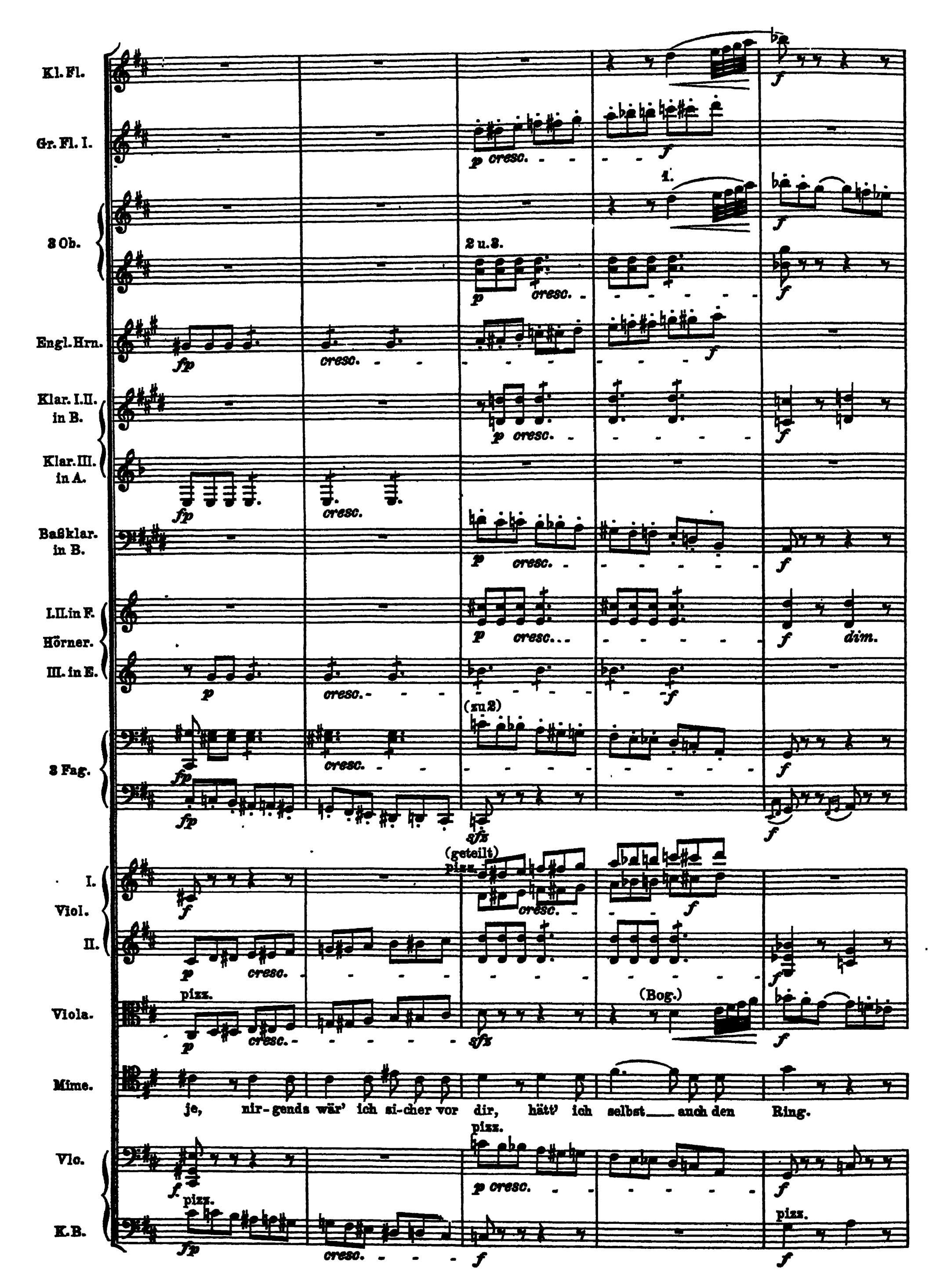
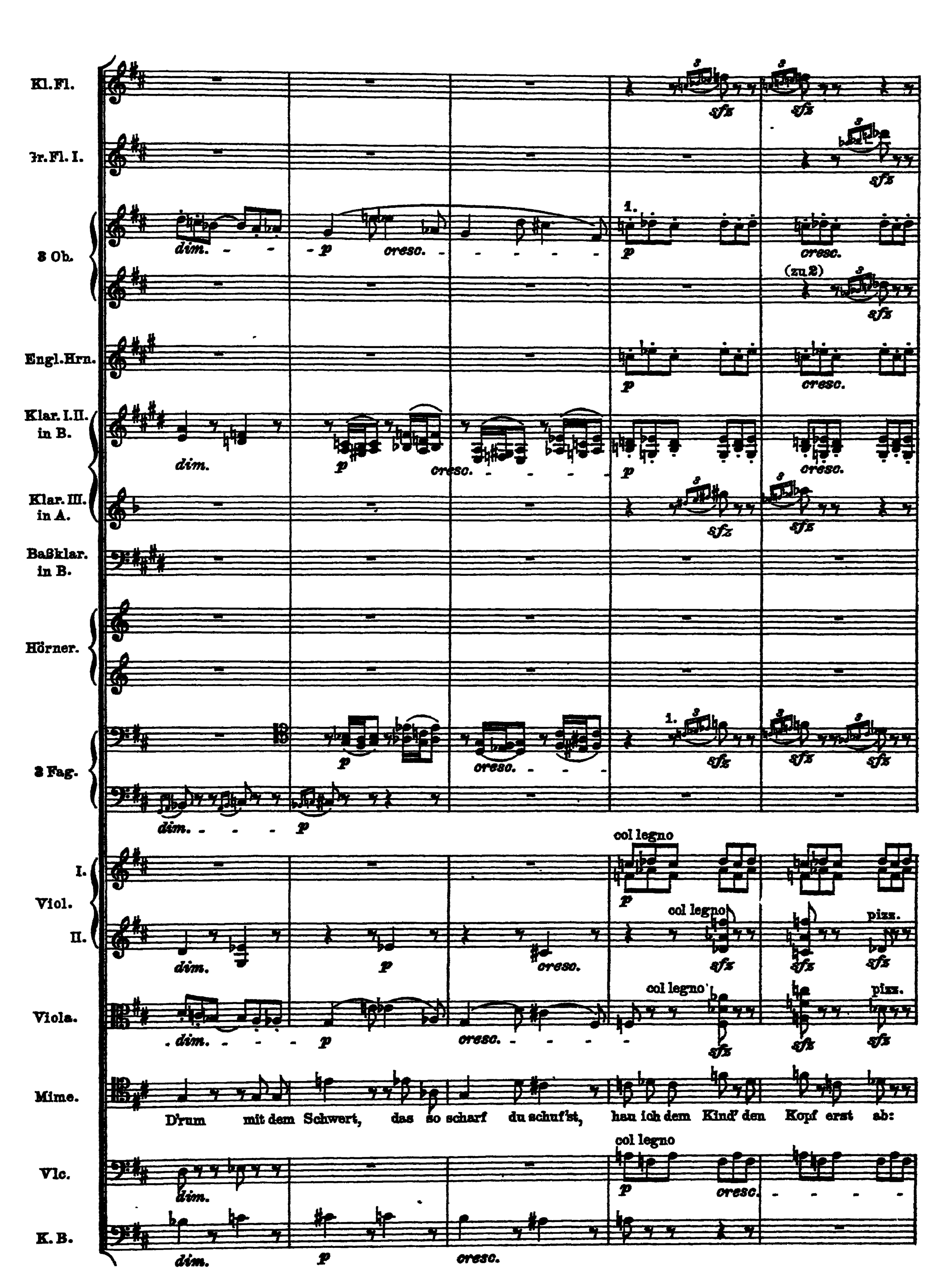
In a symphonic work where the terrible is combined with the grotesque, the back of the bow has been used to strike the strings. This is called col legno (with the wood). This strange device should be employed very rarely and only for a very definite pur-
pose. Only in a large orchestra is its effect sufficiently noticeable. The numerous bows quickly falling on the strings produce a kind of crackling sound which would be scarcely audible with a small number of violins, so weak and short is the sound in this case.
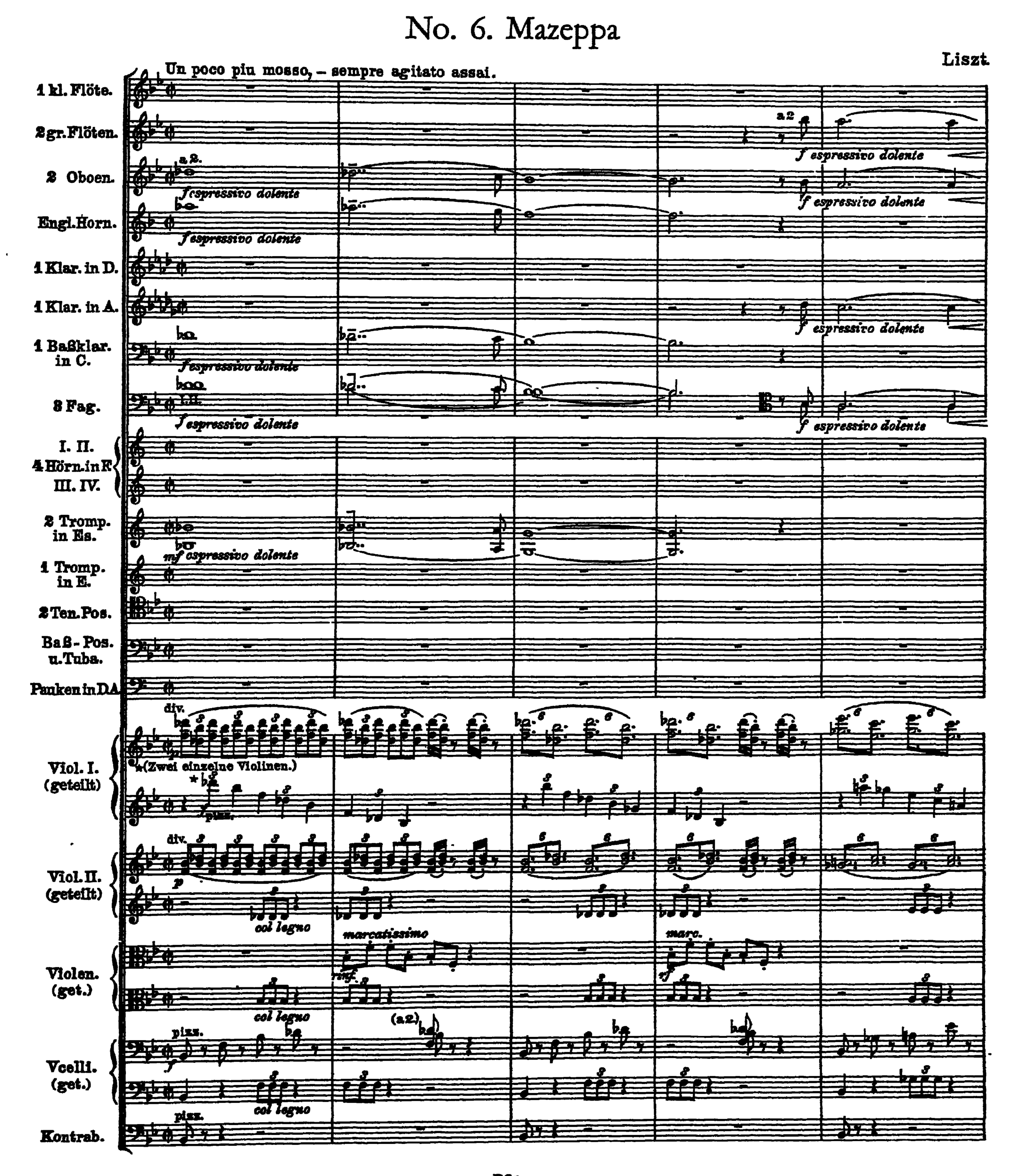
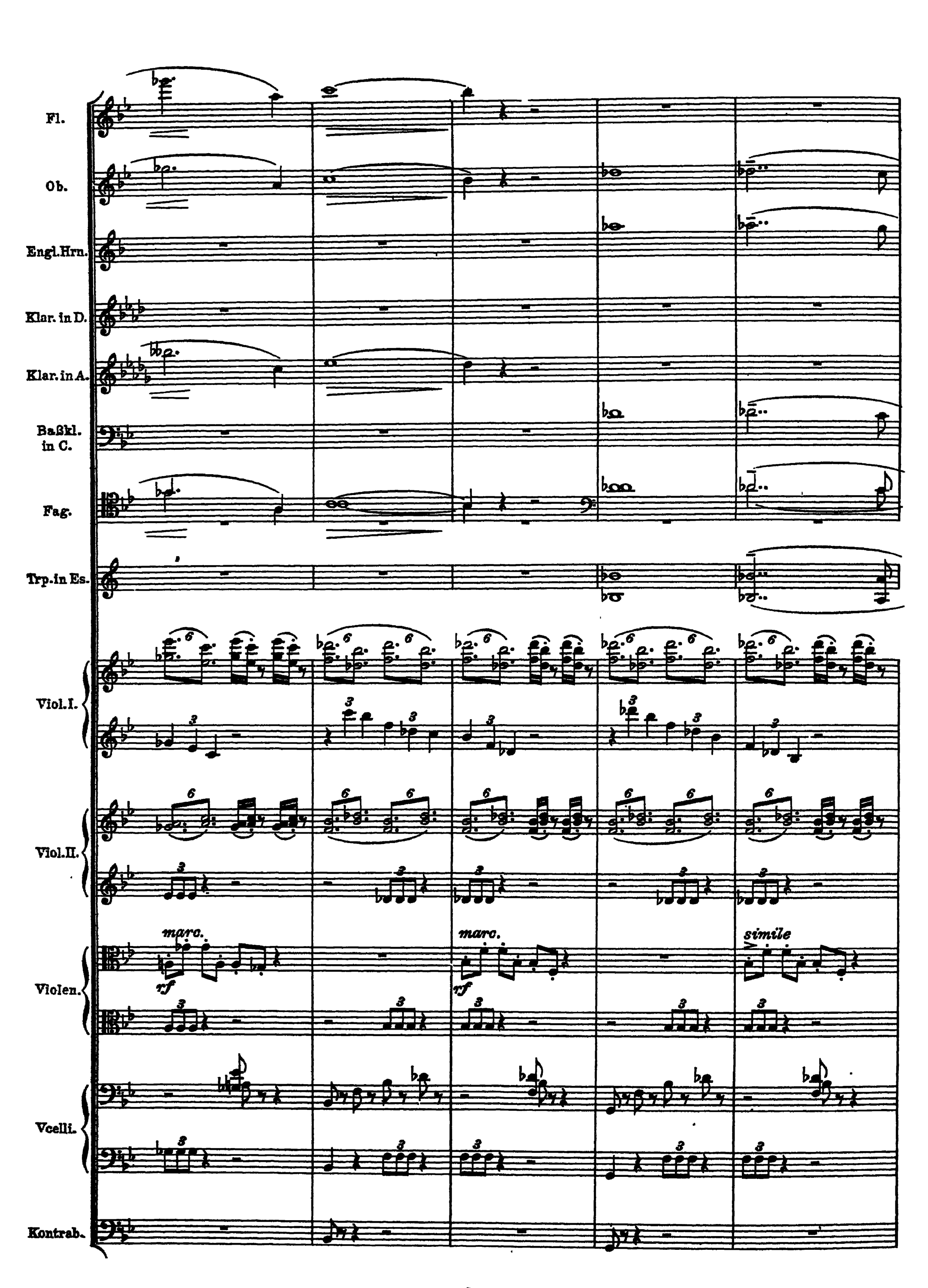
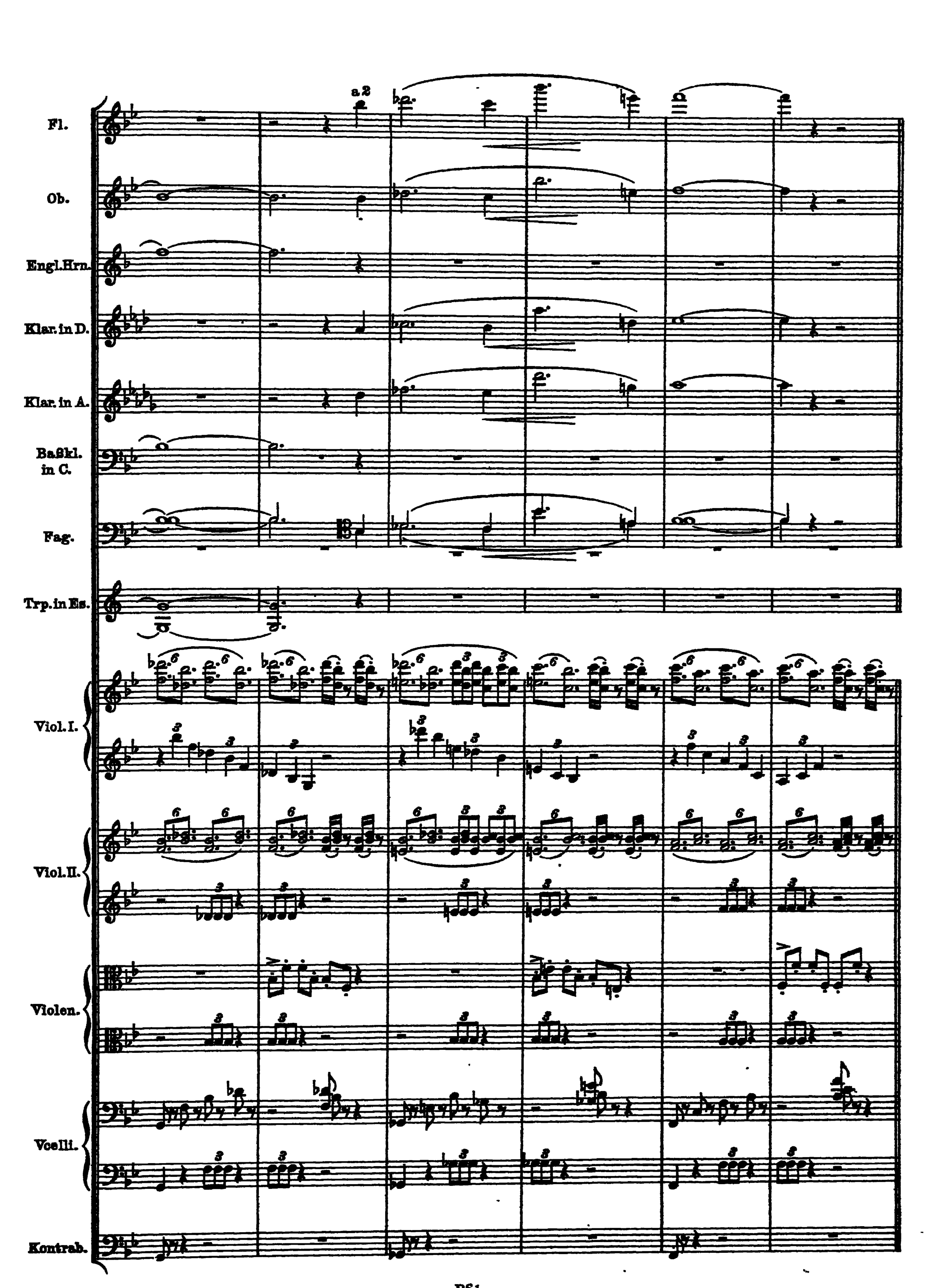
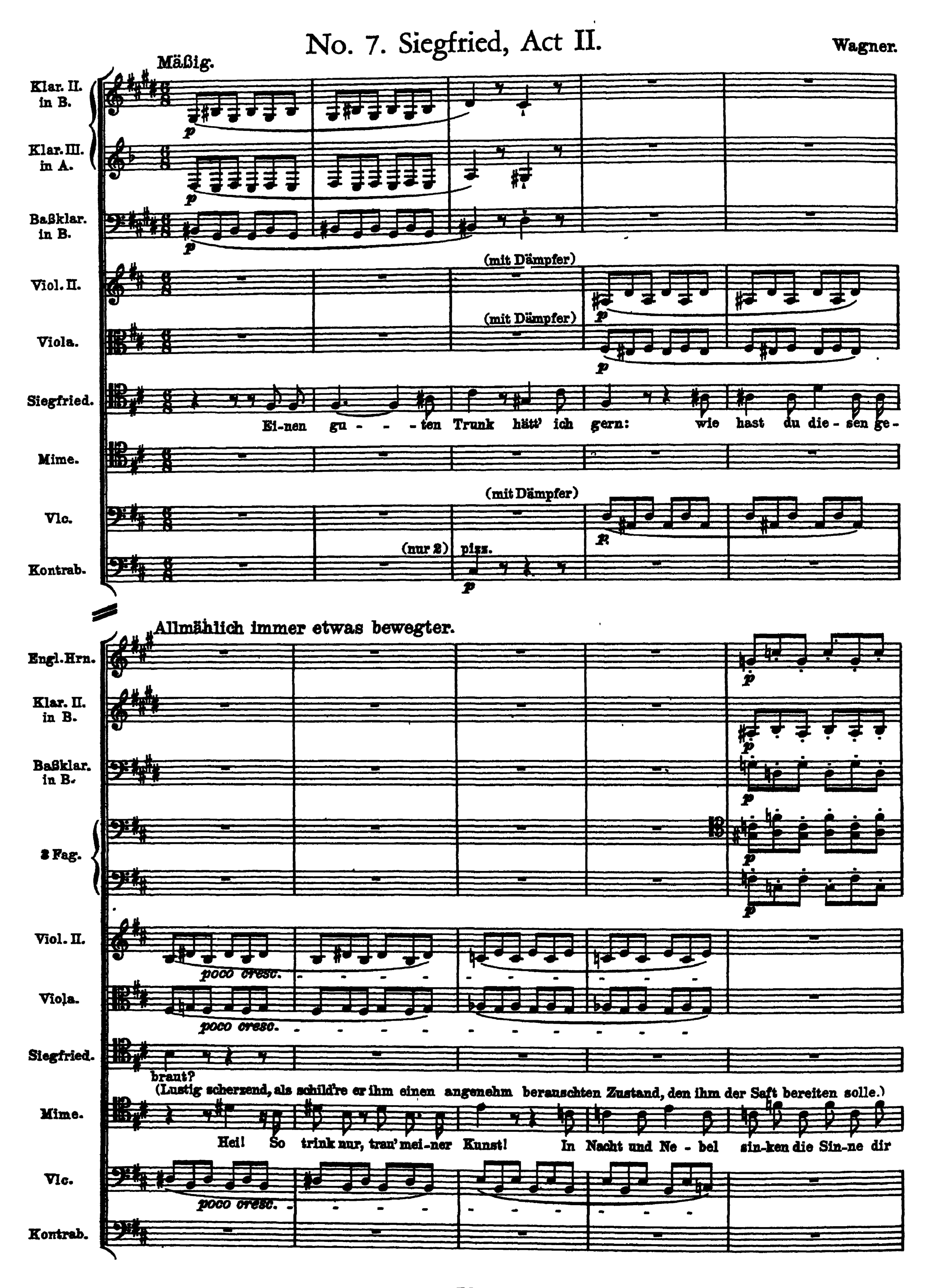
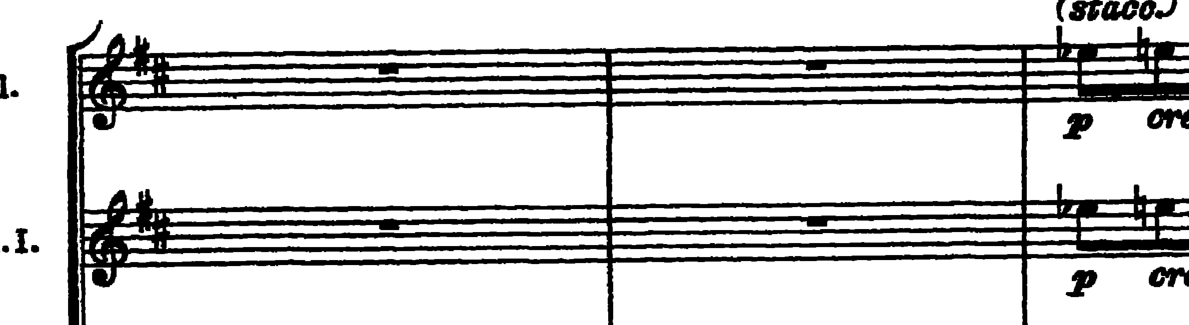
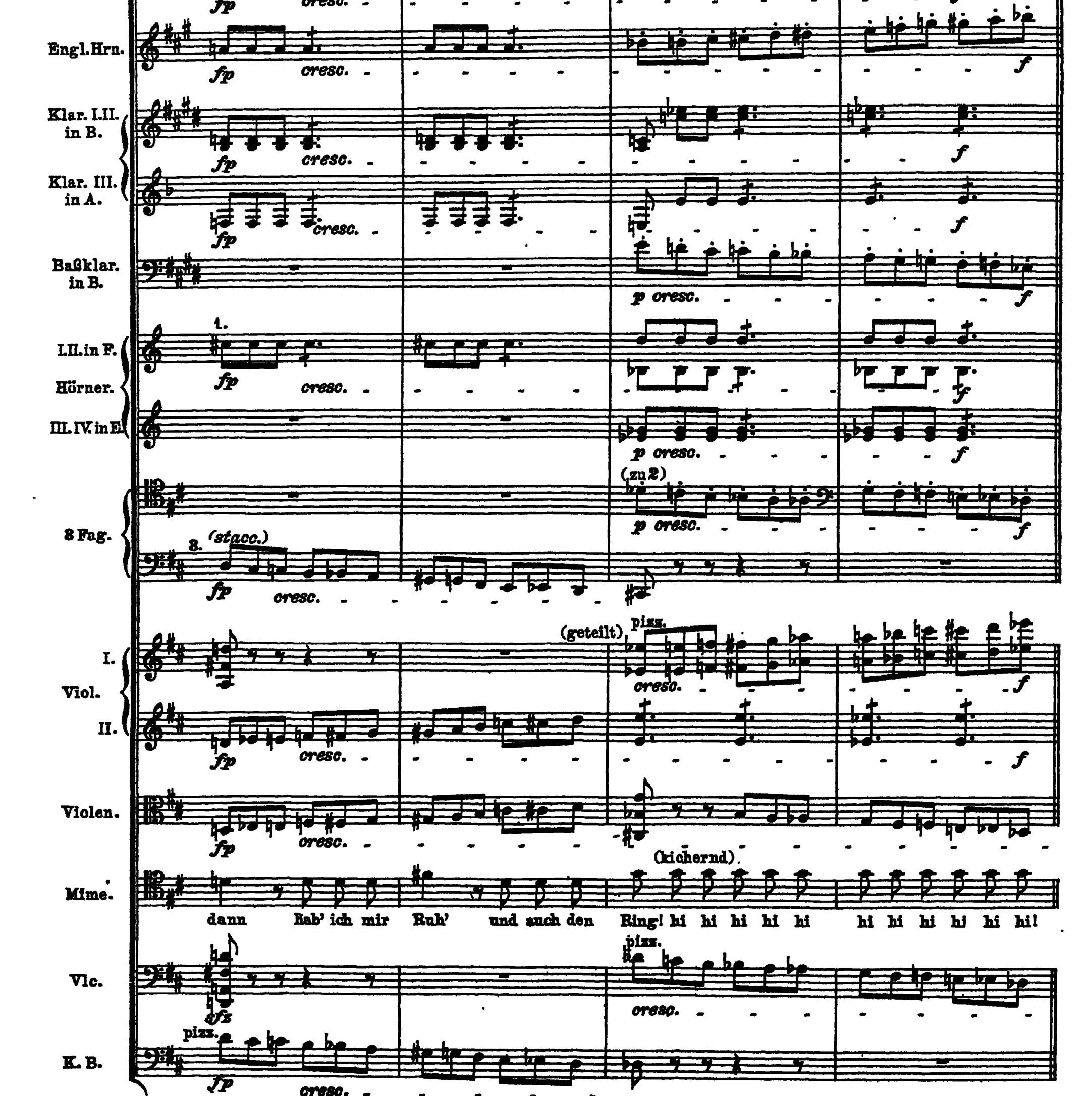
This col legno symbolizes the snorting of the horse in Liszt’s “Mazeppa”, the devilish giggling of Mime in Wagner’s “Siegfried”. (Examples 6, 7.)
Gr. FL I.



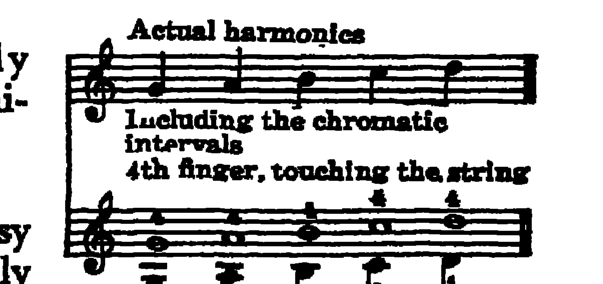
The so-called harmonics (flageolet tones) are produced by touching the strings lightly with the r of the left hand. Thereby the fingers divide the length of he strings at certain spots ( he nodal points) without, however, pressing them down upon the fingerboard. These harmonics have a peculiar character of
mysterious softness; some are. very high and thus greatly extend the upper range of the violin. A distinction is made between natural and artificial harmonics. The natural harmonics are produced by touching lightly certain spots on the open strings. Those responding most safely and sonorously are listed below. The black (quarter) notes represent the real pitch of the harmonics; the white (whole) notes indicate the points touched on the open string.




The artificial harmonics are obtained very clearly over the whole range of the scale by pressing the first finger firmly on the string (as a kind of movable nut) and touching the indicated point on the string lightly with the other finger.
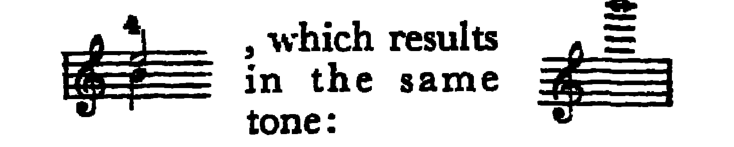
The octave, lightly touched, produces its uni-
This fingering is not easy | and is used almost only erererk on the fourth string. a2, Roger, pressing the string
The fifth, lightly touched, produces its high octave: This fingering is- easier than the preceding and less easy than the follow-
the open E-string, whose fifth lightly touched produces its higher octave (B), sounds better than a string pressed down by the first finger, as e.g.:
The fingerings with a touched major or minor third are used very little; the harmonics produced do not sound well.
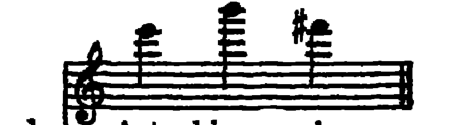
The major third, lightly touched, produces its high double octave:
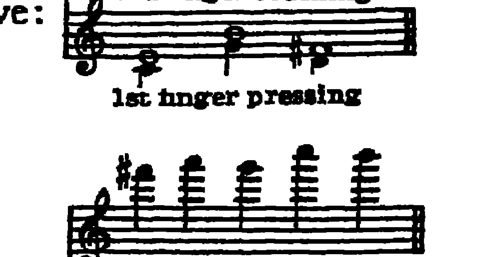
The minor third, lightly touched, produces its high major seven-}p-
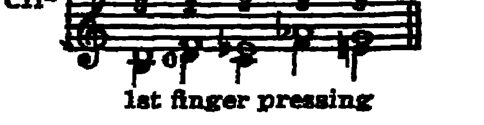
teenth: ee
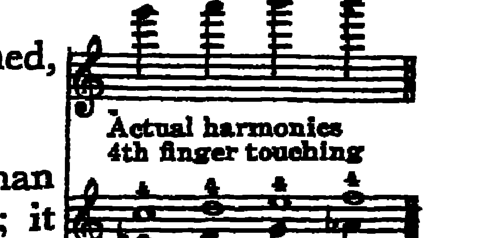
The major sixth, lightly touched, 5 E produces its high twelfth:
This fingering is used less than that with the touched fourth; it is nevertheless quite good and fre-
1st finger pressing
quently useful..
I repeat, the positions with touched fourths and fifths are by far the most advantageous.
Some virtuosos produce double stops in harmonics; but this effect is so difficult and therefore dangerous that composers are to be warned against using it.
The harmonics on the fourth string have a flutelike character; they are preferable for a cantabile execution of a slow melody. Paganini used them with wonderful success in the prayer from “Moses”. The harmonics on the other strmgs become increasingly more delicate and soft as they rise in pitch. This, as well as their crystalline sound, makes them especially appropriate for those chords which may be called fairy-like: harmonic effects which fill our imagination with radiant dreams and conjure the most delicate
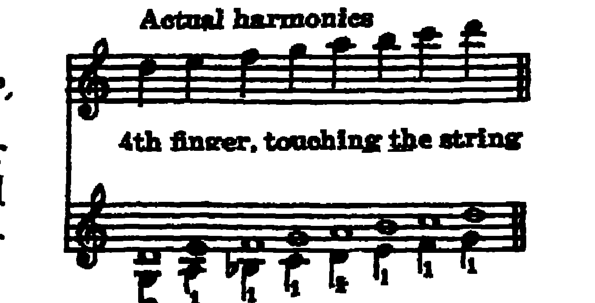
The fourth, lightly touched, produces its
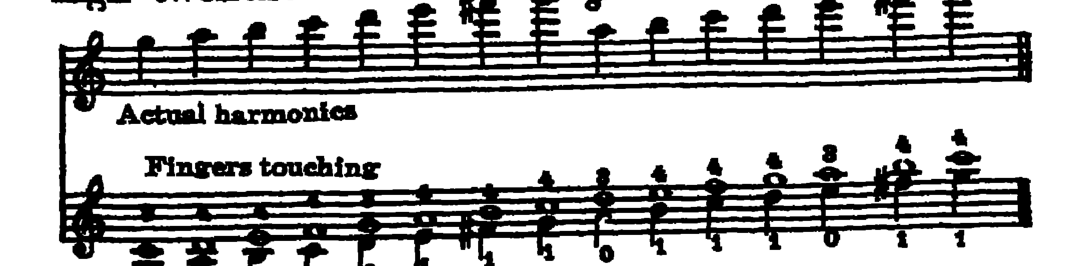
ing is the easiest and therefore to be preferred, except when the harmonic is the twelfth of an open string; in that case the fingering with the fifth
is preferable. 2% it is better to o Thus, to sound 4 = use this posi- = a single high B, tion: ?
images of-a poetic, supernatural world. Although our
violinists have become quite familiar with these effects, they should not be used in fast movements or at least not in rapid successions of notes if their perfect execution is to be ensured.
Of course, the composer can employ them in two, three or four parts according to the number of violin parts. The effect of such sustained chords is very impressive if they are warranted by the subject of the piece and well combined with the rest of the orchestra. I have used such chords for the first time, in three parts, in the scherzo of a symphony, sustained above a fourth violin part not in harmonics, which trills continuously on the lowest note. The extraordinary delicacy of the harmonics is enhanced here by the use of mutes; thus softened they rise to the extreme heights of the musical scale, which could hardly be reached by ordinary tones. (Example 8.)
Sea ail th ll Via sail at a att ll I


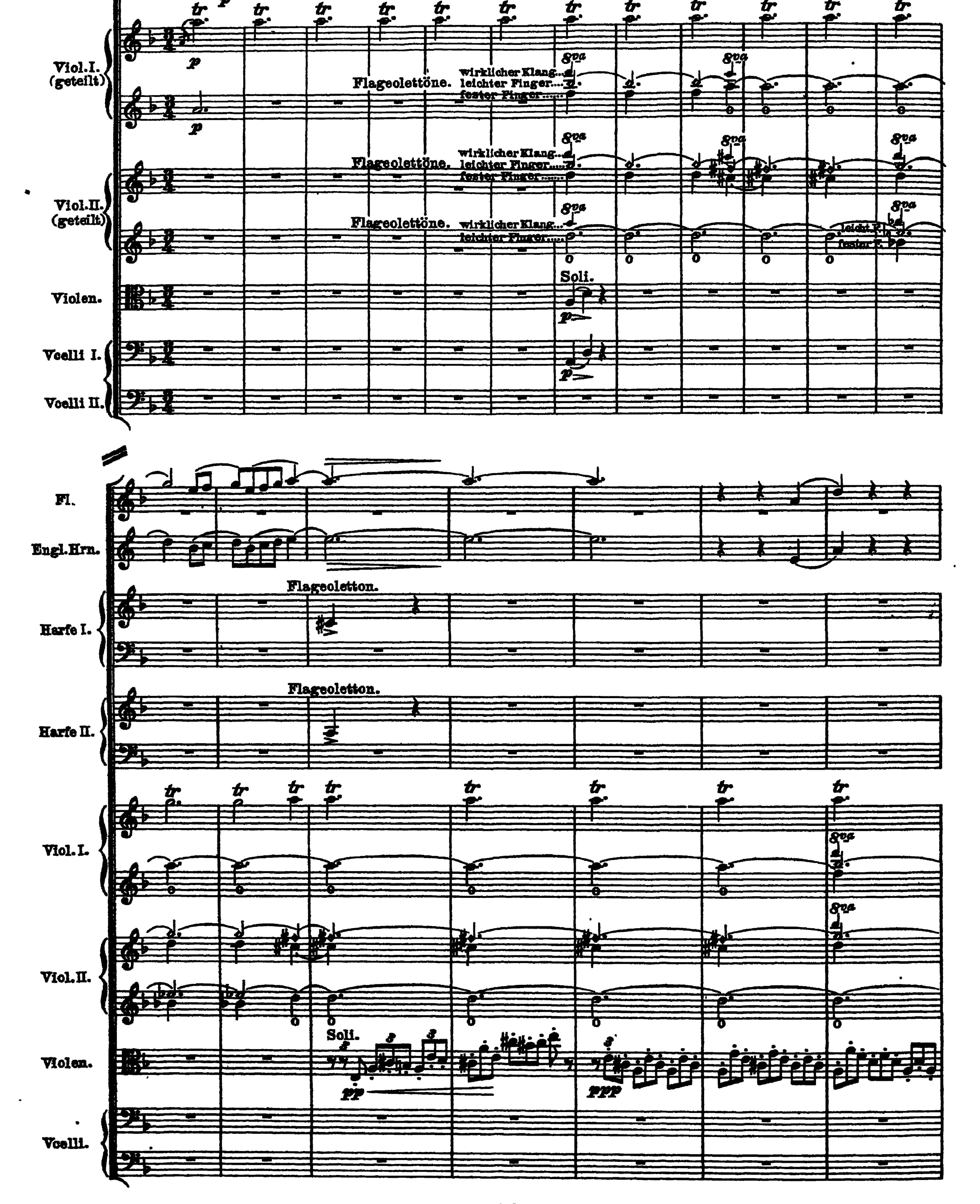
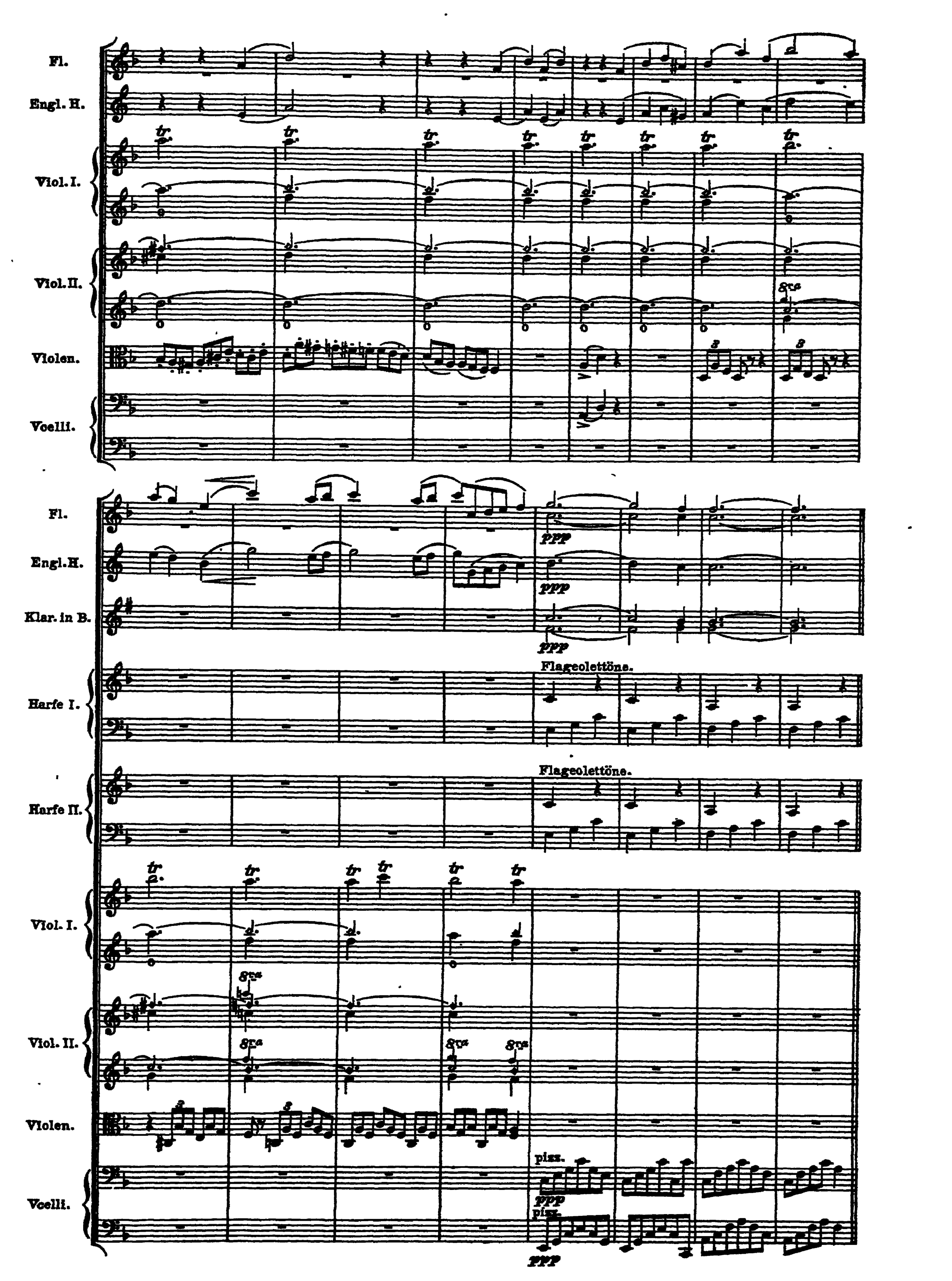
In writing such chords in harmonics, it is absolutely necessary to indicate by notes of different size and shape, placed one above the other: the note for the finger touching the string and that of the actual harmonic (on open strings); and the note for the pressing finger, the touching finger and the actual harmonic (in the other cases). This sometimes results in three notes for a single tone, but without this precaution the execution might easily become a hodgepodge, in which even the composer would have difficulty to recognize his own intentions.
This is no longer necessary. The sign 0 above the note (the actual pitch) is now sufficient to indicate the execution in harmonics. The older no-
Mutes (sordines) are small wooden devices which are placed on the bridge of string instruments in order to diminish their volume of sound. They give the instrument at the same time a mournful, mysterious and soft expression, which is frequently and felicitously used in all styles of music. Mutes are usually employed in slow movements; but they are just as appropriate for fast and light pieces or for accompaniments in quick rhythms if the character of the piece demands them. Gluck proved this admirably in his sublime monologue of Alceste (Italian version), “Chi mi parla”. (Example 9.)
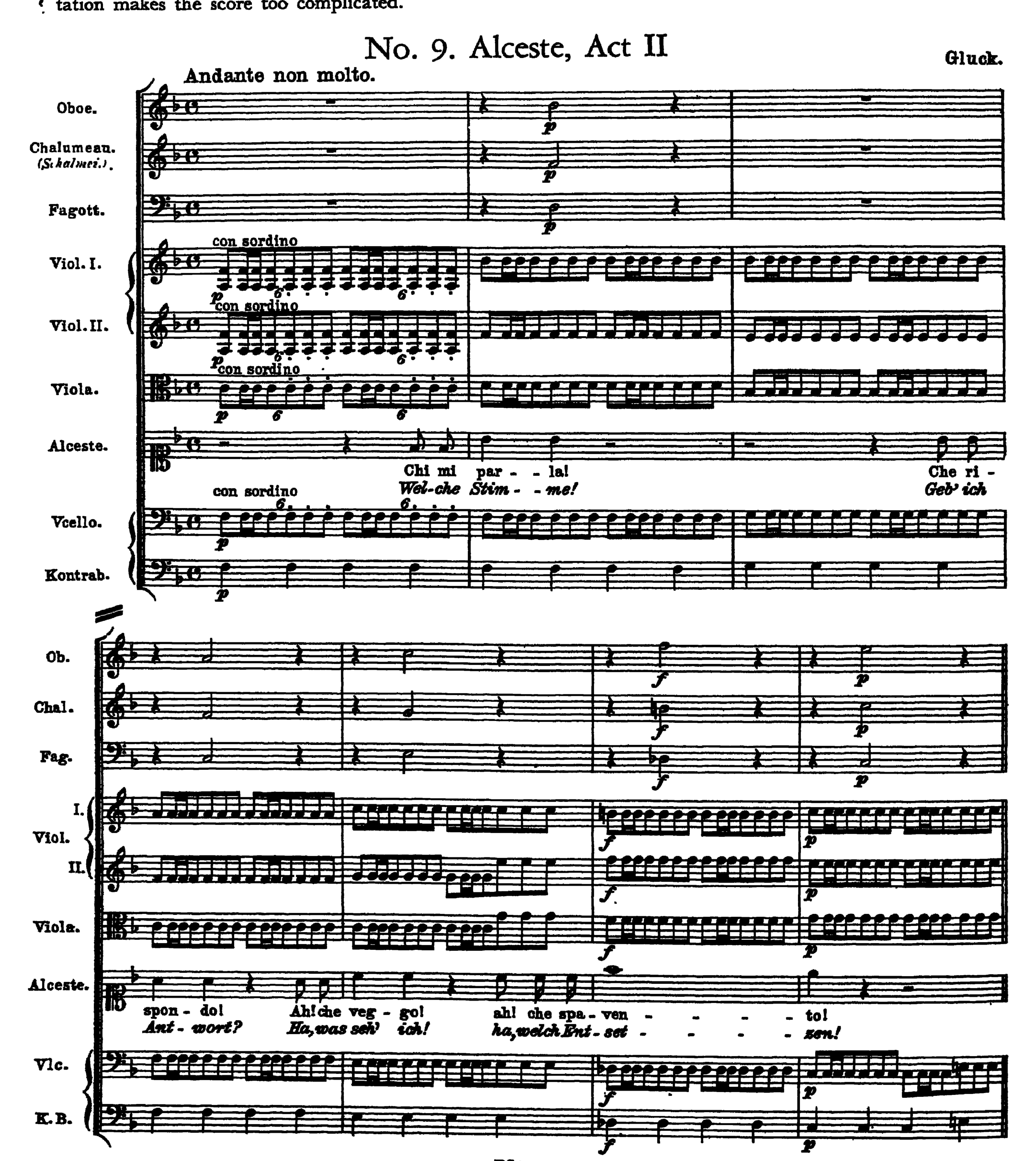
When mutes are indicated, they are generally used by the whole string section. But more frequently than it is usually assumed there are circumstances where only a part of the strings (e.g. the first violins) employ mutes; the mixture of bright and muted tones produces a peculiar color. Sometimes the character of the melody is so different from that of the accompaniment that the use of mutes has to be planned accordingly.
The composer, when indicating the use of mutes in the middle of a piece (by the words con sordini), must
No. 10. Romeo et Juliette, Scherzo de Ja Reine Mab
lar.in B. —a —= ee SS T_T en aannaeeent
not forget to allow sufficient time for putting them on. He should provide a rest in the violins, equal in length to about two bars in 4-4 time, moderato. The rest may be shorter when the words senza sordini indicate that the mutes are to be removed; this can be done in much less time. The sudden transition from the muted tones to bright, natural ones (without mutes) is sometimes immensely effective in a large orchestra. (Example 10.)
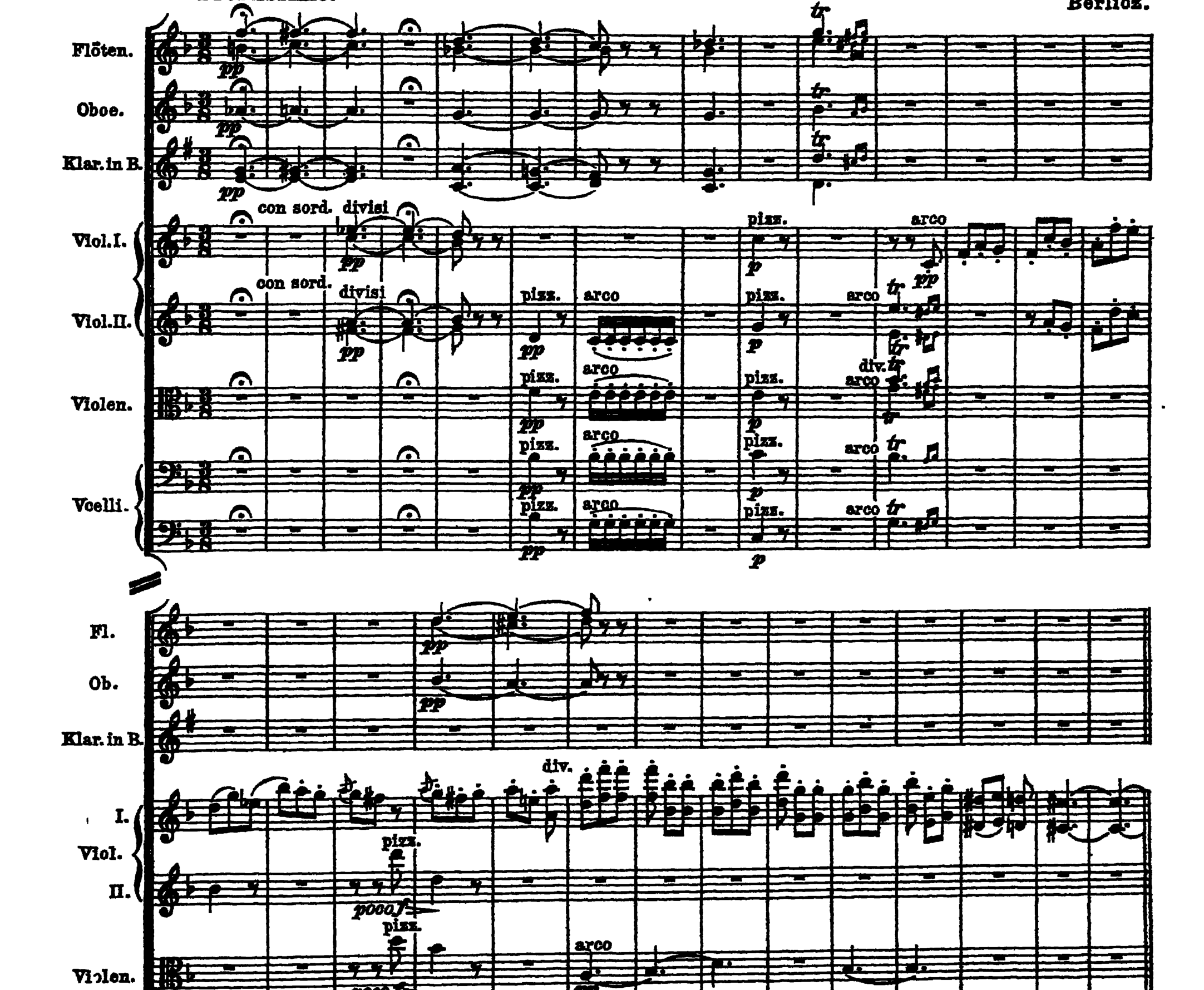
Voelli. f a arco 1 } n

In the third act of “Meistersinger’ (scene of Sachs and Walter) the mood of the dreamy young man in his conversation with Sachs is wonderfully painted by the entrance of the muted second violins. The device is as simple as it is ingenious (the two words are frequently synonymous). An equally wonderful example is the final scene of “Tristan” where Isolde rises from the prostration of despair to her last enchanted vision. The first violins had been silent for a long time and left the lead to the second violins; then, before Brangaene’s words, “‘Sie wacht, sie lebt”, they enter con sordini over muted horns with the theme of Isolde’s Liebestod. The theme, the orchestration and the poetic idea combine into one of the most sublime effects.
‘There are new mutes which are fastened to the lower part of the bridge and which only have to
No. 11. Symphony in Bb, 2nd movement
be turned into position; but the tone of the violins
suffers considerably.
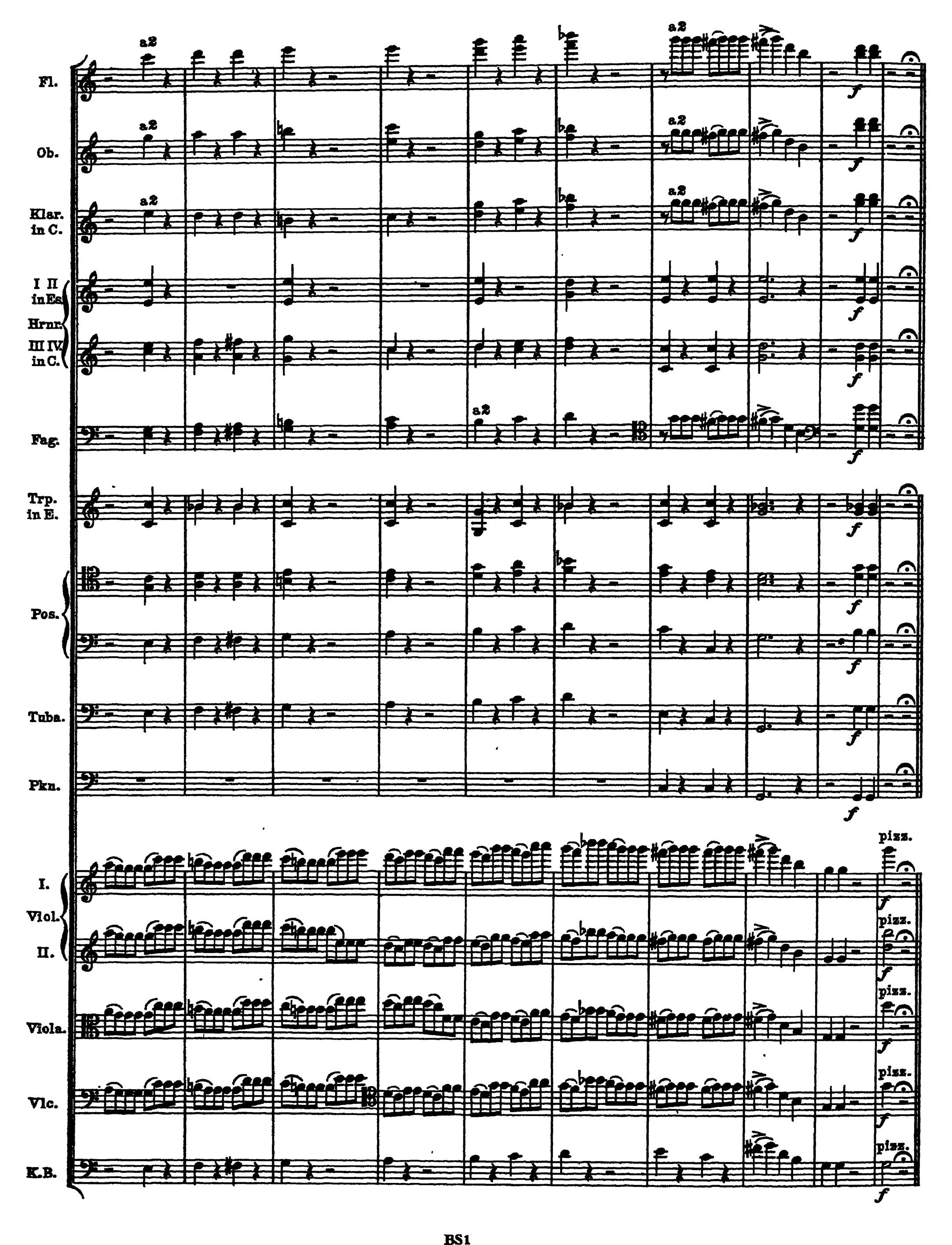
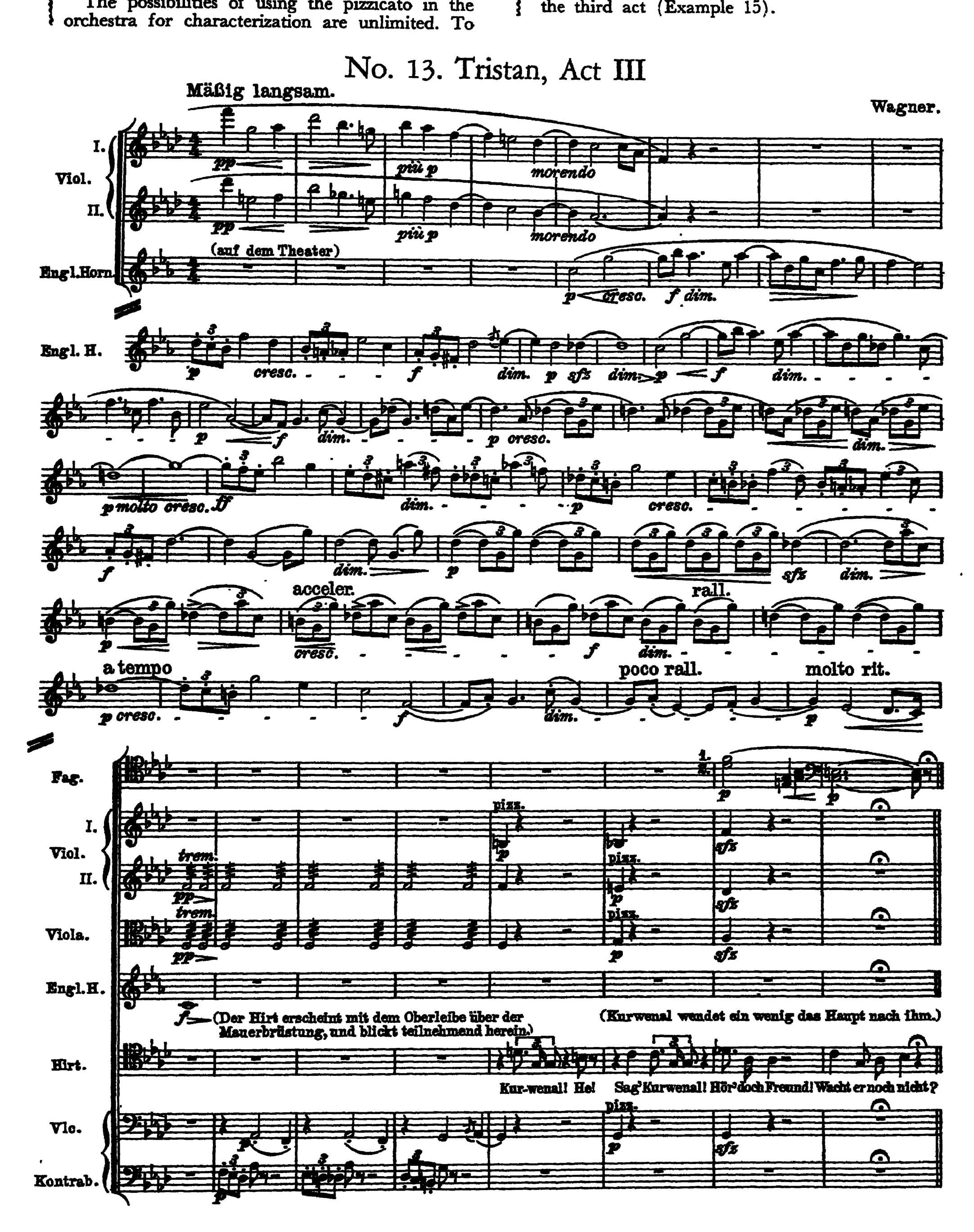
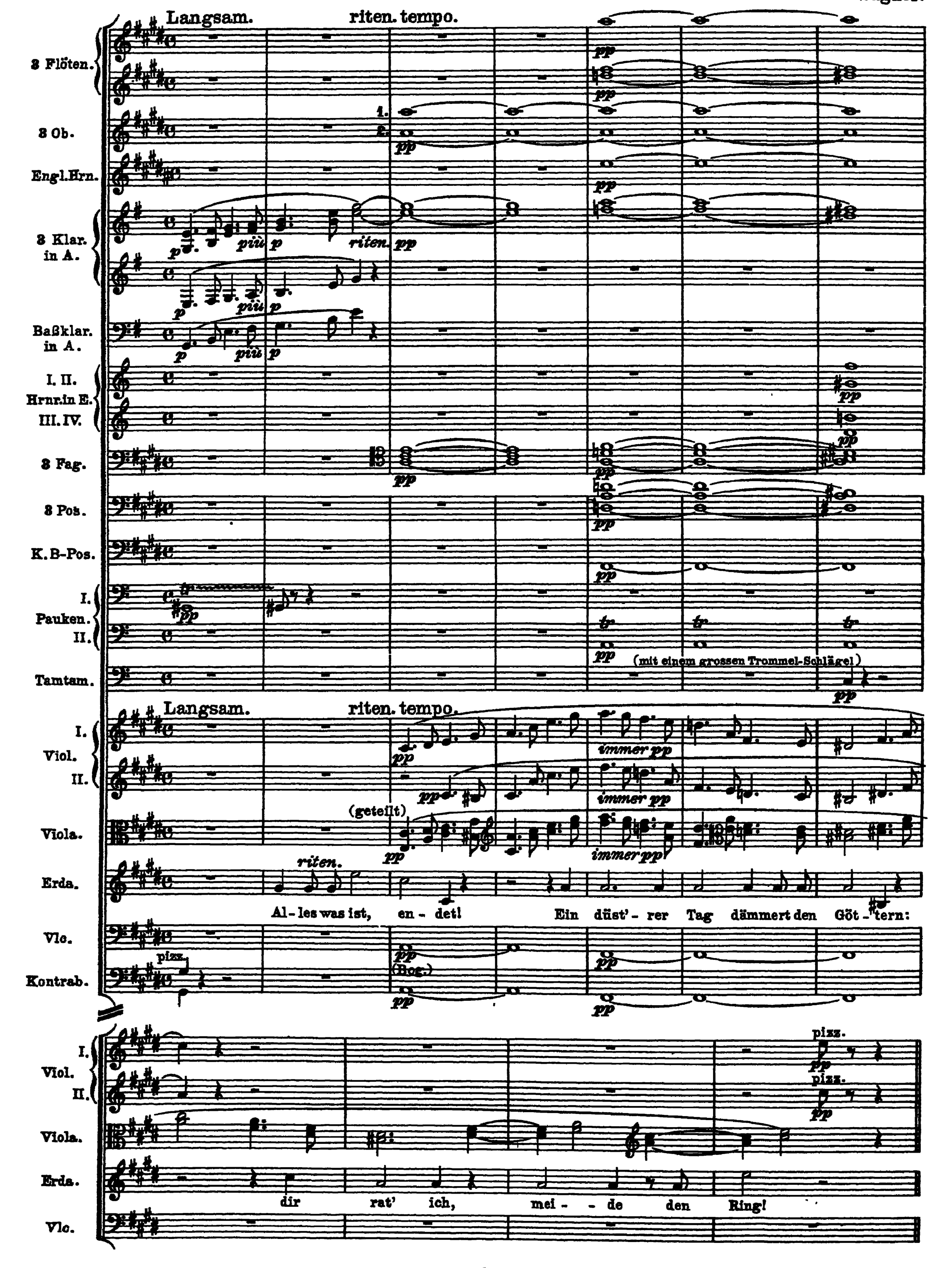
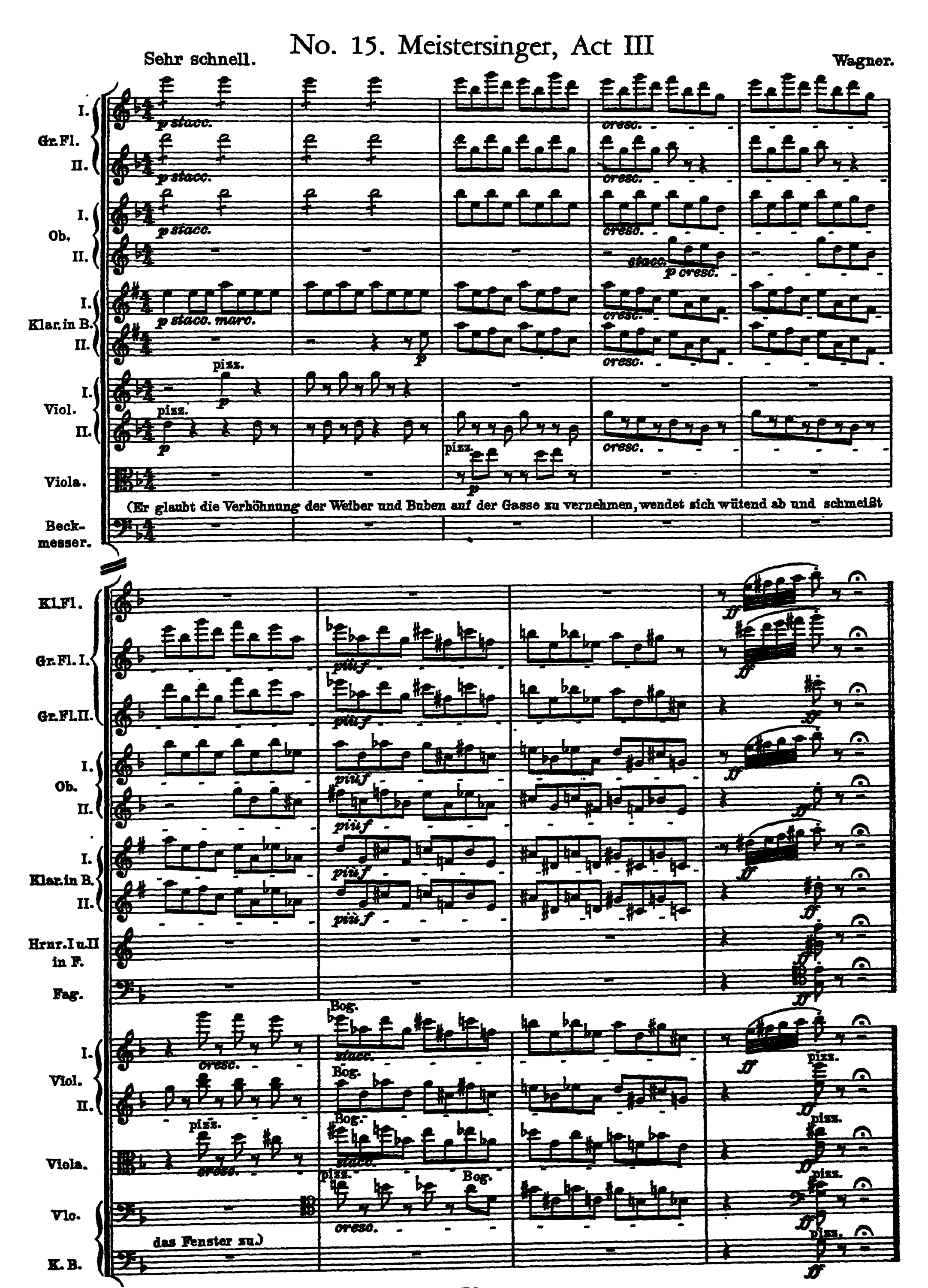
The pizzicato (plucking of the strings) is generally used with bowed instruments. The resulting sounds serve as accompaniments and are very popular with the singers because they do not cover their voices. They are also important for symphonic effects and even in vigorous outbursts of the whole orchestra, where they may be employed in the whole choir of strings or only by one or two sections.
The Adagio of the Symphony in Bb by Beethoven offers a charming example of pizzicato in the second violins, violas and basses while the first violins are played with the bow. The contrasting sounds are here blended in truly marvelous fashion with the melodic sighs of the clarinet, enhancing its expression. (Example 11.)
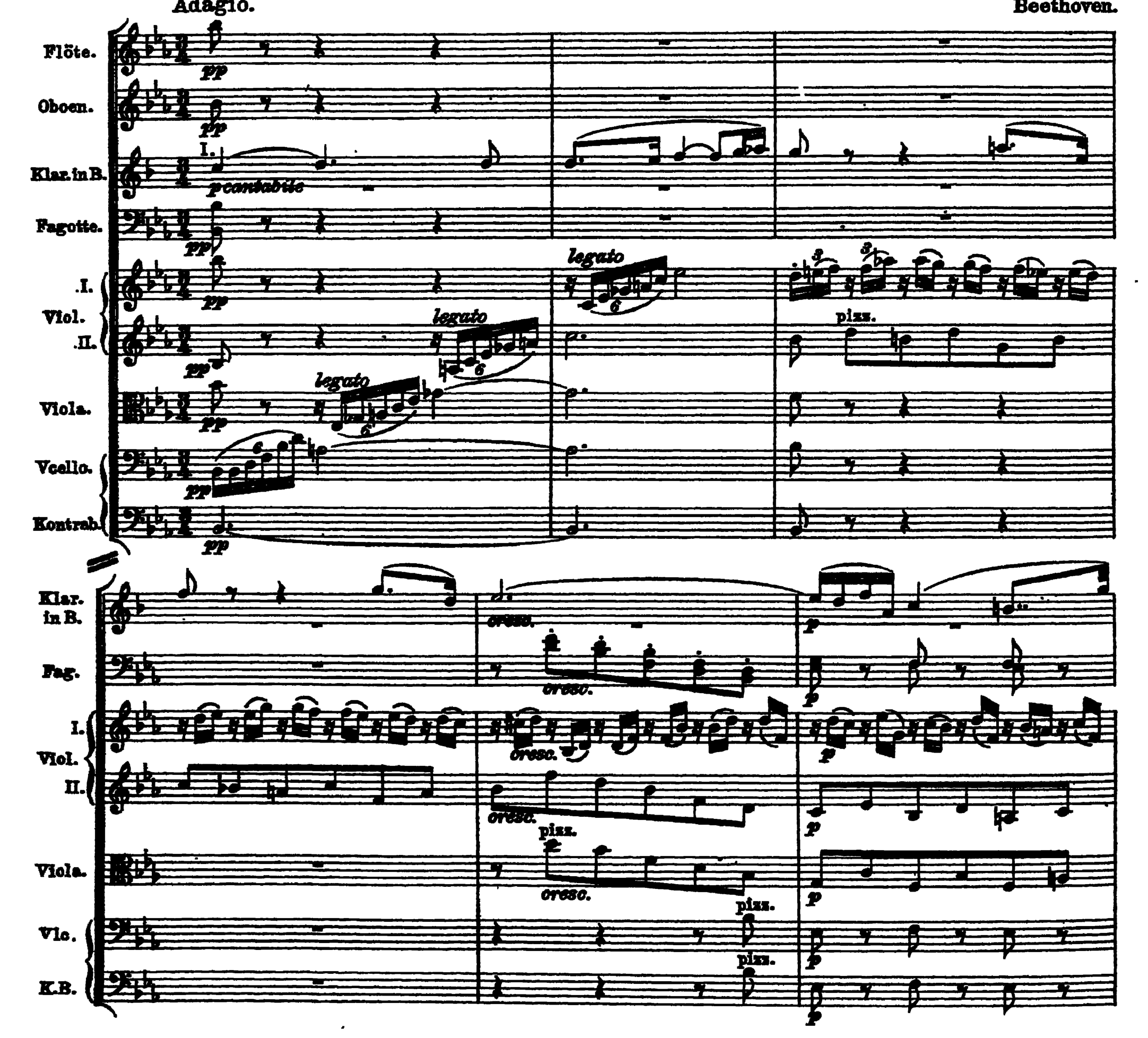
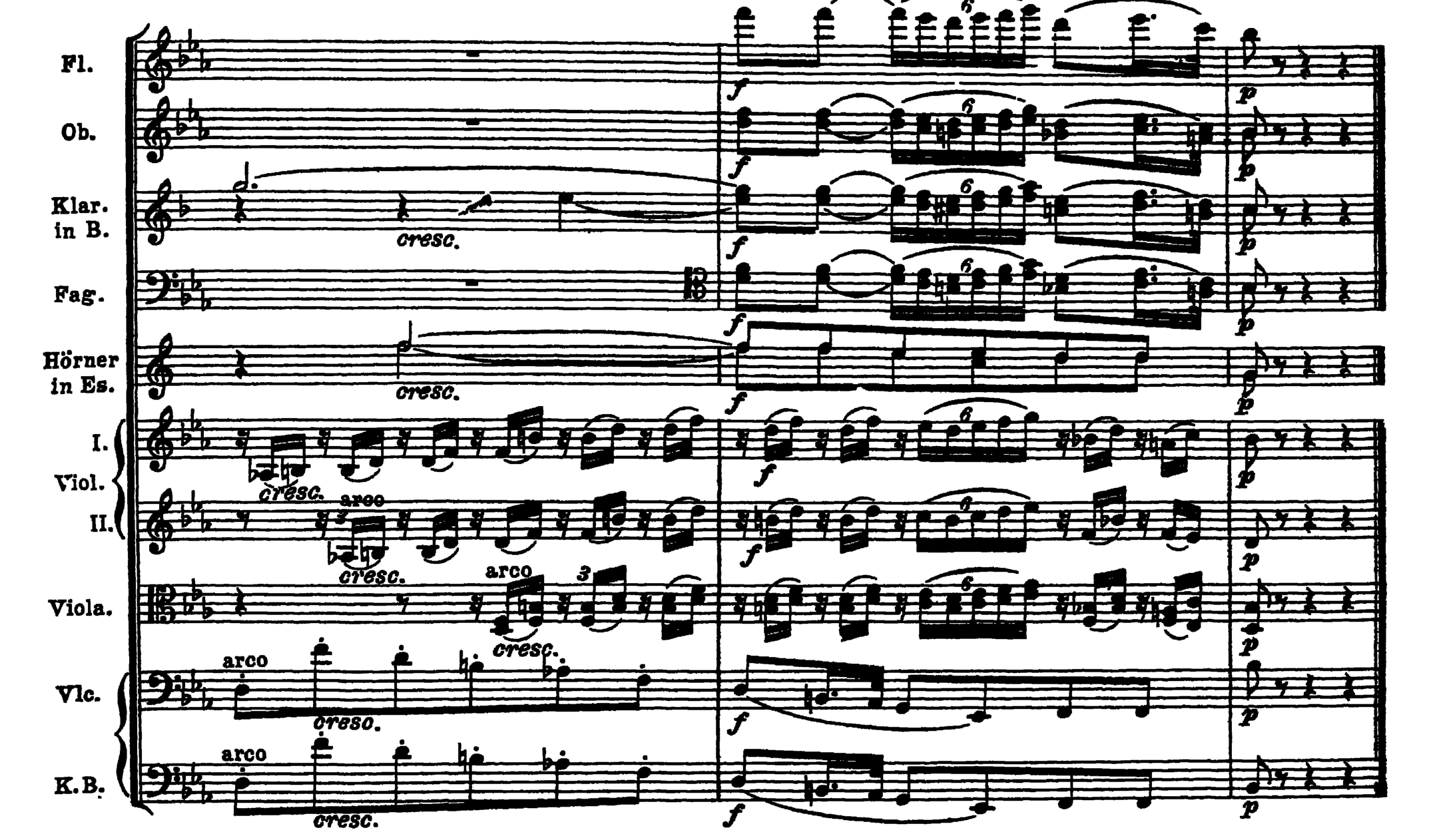
If the pizzicato is employed in forte, it should be written neither too high nor too low. Extremely high tones are harsh and dry; the low ones are hollow. In a powerful tutti of wind instruments a pizzicato of all string instruments, like the following, will produce a striking impression:
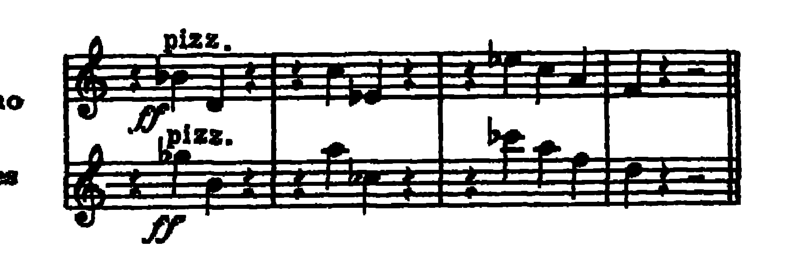
Pizzicato chords of two, three and four notes in fortissimo are equally valuable. The one finger employed glides so quickly across the strings that they sound almost simultaneously and seem to have been plucked at the same time. The various kinds of pizzicato accompaniments in piano have always a delicate effect. They afford a sense of relief to the listener and—if not abused—give a pleasing variety to the sound of the orchestra.
In the future the pizzicato will doubtless be used in even more original and attractive effects than heretofore. Violinists, not considering the pizzicato an integral part of violin technique, have given it hardly any serious attention. They are accustomed to use only the thumb and forefinger for pizzicato and hence are not able to play passages and arpeggios faster than sixteenths in 4-4 time of a very moderate tempo. If, instead, they were to lay down the bow, the little finger of the right hand could rest on the body of the violin and they could use the thumb and the other three fingers like guitar players. Thus they would soon
acquire the skill to execute passages like those in the following example, which are impossible at the present time:
figures above the notes refer to the fingers of
The the right hand, the letter T indicating the thumb
Allegro non troppo.


The repetition of the upper notes in these examples becomes quite easy if the first and second fingers are used alternatingly on the same string.
Short appoggiaturas are by no means impracticable in pizzicato. The following passage from the Scherzo of Beethoven’s C-minor Symphony is always executed very well.
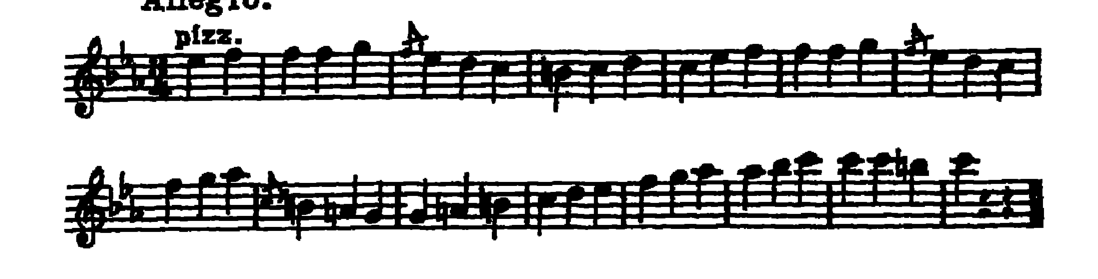
Some of our young violinists have learned from Paganini to play rapid descending scales in pizzicato by plucking the strings with the fingers of the left hand, which rests firmly on the neck of the violin.
They sometimes combme pizzicato notes (always played with the left hand) with bowed tones, even vantage of them.
using the pizzicato as an accompaniment of a melody The following quotation from the overture to played by the bow. All players will doubtless become King Lear by Berlioz shows an ingenious employfamiliar with these various techniques in the course ment of the pizzicato (Example 12).
of time. Then composers will be able to take full ad-
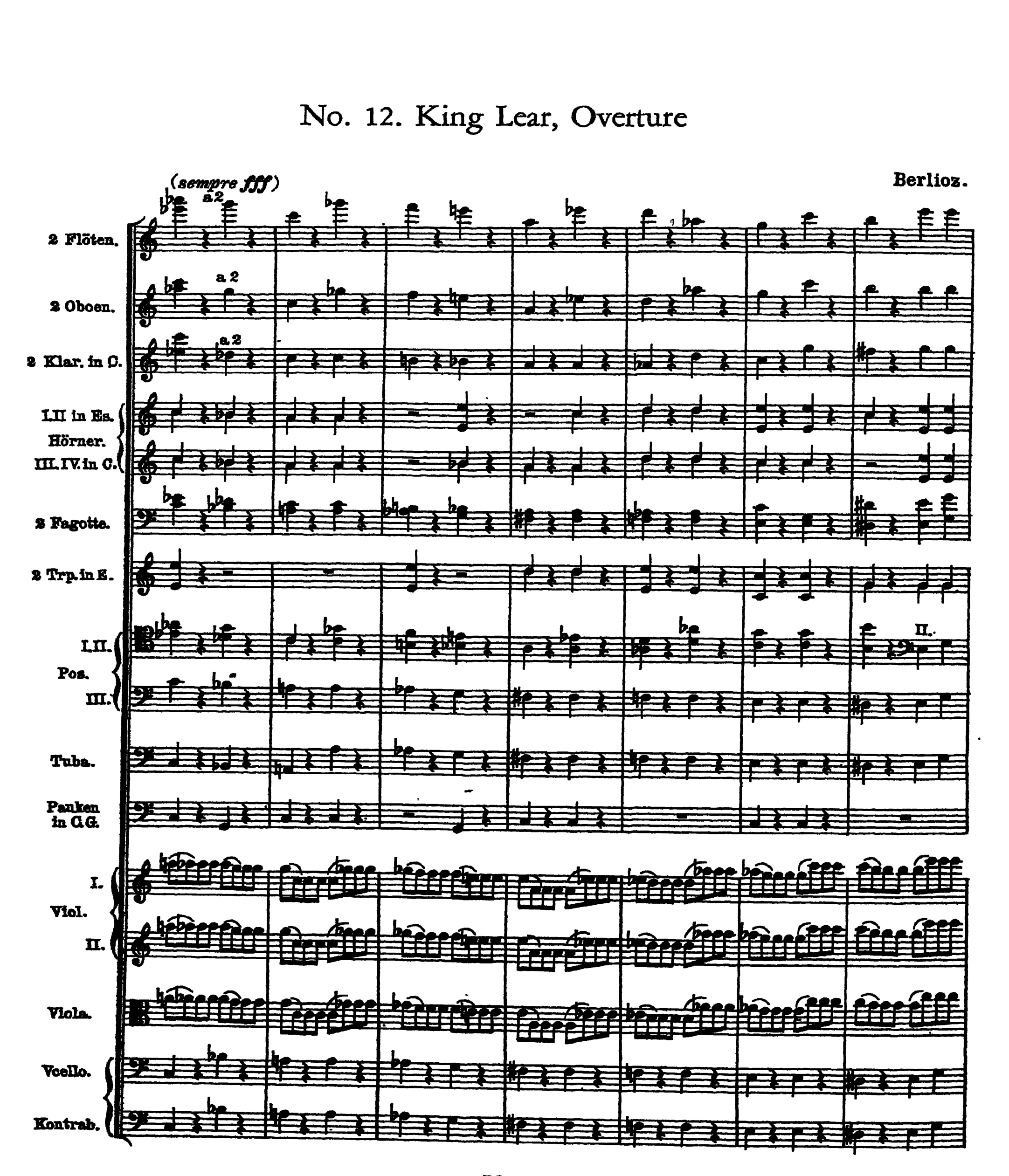
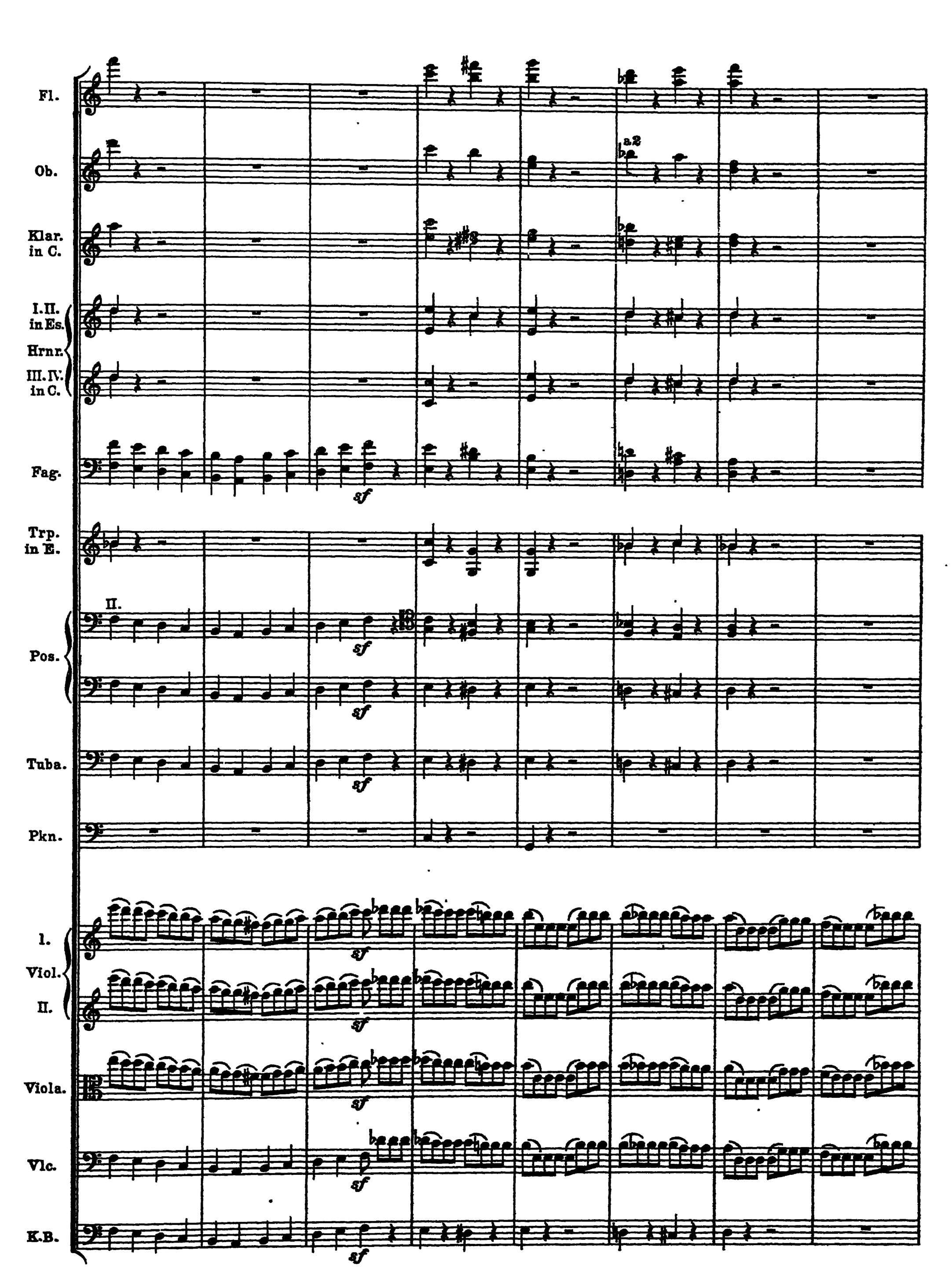
place I always have a feeling as if a
string had
burst in Lear’s heart o:
Yr, more realis-
tically, a vein in the half-mad
king’s brain.
quote a few exam third act (Exam
ple 13); “Rheingold”
14); “Meistersin
ger”, Beckmesser’s pantomime in
No. 14. Rheingold
a ee Pa Sl IR dial faa at Re TaT (es alae TU]
With their bows violinists are nowadays able to execute almost anything required. They play in the upper region almost as easily as in the middle; the
most rapid runs; the most eccentric designs offer no.
difficulty. In an orchestra where they are sufficiently numerous, what one of them misses is executed by the others. Thus mistakes are hardly noticed and the final result is exactly as the author intended it. However, sometimes the rapidity, complexity or high position of tones would make a piece too dangerous; or
else the author may want to be sure of a secure and neat execution: in such cases the violins should be divided, some playing one part of the passage, the rest another. Thus the notes of cach section are interspersed with short rests, not noticed by the listener, which allow, as it were, a breathing space to the players and afford them time to reach difficult positions securely and to strike the strings with the neces-
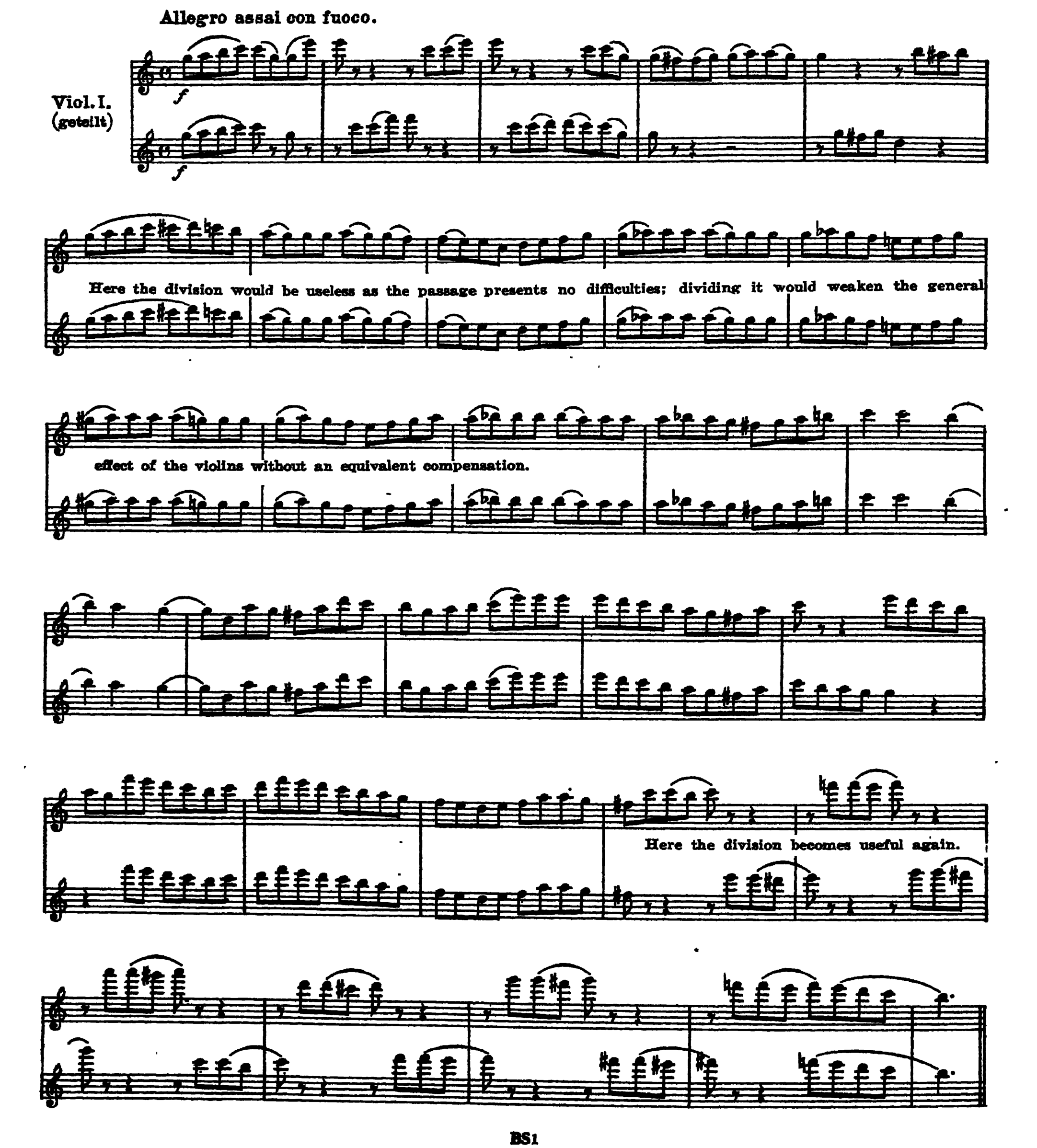
If it is desired to have similar or still more difficult passages executed by all the violins, it will always be preferable to divide the first violins into two groups (as in the preceding example) and to let the second violins, also divided into two groups, simply double the two parts of the first violins, instead of giving one part to all the first violins and the other part to all the second violins. The distance between the two sections would disrupt the even flow of the passage and
would make the joints between the parts too obvious. But if the parts are divided between the two players at each desk and each part is thus played on both sides of the orchestra, the fragments will connect smoothly and it will be impossible to notice the division of the passage. The listeners will believe to hear it executed by all the violins without interruption. Accordingly, the passage is written as follows:
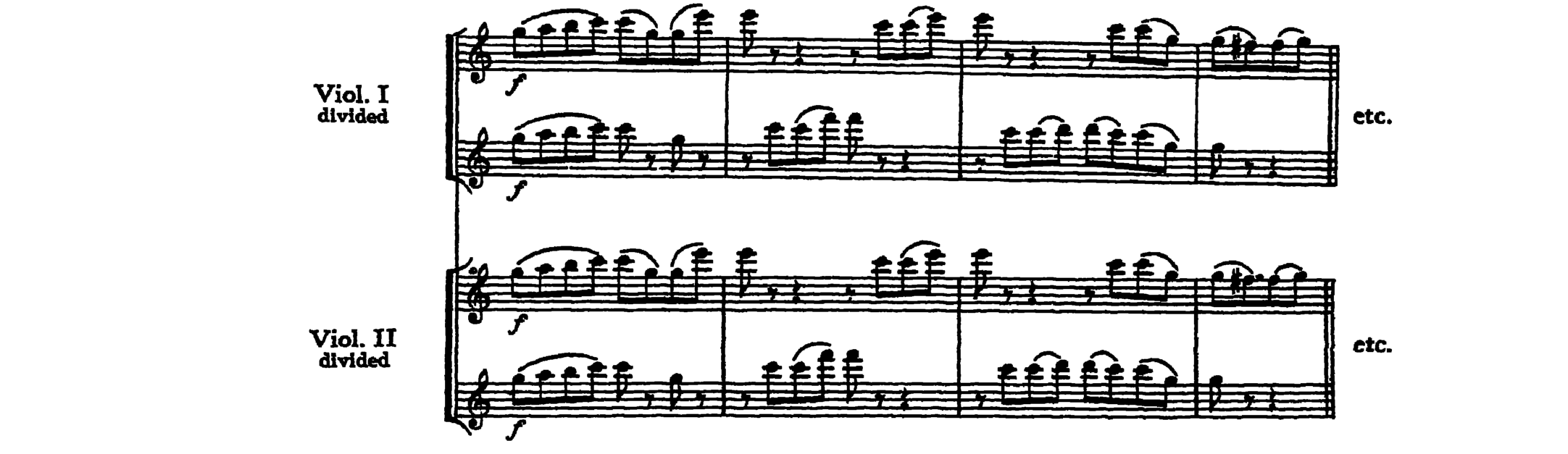
Moreover, this procedure is applicable to all instruments of: the orchestra which have the same quality and lightness of tone. It should be applied whenever a phrase is too difficult to be played well by a single instrument or a single group.
This conception applies to the style of instrumentation which I would call the classical. It stems from the spirit of chamber music and was transferred to the treatment of orchestras. Its main characteristic is that every figure can be executed with absolute clarity by all the instruments. Its opposite is the al-fresco treatment of the orchestra as introduced by Wagner. The classical stands in the same relation to the al-fresco style as that of the Florentine painters of the 14th and 15th centuries (which stems from miniature painting) to
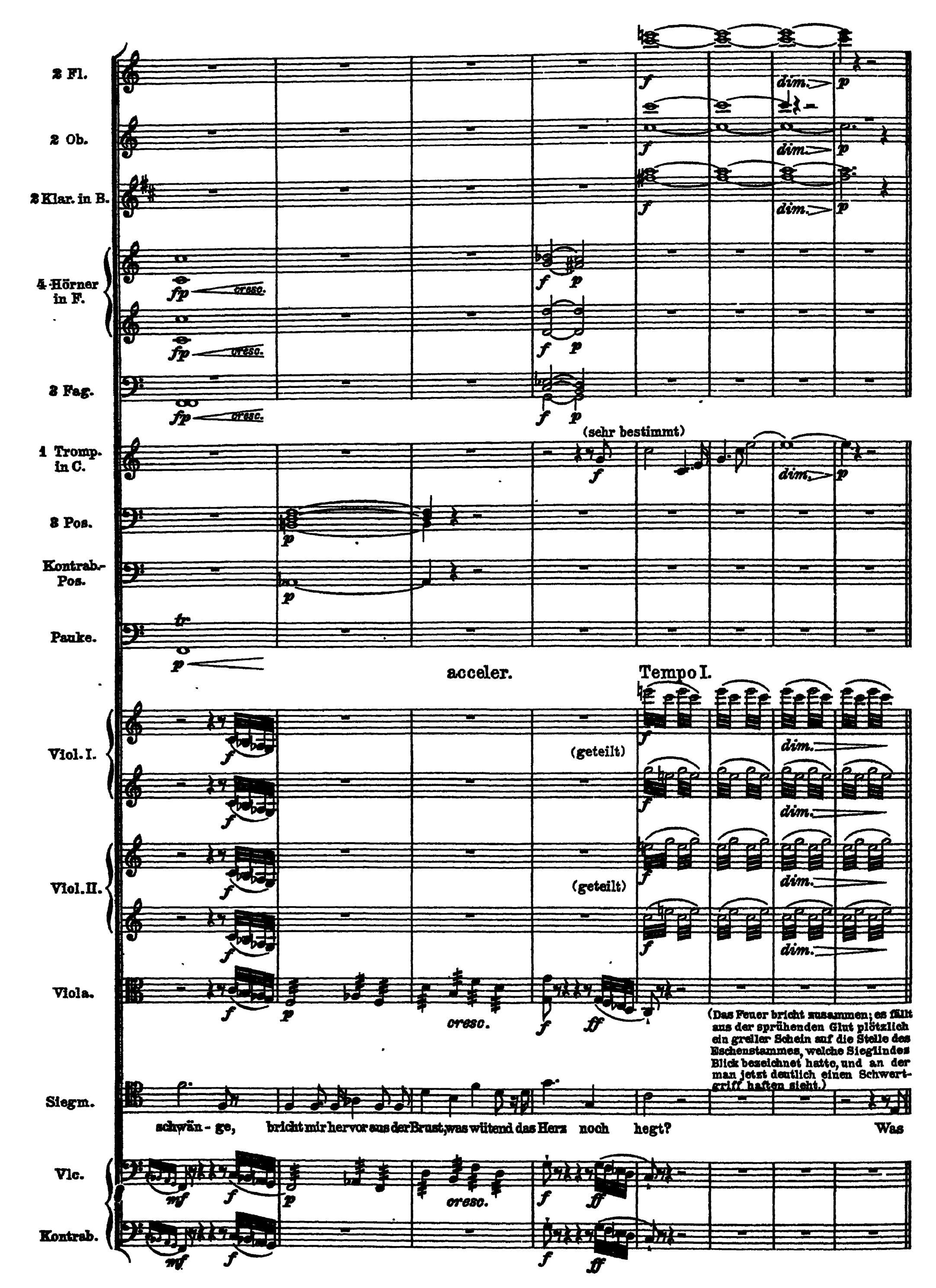
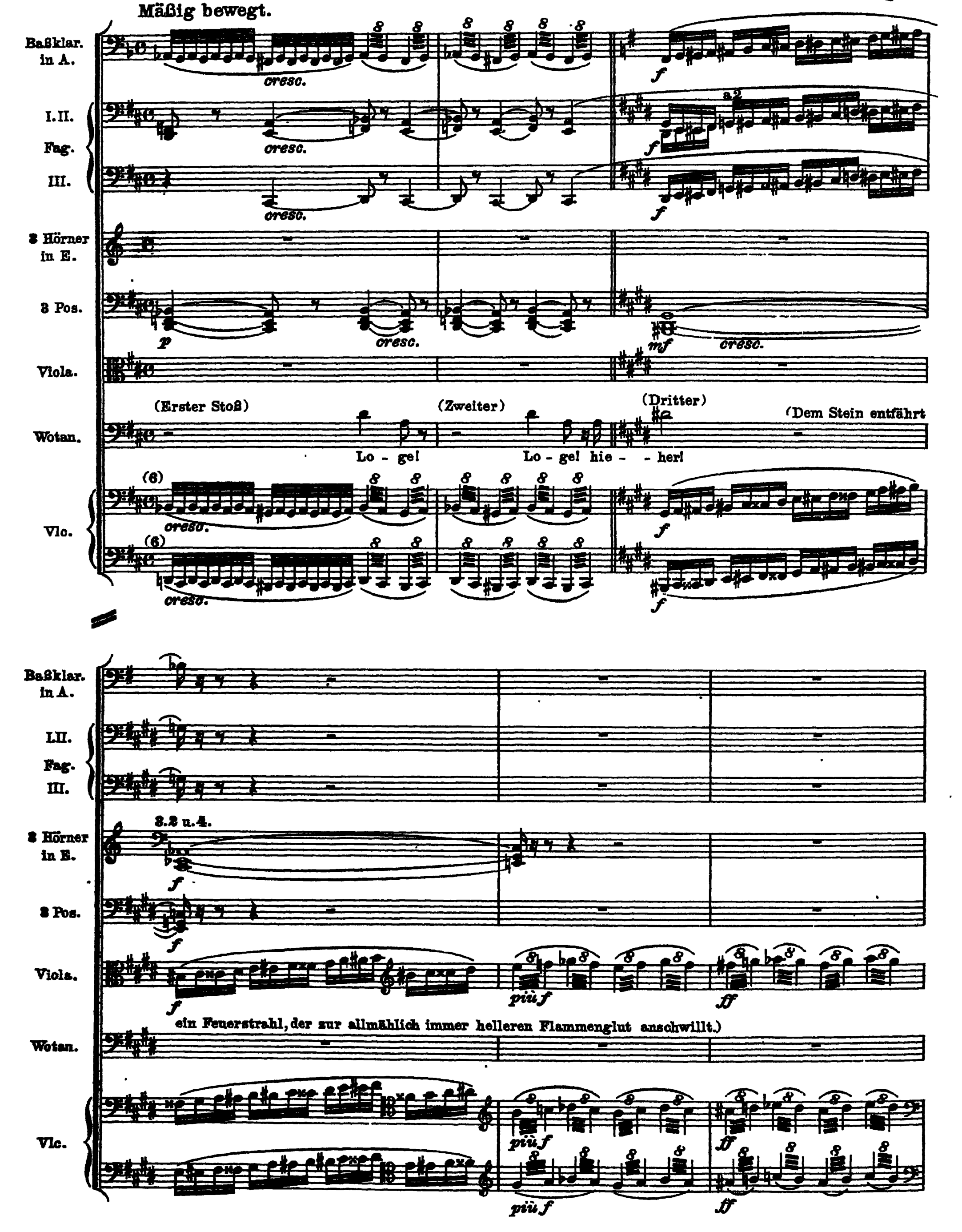
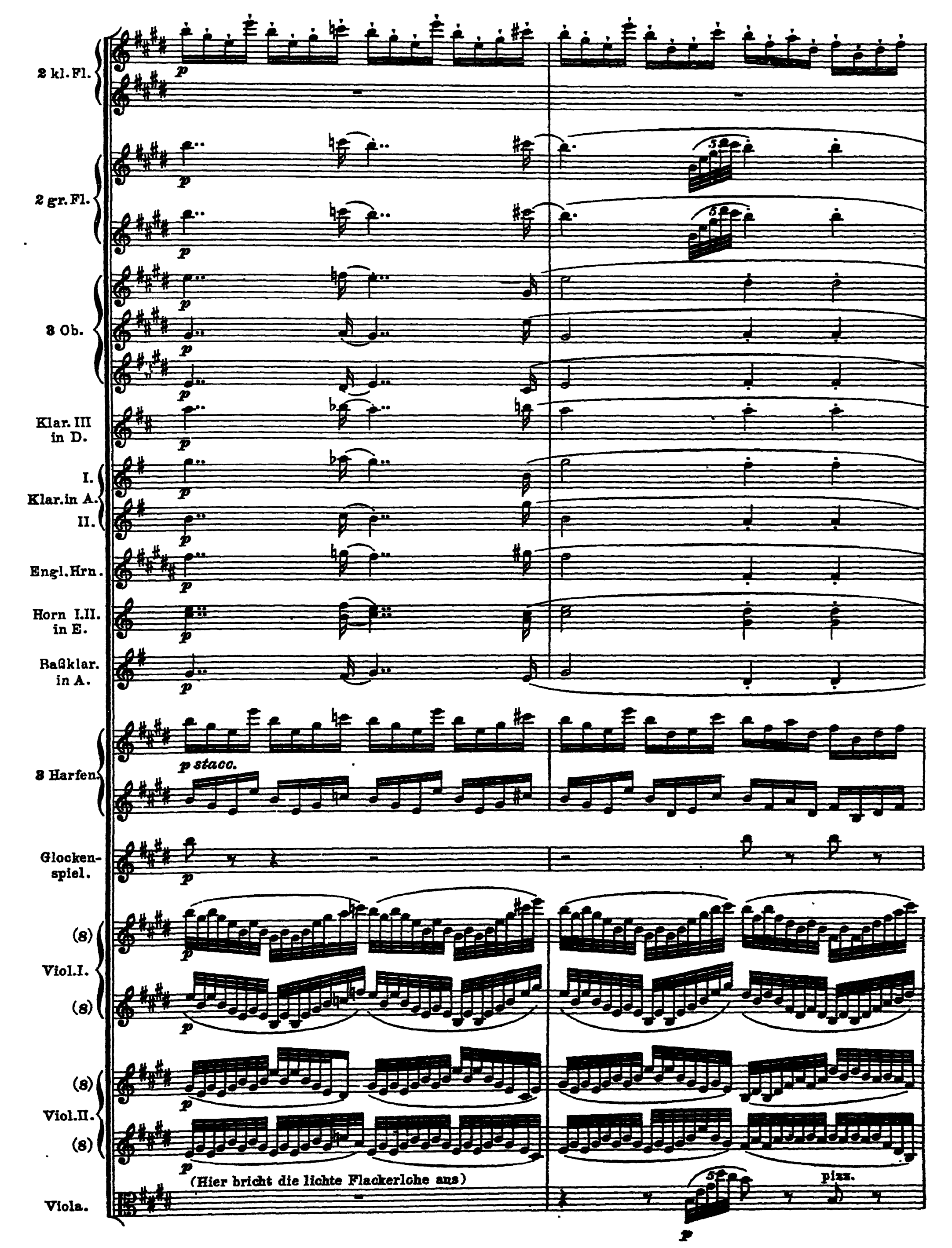
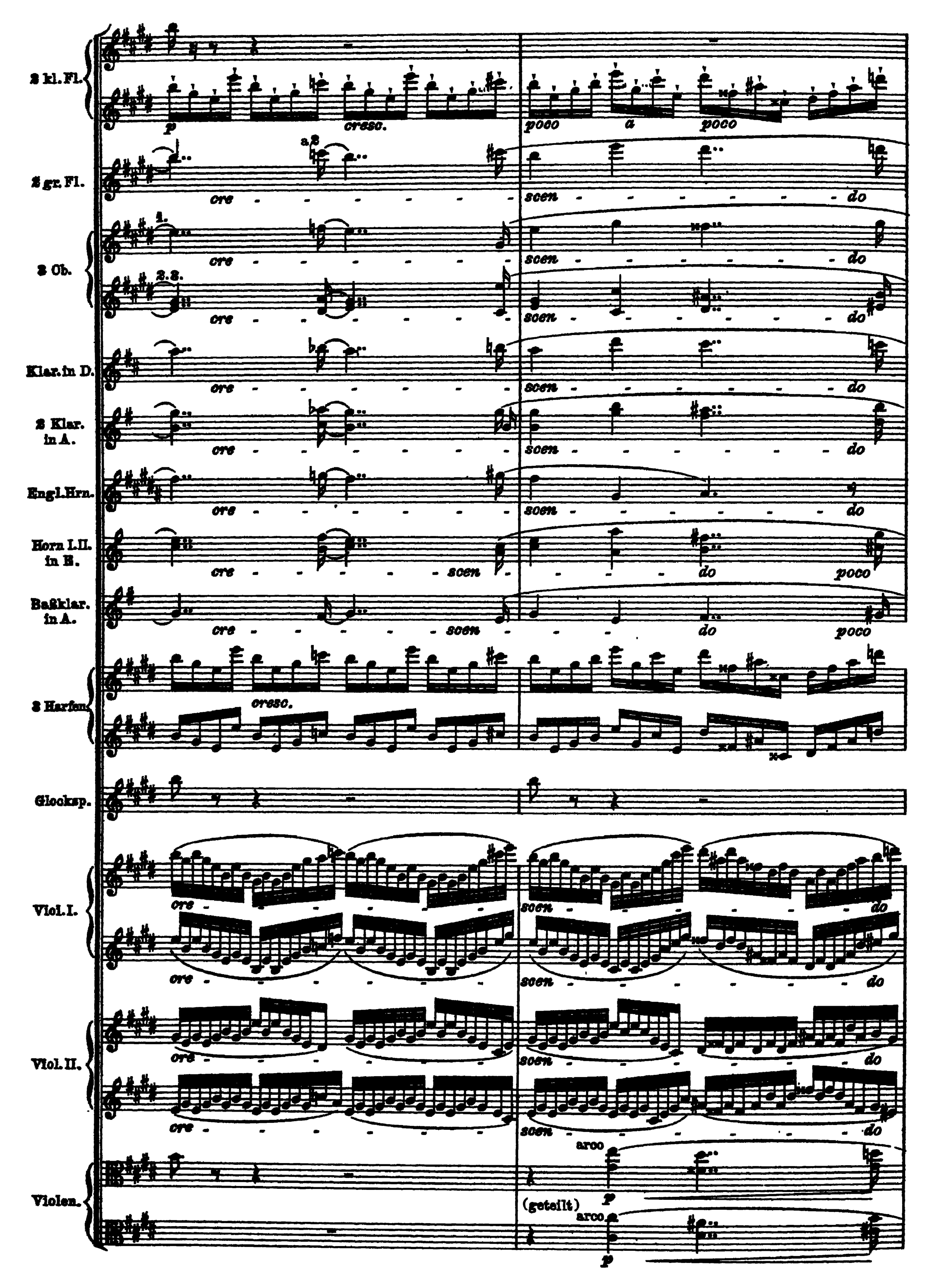
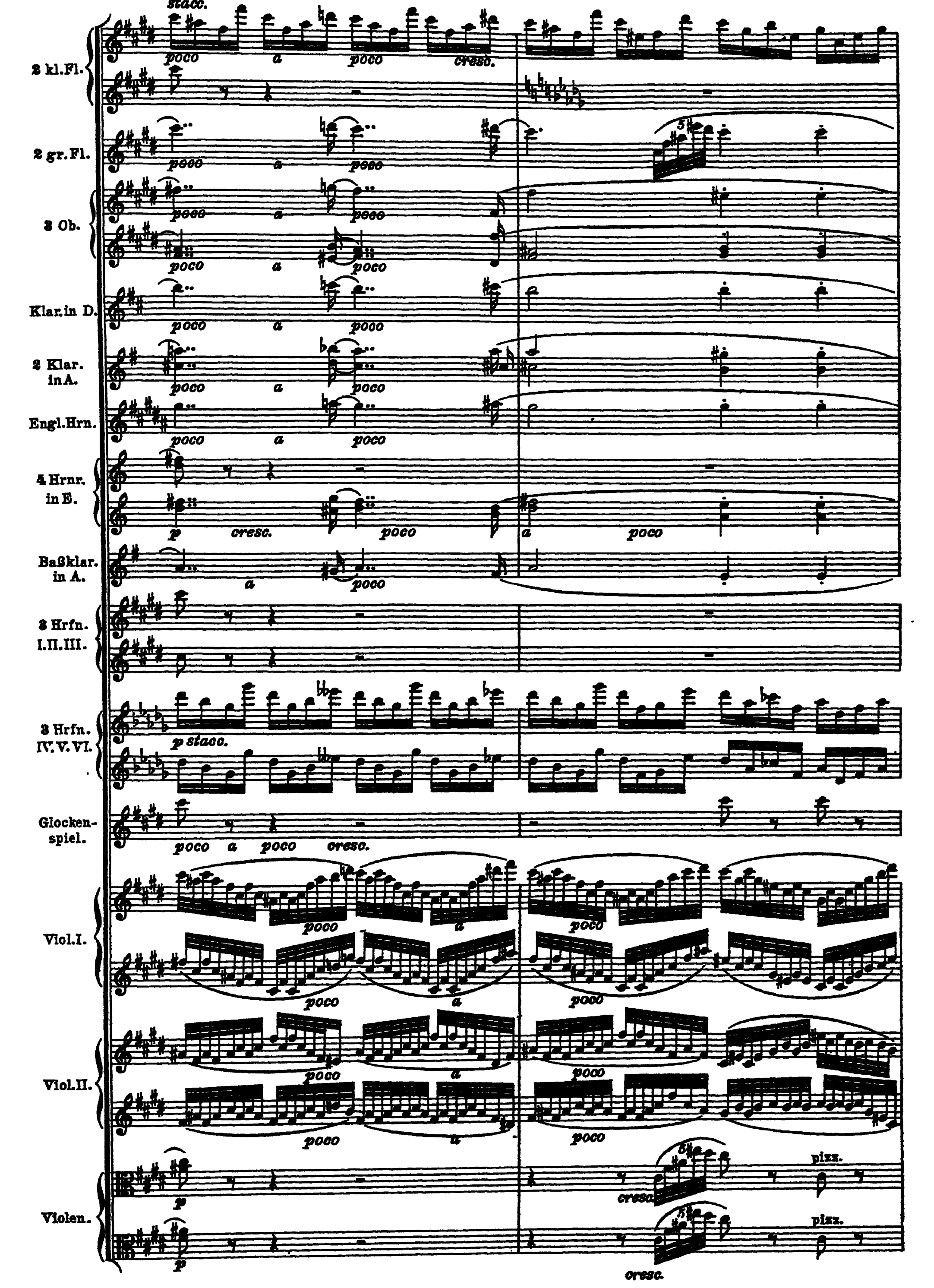
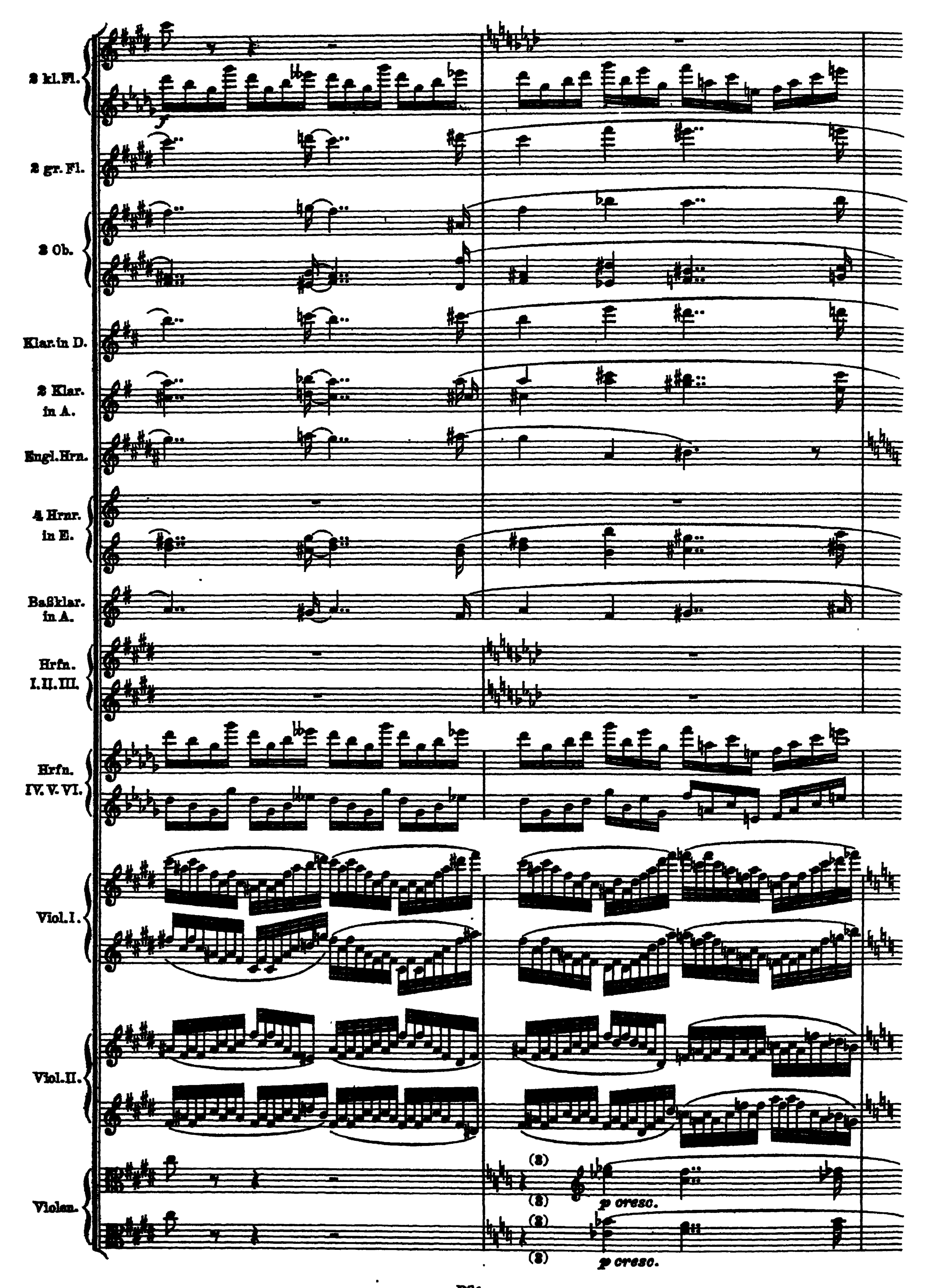
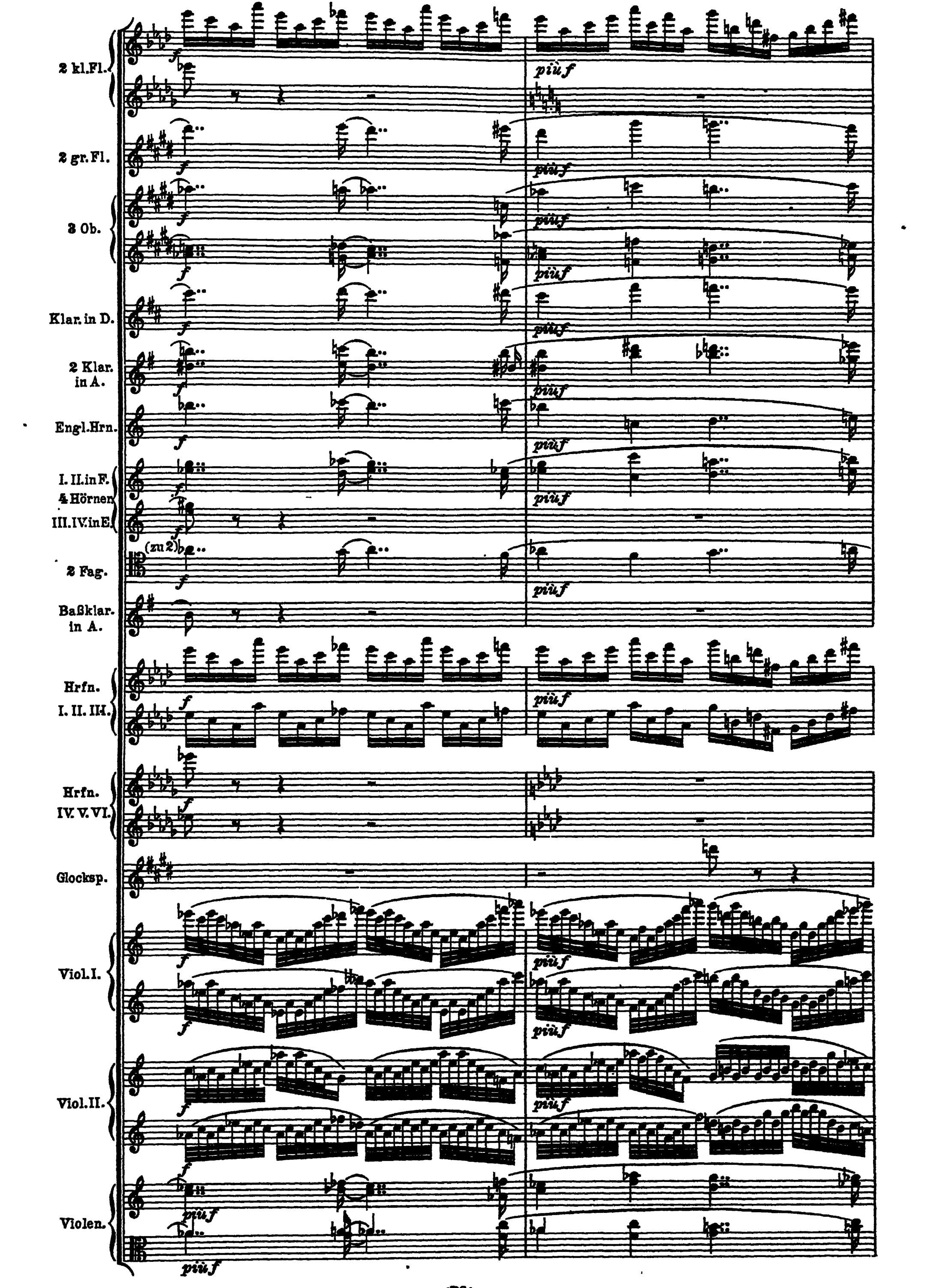
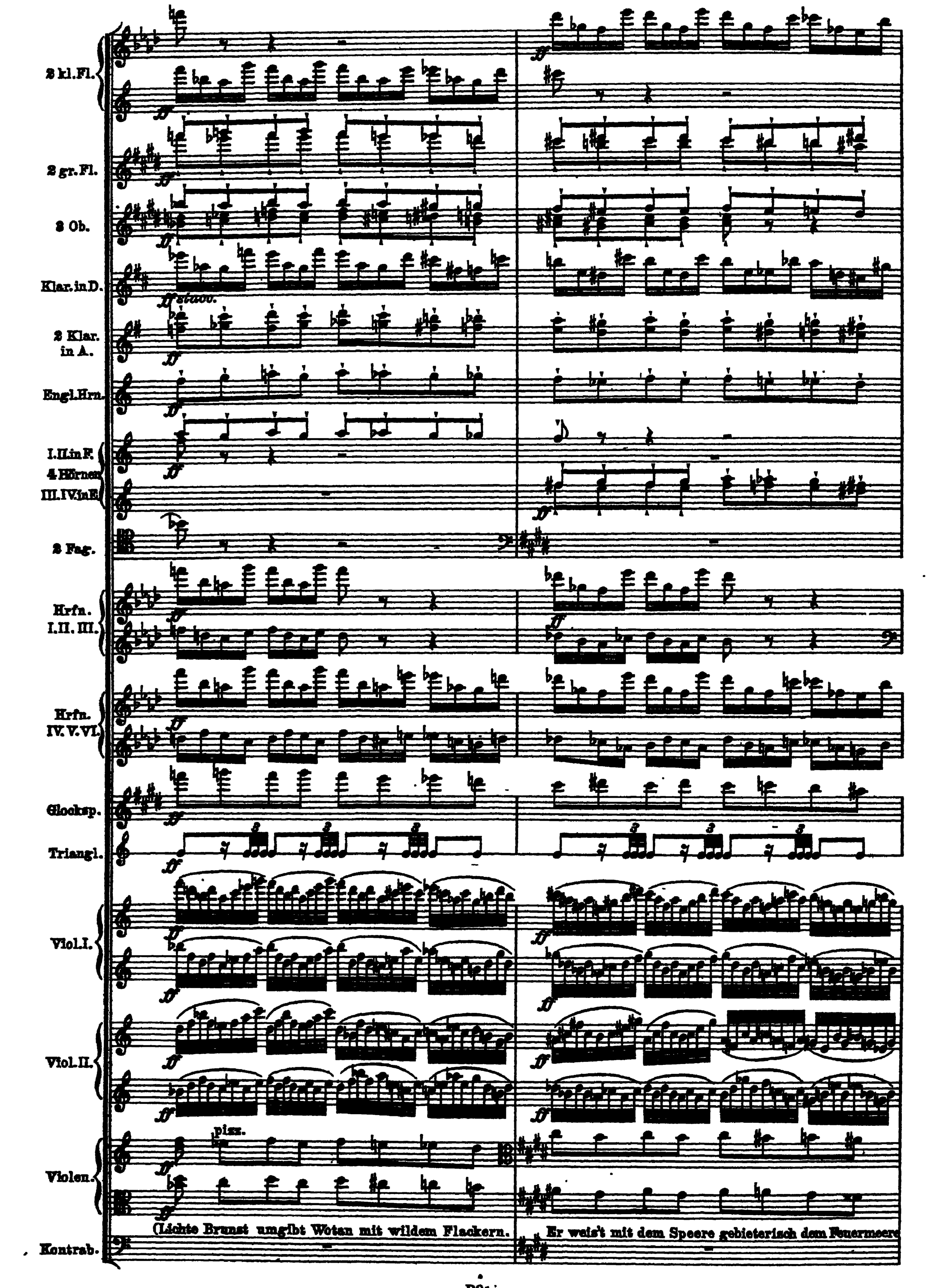
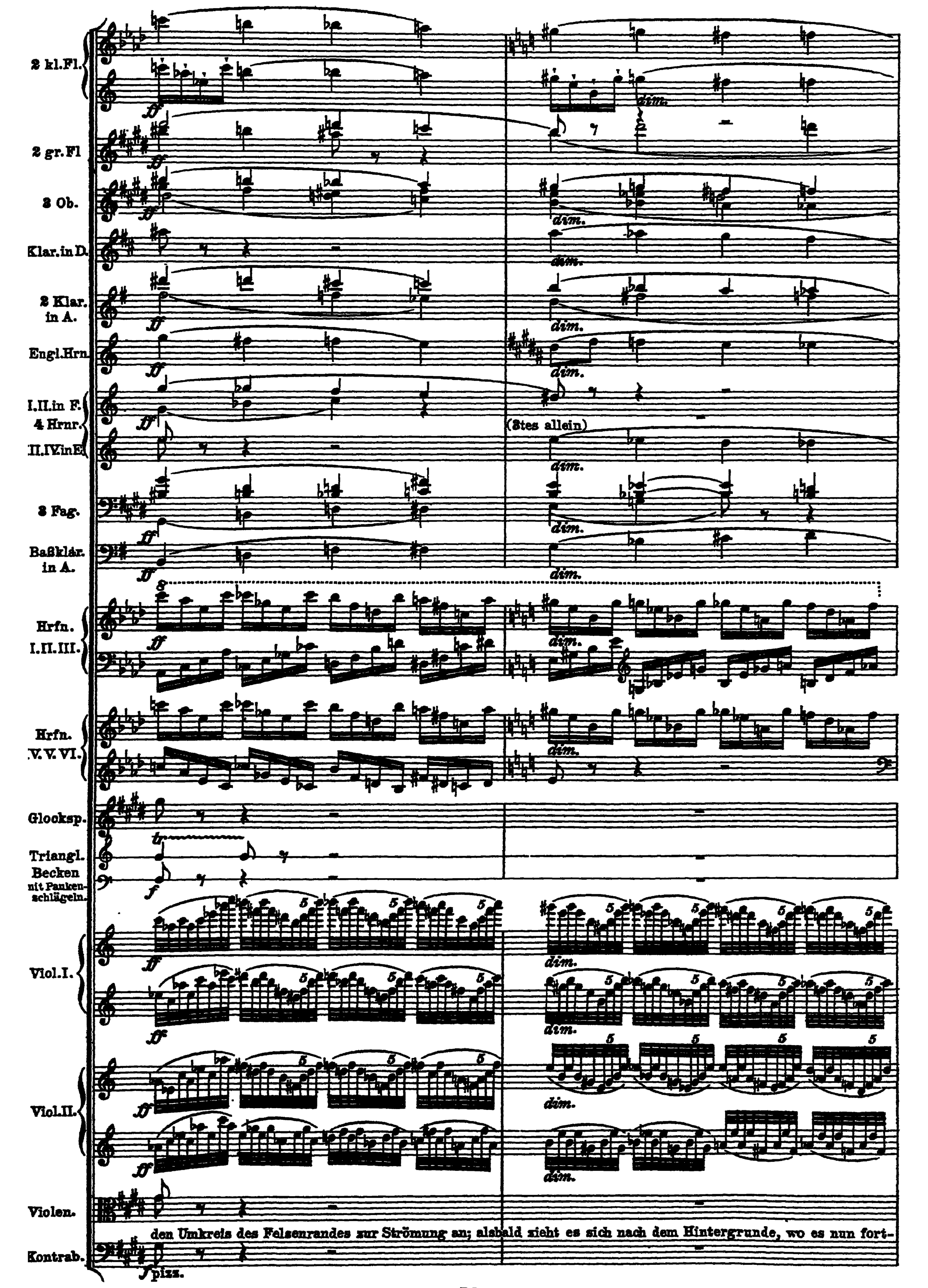
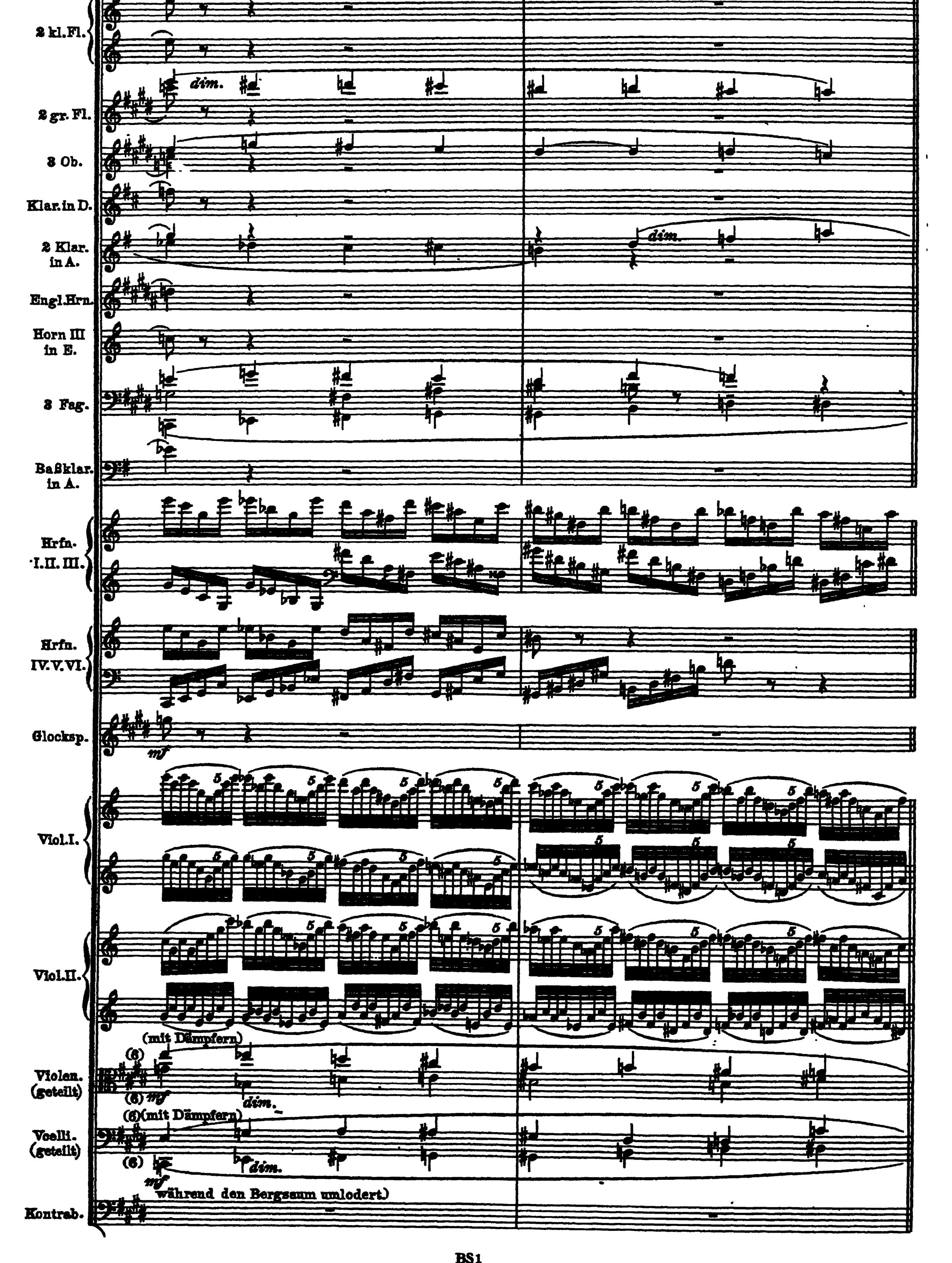
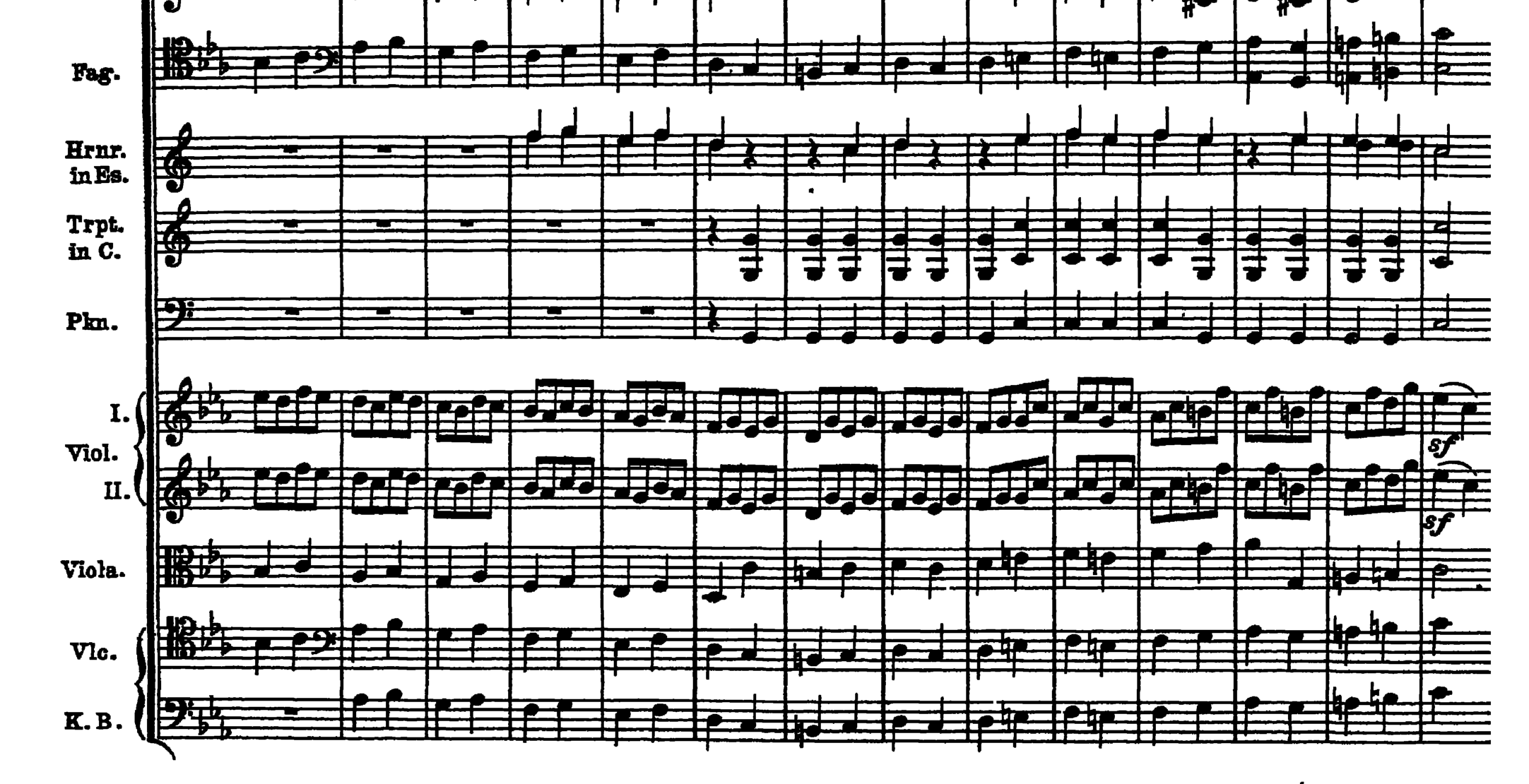
the broad manner of a Velasquez, Rembrandt, Franz Hals and Turner with their wonderfully shaded color combinations and differentiated light effects. The most obvious example of the fresco style is the treatment of the violins in the Magic Fire Music in the third act of “Walkuere” (Example 16). Executed by 16 to 32 violinists, this passage achieves a wonderful, exciting effect. A better musical description of the seething flames flickering in a thousand tints cannot be imagined. An easier, perhaps somewhat slower figuration would probably have made an impression of stiffness such as I cannot help noticing in the “Rheimgold” during the song of the Rhine Maidens swimming around the reef:

No. 16. Walkuere, Magic Fire Music
I believe that passages on the fourth string and, for certain melodies, also the high tones on the third string could be used to much better advantage than has been the case heretofore. If a particular string is to be used for special effects, the point for changing the string should be clearly indicated. Otherwise the players would soon revert to the ordinary manner of execution, out of habit as well as for the sake of greater facility.

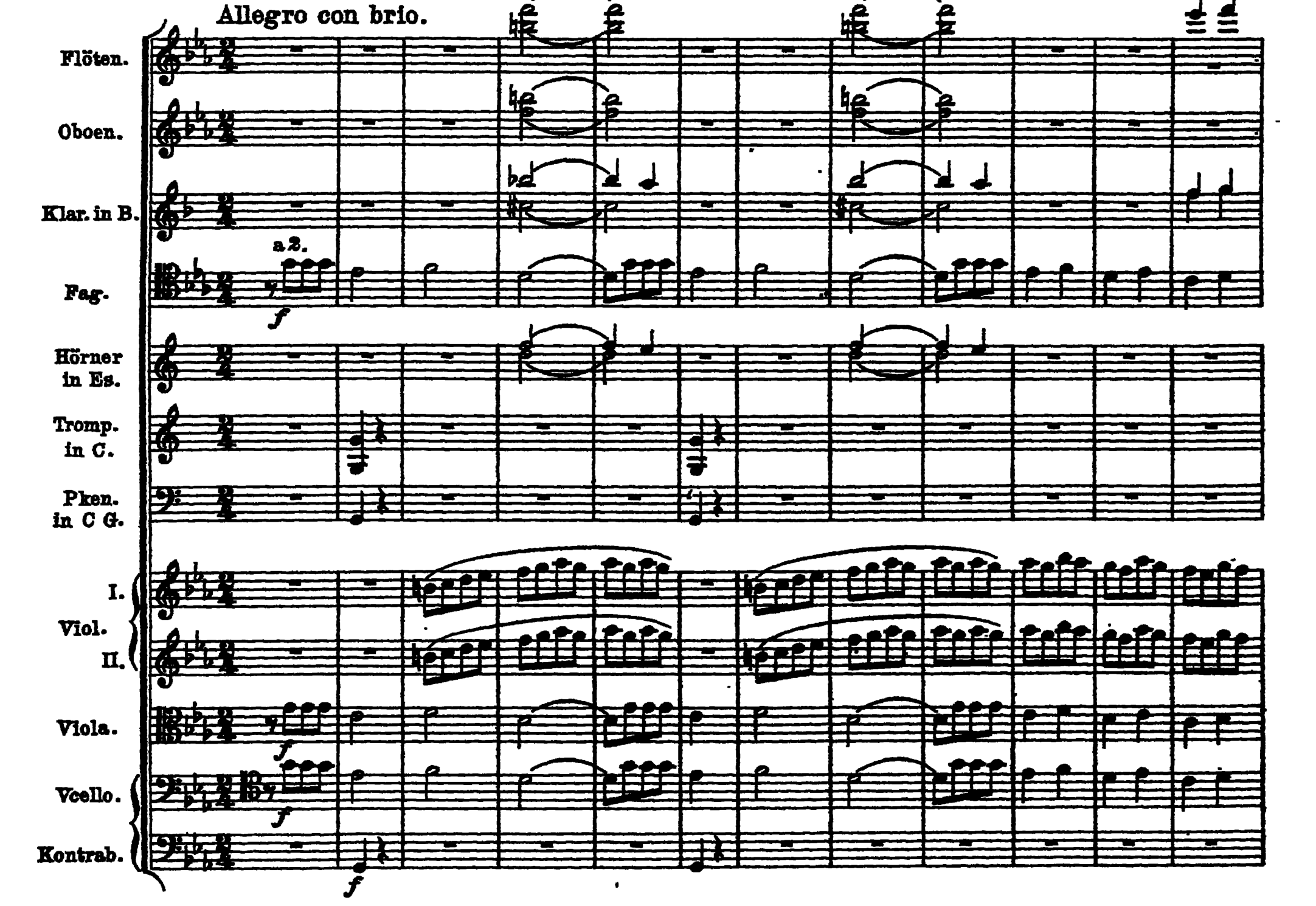
No. 17. Symphony in C minor, 1st movement
Frequently the first violins are doubled one octave lower by the second violins in order to give greater power to a passage. But unless the tones are extremely high, it is much better to double them in unison; the effect is incomparably stronger and finer. The overwhelmingly powerful effect shortly before the end of the first movement of the C-minor Symphony by Beethoven is due to the unison of the violins. In such cases it is not advisable to reinforce the violins by adding the violas in the lower octave. The low tones of the violas, being much weaker than those of the violins, would only produce an ineffective drone which would darken rather than reinforce the high tones of the violins.* Unless the viola part can be made more prominent, it is better to use the violas for reinforcing the violoncellos in the unison, insofar as their range permits, instead of in octaves. This is what Beethoven did in the C-minor Symphony. (Example 17.) *Very true! This applies also to French horns
Pk. rr 7 == a or Sa sot bent = +—t ——— a a soe | tt — a _ Satpinp pals Pe —jegeiaegs ——_ ——oF
Violins have more brilliance and are played more G easy rather gay, somewha easily in keys which permit the use of the open strings. commonplace
Only the key
of C appears to form an exception to
this rule. It sounds less bright than the keys of A and E although all four open strings are available in C whereas only three remain in A, and but two in E.
I think it is possible to define the characteristic timbre of the different keys on the violin and their ease of execution, as follows:
grave, but dull and pallid
C# very difficult
less pallid, and more pro-
Db difficult, but less
so than C#
gay, noisy, somewhat
D# almost impracticable
majestic, rather bright,
E not very difficult
brilliant, gorgeous, noble
Fb impracticable
energetic, vigorous
Ft very difficult
brilliant, incisive
Gb very difficult
less brilliant, softer
G# almost impracticable
dull, but noble
Ab not very difficult
soft, veiled, very noble
easy brilliant, elegant, joyful A# impracticable Bb easy noble, but without bri]
liance B_ not very difficult noble, bright, radiant Cb almost impracticable noble, but not very
sonorous
Minor keys C easy somber, not very sonorou C# rather easy tragic, bright, distinguished Db very difficult somber, not very sonorou D easy plaintive, sonorous, some
what commonplace D# almost impracticable dull Eb difficult very dim and mournful E easy shrill, commonplace
Fb impracticable F rather difficult
not very sonorous, som
F# less difficult
tragic, sonorous, incisive
Gb impracticable
G easy melancholy, rather sonor-
G# very difficult not very sonorous, sad,
Ab very difficult, almost very dull, sad, but noble
A easy rather sonorous, soft, sad,
A# impracticable
Bb difficult somber, dull, rough, but
B easy very sonorous, wild,
harsh, sinister, violent
Cb impracticable The string instruments, the combination of which forms what is rather improperly called the quartet, are the basis and-the constituent element of the whole orchestra. They possess the greatest power of expression and an indisputable wealth of timbres. Particularly the violins are capable of a great number of seemingly incompatible nuances. They convey (in a mass) force, lightness, grace, somber seriousness and bright joy, reverie and passion. The problem is only to know how to make them speak. Moreover, it is not necessary to calculate for them the duration of
No. 18. Walkuere, Act III Wagner.
a sustained tone (as for the wind instruments) and to relieve them by occasional rests; one can be sure that they will never be out of breath. The violins are faithful, sensible, active and indefatigable servants.
Tender and slow melodies, confided too often nowadays to the wind instruments, are never rendered better than by a mass of violins. Nothing can equal the stirring sweetness of some twenty E-strings vibrated by as many skilled bows. Here is the true female voice of the orchestra, a voice at once passionate and chaste, penetrating and soft; whether it weeps, laments, prays or jubilates—no other voice possesses its range of expression. A minute movement of the arm, an unconscious impulse in the player, hardly noticeable with a single instrument, produce in a group the most wonderful shadings and arouse feelings which penetrate to the depth of the heart.
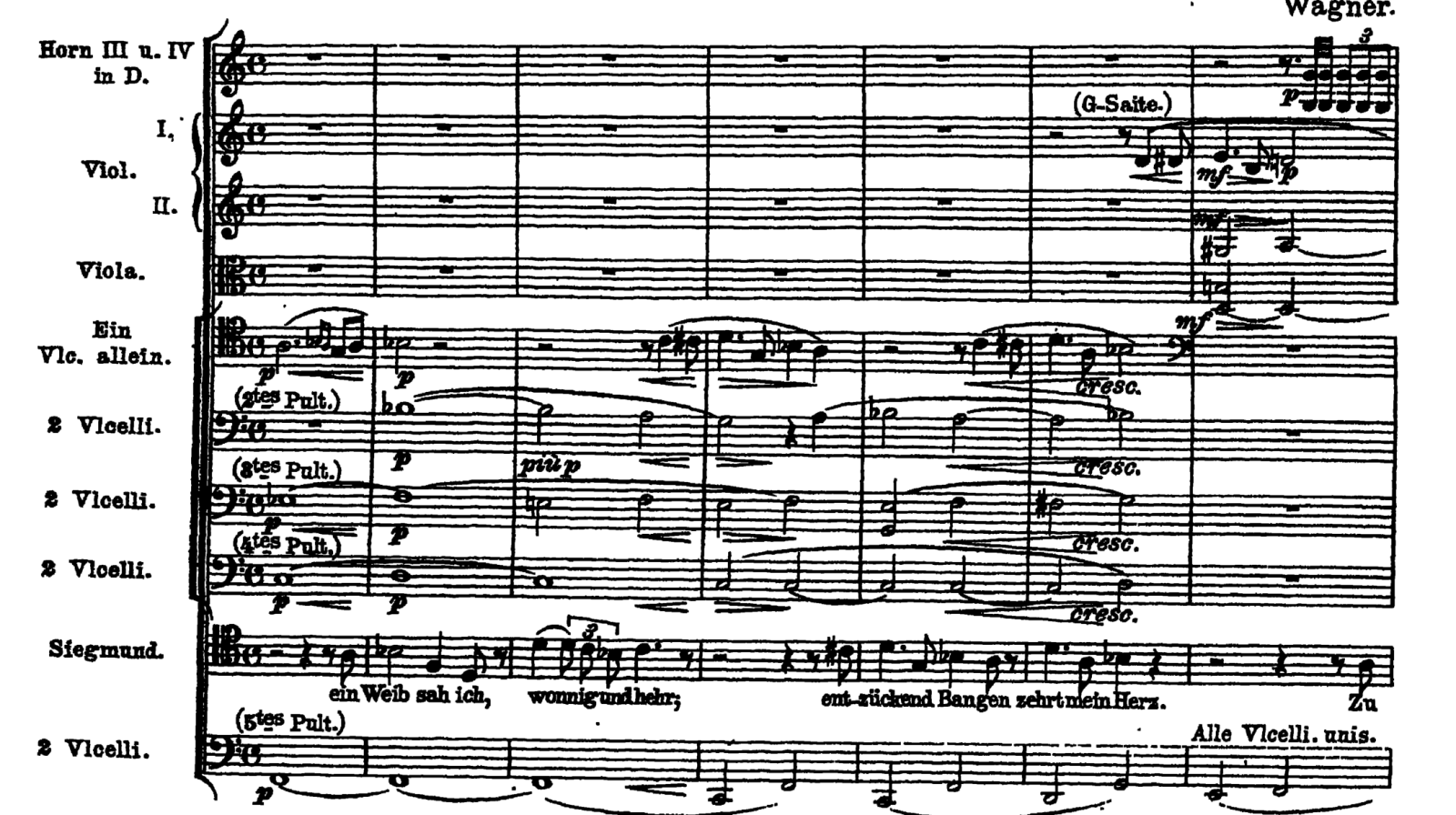
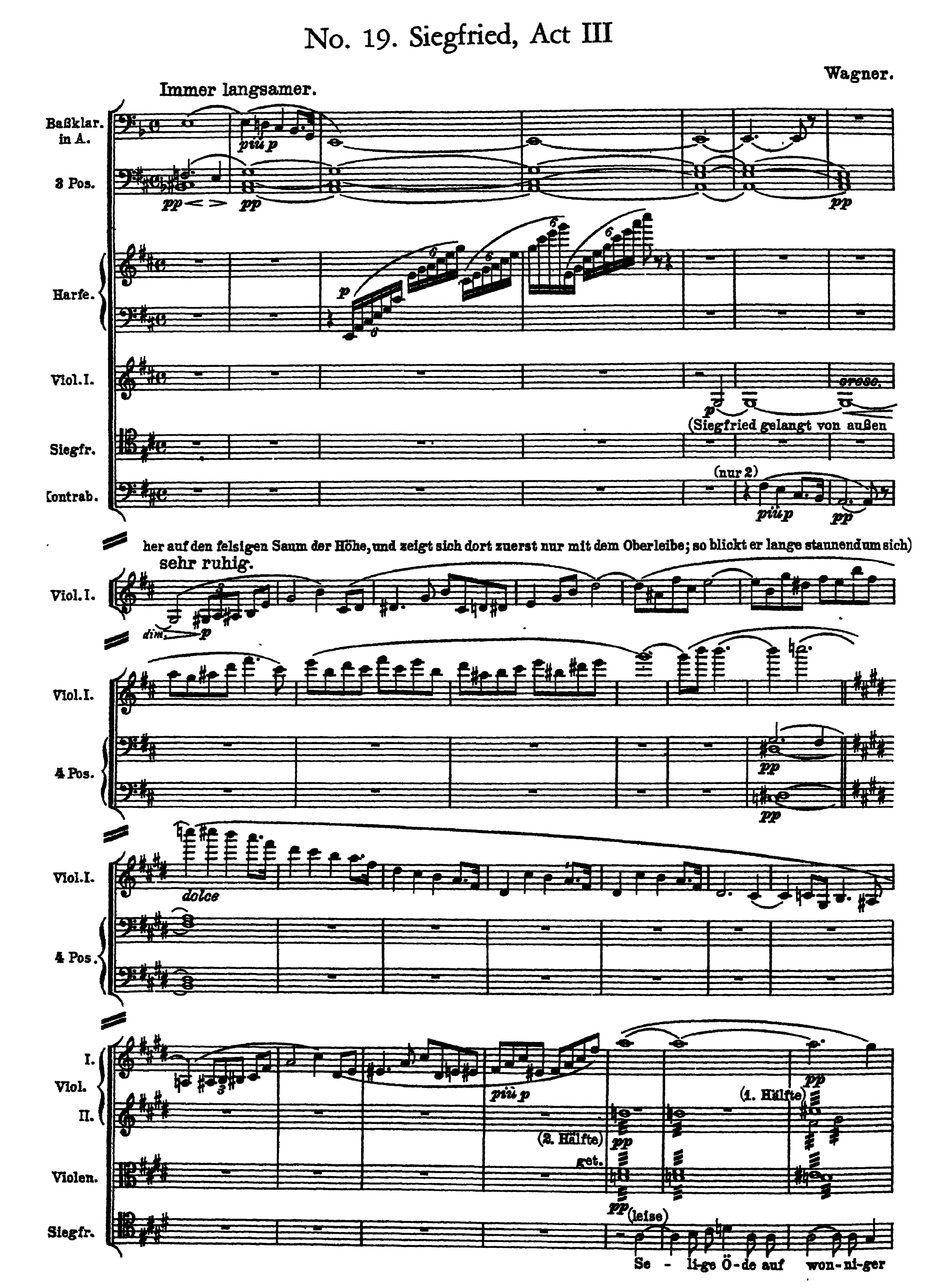
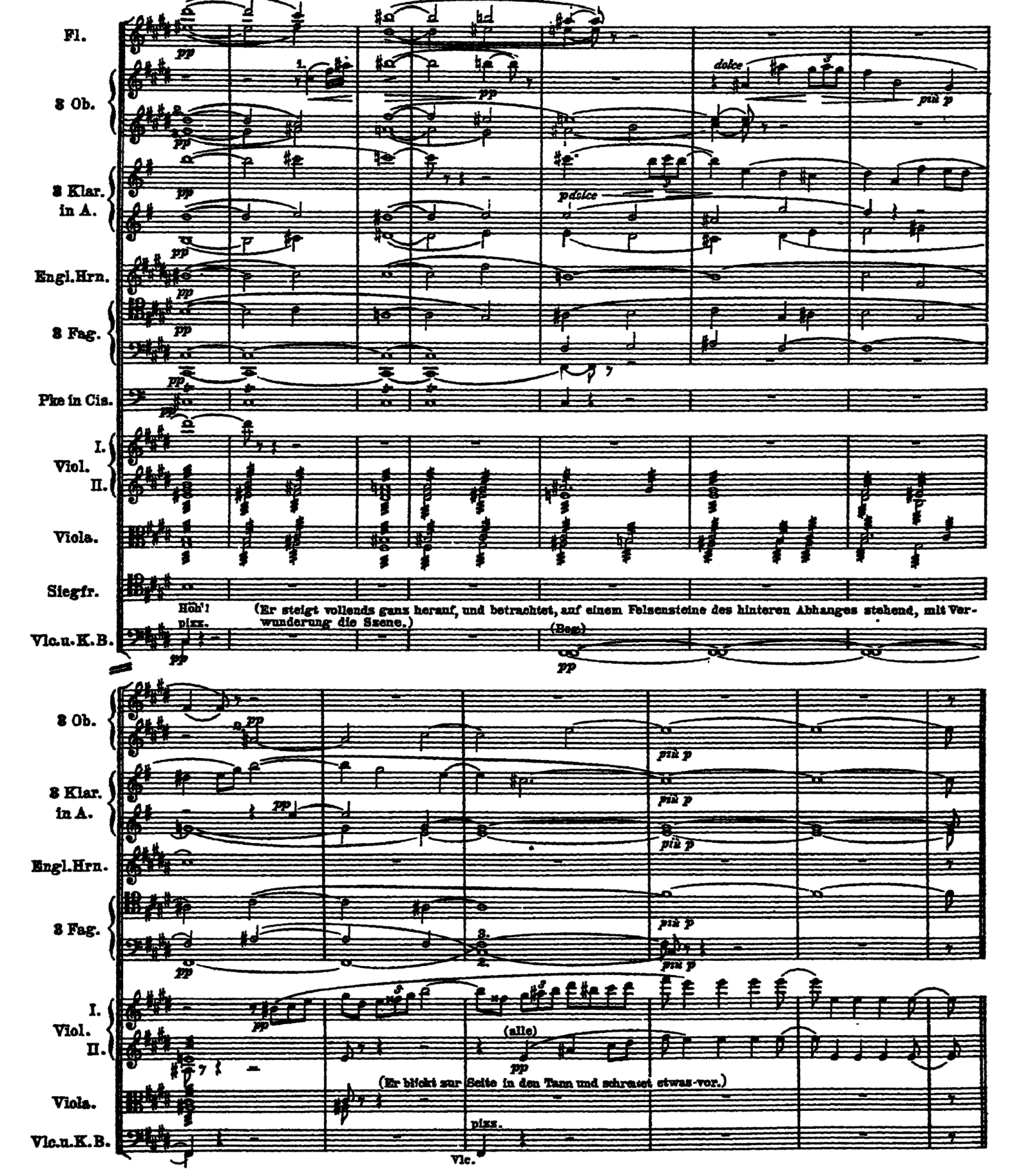
I need hardly mention here the angelic purity of the violins in the Prelude to “Lohengrin”. The same violins, in a stirring passage in the third act of “Walkuere”, reveal the human bliss of motherlove. (Example 18.) Then again, in the third act of “Siegfried”, they depict the “selige Oede auf wonniger Hoeh” (haven of bliss on the mountainous height) in cloudless brilliance. (Example 19.)
With the same fidelity the violins lend their tones $ Wagner, inexhaustible in the symbolic use of the to express the apprentice’s love (David in “Meis- orchestral language, even individualized the first tersinger’”’) : and second violins in “Tristan”. The second vio-

Esau! and tone, serve as accompaniments for. the eecond- —* + ary figures, Kurwenal, Brangaene and King Marke; (Was war nur der Lene?) while the warmer and nobler first violins—accus-
lins, customarily somewhat inferior in execution tomed to lead—jubilate and suffer with the two great masters used it exclusively as a meaningful
heroes of the action. symbol: Beethoven, in the Benedictus of his Missa At the close of this chapter I should like to warn Solemnis, to let a pure soul praise the Lord in a
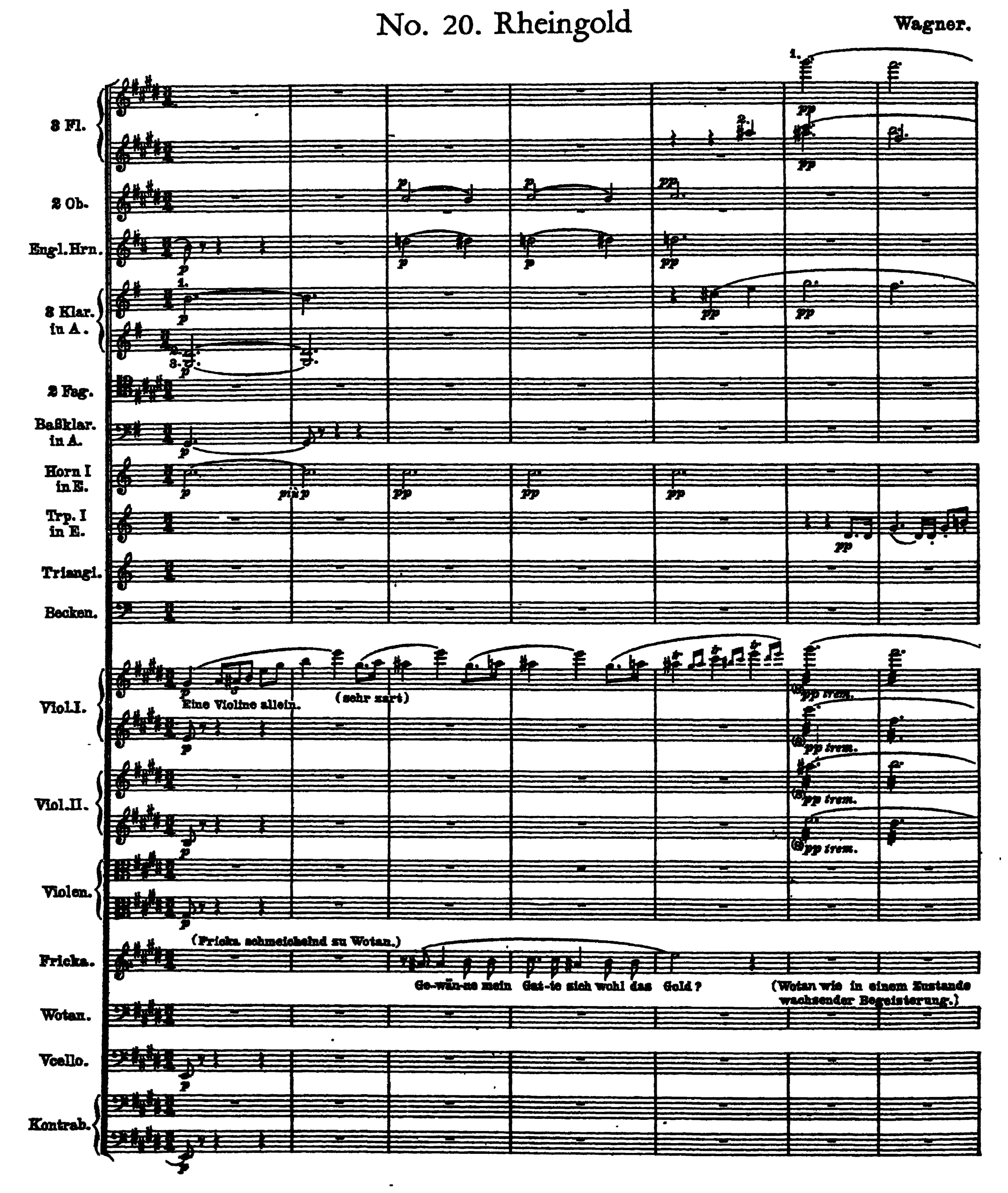
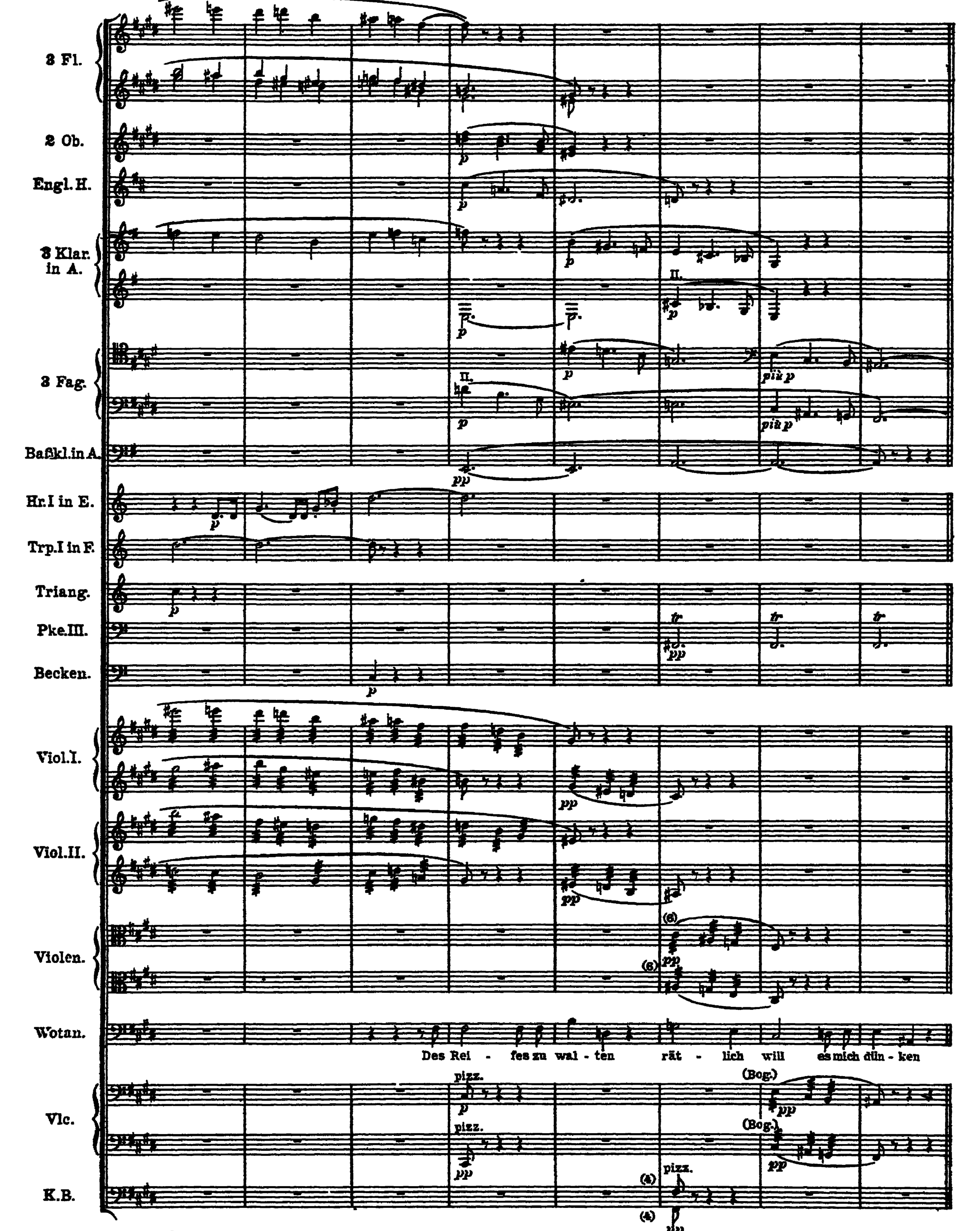
against the so frequent misuse of the solo violin in fervent song; and Wagner, in “Rheingold”, to
the orchestra. The effect of a solo violin is so pe- ‘"$ unveil the innermost secrets of a woman’s heart.
culiar and conspicuous that it should never be em- (Example 20.)
ployed without a compelling poetic motive. The
ip
The economical use of the solo violin in Wag- old truth that a device becomes the more effective ner’s scores may serve to exemplify once more the the less it is used.