 Playable Books
Hector Berlioz · section 27 of 67
The French Horn
Read and hear this section in the playable edition →

Since this instrument is adapted for numerous changes of key by which its pitch can be raised or lowered, it is impossible to indicate its precise range without also naming the particular key of the horn in question. In fact, it is easier to produce high tones than low ones on horns of a low key—with the exception of the horns in low A, Bb and C, the extreme length of whose tubes makes the execution of high tones difficult. On the other hand, it is easier to produce low tones than high ones on horns of a higher key. Besides, some horn players who use a wide mouthpiece and are mainly experienced in playing the lower tones cannot produce the higher ones; others who use a narrow mouthpiece are only accustomed to playing the higher tones. Each key of the instrument has its own specific range; moreover, there is the difference between the ranges of the players of the high (first) and the low (second) horn.
The horn is written in the G and F-clefs; but the Gclef is to be read an octave lower than written, The examples below will make this clear.
All the horns except the one in high C are transposing instruments. Their notation does not correspond with the actual sound.
Horns are capable of producing two very different types of tone. The open tones, almost all of which give the sound of the harmonic divisions of the tube, are produced by the player's lips and breath alone. The stopped tones are produced by more or less closing the bell (the lower orifice of the horn) with the hand.
The following table gives the open tones in the different keys and ranges of the first and second horns.
“Most of Berlios’ statements in this chapter are ont of date. See note on p. 257
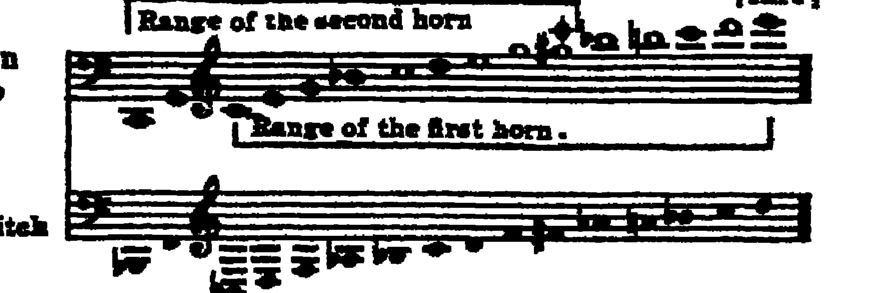
+ nis open G# is not so easy to produce as the G but it becomes easy if prepared by a neighboring tone, ic. G, F# or A. It is a little too high.
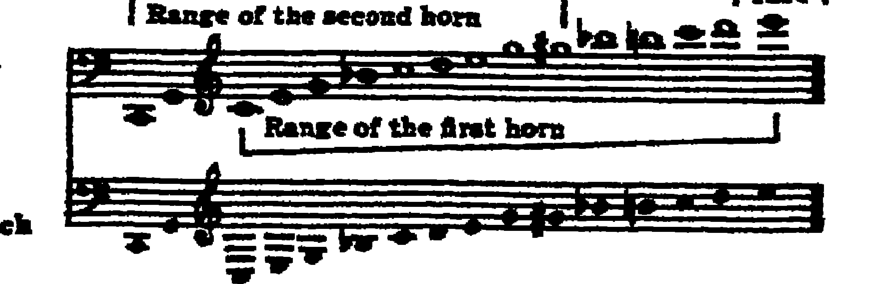
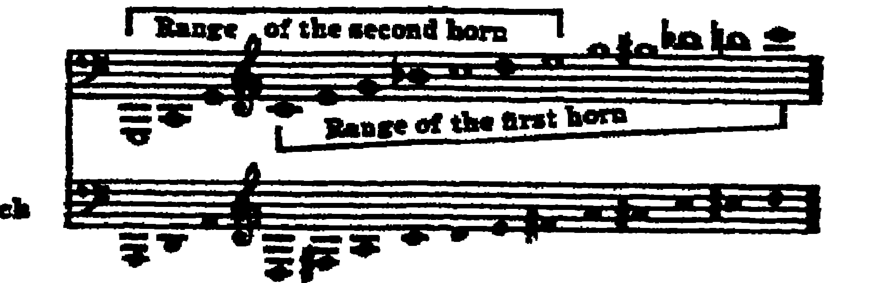
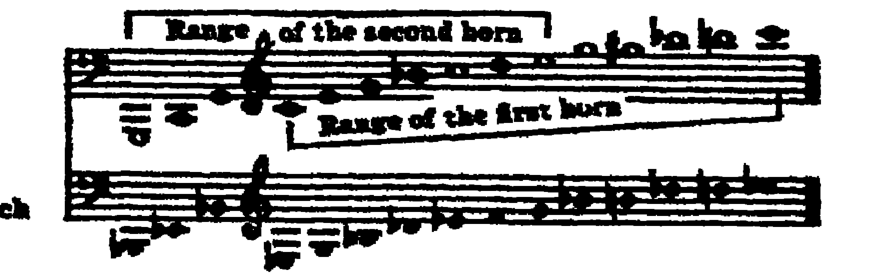
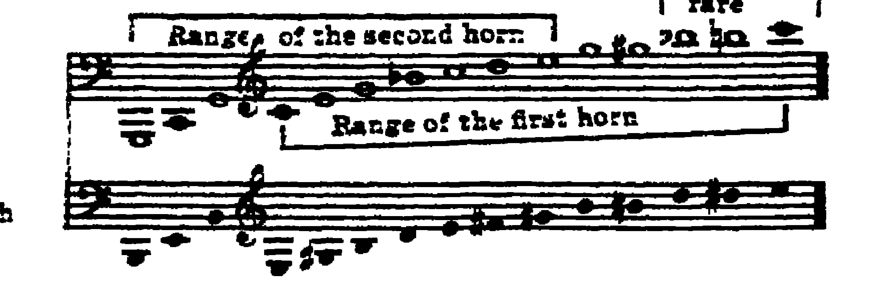
i Ranges of the second hor: / bo, 72 to =
Aztua.p.tch
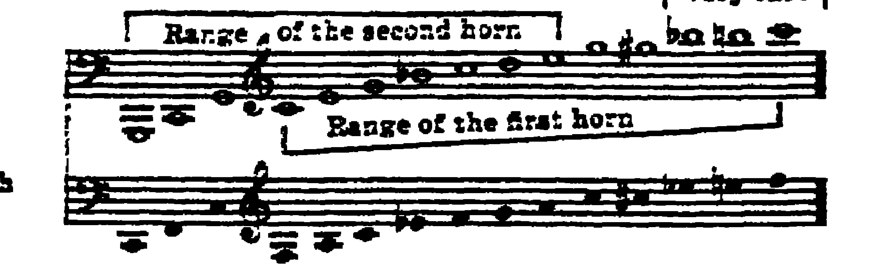




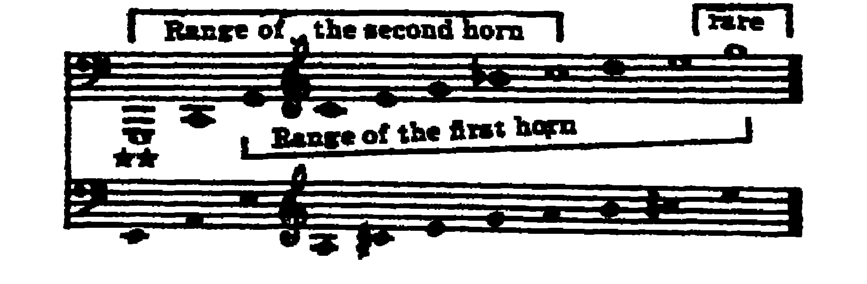

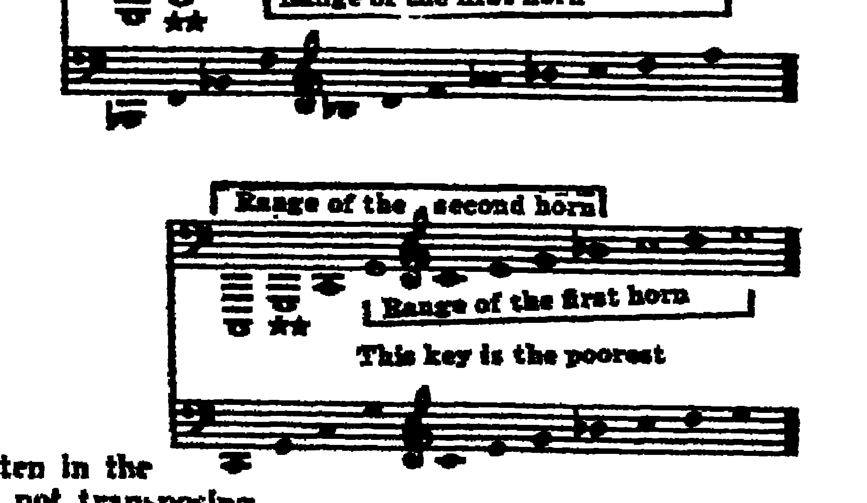
G-clef are not transposing,
The family of horns is complete. There are horns in all keys, although this is not generally known. The keys which seem to be missing in the chromatic scale are obtained by means of a lengthening piece which lowers the instrument by a semitone. Thus, only the horns in low Bb, C, D, E+, E, F. G, A®, high B® and high C are made in one piece; bat by adding the lengthening piece to the horns in low B’ and lew C, one obtains low A and,B. In the same fashion. DD is changed inte D> (or C#), G into G® (or F*) and high C into high B (or C>), The last
“*This luw G is easier In the higher keys, but it is generally poor and uncertain in all the keys.
key can also be obtained by pulling out the slide of the horn in high C.
The stopped tones show marked differences of character and sonority, not only in comparison with the open tones, but also among themselves. These differences are caused by the greater or smaller opening left in the bell by the performer's hand. For certain notes the bell must be closed a quarter, a third or one-half, for others almost completely. The more the bell is closed, the duller and rougher becomes the tone and the more difficult is its secure and clean production. The stopped tones are therefore very different from each other. We shall use the sign 1:, to indicate those tones for which the bell is only half closed. and which are therefore better in quality. In the following example, white (whole) notes indicate the above listed open tones, black (quarter) notes represent stopped tones.



In order to be able to list the complete range of the horn we must first mention several additional open tones which are less well known than the others, but which may be used to good advantage. These are: the high
Gb bese » which is always a little too low and seems
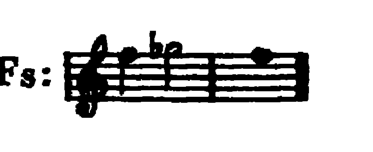
in tune only when used between two Fs: peicfaety
(therefore it can never be used as F#); then the low
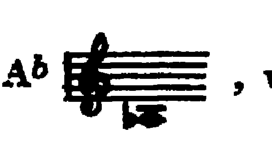
Ab : » which is obtained by forcing the G and
compressing the lips; the low F —— » which, on the
contrary, is produced with relaxed lips. These last two notes are of great value; the A® in particular frequently produces excellent effects in all keys higher than the key of D. However, the playing of the F is a little more risky; it is more difficult to sustain it safely and cleanly. These low tones can be produced without any preparation if they are not preceded by very high ones; but it is usually best to place them after a G—for example:

Passing from A> to F is possible in moderate tempo:
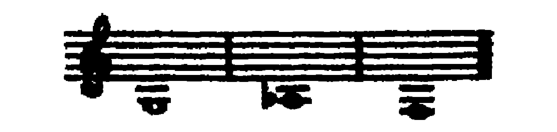
Below these notes some horn players can produce the
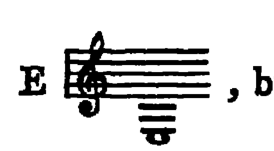
E —, but it sounds bad and is very hard to play.
I advise composers against employing it, as well as the following five notes beneath the low C; they are seldom in tune and can be sustained only with difficulty. If used at all, they should be written only for medium horns such as those in D, E and F, and then only in a descending progression:

By combining the range of the first horn with that of the second horn, and by adding to the natural open tones the artificial open tones and the stopped tones, we obtain the following immense chromatic scale, progressing upwards:
Complete range of the horn

Horn in F > =




The lower the key, the more difficult are rapid successions on the horn; in this case the tube is longer and cannot be pat into vibration instantaneously. Low tones, even the natural ones, can succeed each other in all keys only in moderate tempo. Incidentally, this is a general law which has to be observed with all instruments. Since the low tones result from a smaller number of vibrations, the sonorous body requires more time to produce them. Hence, a passage like the following would be impractieable or of poor effect on a low horn (in Bb, C or D):
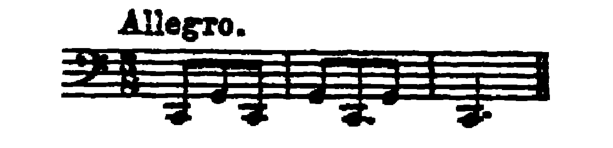
Also the following would be very bad on a horn in low C or B®, even though practicable on a horn in F and in higher keys:

When using stopped tones, especially in the orchestra, one should try to intersperse them as much as possible with open ones, and not to pass from one stopped tone to another stopped one, particularly from one poor stopped tone to another equally poor one.
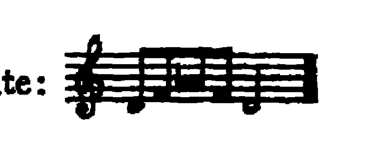
Thus it would be senseless to write: I
A passage like the following, however,
would not lack sonority and would be easy to execute because it contains but one poor stopped tone (the first A>); whereas the same passage transposed to its lower octave or fifth would be ridiculous as well as exceedingly difficult :
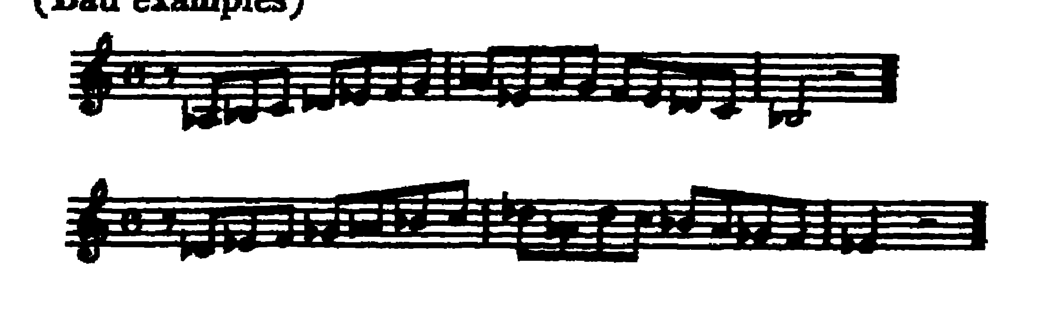
These three examples show that the best are to be found above the medium Ab with h tion of the following four:
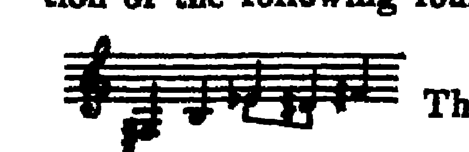
aaa They constitute the series already
indicated above:
: a es oe
Hence. the above cited example in 46, although good in one octave, is very bad in the lower one—where it consists almost completely of the poorest stopped tones:
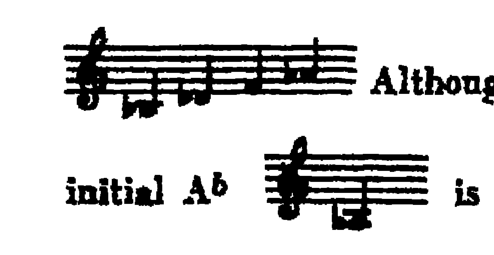
SEE a ntoogh it in an artifotal tone, the initial Ab —_ is very risky because it has to be
taken quickly and without preparation.
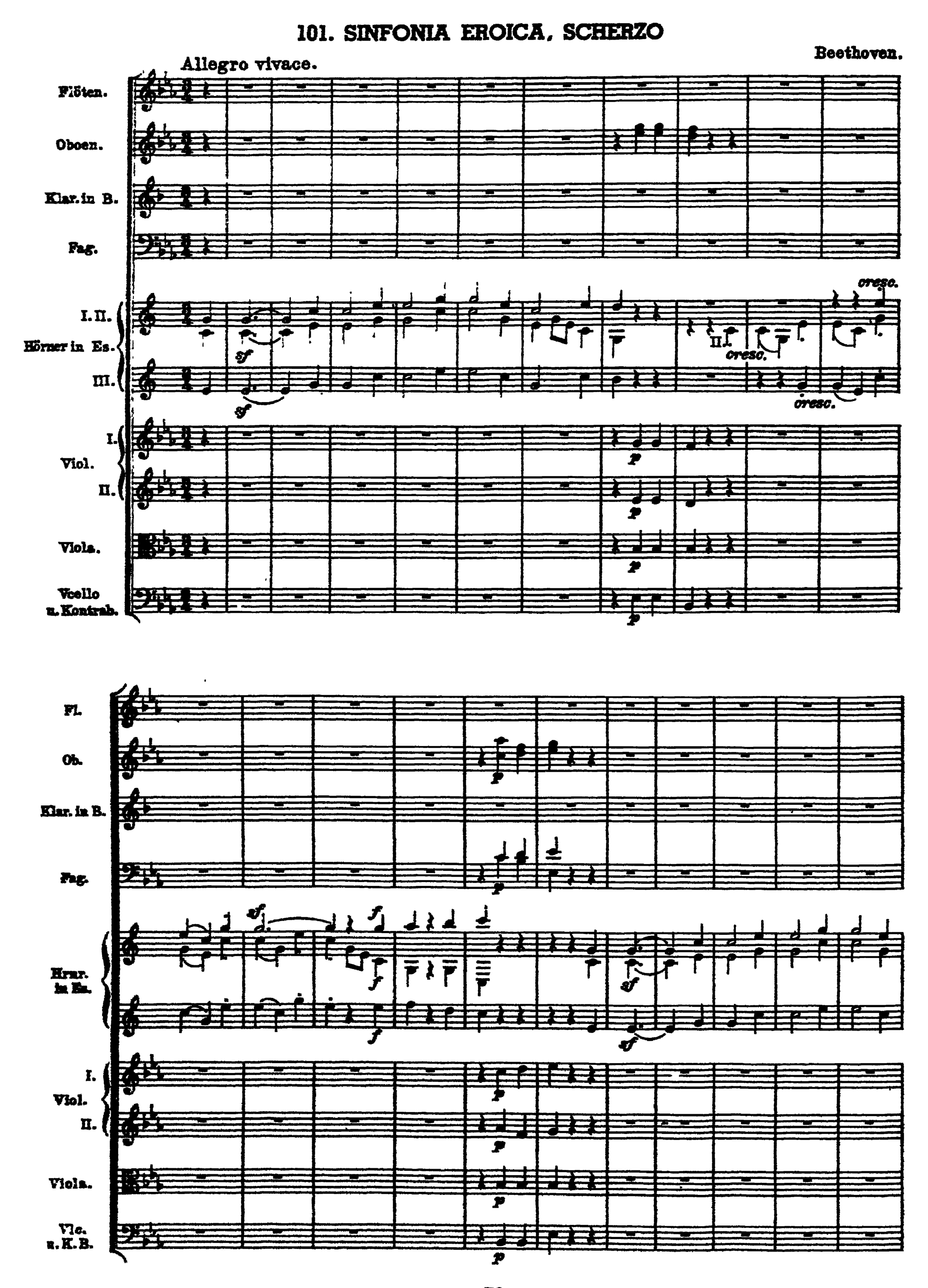
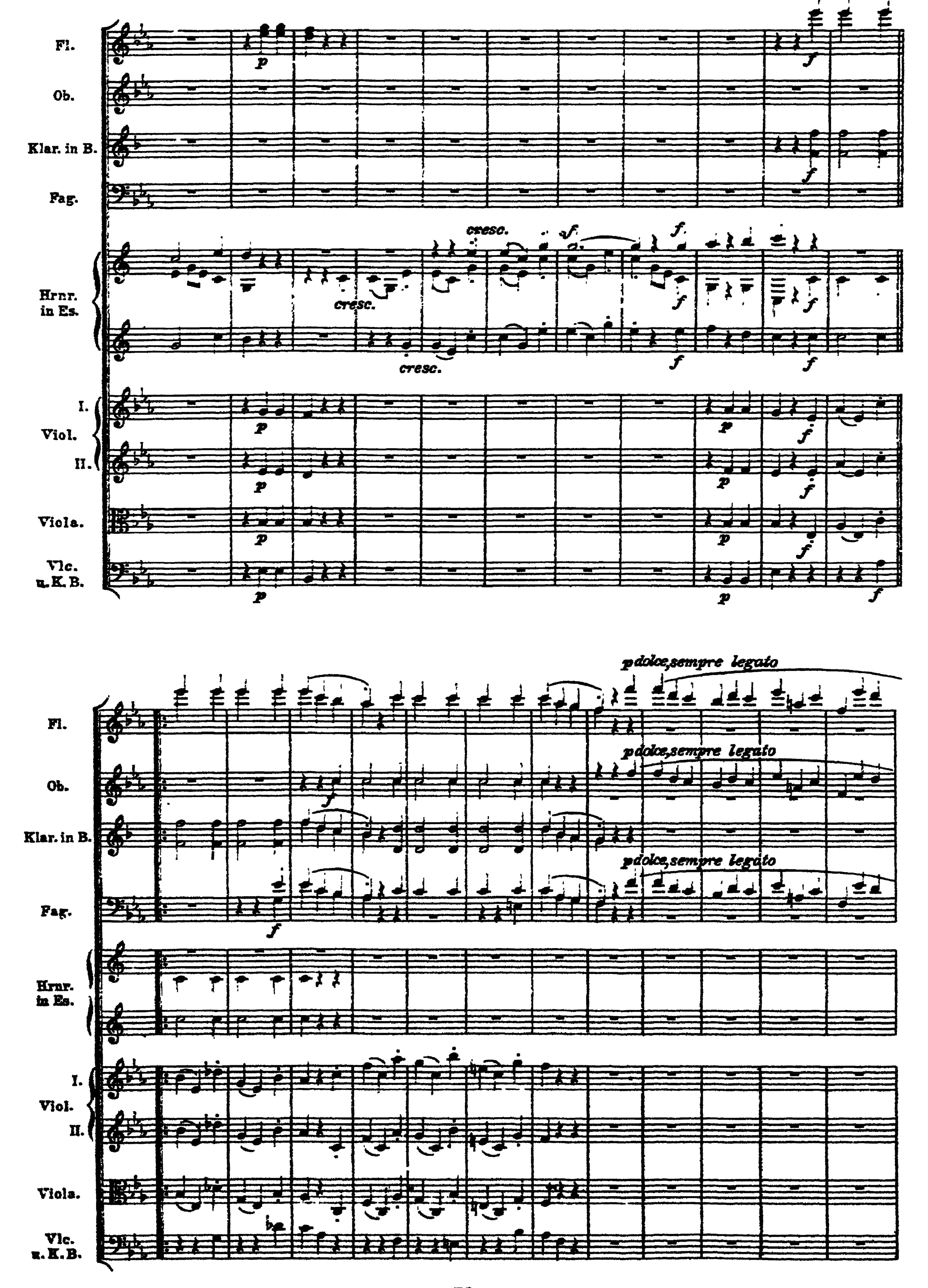
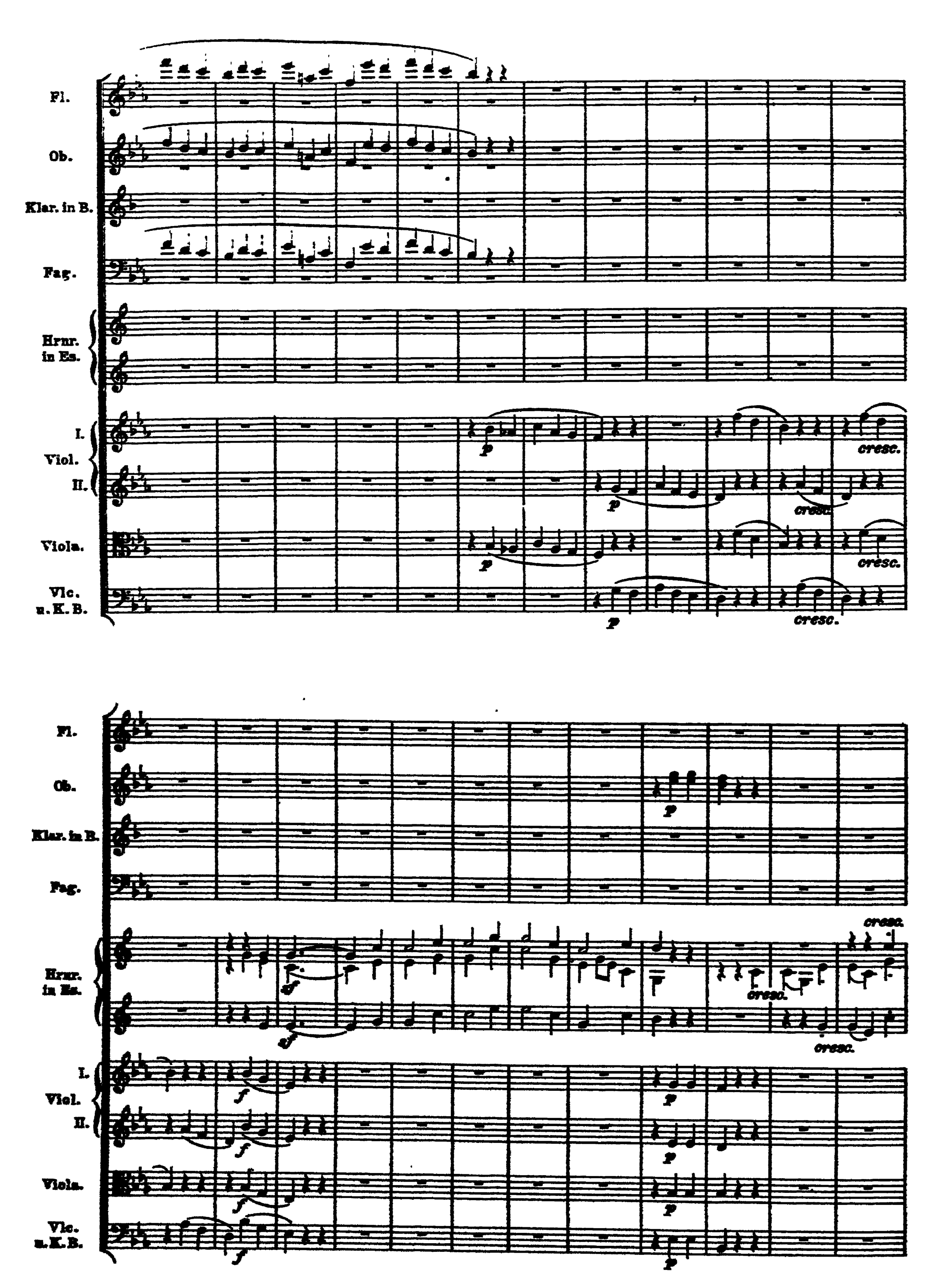
In general the old masters limited themselves to the use of open tones; to be frank, they employed them quite clumsily. Even Beethoven is very reluctant to use stopped tones, execpt in a solo passage. His scores offer very few examples of them; whenever he has recourse to them, it is ususlly for some striking effect. For example, see the stopped tones of the three horns in E> in the Scherzo of the Eroica, and the low F# of the second horn in D in the Scherzo of the A-major Symphony (Examples 101 and 102).
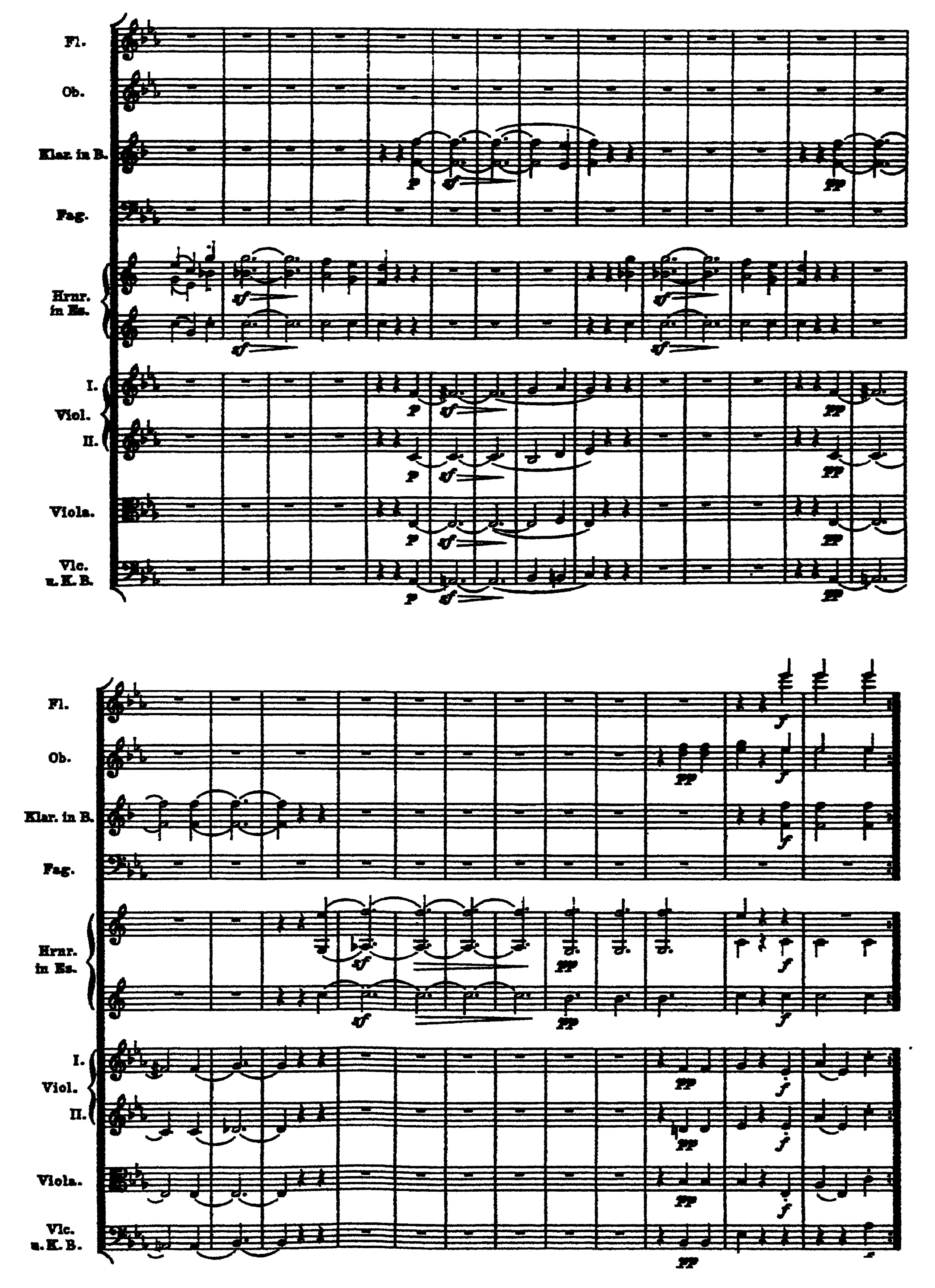
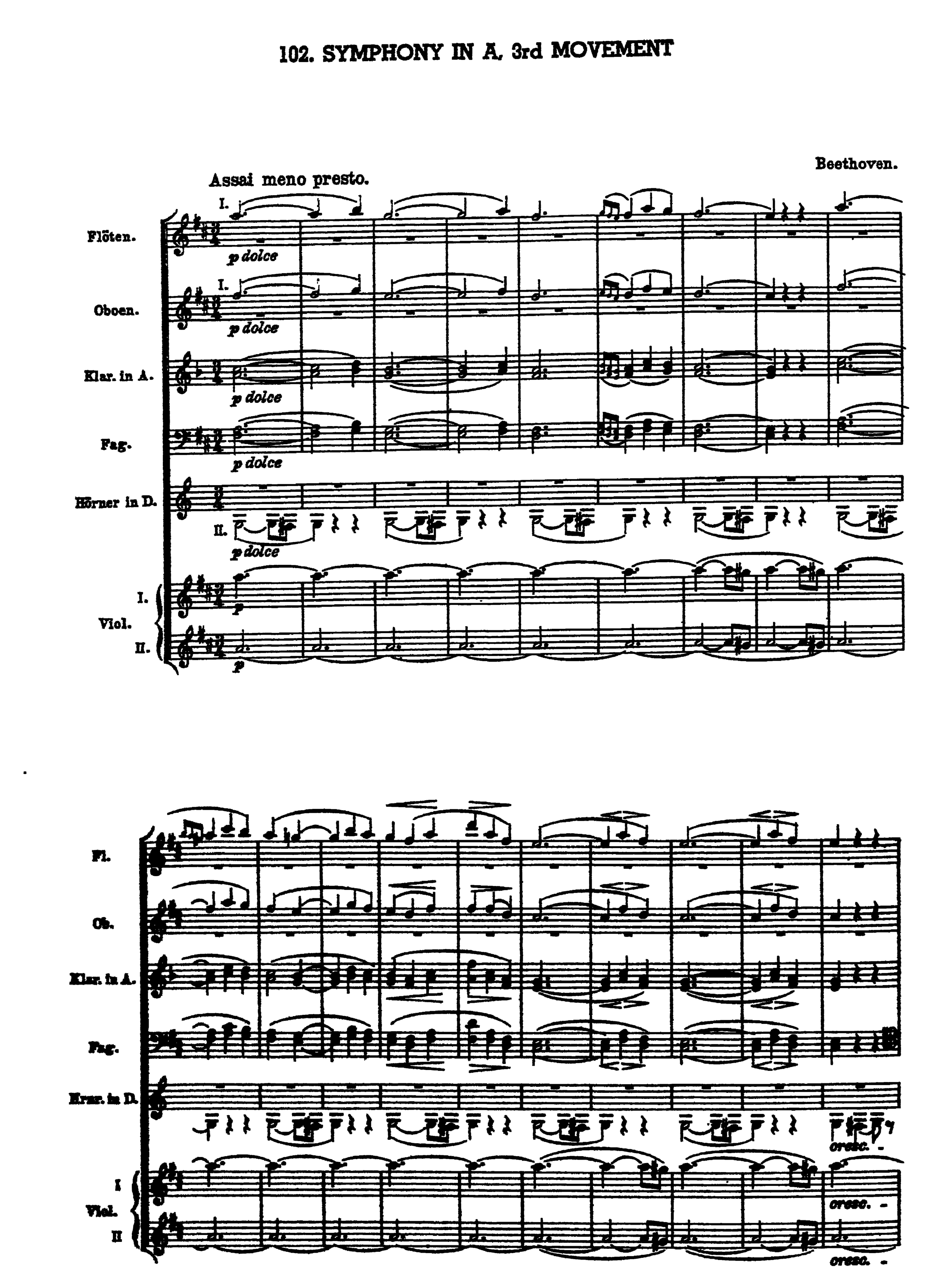
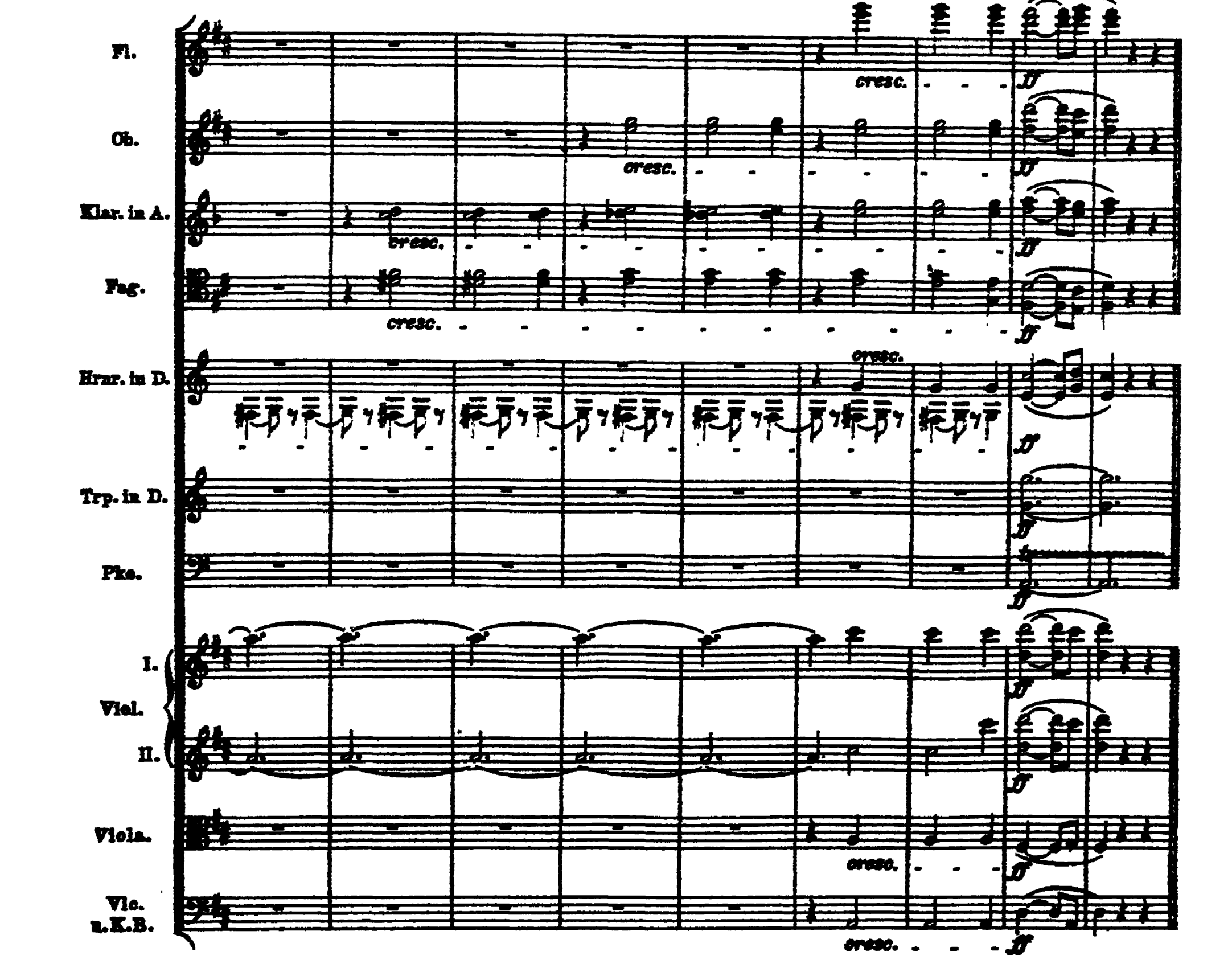
This method is doubtless better than the opposite one, adopted nowadays by the majority of French and Italian composers. They treat the horns very much like bassoons or clarinets, without taking into account the enormous difference between stopped and open tones as well as the differences among the stopped tones. They pay no attention to the difficulties encountered by the player in taking a particular note after another one which does not naturally lead up to it; nor are they concerned with the dubious intonation, the weak tone or the rough and strange character of sound caused by the fact that the bell remains two-thirds or three-quarters closed. In short, they have not the slightest idea that a thorongh knowledge of the instrument together with good taste and commonsense may have something to do with the application of these tones, which these schoolboy-masters fling at random into the orchestra, Even the parsimony of the old composers is preferable to this ignorant and odious prodigality. |
Unless stopped tones sre wanted for some particular effect, one should at least avoid those whose sound is too weak and too unlike the other tones of the horn. These
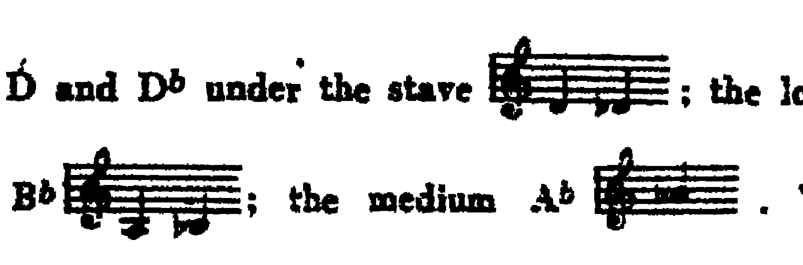
are: D and D® under the stave ———- the low A
should never be used as mere filling notes, but only for the sake of an effect which corresponds with their hollow, rough and wild sound. I would except only the mediom Ab, if it is indispensable for the completion of a melody, such as:
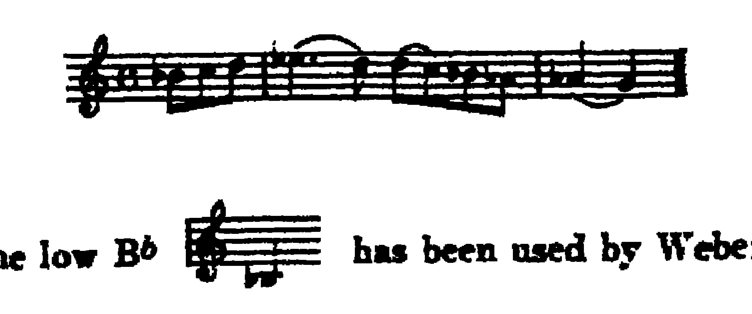
The low Bo = has been used by Weber in one.
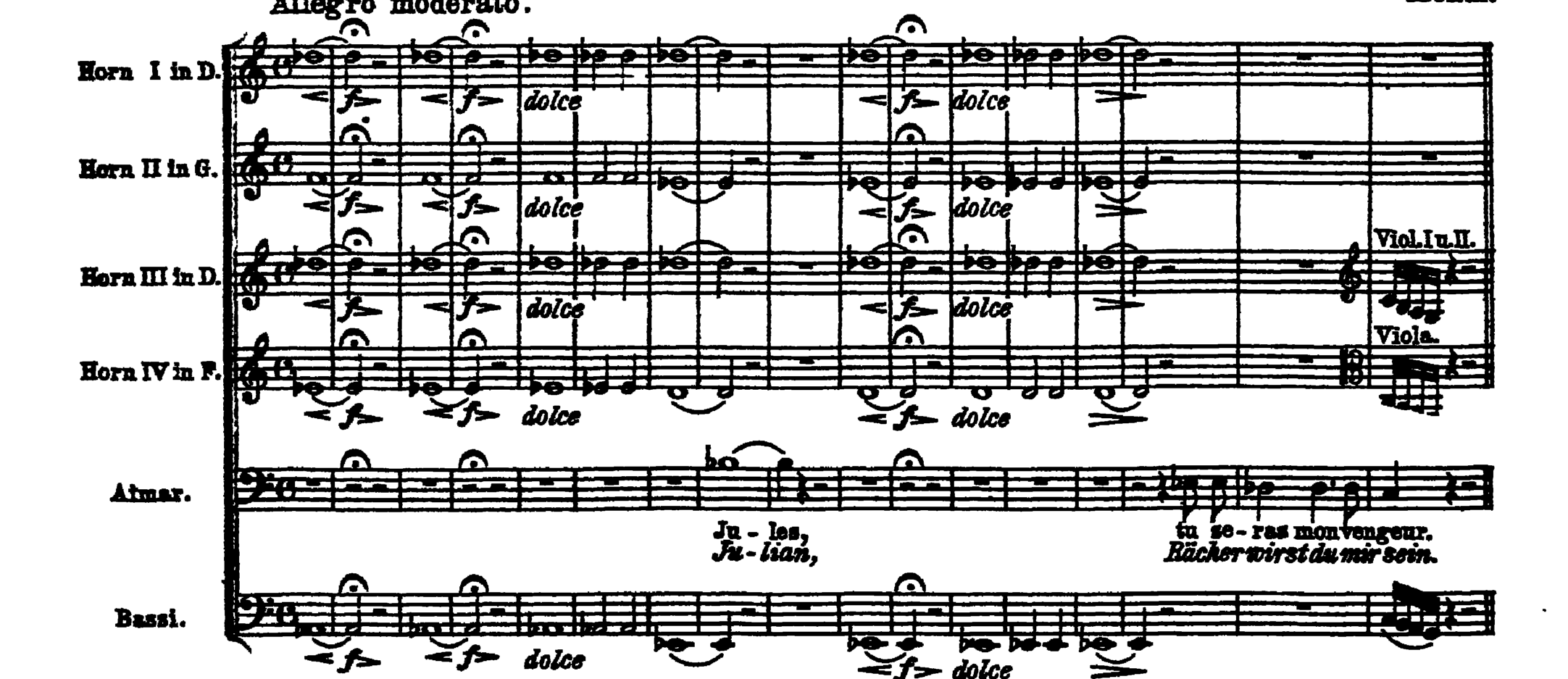
instance with excellent dramatic purpose—in the scene in “Freischuets” where Kaspar conjures Samiel; but this tone is so closed and hence so hollow that it is searcely audible unless the entire orchestra suddenly pauses at the moment of its utterance. For the same reason, the medium A> employed by Meyerbeer in the scene of the nuns in “Robert le Diable” (when Robert approaches the tomb to break the enchanted twig) is noticeable only because almost sl] the other instroments are silent; and yet this note is mach more sonorous than the low B®. In scenes of secret horror these stopped tones. employed in several voices, may produce ‘great effects. Méhul. I believe, is the only composer who made use of them, in his opera “Phrosine et Mélidore”. (Example 103°.
103. phrosine et melidore
Major and minor trills are practicable on the horn, but only over a small portion of its scale. The following are the best:
Horns are usually written without signature—regardleas of their key or that of the orchestra. However, when the melody is in the horn and the instrament is not in the same key as the orchestra, it is better to indicate the signatare required by the key of the piece; but one should always endeevor to use as few accidentals as possible. Thus, the horn in F, for instance, is very suitable

for a solo when the orchestra plays in E®: first, because it is one of the best keys on the instrument, and secondly, because this combination requires only two flats for the horn (ie. BO and E®), of which one, the B®, is an open tone in the medium and high range of the scale and does not impair the sonority of the part of the scale which would chiefly be used; for instance:
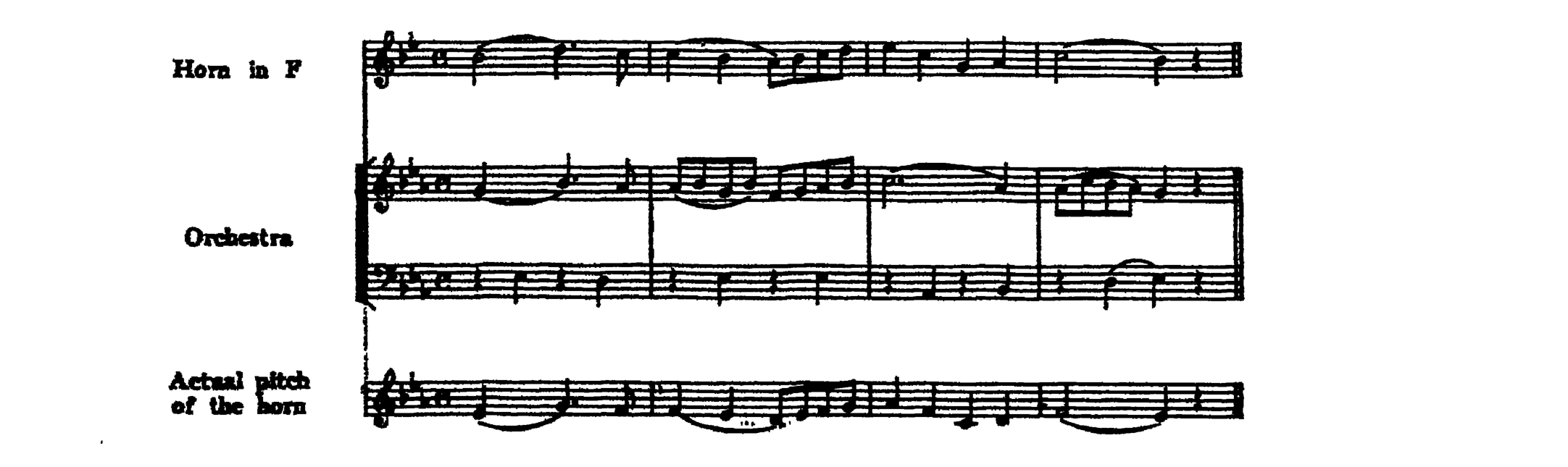
To be sure, 2 horn in E? would have been jast as suitable for this passage:

Horn in Eb
but if the melody should cuntsin frequently the fourth and sixth steps of this seale {A and C}, then the horn in F would be preferable, since its two notes E* and G
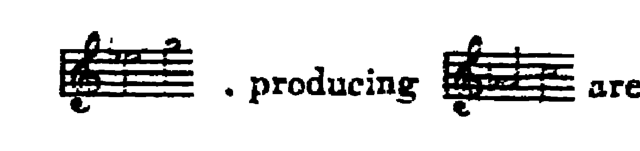
==. producing i are much better than the
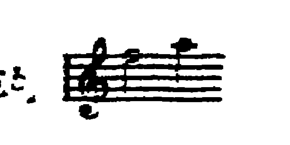
corresponding notes of the Lorn in E*, =
Orchestras formerly included oniy two horns: at present there are always four. With two horns—even if the stopped tones are fully utilized—the use of the instrament would be greatly limited in the case of modulstiun inte distant keys. With four horns. however, it is easy
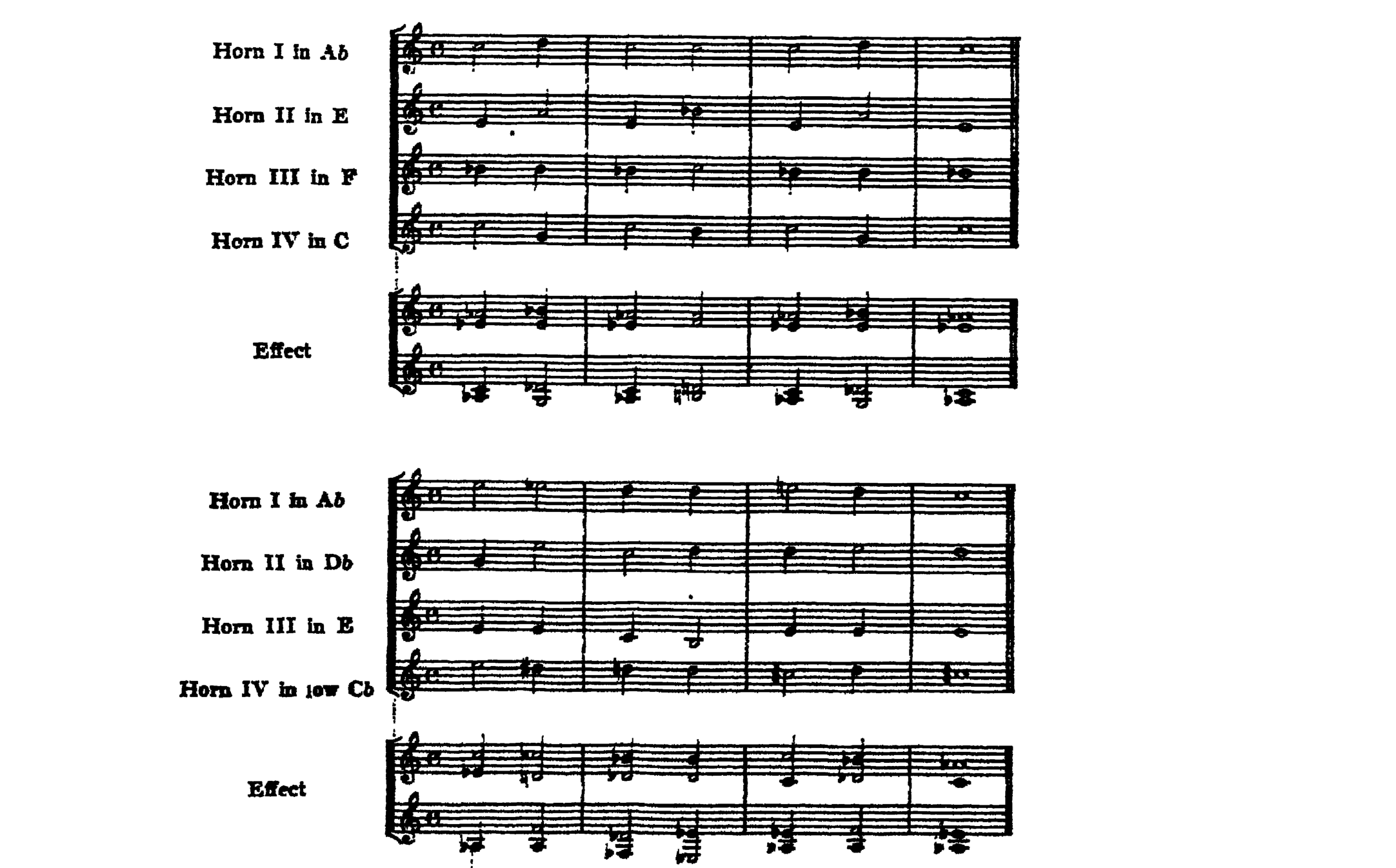
to manage this by using horns in various keys. The use of four horns in the same key would almost inevitably betray a flagrant lack of skill, It is incomparably better to use two horns in one key and two horns in another; or the first and second horns in one key, the third horn in another. and the fourth horn in a third key—which would be still more useful: or. finally, four horns in four different keys—which would be particularily advantageous if many open tones are required.
For example, if the orchestra plays in A, the frst horn may de in A’. the second in E (on account of its E, which produces G= or, enharmonically, 45), the third in F, the fourth in C. Or else. the first horn could be in AY. the second in D”, the third in E, and the fourth in low B “on account of its E. producing D* or, enharmonieally, E5:. The four keys can be combined in many different ways according to the contents of the work. It is the composer's task to caiculate the combination most suitable to his harmonies, and to select his horas accordingly. In this fashion one can arrange to have only very few chords not contsining four, three, or at least two open tones—as the following examples show:
If several different keys are used, it is better to assign the higher keys to the first horns and the lower keys to the secund horns. Another precaution, frequeatly disregarded by many composers. is the avoidance of chang ing from a very high to a very low key (or vice versa} during a piece. For example, the sudden transition from
high A to low B/ is very difficult for the player. With four horns now available in all orchestras, such awkward skips are easily avoidable.
Up to this point, Berlioz’ text is obsolete and is only of historical value. (See the appendix at the end of
The horn is a nuble and melancaviy instrument: but the expression and the character of its tone is such that the instrument is net limited to any particular type of composition. It blends weil with the general harmony. Ever a composer of timited skill can employ it as he secs tit—vither prominentiy or in a more unobtrusive though ascfu! role. In my opinion, no composer has used the horn in a more original, poetic and accomplished fashion than Weber. In his three masterworks. “Oberon”, “Euryanthe” and ‘“Freishuetz”. he his endowed the horn with 2 mew acd woaderfa! language—a ianguag? which. before him. only Méhul and Beethoven understood, and whdse parity has been preserved by Meyer
beer better than by anybody else. Of all the orchestral instruments, the horn is the one for which Gluck wrote least felicitously. A simple scrutiny of one of his works will suffice to prove his want of skill in this respect. However, we must cite as a stroke of genius the three horn tones imitating Claron’s conch in the aria “Caron ‘‘appeile” in his opera “Alceste”. The medium C is repested three times by two horns in D in unison. The composer requires the bells of the two horns to be placed one against the other, so that they serve mutually as “sordines”. The tones bounding against each other sound as if emanating from o distant cave. This produces a yery strange and dramatic effect:.

I believe. however, that Gluck would have obtained approximately the same result with the stopped medium A® of two horns in G*:
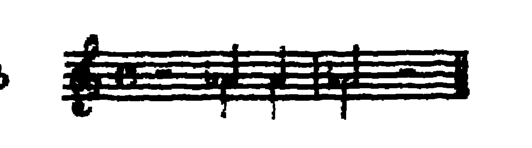
But it is possible that the horn players of that period were not sufficiently sure of such attacks; in that event the composer did well in using this strange device to damp the most open tone of the horn in D and to make it sound distant.
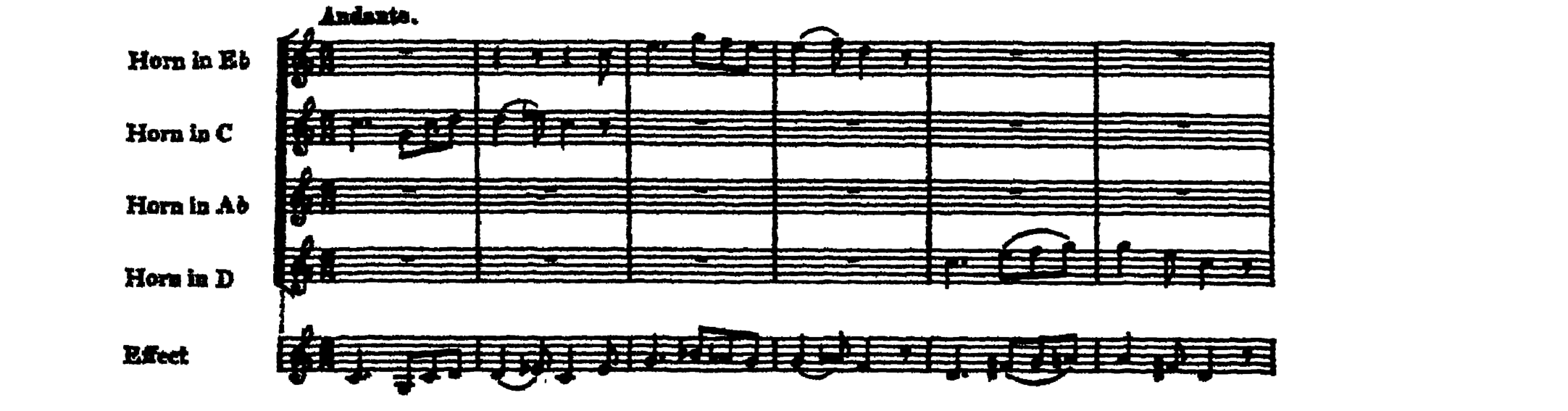
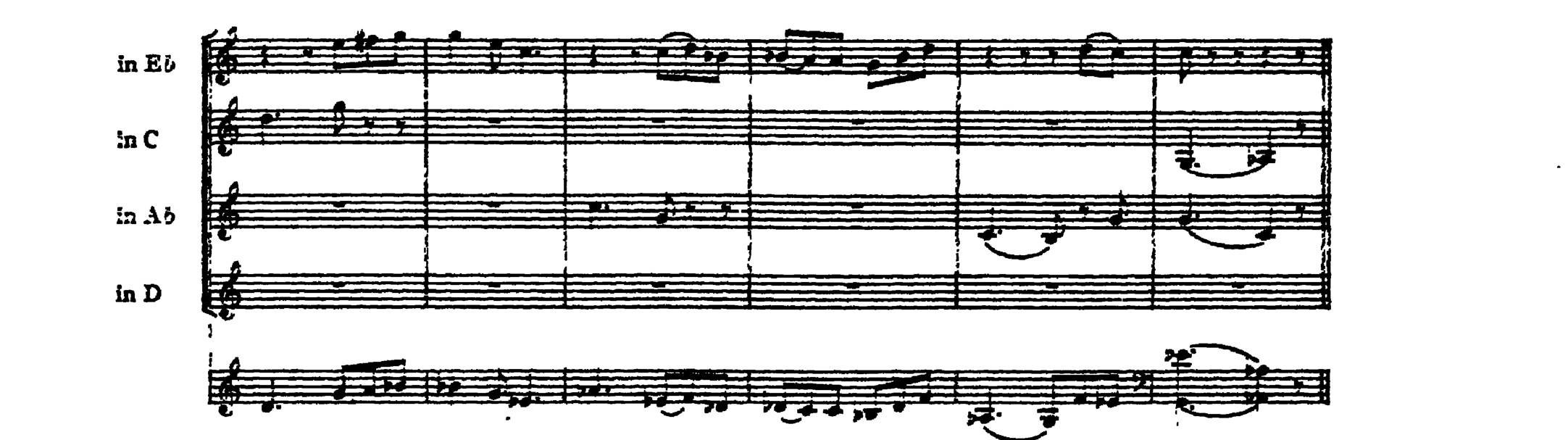
In the hunting scene of his “Guillaume Tell” Rossini conceived the idea of having four horns in E> execute a diatonic passage in unison. This is very original. When four horns are thus to be combined in a sustained melody or in rapid passages containing open as well as stopped tones, it is far better to use horns in four different keys (unless the idea is based just on the variety and uneveness of these tones). The open tones of one horn compensate for the weak stopped tones of the others, preserving
A very advantagecus method—of which, however, I know only one example—is to have four horns in different keys alternate in the execution of a solo melody. Eech of them tskes the notes corresponding with its
the balance and giving evenness to the whole scale of the four combined horns. If the horn in C plays a stopped E}, the horn in E> an open C, the horn in F an open Bb, and the horn in low B® a stopped F, these four different timbres result in a quadruple E> of great sonority. The same spplies to the other tones.
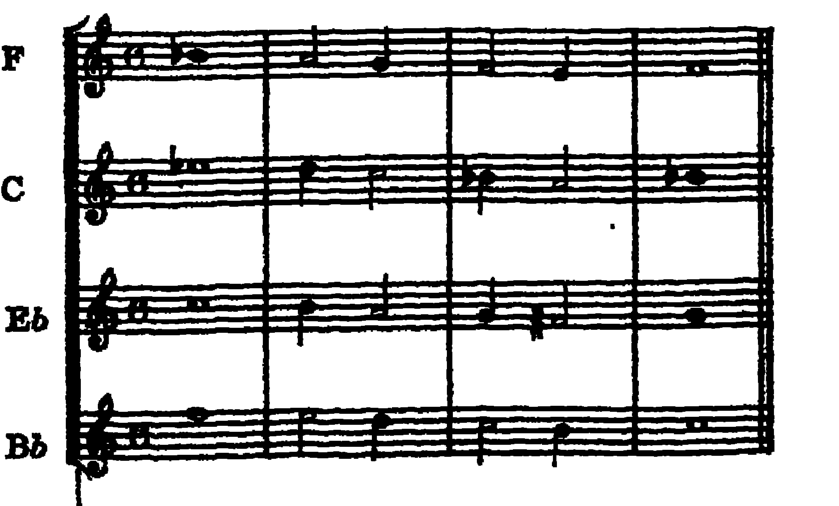

open tones. If the melodic fragments are skillfully linked together, the melody seems to be played by 2 single horn, almost all of whose tones are open and of the same quality.
As I have said above, the horn is 2 nohie and melancholy instrument—notwithstanding the frequentiy quoted hunting fanfares. In fact. the gaiety of these flourishes arises rather from the melodies themselves than from the timbre of the horn, Hunting fanfares lose much of their gaiety if they are not played on real hunting horns —instruments of little musical valuc.whose strident and obtrusive tone differs greatly from the chaste and reserved voice of the French horn. However. by forcing the flow of air in the tube of the horn in a partieuiar manner, its tone can be made to resemble thst of the hunting horn. This is called making the tone brassy.
This may occasionally produce excellent effects even
with stopped tones. When open tones are to be forced, composers generally require the performers to tern the bells upward so as to give the sound the greatest possible sharpness. This position of the instrament is indicated by : Beil turned upward, A maguiticent example of this method is found in the vivlent outburst at the end of the duet “Gardez-vous de la jalousie” in Méhul's “Euphrosine et Coradin”, Grétry. stil] under the impression produced by this terrible outery of horns, one day answered sumeone why asked him for his opinion of this crushing piece: “It is as if one wanted to split the roof of the theater with the skulls of the andience.”