 Playable Books
Hector Berlioz · section 30 of 67
The Cornet
Read and hear this section in the playable edition →
(Cornet with three pistons or with cylinders)
Its range is approximately two octaves and two or three tones, The valve mechanism with which it is furnished enables it to play all chromatic steps down to the low
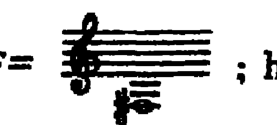
F= +}; however, this tone and the two or three preceding ones {A, A, and G) are practicable only on high cornets. On these high cornets it is even possible
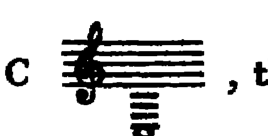
to produce the low C —, the first natural tone
of the cornet (as will be presently seen); but its production is very risky; moreover, its sound is poor and of very questionable usefulness.
There are cornets in C, Bb, A, Ab, G, F, E, E> and D. By means of the lengthening pieces mentioned above in the chapters on the horn and the trumpet, the pitch of the instrument is lowered a semitone, and the keys of B,
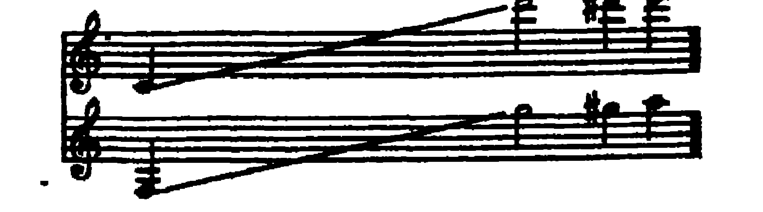
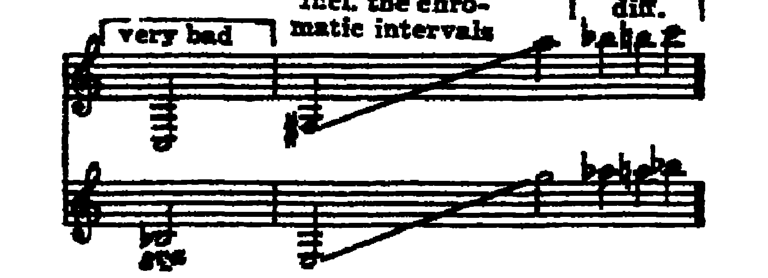
Range of the Cornet in different keys:
F# and even D® can thus be obtained. But the facility of modulating as a result of the valves makes these changes of key almost useless. Besides, the low keys— such as G, F, E and D—are generally of poor tone quality and lack purity of intonation. The cornets in A}, A and Bd are the best; I think they should be used almost exclusively. The highest cornet—the one in C— is rather difficult to play.
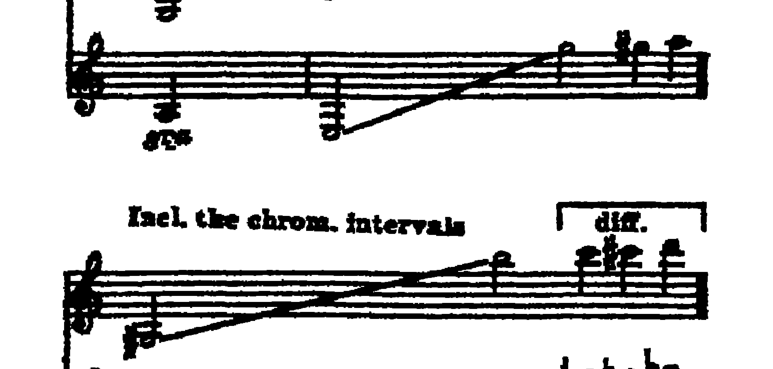
The following table shows the range which may be assigned to the various cornets. Some performers can produce a few additional tones above and below this range; but these are very risky, and we are disregarding them. The cornet is written in the G-clef. The following are the natural tones of its tube, which is shorter than that of the trumpet:

Incl. the chrom. intervals ar a

Cornet in BD

Cornet in A
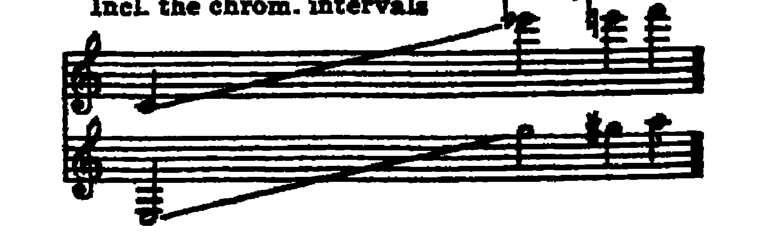
Cornet in E
Actual pitch
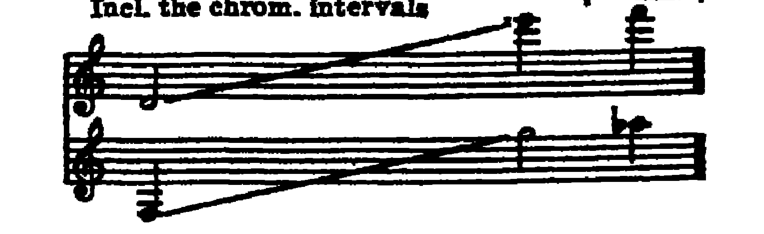

The highest notes of these examples, all of which
sound the same G — » are iess risky and of better
quality in the higher keys. Thus, the high B® of the cor-
netin A; the high A of the cornet in B® <=
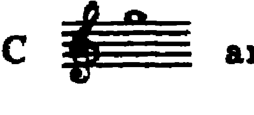
and the high G of the cornet in C _ are incom-
parably better and easier than the high F of the cornet
in D — or the high E of the cornet in oe
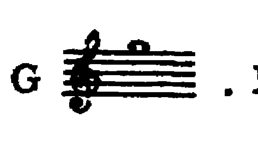
“4th oct. practicante vesee, Only in the lower keys
Cornet eind ost ata SS> me sot = a“
One sees—and it is important to remember this—that the part of the range of a brass instrament on which only the following three natural tones can be produced iwithont valves’

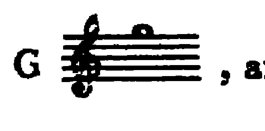
All these notes sound the same G —. Moreover,
this observation applies to all brass instruments.
Most major and minor trills are practicable and of good effect on high cornets—for instance those in A, Bb and D—but only on the following part of the scale:
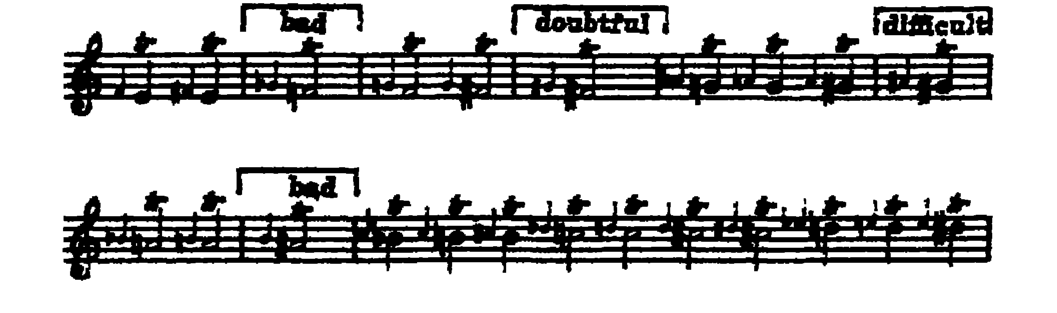

The following list shows the relation hetween the horns, trampets and cornets in their various keys, The first low tone of the cornet in C is, as stated above. the higher octave of that of the trumpet in C; just as the first low tone of the trumpet in C is in turn the higher octave of that of the horn in C. The natural tones of the horns (those which result from the resonance of the tube) are thus reproduced by the trumpet in the same
order, but in the higher octave. Those of the trumpet -
would be reproduced in the same fashion by the cornet if the lips of the plaver were strong enough to produce the highest tones, which, however, is not the case.


is always its second octave, i.e. proceeding from low to high,
The cornets have their best tones mainly in the second octave. Considering the cornets in A, BO and C as high trumpets (an octave higher than the trumpets in A, Bd and C). one could have written them accordingly. This has been purposely avoided, and cornets are written according to their place on the general musical scale, their lowest tone an octave above that of the trumpet. The best tones of the cornets are in or near their second octave:

Cornet in C
If the cornets were written like the trumpets. these notes would always be below the stave and would necessitate the constant use of ledger lines:

Cornet in C written like a trompet in high C
This inconvenient method of notation has nevertheless been preserved in Prassian military music; one should be aware of this.
In the following table the key of C has been taken as the point of departure for the various kinds of horns, trumpets and cornets. As for the cornets, the lower their key, the longer becomes their scale; this is why the listing of cornets starts with the highest keys, On the other hand, the scale of trumpets and horns becomes shorter as they rise in key (with the exception of the three keys below C—low B, B? and A).
omltted it from the scale of the korn in iow C and Bd.
Comparison of the different keys
Of the of the of the cornet trumpet horn
LC itypica: key)
SAP j A Ad (rare!
7.Gd j Gb
C (typical key" 4 4 high C B 1 high B Bb | high Bb A ivery rare) ¥ high A
C (typical key)
A (very ~are)
This will clarify the relations between horns, trumpets and cornets and their respective positions in the scale of tones,
I should like to add that the best tones of the valve trumpets (with pistons or cylinders) are near their third octave, which is identical with the second octave of the cornets. Therefore, passages for the cornets in A. B and C, written within the following range:

can also be executed on trumpets in A, B and C, without any change. This makes it possible to replace them with trumpets without any disadvantage—in orchestras lacking cornets (as the German ones).
The cornets in A, Bb and C have a smaller range than the trumpets in A, Bb and C; they can scarcely go above
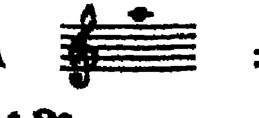
Cornet in Bb = Cornet in C =
On the other hand, the trumpets not only have several additional tones at the low end of their range—even though they may be poor—but they also produce more
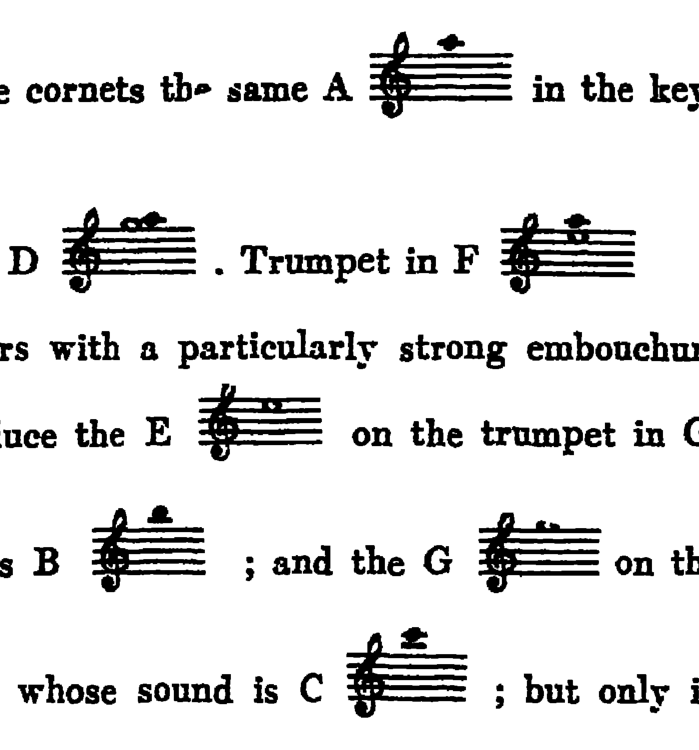
easily than the cornets th- same A — in the keys
of D and F:
Some players with a particularly strong embouchure
can even produce the E = on the trumpet in G,
whose sound is B — 3 and the G — on the
trumpet in F. whose sound is C =; but only in
passing, and only if they are skillfully prepared. In any case, performers capable of reaching these extreme notes are rare; in composing it is better not to write them.
Trumpets, having a narrow tube, a small mouthpiece and a not very wide bell, play high tones with greater facility. The cornets, on the contrary, have a rather wide and almost conical tube, their bell and mouthpiece are somewhat larger, which makes their low notes easier than the high ones and gives their tone the peculiar quality distinguishing it from that of the trumpets.
Before proceeding to examine the timbre of the cornet, it may be useful to repeat here what has been said in connection with the valve horn about the function of the three cylinder or piston valves attached to brass instruments in general.
These three valves give to these instruments the chromatic scale (from the second octave upward), filling al the gaps between their natural tones; furthermore, they add six chromatic notes below the two lowest sounds:
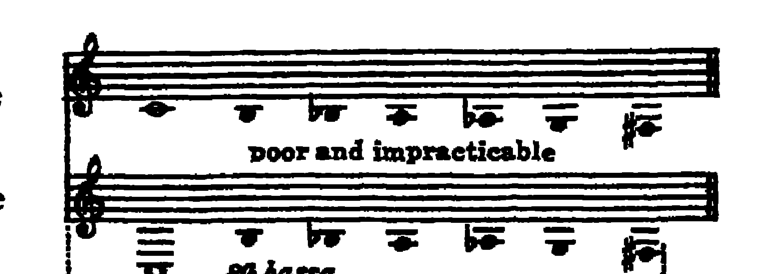
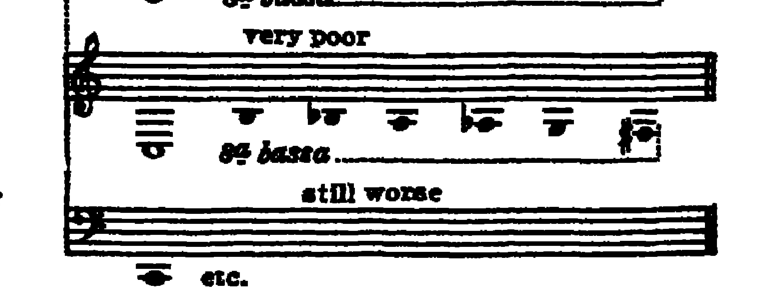
But this first low C is already so indistinct and so diffcult to sustain that the lower notes added by the valves become, as may be imagined, completely impracticable. The situation is similar with the horns.
Although the cornet can execute all steps of the chromatic scale, the choice of key is not unimportant. It is always better to select that key which permits the use of the greatest number of natural tones (it is hardly necessary to repeat that'natural tones are those produced without valves by the resonance of the tube alone), such

(according to French notation)
—and which requires but few flats cr sharps in the signatare. For instance, if the orchestra piays ir E. the ccrnet in A should be used. which would then play in G {the cornet in E being one of the least satisfactory ones |:
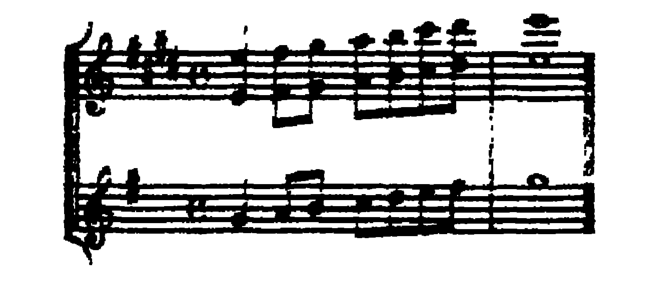
Cornet in A
With an orchestra playing in D, it would also be br:- ter to use the same cornet, this time piaying in F:
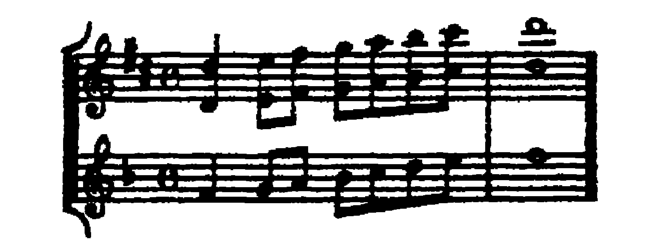
Cornet in A
If the orchestra plays in E®, the cornet in B® is used
which plays in F—with one Sat in its signatore: and Similiriy in other cases.
iorefer the reader again to the explanation. regarding the various keys of horns and trumpets, The immuena progress in orchestral technique {though unfortunitelr not in the art of phrasing! since Berlioz’ time should always be kent in mind.
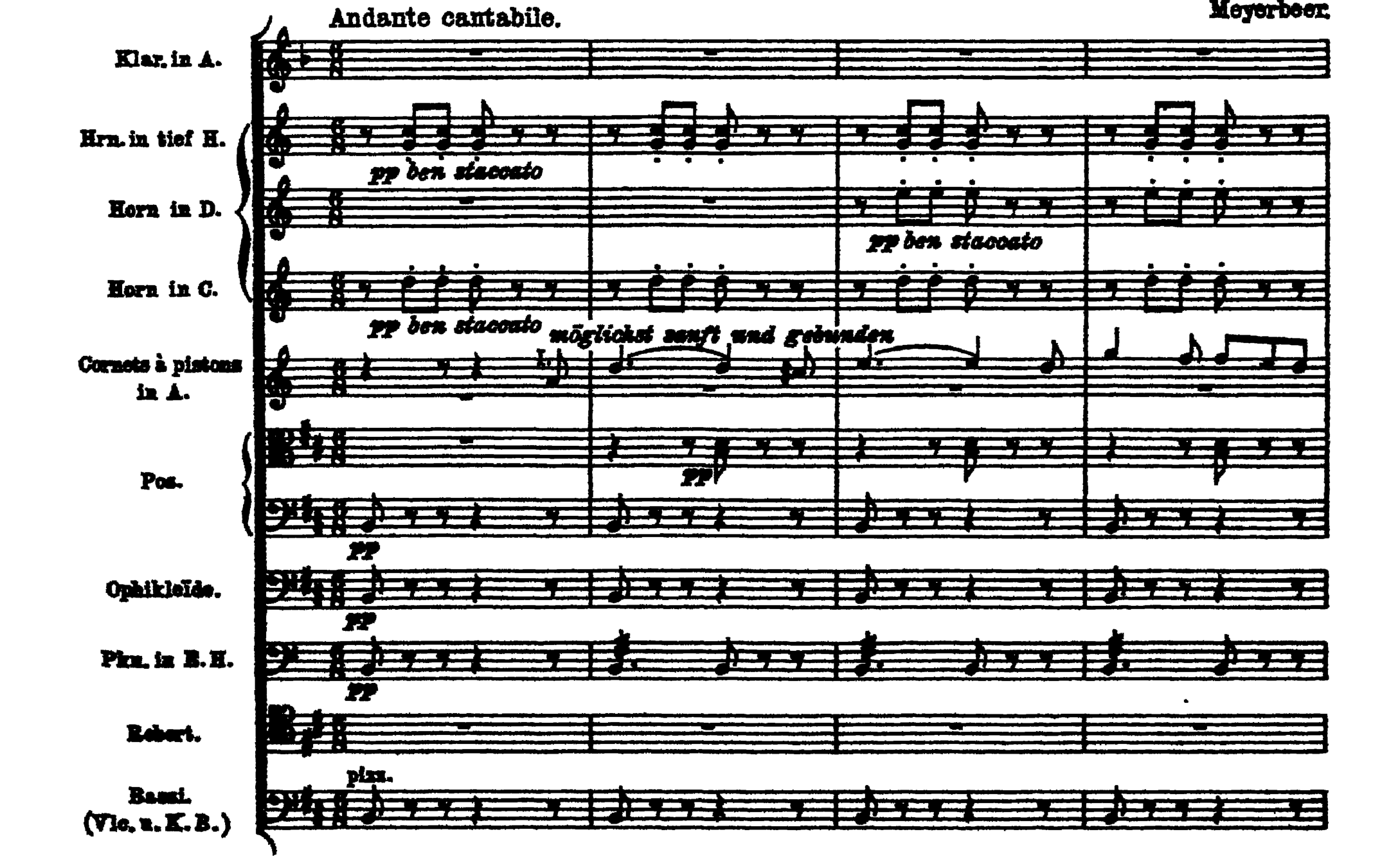
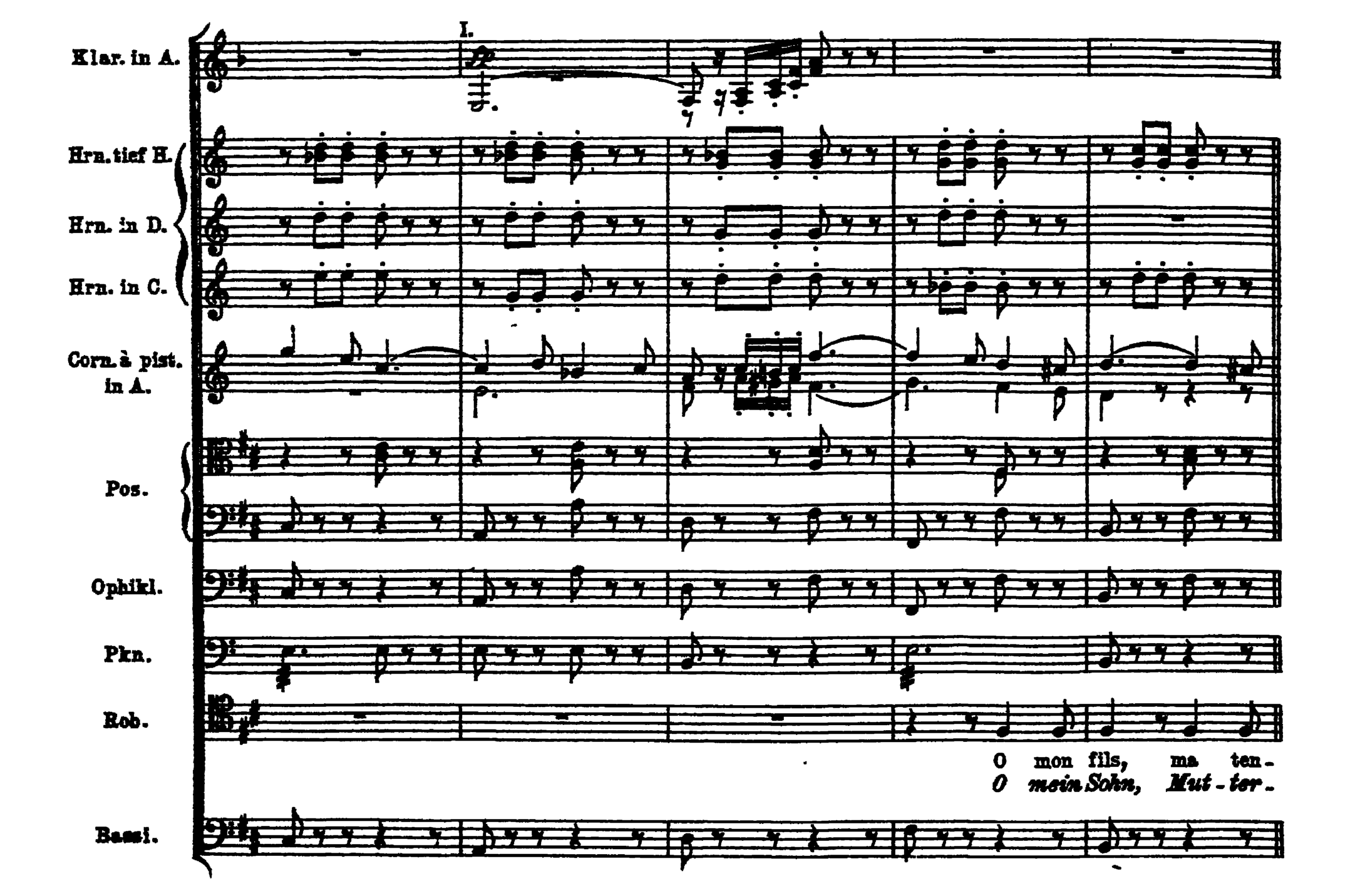
In France the cornet is very much in fashion at present, especiaiiy in certain musical circles where elevation and purity of style sre not considered esoentil qualities. It has become the indispensabie solo instrament in quadriiies, galops. variations and other seccnd-rate compositions, The prevailing custom in dance orchestras of assigning melodies more or less devoid of criginaiity and distinction to the cornet, as well as the essential character of its tone—which has neither the nebiiity of the horn nor the dignity of the trampet— make the introduction of the cornet into the higher melcdie style very difficult. Nevertheless, it might be used here with advantage: but only in rare instances, and provided that it is given only slow and dignified passages. Thus. the cornet is very suitable for the ritornelle of the trio in “Robert le Disble’—“‘O mon fils" (Example
117. robert le diable, act V
at OME ES ON ee ee ee eee eee ee ee
Sad Se ew oe oe a a a a a ns oo oo Loe ao ao Scan aaa oar Lact aase =ey semen
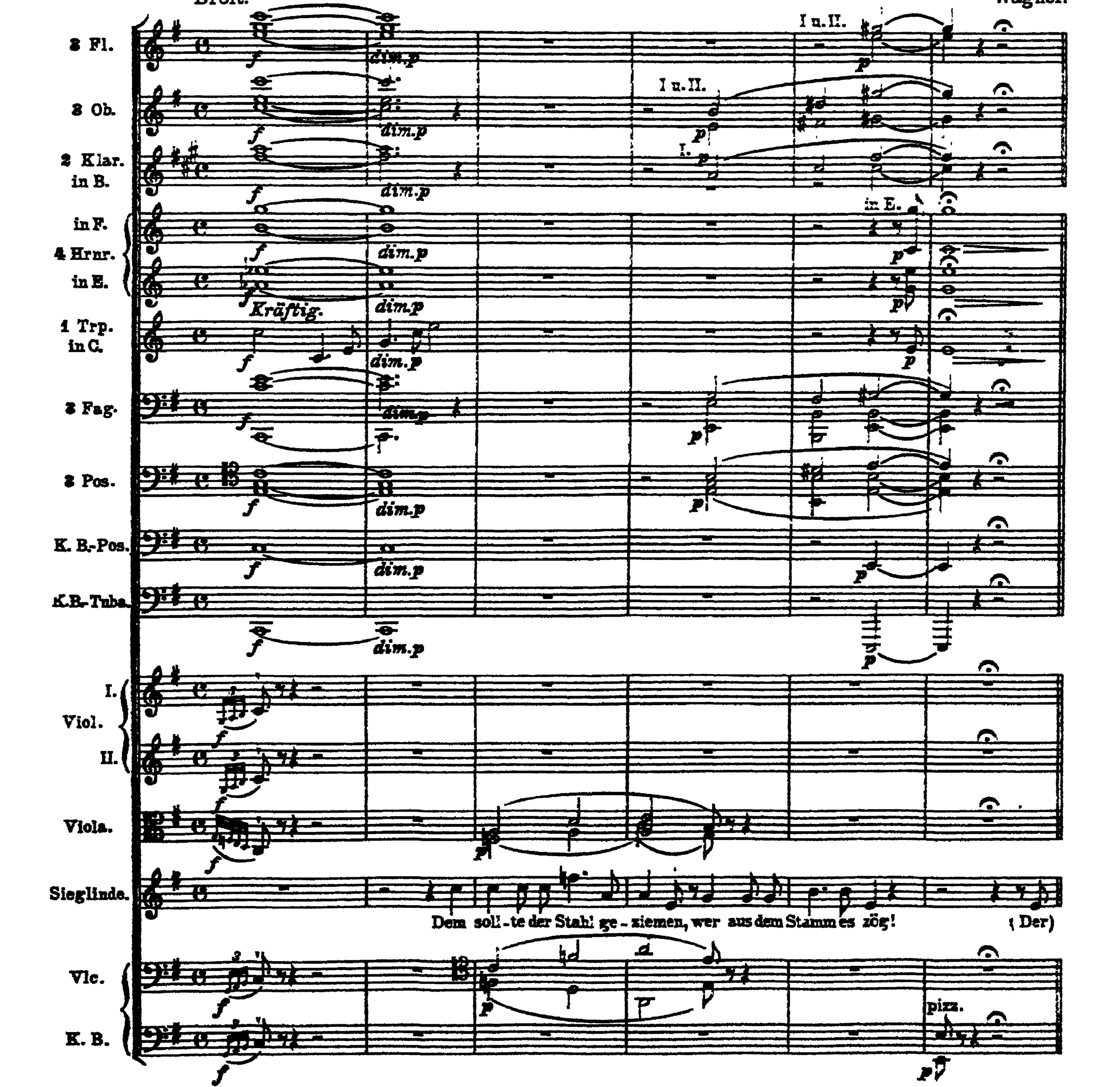
I must admit that I have a violent aversion against the manner of using the trumpet as melody-carrying instrument (that is, the trumpet alone with just a simple accompaniment). The kind of polyphonic style which Bach developed to its highest point and which was to find a wonderful rebirth in Beethoven's last quartets and later in “Tristan” and “Meister-
singer”—this style was completely alien to Berli Hence, the finer combinations of the trumpet tc with wood-winds and horns were really created ot by Richard Wagner’s tonal imagination.
Example 118 (“Walkuere”, first act) gives a wi derful illustration of this kind of tone combination.
118. walkuere, act I
Gay melodies played on this instrument will always run the risk of losing some of their nobility, if they possess any. If they lack it, their triviality is greatly increased. A commonplace phrase which might sppear tolerable when played by the violins or wood-winds would become trite and vulgar if rendered by the blaring, obtrusive and coarse tone of the cornet. This danger
is obviated if the pessage is played by one or several trombones at the same time; their powerful voice would
cover and ennoble that of the cornet. Employed in harmonies, the cornet blends very well with the mass of brass instraments. It serves to complete the chords of the trumpets, and it ean contribute to the orchestra those diatonic or chromatic groups of notes which, because of their rapidity, suit neither the trombone nor the horns. Cornets are generally written in two voices. and frequently in different keys.