 Playable Books
Concept index · Rhythm and the orchestra
The brass
Taught in 3 books. Each one opens at the passage; ▶ plays the example beside it. Also called horn, trumpet, trombone, tuba.
This index is Playable Books’ own: a first pass that finds the term’s words in each book, corrected by hand. The authors did not tag these passages, and their terms can differ (Fux’s “ligature” is a suspension). The quoted text is the book’s.
 Principles of OrchestrationNikolai Rimsky-Korsakov, 1922
Start: Brass →- Melody in the brass · 2 playable examples
- Brass in unison, in octaves, thirds and sixths
- A. Combination of wind and brass in unison
- B. Combination of wind and brass in octaves · 2 playable examples
- D. Combination of strings and brass
- Harmony in the brass
- Duplication in the brass · 4 playable examples
- A. Combination of wind and brass
- Brass
…in three's | Group corresponding to the wood-wind in four's | | (II—Small trumpet). 2 Trumpets I, II. | 3 Trumpets I, II, III. | 3 Trumpets I, II, III. | (III—Alto trumpet | (III—Alto trumpet or | or: | Bass trumpet.) | { 2 Cornets I, II. | | { 2 Trumpets I,…
- Brass
Though far less flexible than the wood-wind, brass instruments heighten the effect of other orchestral groups by their powerful resonance. Trumpets, trombones, and tubas are about equal in strength; cornets have not quite the same force; horns, in forte…
- Comparison of resonance in orchestral groups and combination of different tone qualities
In the most resonant group, the brass, the strongest instruments are the trumpets, trombones and tuba. In loud passages the horns are only one-half as strong, 1 Trumpet = 1 Trombone = 1 Tuba = 2 Horns. Wood-wind instruments, in forte passages, are twice as…
- Brass in unison, in octaves, thirds and sixths
Trumpet 2 Horns | Trumpet Trombone | Trombone Tuba | 2 Trombones Trombone + Tuba | 2 Trumpets 2 Trombones | 2 Horns Tuba
- A. Combination of wind and brass in unison
The combination of a wood-wind and brass instrument produces a complex resonance in which the tone of the brass predominates. This resonance is naturally more powerful than that of each instrument taken separately, but slightly sweeter than the brass…
- Different ways of orchestrating the same music
If the phrase is too low in register for the trumpets it should be given to the horns (instruments allied to the trumpet); if the phrase is too high it may be entrusted to the oboes and clarinets in unison, this combination possessing the closest resemblance…
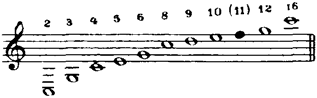 ▶ Fig. 26
 ▶ Fig. 27
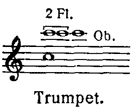 ▶ Fig. 28
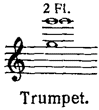 ▶ Fig. 29
 ▶ Fig. 102
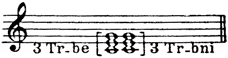 ▶ Fig. 103
 OrchestrationCecil Forsyth, 1914
Start: No. 20. The Valve Horn' in F → Start: No. 17. The Valve-Trumpet → Start: No. 19. The Cornet → Start: No. 21. The Tenor (or B) Trombone.' → Start: No. 25. "The Tubas." → Start: No. 26. The Saxhorns and Flügelhorns →- Brass instruments
- No. 18. The Bass-Trumpet
- No. 22. The Alto (or Eb) Trombone
- No. 23. The Bass (or G) Trombone
- No. 24. The Double-Bass-Trombone · 1 playable example
- No. 29. Obsolete Brass-Wind
- No. 35. The English-Horn
- No. 42. The Bassett-Horn and The Alto-Clarinet
- Brass instruments
BEFORE we begin to study the technical development of the modern Brass Instruments, we must devote a few pages to the early instrumental types from which they sprang. It need scarcely be said that neither the Horn nor the Trumpet began its existence in the…
- Brass instruments
…labouring, under a terrible handicap in the matter of their orchestral Brass. This is, however, quite wrong. We are regarding the matter far to much from our own musically developed point of view. In the first place, up to Beethoven's day music seldom strayed…
- Brass instruments
…The student will have observed that, of the three types of modern orchestral Brass, only two-the Horn and the Trumpet-have been mentioned so far. The third type-the Trombone-gave the cue which led to the second revolution in the Brass department. The Trombone…
- Brass instruments
Trumpets, Valve Horns, Cornets, and, rarely used, the tour upper Saxhorns. (Used in military bands either here or abroad: Valve Trombones, Flügelhorns, Ienor-Cors.) (B) Whole-tube instruments, used regularly in our military bands: the Bo Euphonium, the Eb…
- No. 20. The Valve Horn' in F
…to be the usual arrangement down to Beethoven's middle life, when the Alto-Trombone began to find itself edged out of the orchestra. This was due to the fact that its tone-quality in the middle and lower registers could not compete successfully with that of…
- No. 25. "The Tubas."
…theme used by Wagner in Parsifal furnishes an example of the use of the Tuba and Bass-Trombone in octaves as a bass to the Horns, Trumpets, and Trombones. In this example the Full Score has two separate staves for the Tenor Trombone parts. They are here…
 ▶ Fig. 242
 ▶ Fig. 274
 ▶ Fig. 306
 Treatise on InstrumentationHector Berlioz, 1905
Start: The French Horn → Start: The Trumpet → Start: The Cornet → Start: The Trombones → Start: The Tubas → Start: Saxhorns →- The French Horn
to manage this by using horns in various keys. The use of four horns in the same key would almost inevitably betray a flagrant lack of skill, It is incomparably better to use two horns in one key and two horns in another; or the first and second horns in one…
- The Valve Horn
Except for the above stated difference in softness between the horns in F and high B®, all the other differences in timbre between the various valve horns are merely illusory. This is why many horns in different keys are no longer used. Generally, the pisy-…
- The Trumpet
keys of the horns and about the method of taking advantage of them in combination applies equally to the trumpets. It should be added, however, that there is rarely an opportunity for using them in different keys. Most of our orchestras provide the composer…
- The Cornet
The following list shows the relation hetween the horns, trampets and cornets in their various keys, The first low tone of the cornet in C is, as stated above. the higher octave of that of the trumpet in C; just as the first low tone of the trumpet in C is in…
- The Cornet
The cornets have their best tones mainly in the second octave. Considering the cornets in A, BO and C as high trumpets (an octave higher than the trumpets in A, Bd and C). one could have written them accordingly. This has been purposely avoided, and cornets…
- The Cornet
…key of C has been taken as the point of departure for the various kinds of horns, trumpets and cornets. As for the cornets, the lower their key, the longer becomes their scale; this is why the listing of cornets starts with the highest keys, On the other hand,…
More in Rhythm and the orchestra
Meter and time signature · Syncopation · The strings · The woodwind · Percussion