 Playable Books
Concept index · Rhythm and the orchestra
Syncopation
Taught in 10 books. Each one opens at the passage; ▶ plays the example beside it. Also called syncopated, syncopations.
This index is Playable Books’ own: a first pass that finds the term’s words in each book, corrected by hand. The authors did not tag these passages, and their terms can differ (Fux’s “ligature” is a suspension). The quoted text is the book’s.
 Gradus ad ParnassumJohann Joseph Fux, 1725
- Fourth species counterpoint: syncopation and suspensions · 18 playable examples
- Fourth species counterpoint: syncopation and suspensions
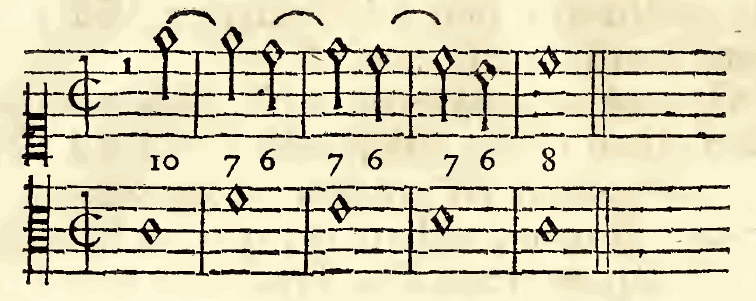
…the second on the thesis. This species is customarily called Ligatura, or Syncopation, and is of two kinds: consonant and dissonant.
▶ Fig. 62 nearby - Fifth species counterpoint: florid counterpoint
…and that, on entering the thesis, you have generally used oblique motion or syncopation. I wish to commend this practice to you further, because it adds very great grace to counterpoint.
▶ Fig. 85 nearby - Double counterpoint
…a unison, which, as already said, is less properly used except through syncopation. The reason for not exceeding the bounds of the octave is that the function of double counterpoint is to produce varied and different harmony through inversion. But if you pass…
▶ Fig. 303 nearby - Double counterpoint at the twelfth
It now comes to mind that at the beginning of this counterpoint it was said that it cannot be made unless the sixth is excluded. Understand this of an untied sixth. For the following example makes clear that a syncopated sixth may be used. For example:
▶ Fig. 356 nearby - Double counterpoint at the twelfth
…the cantus firmus itself, note for note, or in its likeness, changing or syncopating some note form, as appears in the following example:
▶ Fig. 384 nearby
 ▶ Fig. 62
Fourth species counterpoint: syncopation and suspensions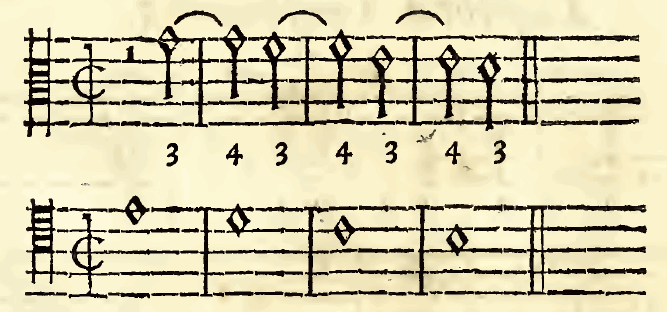 ▶ Fig. 63
Fourth species counterpoint: syncopation and suspensions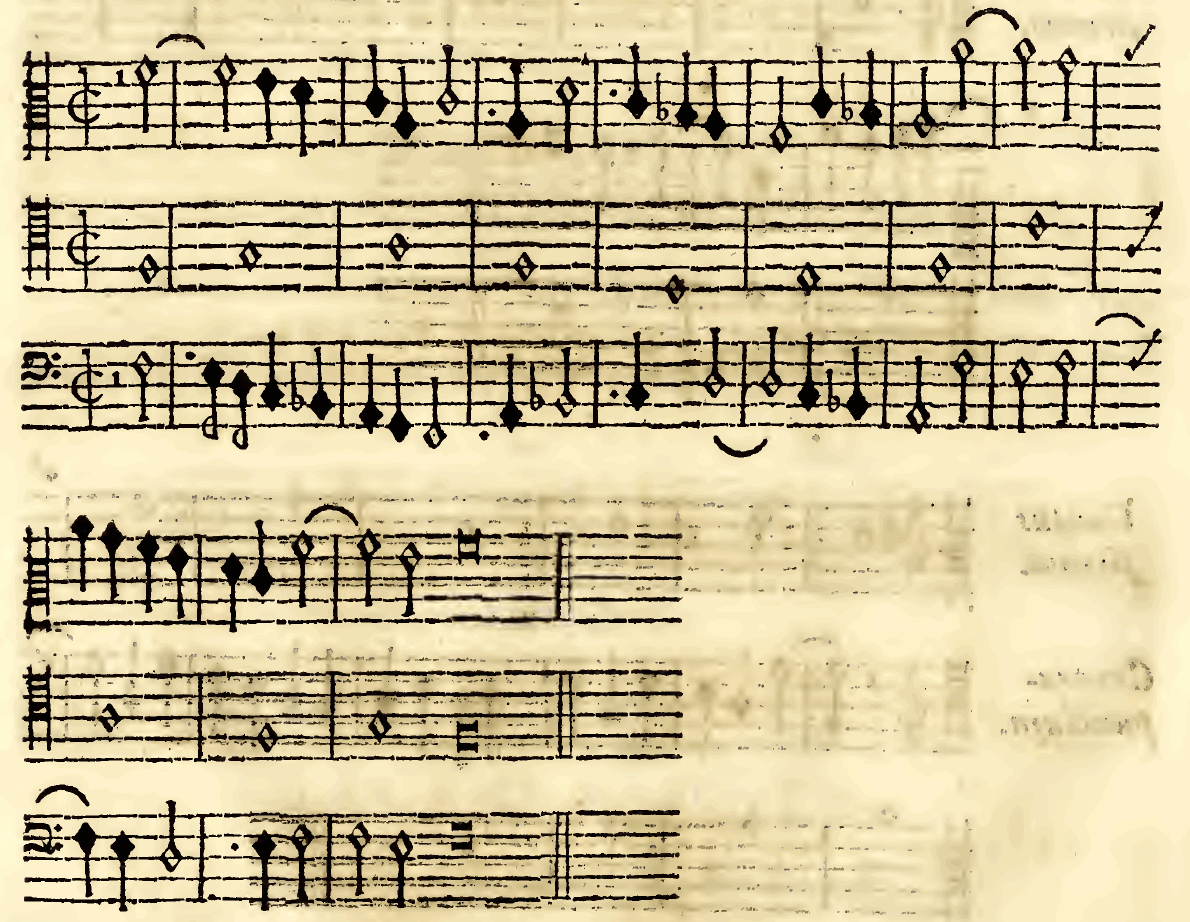 ▶ Fig. 85
Fifth species counterpoint: florid counterpoint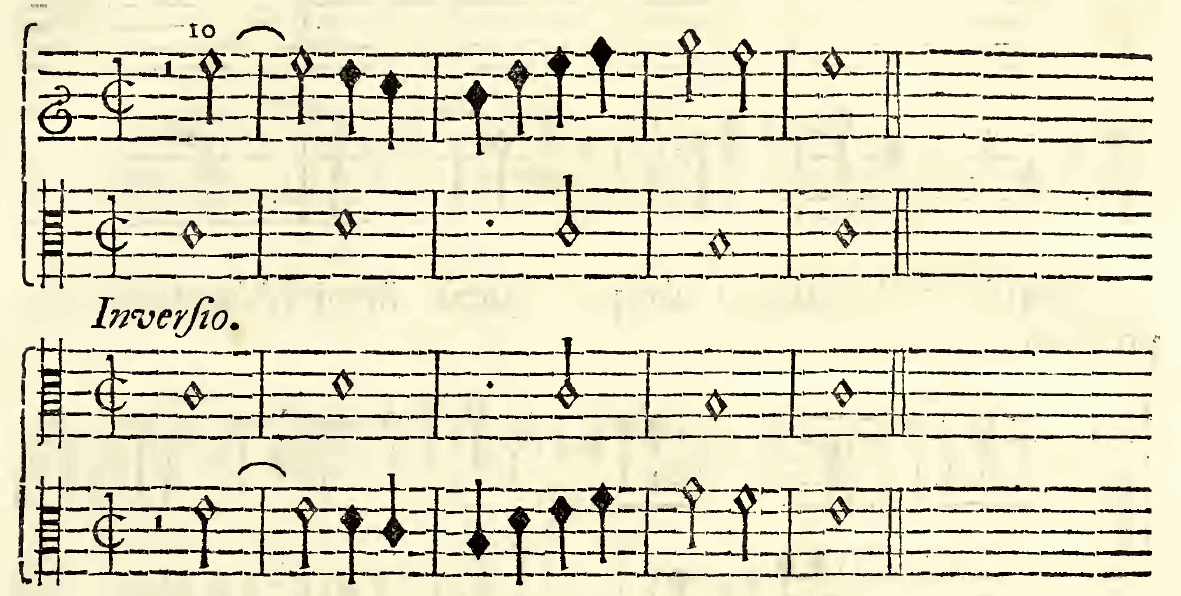 ▶ Fig. 303
Double counterpoint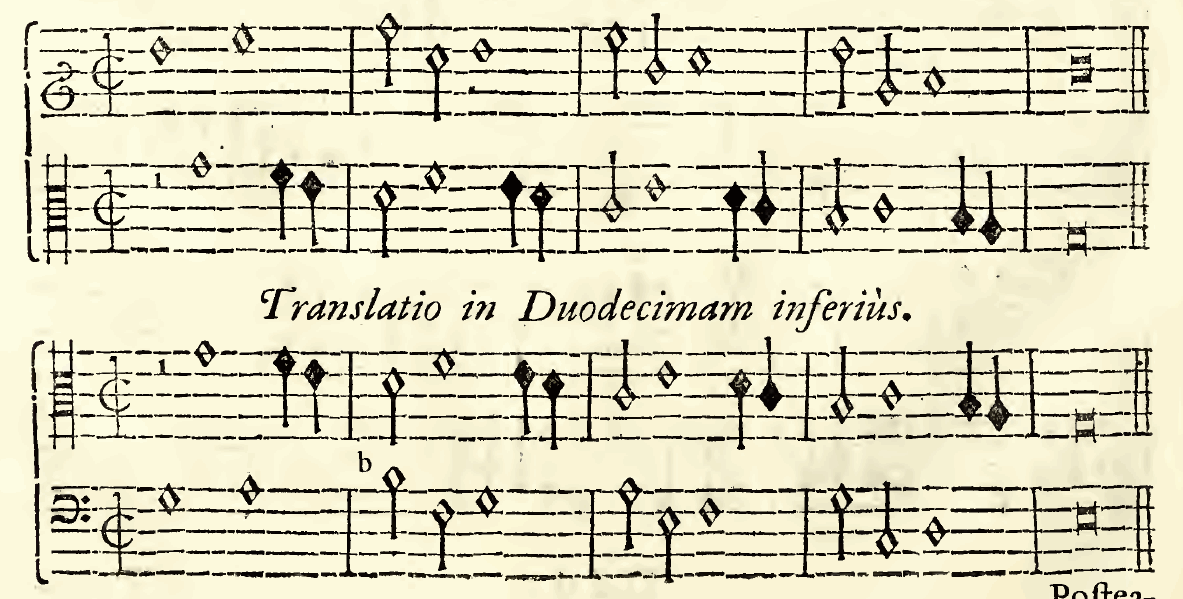 ▶ Fig. 356
Double counterpoint at the twelfth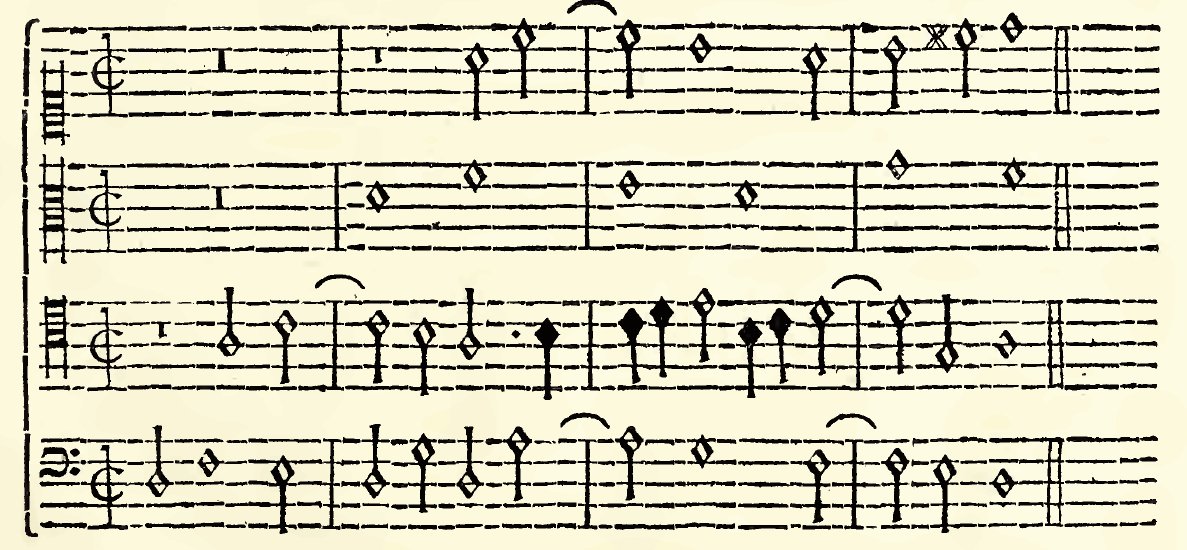 ▶ Fig. 384
Double counterpoint at the twelfth
 Exercises in Elementary CounterpointPercy Goetschius, 1910
- Chapter X. Syncopation, Or Shifted Rhythm · 13 playable examples
- Chapter X. Syncopation, Or Shifted Rhythm
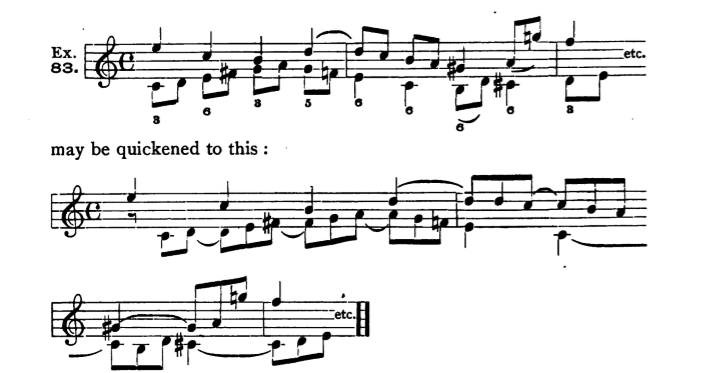
…so that they fall between (instead of upon) the beats. The resuit is syncopation, and is invariably permissible when applied to a counterpoint that is entirely smooth and faultless to begin with. (Comp. par. 108.)
▶ Fig. 163 nearby - Chapter X. Syncopation, Or Shifted Rhythm
In the following examples the parts are alternately syncopated (in two of an almost endless variety of forms):
▶ Fig. 166 nearby - Chapter X. Syncopation, Or Shifted Rhythm
…original construction of the counterpoint that is to be manipulated in these syncopated forms. Only the smoothest and most perfect models can be thus utilized.
▶ Fig. 170 nearby - Chapter XI. The Tie, Continued. Rests
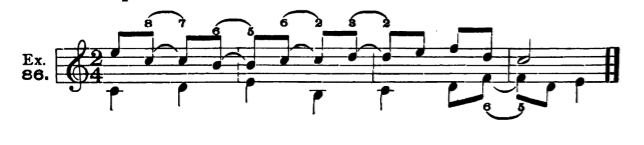
…appear to have been derived. This goes to prove that the simple process of syncopation explained in the preceding lesson (Exs. 78 to 82) is likely to prove quite sufficient for the ordinary applications of the tie, though it covers a narrower range of…
▶ Fig. 180 nearby - Chapter XXIV. Contrapuntal Harmony
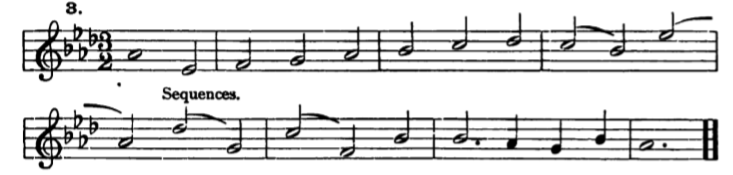
4. Manipulate, at the keyboard, each one of the above simple harmonic versions (including Exs. 162, 164,166 and 168) in a rhythm of two notes to each beat, with shifted parts (syncopation), as shown in Ex. 144, B.
▶ Fig. 423 nearby - Chapter XXV. Four-Part Counterpoint
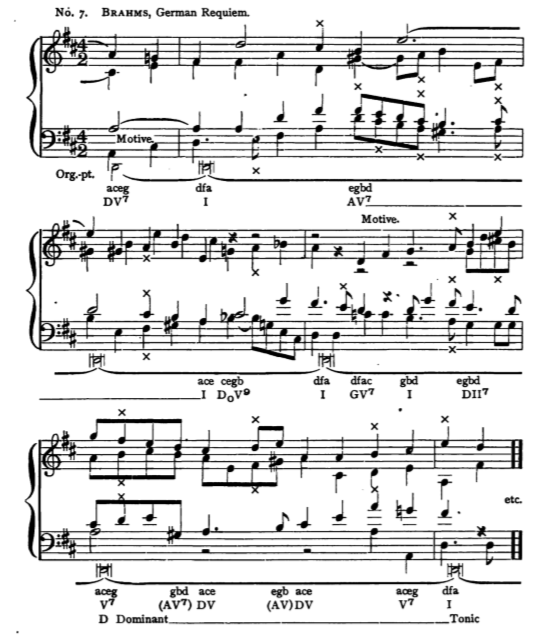
…in Bass (in half-notes), and how this line is later imitated in Alto, and, syncopated, in Soprano and Tenor. In measure 4, the a in Soprano is the lowered 7th step of B minor, used on the way down, in preparation (also) of E major.
▶ Fig. 432 nearby
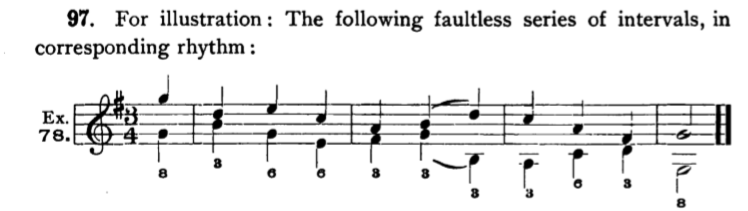 ▶ Ex.78
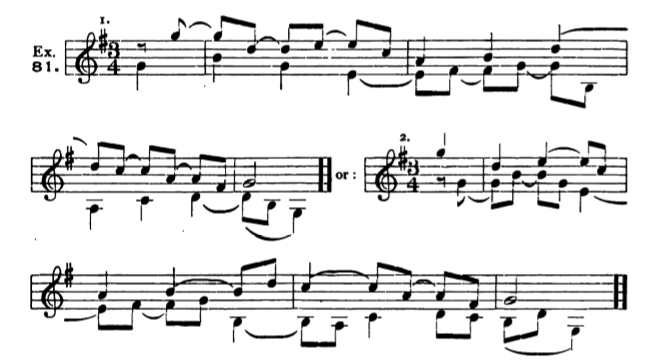 ▶ Ex.81-1
 ▶ Ex.83-2
 ▶ Ex.86
 ▶ Exercise 24.3
 ▶ Ex.171-7
 Counterpoint AppliedPercy Goetschius, 1902
- Chapter I
or when several such (brief) ties occur in succession, as syncopated form of an entire passage:
▶ Fig. 50 nearby - Chapter II
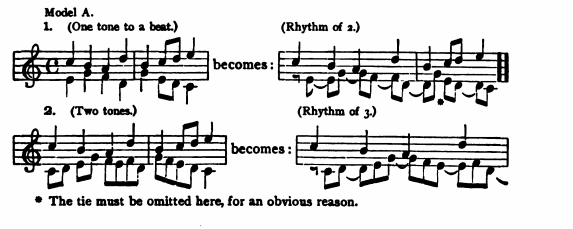
…with one, two, or three notes to a beat, and results in a faultless syncopation of the same, representing, in each case, the next higher grade of rhythmic motion; ie., the original formation of one note to each beat becomes one of two notes, two notes become…
▶ Fig. 99 nearby - Chapter II
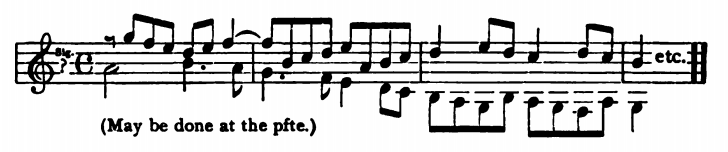
…4 notes to each beat, successively. A few experiments may be made with ties (syncopation), as shown in Exercise 4. Refer to par. 21, b, c, d, f.
▶ Fig. 132 nearby - Chapter III
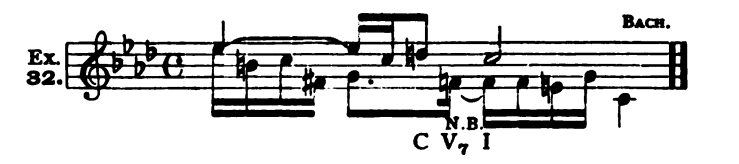
…as tending toward the mutual independence of the parts. All forms of syncopation are simply the consequence of ties (actual, or —according to their location in the measure - implied), and therefore serve the same important end. The treatment of the tie is…
▶ Fig. 143 nearby - Chapter III
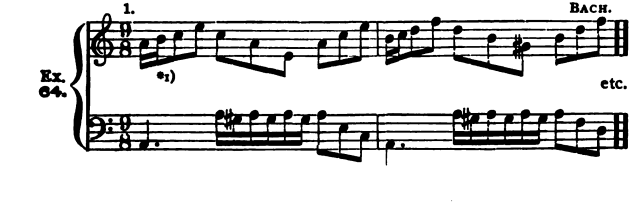
…of the tie is given in Ex. 44, No. II. See also Ex. 45-2. Ex. 50-1 (syncopation). In each of these cases the general rhythmic effect is regular, and preponderantly uniform, because of the correct alternation of the parts, as shown in par. 2za. Ex. 64-3…
▶ Fig. 143 nearby - Chapter III
…The irregularities of the first measure are reproduced in the next. *3) The syncopation of the upper part is continued, symmetrically, for three measures. See also Ex. 6A-3, measures 2 and 3, uniformly irregular; Ex. 54-3 (the irregular division of the first…
▶ Fig. 143 nearby
 ▶ Ex32
 ▶ Exercise4-Model-A
 ▶ Exercise5-0
 ▶ Ex64
 Analysis of J. S. Bach’s Forty-Eight FuguesEbenezer Prout, 1910
- Fugue 8 · Book I, No. 8 · BWV 853
…There is no countersubject. A codetta of nearly two bars, suggested by the syncopated rhythm of the subject, precedes the entry of the third voice, the bass, which enters with the subject in bar 8; and a second codetta (bar 10, fourth beat, to bar 12, first…
▶ Fig. 22 nearby - Fugue 21 · Book I, No. 21 · BWV 866
…from bar 6, last quaver, to bar 9, will be readily recognized by its syncopations and iterated notes, the second (CS 2), bars 9 to 13, by the detached semiquaver figures and rests.
▶ Fig. 52 nearby - Fugue 45 · Book II, No. 21 · BWV 890
…the alto, at first absolutely without accompaniment and then (bar 33) with syncopated countersubject in the treble, and one in long notes in the bass, consequently marks the commencement of the middle section. The companion entry, from bar 40, shows the…
▶ Fig. 104 nearby
 ▶ Subject · Fugue 8
 ▶ Subject · Fugue 21
 ▶ Prout’s excerpt · Fugue 45
 Treatise on HarmonyJean-Philippe Rameau, 1722
- Chapter sixteen
…This is especially clear because the rule of preparing dissonance through syncopation and resolving it by subsequent descent concerns only the seventh's upper sound, not its lower sound, which is its principle. When that seventh is inverted into a second…
▶ Fig. 77 nearby - Chapter sixteen
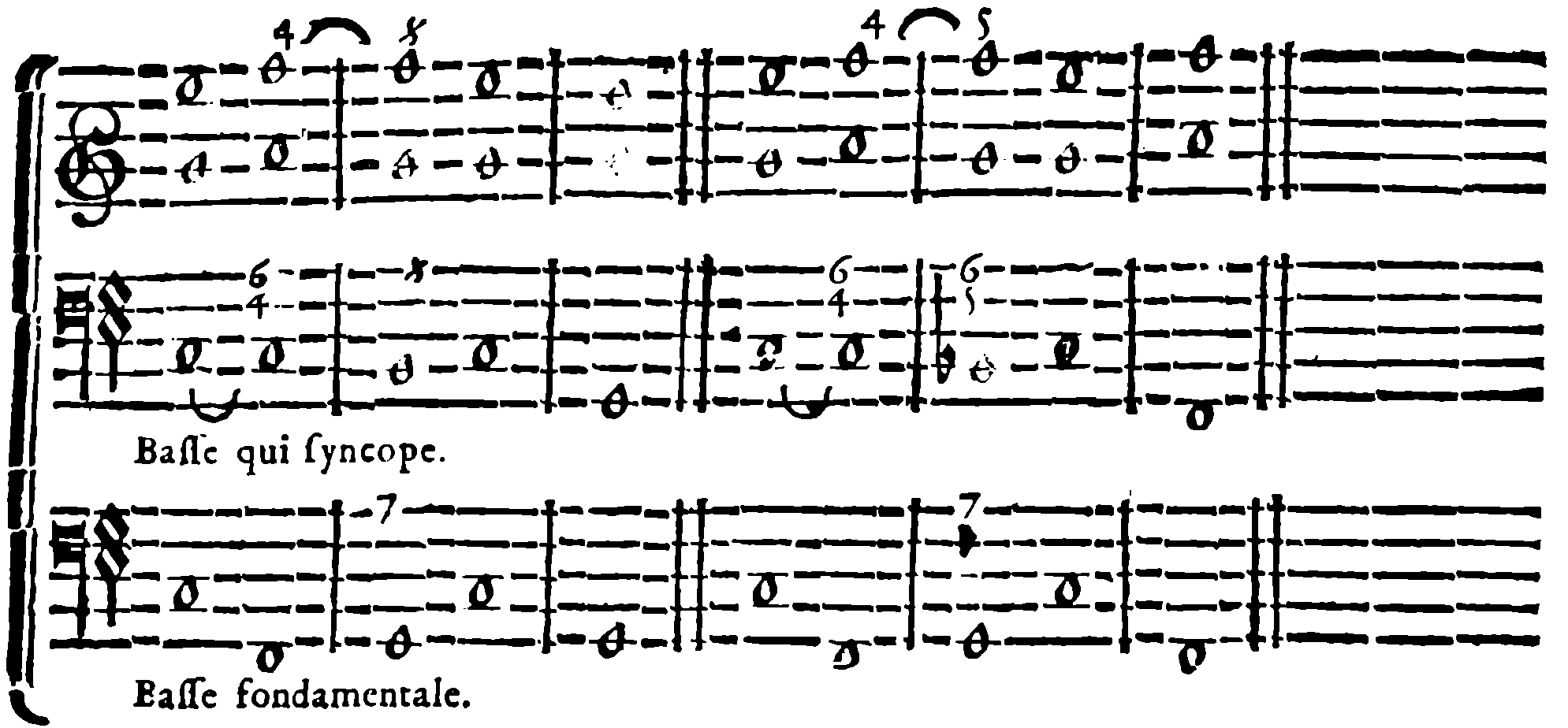
If the fifth syncopates at (A), this arises from the natural succession of consonances and the composer's choice to sound the fifth rather than another consonance, not from obedience to the dissonance rule. If the bass syncopates beneath the fourth at (B),…
▶ Fig. 77 nearby - Chapter sixteen
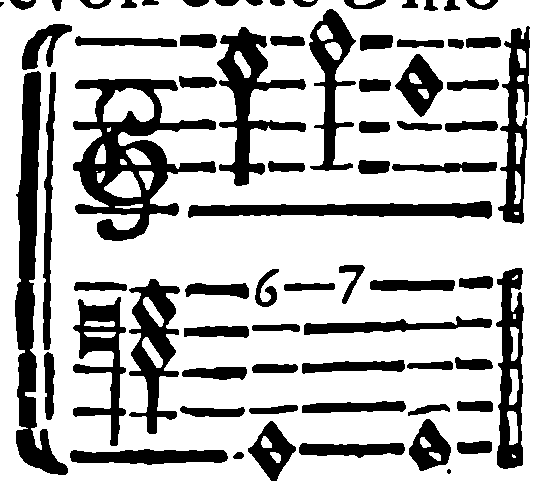
…most natural. The only possible objection is the imperfection of the first syncopation, which does not begin on a weak beat. For that requirement to apply, however, a second must belong to the sixth–fourth chord or be implied in it. The second then being the…
▶ Fig. 80 nearby - Chapter sixteen
…by step, there by leap; here it is dissonant, there consonant; here it must syncopate, there it cannot. This is precisely the source of obscurity in the rules. For example, we are told that every dissonance must be prepared through syncopation, then that the…
▶ Fig. 81 nearby - Chapter sixteen
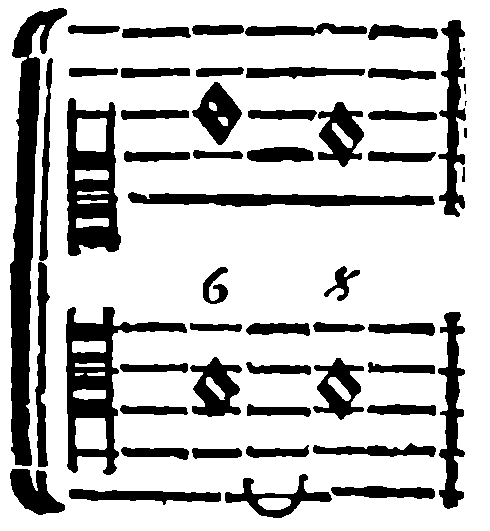
…to the perfect chord cannot be removed when the seventh added to it syncopates. The seventh therefore syncopates both against this major third and against the chord's fundamental sound. Since the major third then becomes the object of every major and augmented…
▶ Fig. 81 nearby - Chapter sixteen
These are the different principles behind the rule permitting bass syncopation. Without explanation, the rule leaves us in error: we do not know whether consonance or dissonance must syncopate, and consequently do not know the syncopated note's subsequent…
▶ Fig. 82 nearby
 ▶ Fig. 77
 ▶ Fig. 80
 ▶ Fig. 81
 ▶ Fig. 82
 Guide to the Practical Study of HarmonyPyotr Ilyich Tchaikovsky, 1900
- Chapter XXIV. Anticipation
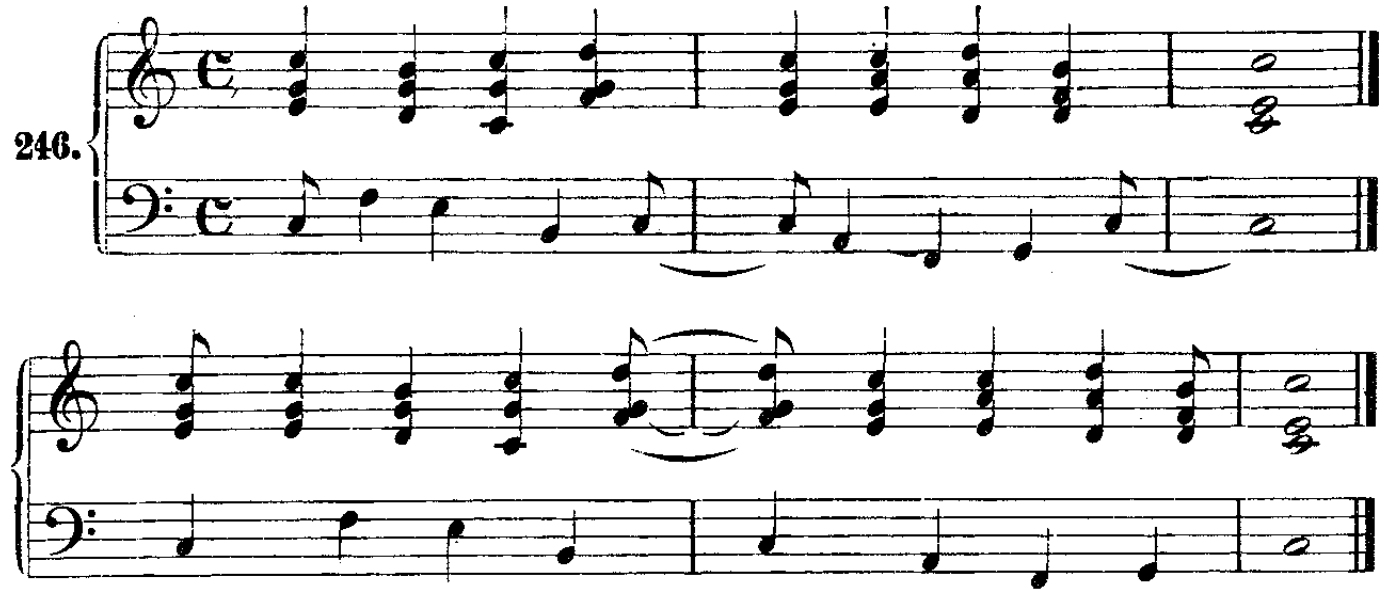
§ 81. There is a syncopated movement between Bass and upper voices, which gives rise in turn to a row of suspensions or anticipations, according to whether the Bass or the upper voices fall on the accented beats.
▶ Fig. 258 nearby
 ▶ Fig. 258
 Principles of OrchestrationNikolai Rimsky-Korsakov, 1922
- Use of percussion instruments for rhythm and colour
…almost invariably correspond to the strong beats of the bar, highly-accented syncopated notes or disconnected sforzandi. The triangle, side drum and tambourine are capable of various rhythmic figures. Sometimes the percussion is used separately, independently…
 OrchestrationCecil Forsyth, 1914
- No. 35. The English-Horn
…in the unison by the muted Violas. The English-Horn is accompanied by quiet syncopated chords for the three French-Horns. The effect is very happy—what one may call the entente cordiale in orchestration. The empty bar at the end of the English-Horn part is…
- No. 47. The Viola (or Tenor)
…Tauride the air of Orestes, in which the Violas play a continual throbbing syncopated middle-part. The whole Viola part has only a compass of a minor third-G to Bb-and out of sixty bars fifty contain merely repetitions of the note A. Berlioz claims this…
 Treatise on InstrumentationHector Berlioz, 1905
- The Viola
…the viola part and, particularly, to the timbre of its third string, to ‘its syncopated rhythm and to the strange effect of the unison between its syncopated A and the A of the basses, whose different rnythm abruptly cuts through the syncope. (Example 21.)
- On Conducting
…two. The majority of players, however, usually become uncertain when the syncopation begins and the triple rhythm clashes with the duple; they need assistance, which can be given to them in the following manner. The uncertainty in a group of performers caused…
- On Conducting
…where not two different and contrasting rhythms clash, bat where simple syncopation is introduced. If the conductor divides the bar according to the number of accents in it, he destroys the effect of the syncopation for all listeners who see him, substituting…
- On Conducting
by making six movements to a bar, as indicated above the notes, instead of the four previously maintained; only the latter enable the listener to recognize and. feel the syncopation clearly:
 Complete Method for Rhythmical ArticulationPasquale Bona, 1905
- Study 60
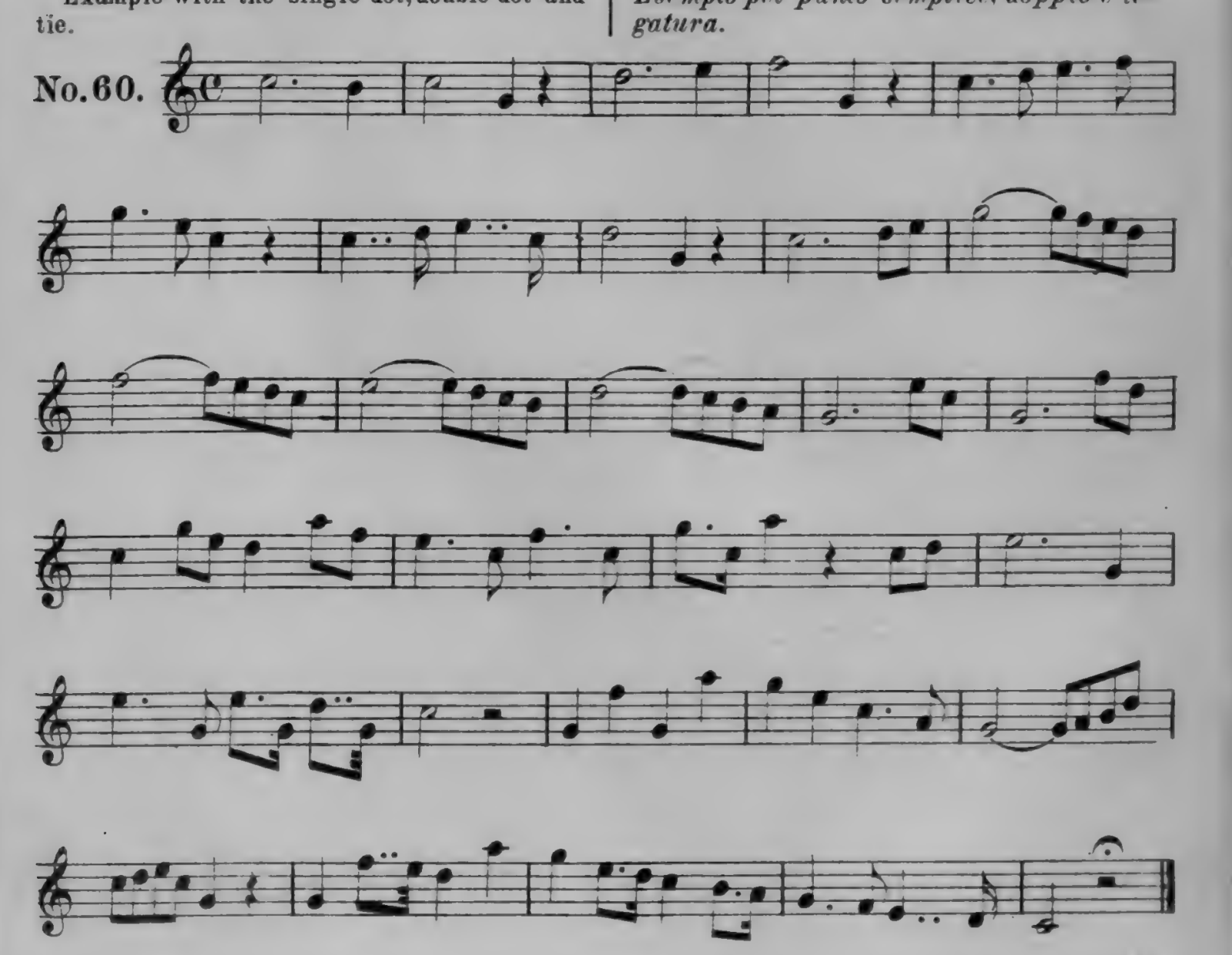
It is necessary that the teacher should instruct the pupil in cases where the dot, the tie and the syncopation produce the same effect.
▶ Fig. 70 nearby - Study 60 · Caption
Example. Single dot. Tie. Syncopation. Tie.
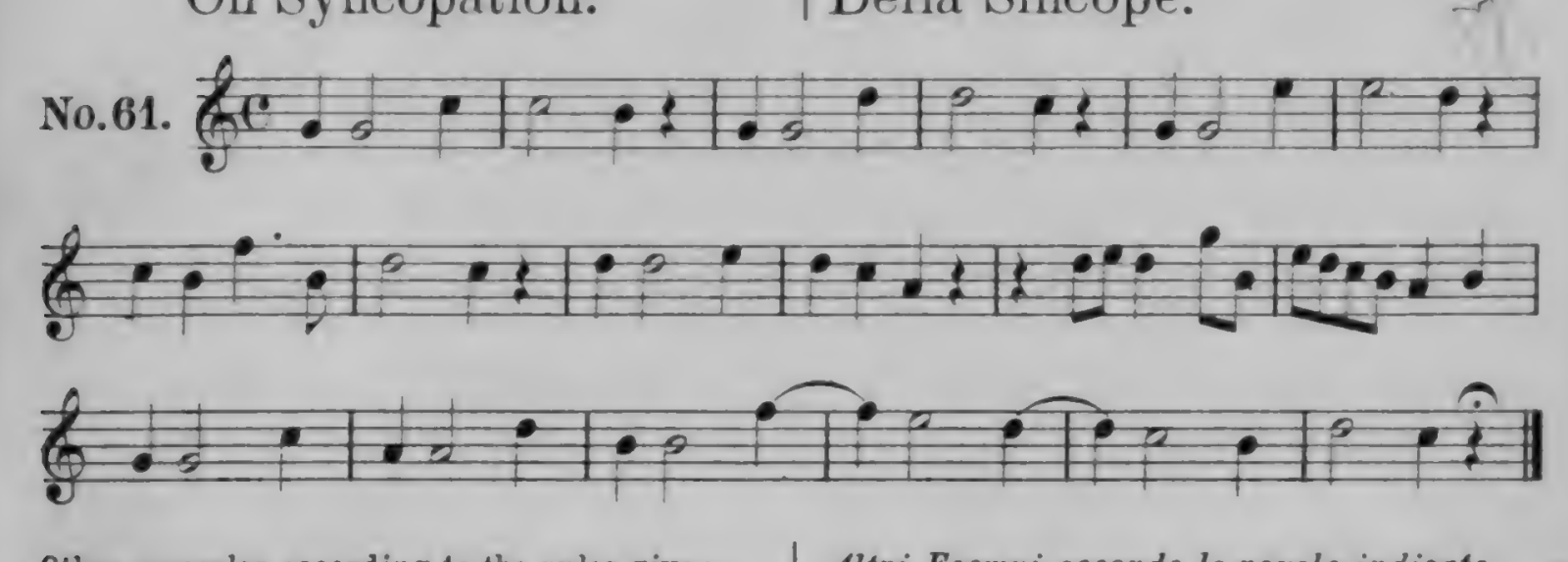
▶ Fig. 71 nearby - Study 61 · Caption
On Syncopation.
▶ Fig. 72 nearby
 ▶ Fig. 70
 ▶ Fig. 71
 ▶ Fig. 72
More in Rhythm and the orchestra
Meter and time signature · The strings · The woodwind · The brass · Percussion