 Playable Books
Concept index · Rhythm and the orchestra
The woodwind
Taught in 3 books. Each one opens at the passage; ▶ plays the example beside it. Also called woodwinds, flute, oboe, clarinet.
This index is Playable Books’ own: a first pass that finds the term’s words in each book, corrected by hand. The authors did not tag these passages, and their terms can differ (Fux’s “ligature” is a suspension). The quoted text is the book’s.
 Principles of OrchestrationNikolai Rimsky-Korsakov, 1922
Start: Wood-wind →- Melody in the wood-wind
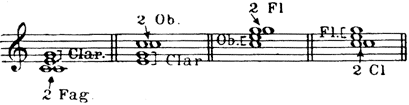
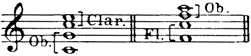
- Wood-wind harmony · 4 playable examples
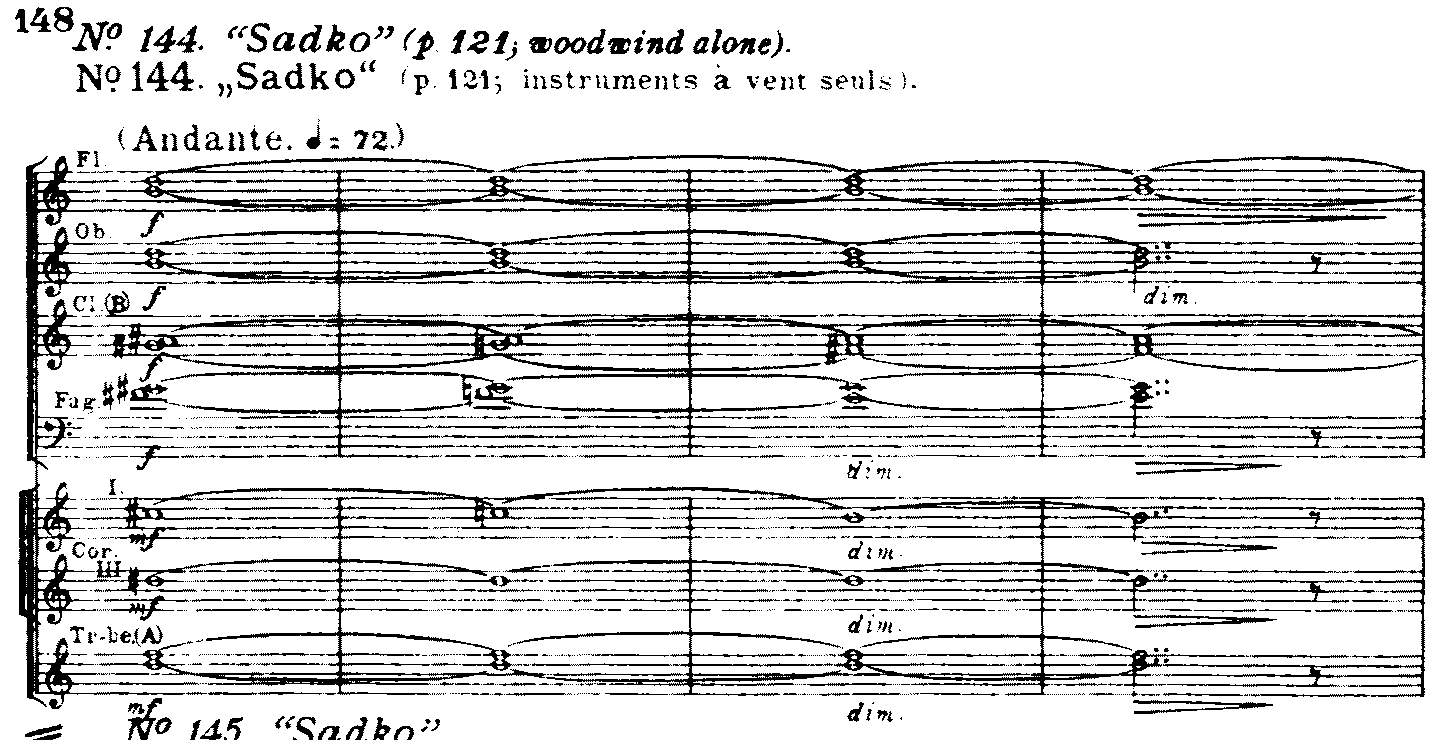
- No. 144. “Sadko” (p. 121; woodwind alone). No. 144. „Sadko“ (p. 121; instruments à vent seuls) · 1 playable example
- Wood-wind
…place of his usual instrument, are enclosed in brackets. As a rule the first flute, first oboe, first clarinet and first bassoon never change instruments; considering the importance of their parts it is not advisable for them to turn from one mouth-piece to…
- Wood-wind
Wood-wind in pair's | Wood-wind in three's | Wood-wind in four's (II—Piccolo). | (III—Piccolo). | 1 Piccolo (IV). 2 Flutes I. II. | 3 Flutes I. II. III. | 3 Flutes I. II. III. | (II—Bass flute). | (III—Bass flute). 2 Oboes I. II. | 2 Oboes I. II. | 3 Oboes I.…
- Wood-wind
Flutes and clarinets are the most flexible wood-wind instruments (the flutes in particular), but for expressive power and subtlety in nuances the clarinet supersedes them; this instrument can reduce volume of tone to a mere breath. The nasal instruments, oboe…
- Wood-wind
The duty of the piccolo and small clarinet is, principally, to extend the range of the ordinary flute and clarinet in the high register. The whistling, piercing quality of the piccolo in its highest compass is extraordinarily powerful, but does not lend itself…
- Melody in the wood-wind
The normal order of wood-wind instruments and that which produces the most natural resonance is the following: Flutes, Oboes, Clarinets, Bassoons (the order used in orchestral full scores). Departure from this natural order, e.g. placing bassoons above…
- Different ways of orchestrating the same music
…allied to the trumpet); if the phrase is too high it may be entrusted to the oboes and clarinets in unison, this combination possessing the closest resemblance to the trumpet tone both in character and power. The question whether one trumpet or two should be…
 ▶ Fig. 54
 ▶ Fig. 55
 ▶ Fig. 304
 OrchestrationCecil Forsyth, 1914
Start: No. 30. The Flute → Start: No. 32. The Piccolo.' → Start: No. 31. The Bass-Flute → Start: No. 33. The Oboe' (or Hautboy) → Start: No. 34. The Oboe d'Amore → Start: No. 35. The English-Horn → Start: No. 39. The Clarinet → Start: No. 40. The Bass-Clarinet → Start: No. 42. The Bassett-Horn and The Alto-Clarinet → Start: No. 37. The Bassoon → Start: No. 38. The Double-Bassoon → Start: No. 27. The Saxophones →- No. 32. The Piccolo.'
In this connection we must remember that all the Flute-family is reedless. That is to say the tone-production does not in the slightest resemble the tone-production of the human voice. It, therefore, totally lacks the strong associative appeal which is…
- No. 32. The Piccolo.'
With such limitations as these the Piccolo is most often called on to brighten the upper octaves of the Wood-Wind. It is impossible, within reasonable limits of space, to give examples of these "doublings." They include combinations with practically every…
- No. 33. The Oboe' (or Hautboy)
Everý composer, from Lully to the unpronounceable Russians, has used the Oboe, and, as was stated above, there is more similarity of method to be found between the ancient and the modern Oboe parts than between any such parts for Flute, Clarinet, or Bassoon.…
- No. 37. The Bassoon
…Symphony orchestras. Of these the 3rd is generally prepared to take either Bassoon or Double-Bassoon as required. In modern times the introduction of the Bass-Clarinet and the Tuba, as well as the perfection of the Valve-Horn mechanism, has contributed to set…
- No. 39. The Clarinet
…Clarite studs at always wep ten in the Full Score immediately underneath the Oboes. This is a mere accident, due to the historical priority of the latter instruments. richard strauss, than whom there can be no better judge, goes so tal as to say that, in…
- No. 39. The Clarinet
A very simple example of "goldsmithery" in the arrangement of Wood-Wind parts may be found in the second subject of the Ist Movement of Mendelssohn's Vrolin Concerto. The subject is played by the Wood-Wind over a held pedal in the solo Violin part. Un its…
 Treatise on InstrumentationHector Berlioz, 1905
Start: The Flute → Start: The Piccolo → Start: The Alto Flute → Start: The Oboe → Start: The Oboe d’amore → Start: The English Horn → Start: Clarinets → Start: The Bass Clarinet → Start: The Basset-Horn → Start: The Bassoon → Start: The Double-Bassoon → Start: The Saxophones →- The Oboe
…C and not a Bb, the C of an alto trombone is also C and not Eb, that of the flute is again a C and not a D. The evident conclusion is that these instruments belong not to the transposing, but to the non-transposing instruments. One may consider them to be in C…
- The Bassoon
…courtesy of M. Gevaert, I heard in the.. Brussels Conservatory a double-bass oboe, whose tone had 1 clarinet in Ab not the slightest similarity with the low tones of the 2 clarinets a a bassoon. It was, down to the extreme depth, the typi clarinets :. shawm…
- The Double-Bassoon
The tenoroon occupies the same Position above the bassoon as the English horn below the oboe. The English horn is written a fifth above the real sound, the tenoroon a fifth below. The tenoroon therefore plays in F when the bassoons play in C, and in G when…
- The Double-Bassoon
connection with the violoncellos, the lowest tones of the bassoons have also, in my opinion, no bass character—unless they are doubled by the low horns. In the modern orchestra, where even the smallest string quartet is weighted down by at least six…
- Clarinets
…they would be of great value to composers on numerous occasions. The high clarinet in F is the one to be most highly recommended; it has now been introduced into all military bands. There are also clarinets in A>. High clarinets in F and E> should be used in…
- The Bass Clarinet
Still lower in range than the preceding, it is a full octave below the clarinet in B®. There is also a bass clarinet in C {an octave below the clarinet in C}, but the one in B> is much more common. Since it is exactly the same instrument as the ordinary…
 ▶ Fig. 447
More in Rhythm and the orchestra
Meter and time signature · Syncopation · The strings · The brass · Percussion