 Playable Books
Concept index · Rhythm and the orchestra
Meter and time signature
Taught in 9 books. Each one opens at the passage; ▶ plays the example beside it. Also called metre, time signature, compound time.
This index is Playable Books’ own: a first pass that finds the term’s words in each book, corrected by hand. The authors did not tag these passages, and their terms can differ (Fux’s “ligature” is a suspension). The quoted text is the book’s.
 Gradus ad ParnassumJohann Joseph Fux, 1725
- Second species counterpoint: two notes against one
…counterpoint, it must first be understood that we are at present working in duple time, whose beat or measure consists of two equal parts: one in the lowering of the hand, the other in its raising. The lowering of the hand is called Thesis in Greek, and its…
▶ Fig. 22 nearby - Second species counterpoint: two notes against one
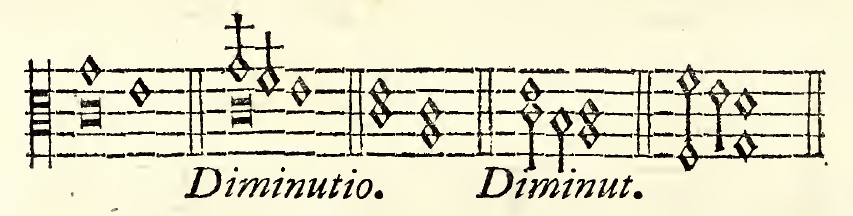
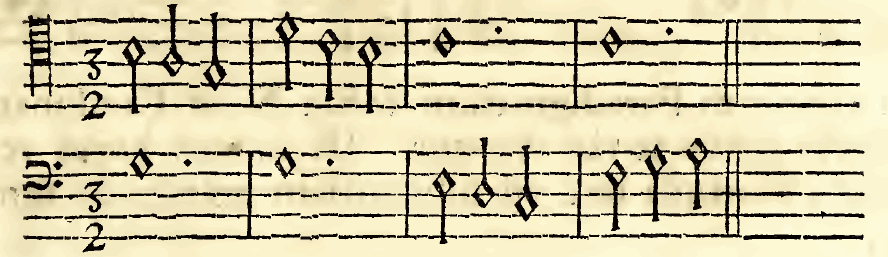
…veil of obscurity being partly lifted for you. Here we should also speak of triple time, in which three notes are placed against one. But because the matter is easy and therefore of little difficulty, I do not think it worthwhile to establish a separate lesson…
▶ Fig. 44 nearby - On various fugue subjects
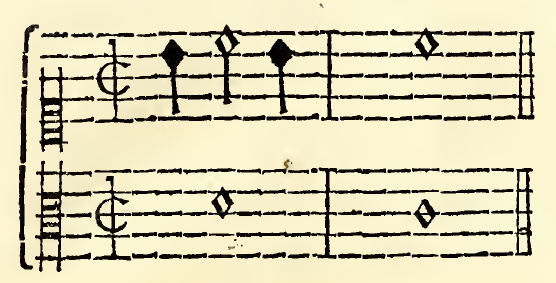
…the measure, ligatures of dissonances are to be used. I say, then, that in duple time marked with a stroke through the sign, for example cut time, ligatures consisting of dissonances must be used only on the thesis, or beginning of the measure, apart from this…
▶ Fig. 452 nearby
 ▶ Fig. 22
 ▶ Fig. 44
 ▶ Fig. 452
 Counterpoint AppliedPercy Goetschius, 1902
- Chapter I
…or, with still more striking effect, from the last beat or beats of one metric group into the first beat of the following group (i.e., at, or over into, the accented pulses).
▶ Fig. 49 nearby - Chapter I
b. On the contrary, a short tie —as a rule, from any value less than a half-beat of the prevailing meter, in moderate tempo, — should be avoided.
▶ Fig. 49 nearby - Chapter II
…the Essential tones are those which represent and obviously govern an entire metric unit of moderate duration, that is, the full beats in somewhat rapid tempo, and the half-beats in ordinary or deliberate tempo, — possibly the quarter-beats in decidedly slow…
- Chapter IV
…is regular, ie., the Imitation appears at the same part of the (next) metric group, so that the arrangement of accented or unaccented units is not disturbed (see Exs. 66, 67, etc.).
▶ Fig. 150 nearby - Chapter IV
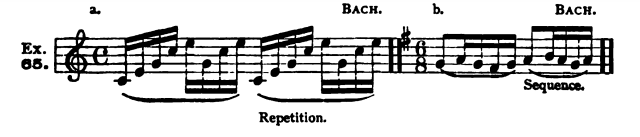
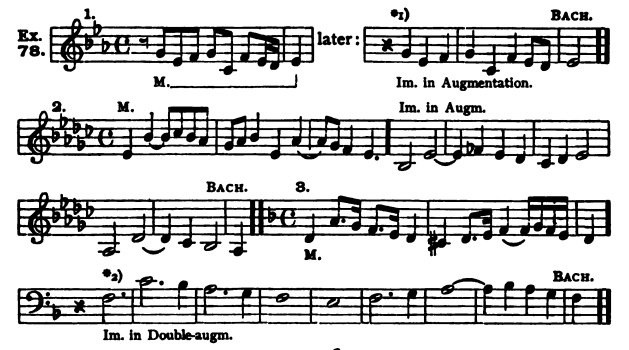
…occurs. This applies naturally to motives in duple rhythm; whereas in triple time it is often necessary to resort to uneven proportions of augmentation, in order to preserve the original arrangement of accented and unaccented tones. This change, though…
▶ Fig. 171 nearby - Chapter IV
…Here the proportions of Augmentation are necessarily uneven; otherwise, the triple measure would be transformed into Juple. — The version at *6) conforms a little more closely to the prosodic effect of the original motive.
▶ Fig. 174 nearby
 ▶ Ex31
 ▶ Ex65
 ▶ Ex78-1-3
 ▶ Ex79
 Treatise on HarmonyJean-Philippe Rameau, 1722
- Table Explaining Essential Terms
METER. Descartes says animals could dance in meter. 150
- Chapter twenty-three
Meter has such power in music that it alone can stir the different passions we have just attributed to the other parts of this art. Without it, all our expression would become languid and fruitless. We may say that it is natural to everyone: almost against our…
- Chapter twenty-three
We can derive meter from the principle of harmony, since it consists only in the numbers two, three, and four, which give us the octave divided arithmetically and harmonically. Moreover, since meter consists only in equal movements, we can reduce it to two…
- Chapter twenty-three
To distinguish meter in music, one must know the numerals placed at the beginning of a piece and the values of the signs we call notes, rests, and so forth. These are thoroughly explained in the books of Messrs. de Brossard, Loullier, l’Affillard, and others;…
- Chapter twenty-three
…beat would be the fastest, called Presto by the Italians. In three-beat meter, one could also use a sixteenth note per beat for the very rapid movement they call Prestissimo; in two-beat meter, an eighth-note beat can express that movement. With slow, less…
▶ Fig. 100 nearby - Book III
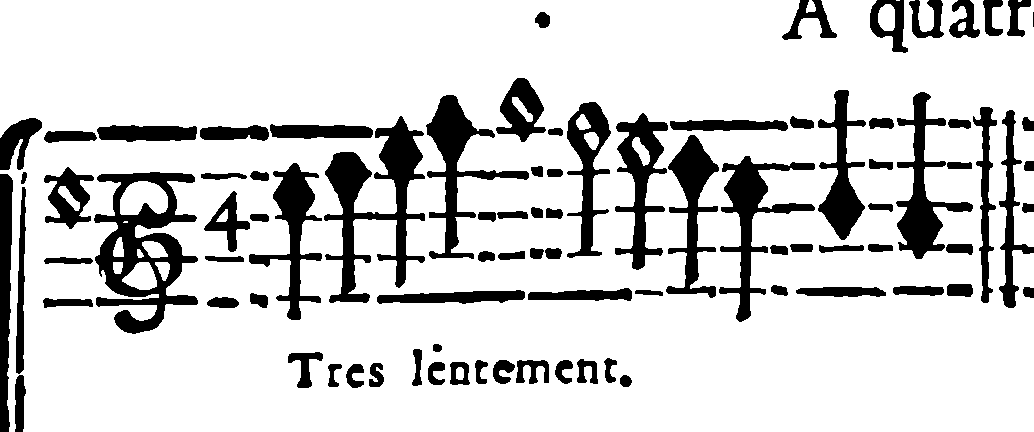
Meter contains several beats. Each walking step may be taken as one beat. Just as walking can be faster or slower, meter can move faster or slower.
▶ Fig. 180 nearby
 ▶ Fig. 100
 ▶ Fig. 180
 Practical Manual of HarmonyNikolai Rimsky-Korsakov, 1910
- Chapter II. Chord Progressions within One Key
The model realizations are in C major or A minor, in duple or triple time.
- Exercise No. 2 (given basses)
The pupil should compose exercises of eight bars, preferably in duple time, on the pattern of the models given.
▶ Fig. 69 nearby - Cadence Formula of the First Kind — with the Succession of Subdominant and Dominant
2) In duple time the fourth degree is always placed on the strong beat and the fifth on the weak beat; in triple time the fourth degree may also be placed on the second (weak) beat and the fifth degree on the third beat.
▶ Fig. 83 nearby - Cadence Formula of the Second Kind (with the Six-Four Chord of the First Degree)
4) In duple time the cadential six-four chord is placed on the strong beat. In triple time it may also be placed on the second (weak) beat; the dominant chord then falls on the third beat.
▶ Fig. 85 nearby - simple, double, etc
REMARK. — We draw the student's attention to the good use of chromatic passing notes formed immediately before passing minor sevenths, and especially in triple time:
▶ Fig. 272 nearby
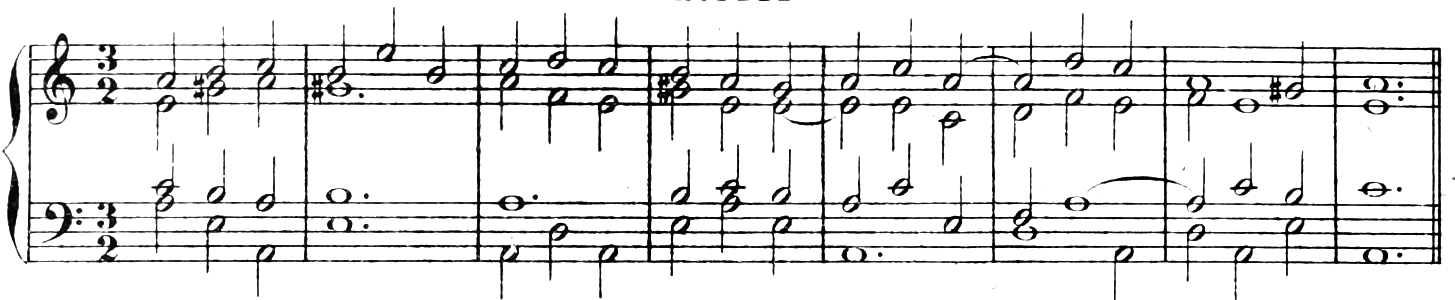 ▶ Model: a given bass in A minor, 3/2, harmonized with I, IV and V
Exercise No. 2 (given basses)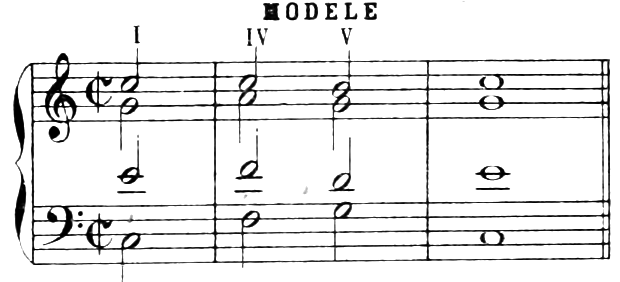 ▶ Model: the first-kind cadence formula I–IV–V–I in C major, cut time, IV on the strong beat
Cadence Formula of the First Kind — with the Succession of Subdominant and Dominant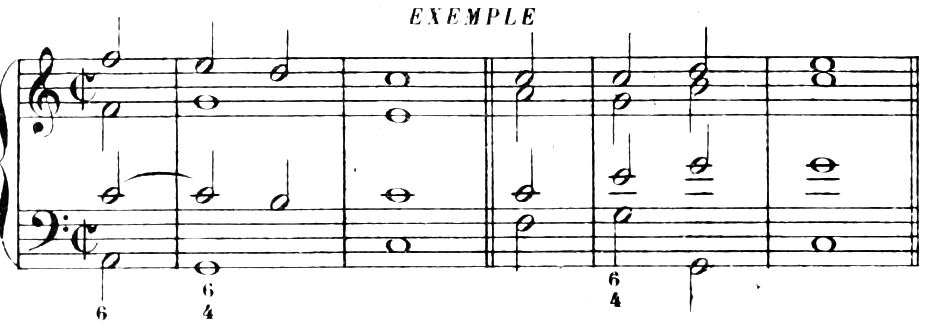 ▶ Example: two cadences in C major, cut time — IV6 or IV, the six-four chord on the strong beat, V, I
Cadence Formula of the Second Kind (with the Six-Four Chord of the First Degree)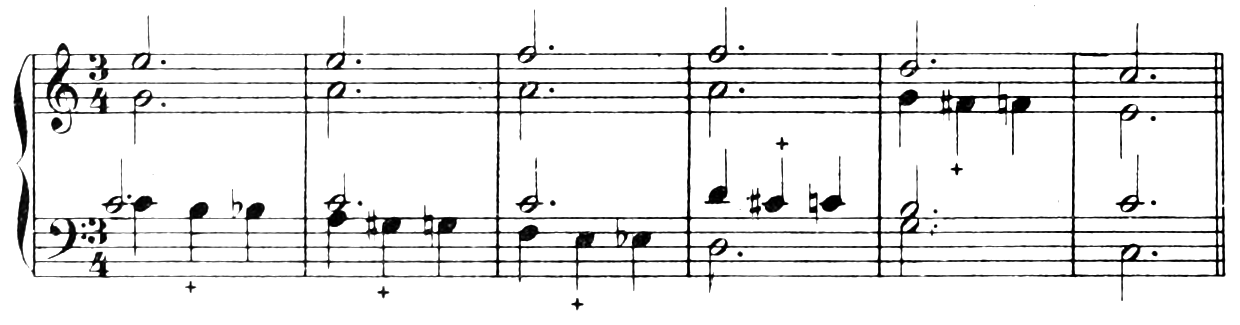 ▶ Example in 3/4: in each bar a chromatic passing note (+) leads directly into a passing minor seventh (bass C–B–B♭, A–G♯–G, F–E–E♭; tenor D–C♯–C; alto G–F♯–F).
simple, double, etc
 PartimentiFedele Fenaroli, 1800
- No. 39 · Gj 1369
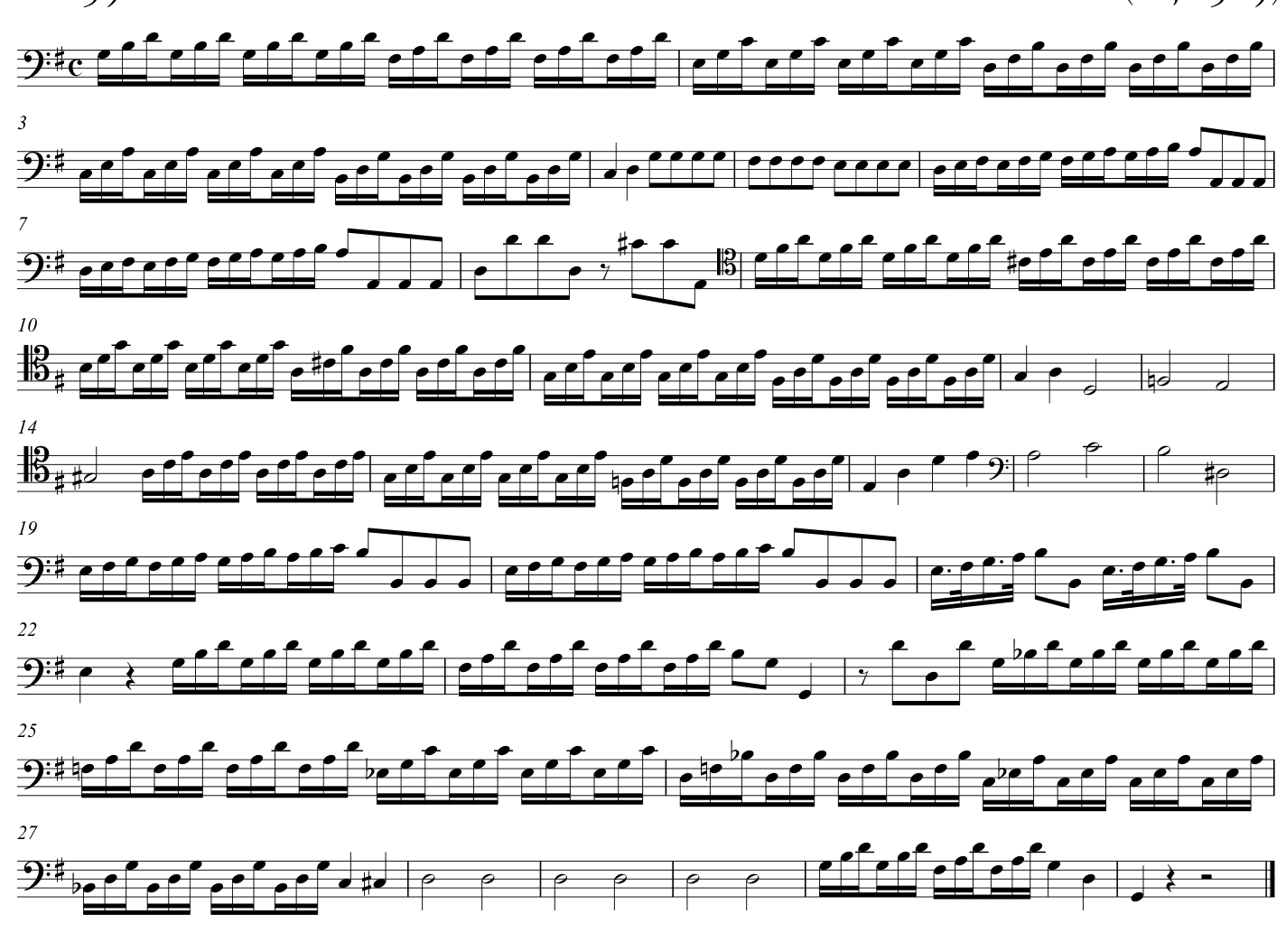
…values. This editorial interpretation restores the printed common-time meter.
▶ Fig. 149 nearby - No. 1, The Theme
The source omits tuplet numerals in this theme. Its beamed subdivisions are interpreted as 3:2 triplets to fit the printed meter; no notes are added.
▶ Fig. 155 nearby - No. 2, The Theme
The source omits tuplet numerals in this theme. Its beamed subdivisions are interpreted as 3:2 triplets to fit the printed meter; no notes are added.
▶ Fig. 157 nearby
 ▶ Fig. 149
 ▶ Fig. 155
 ▶ Fig. 157
 Theory of HarmonyArnold Schoenberg, 1922
- Meter and Harmony · 4 playable examples
- Meter and Harmony
…yield no motive that could induce me to consider the relation between meter and harmony in more detail. Add to this that music is on the same path in rhythm as in harmony. In the last 150 years it has not been content to let its wisdom derive from caution, but…
▶ Fig. 243 nearby - Meter and Harmony
…But—and this cannot be emphasized enough—however suitable the use of unusual meters may be for creating an aura of originality, true novelty can by no means be attained by that alone. An eighth note more or less does not make a worn-out idea fit for use again;…
▶ Fig. 243 nearby - Meter and Harmony
…lines: through displacements of accent, through stringing together different meters, and the like. And yet an author cannot give a performable picture of the rhythms he really has in mind. The future will bring something different here too. The old system…
▶ Fig. 243 nearby - Meter and Harmony · Footnote
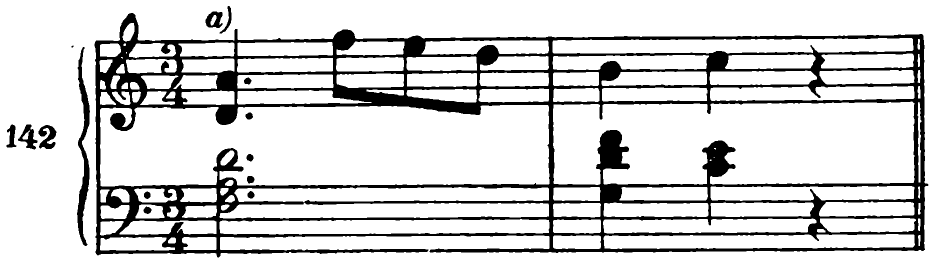
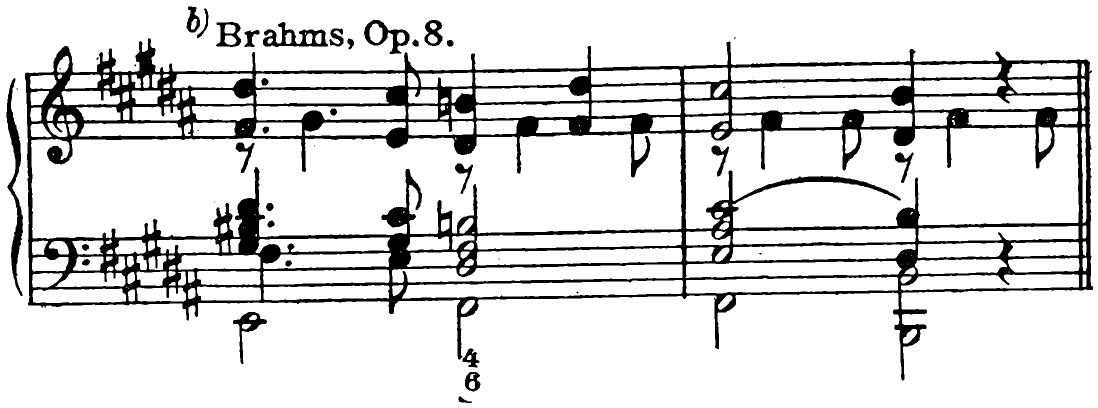
*) In every meter the first beat is accented (good, strong, heavy); in duple meters the second, in triple meters the second and third, are unaccented (bad, weak, light). In compound meters (4/4, 8/4, 6/4, 6/8, etc.) and in the subdivision of the larger values,…
▶ Fig. 244 nearby - Subject index
Meter 246 ff.; parts of the measure 251, 256 (in the pedal point), 360 (in chorales)
 ▶ Example 142a
 ▶ Example 142b (Brahms, Op. 8)
 OrchestrationCecil Forsyth, 1914
- No. 9. The Castanets
The characteristic of the Castanet tigures is a simple quaver rhythm in triple time, in which the central quaver is split up either into semiquavers, into a semiquaver-triplet, or into demisemiquavers.
 Treatise on InstrumentationHector Berlioz, 1905
- On Conducting
The meter with one beat in a bar is, especially from the conductor’s point of view, the same as a meter with two beats in a very rapid tempo; therefore, it is indicated like the preceding. The necessity of raising the point again after lowering it divides the…
- On Conducting
The meters with five and seven beats in a bar are not indicated by special series of gestures, but are treated as combinations of simple meters: the five beats as consisting of three and two beats, and the seven as four and three. They are therefore marked as…
- On Conducting
Triple time, ic. rapid 34 and 34 meter, is treated similarly. The conductor does not mark the second beat, holding the first gesture for two periods and raising his baton only on the third beat:
- On Conducting
If the tempo is very slow, each beat must be subdivided; consequently, quadruple time is marked by eight movements, triple time by six movements, by repeating each of the previously indicated main movements in abbreviated form:
- On Conducting
Once this is clearly understood it becomes obvious that in very slow compound meters (such as 6/4, 6/8, 8/9, 12/8 ete.) the subdivision is even more important. These meters with triple time can be divided in various ways. If the tempo is rapid or moderate,…
- On Conducting
…all his presence of mind, is caused by the combination of different meters. It is easy to conduct a duple meter, each of whose beats is subdivided in two, together with a superimposed duple meter whose beats are divided in three, if both have the same tempo.…
 ArrivalMayank Sanganeria, 2026
- Chapter 7 — Phrase Architecture
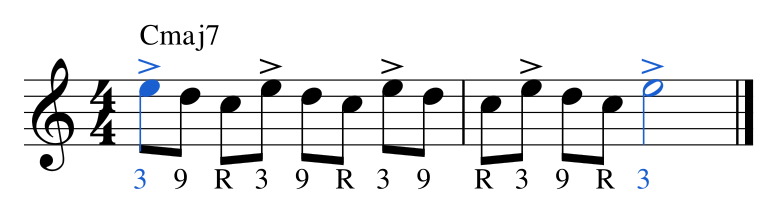
…Every pitch here is safe over Cmaj7 (R, 3, 9), but the accents fight the meter, and that's the point. The arrival grid is suspended for six beats, then restored by E on beat 3 of bar 2.
▶ Fig. 22 nearby
 ▶ Ex. 7.5
More in Rhythm and the orchestra
Syncopation · The strings · The woodwind · The brass · Percussion