 Playable Books
Percy Goetschius · section 4 of 29
Chapter II. Wider Leaps
Read and hear this section in the playable edition →11. The leap of a third (called a narrow leap), used in the first lesson, is always good. But all wider leaps are generally hazardous, and require specific limitations. The principal consideration is as follows:
Rule 3. Any wide skip is natural, and permissible, when both tones belong to the same good chord.
12. The "good " chords are the primary triads on scale-steps I, V, IV; also the II, though more rare; also the chords of the Dominant-7th and Dominant-gth. The chords on steps VI and III, and all subordinate dissonant chords, are too inferior to afford justification for wide leaps. Thus, in C major:
Ex.12

Ex.13a
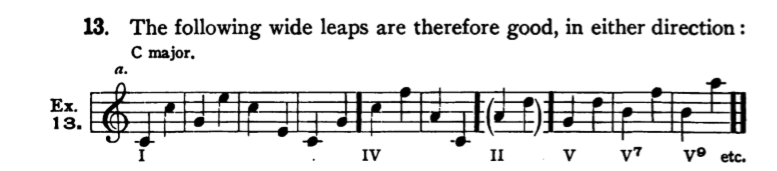
13. The following wide leaps are therefore good, in either direction:
Ex.13b

The following are unnatural, in either direction, and must be avoided, at present:
Ex.14

14. Rule 4. Two or more leaps in the same direction, whether narrow or wide, are also strictly subject to this rule: All the tones must belong to the same good chord. Thus, C major:
Ex.15a

Ex.15b

The following are faulty:
Ex.16

Note. In the first group, the first skip (c to g) represents the I, but the next tone, reached with a leap in the same direction, does not belong to that (same) chord. The leaping tones, arranged in such a manner, always remain in the ear, —" add up," so to speak, — and give the impression of a complete tone-body. The above measures sound thus:
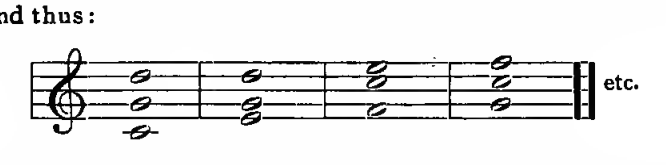
15. This rule applies only to successive skips in the same direction. The moment the direction changes, the ear ceases to " add up " the tones, and judges each leap separately, according to Rule 3. All the faulty progressions of Ex. 16 can therefore be made good by altering the direction. Thus:
Ex.17

16. Rule 5- After a wide leap (beyond a third), the melody usually turns, — changes its direction. Thus:
Ex.18

17. Notice, particularly, that this is not obligatory when the chord remains unchanged. This is distinctly shown in Ex. 15.
It is generally better to tum, however, after a wide leap, even in the same chord; and it is usually quite necessary when the chord changes, — as seen in Ex. 16 (all rectified in Ex. 17). Exceptions do occur, however; see Ex. 20. »
18. Rule 6. A skip of any width may be made towards (or opposite to) the resolving movement of an active scale-step. That is, the resolution of step 7 being upward, any leap down to it is correct. And, similarly, any skip may be made up to steps 6 and 4. In each case, the melody, in turning after the leap, properly resolves the active step. The following movements are all good (C major):
Ex.19
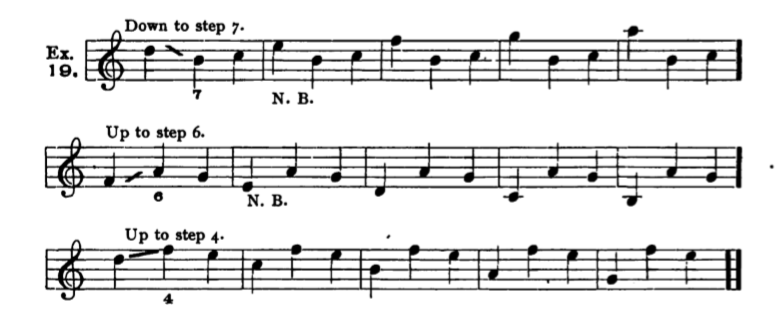
In the measures marked N. B., an exception to a part of Ex. 14 is seen, — skips apparently representing inferior chords. When properly resolved, these progressions are perfectly good.
19. If a wide skip is made, along a good chord-line, contrary to Rule 6, — up to 7, or down to 6 or 4, — an exception is unavoidable. Either the melody cannot turn, after the wide leap, or the active tone cannot be resolved. Thus:
Ex.20
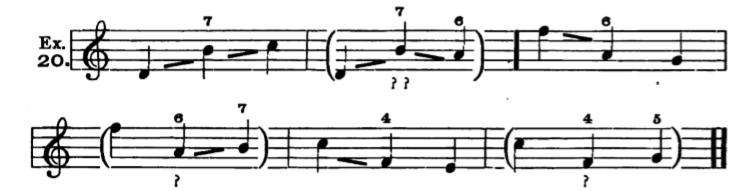
It is usually better to respect the fundamental law (Rule 1), and resolve the active step properly. Therefore, groups 1, 3 and 5 are better than groups 2, 4 and 6, in the above example.
20. Rule 7- The repetition of a tone, or the octave-leap, is always good:
Ex.21

21. Uniform rhythm is always safe, and generally predominates in a melody. But it incurs monotony, and, therefore, notes of various time-values are effective. At least occasionally, a note of greater value, or of less value than the prescribed beat, should be used.
22. Rule 8. The rhythm is regular, and always good, when the longer (heavier) tones appear upon the accented (heavier) beats, and the shorter (lighter) ones upon unaccented beats or fractions of beats. Thus, in regular rhythm:
Ex.22

23. If the order is reversed,— if heavy notes occupy light beats, or light notes occupy heavy beats, — the rhythm is irregular, and the result doubtful. Still, irregular rhythms may always be rectified by recurrence, — that is, by being repeated in the next measure, or some other corresponding measure. Thus (both from Schubert ):
Ex.23a

Ex.23b

Exercise 2
Wider Leaps. Write, as before, a very large number of original melodies, employing the material of this chapter. Review the directions given in Exercise i, and follow all but No. 3.