 Playable Books
Percy Goetschius · section 5 of 29
Chapter III. Exceptional Progressions. Minor Mode
Read and hear this section in the playable edition →24. After thorough exercise of the basic principles of melodic movement, the student will better understand certain less regular traits that may appear in tone-lines. These, though peculiar, and rare, may be fully justified by the circumstances that attend them. A few are specially noted below, and should be thoroughly tested; first at the piano; then ■with the voice; then with the eye; always with close mental application and unceasing reference to the keynote, — of which the mental ear must always be distinctly conscious.
25. First, with reference to scale-step 7 (C major):
Ex.24
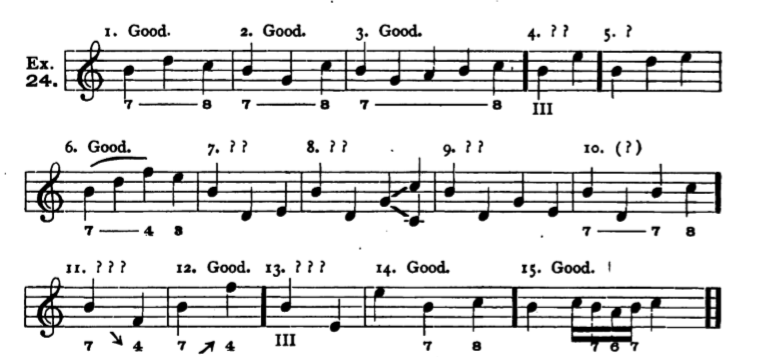
Explanation. G roups 1, 2 and 3 are good, because step 7 passes soon up into step 8. Group 4 is not good, because the skip represents an inferior chord; group 13 is similar, but worse. Group 5 is doubtful, because step 7 does not reach step 8 at all; group 6 is better, because the first three tones represent the Dom.-7th chord, and the resolution of the last one (step 4) satisfies the ear. Groups 7 to 10 are all doubtful, because step 7 makes an extreme leap in the wrong direction; group 10 is the least objectionable, because step 7 recovers itself and ascends to step 8. Group 11 is particularly poor and should be avoided; it may, it is true, occur in the line of the Dom.-7 th chord; but step 7 leaps in the wrong direction; it is an awkward leap (augmented fourth), and, landing on step 4, it cannot recover itself. Group 12, on the contrary, is all right, — see Ex. 19, group 13. Group 14 is considered good,— see Ex. 19, group 2. Group 15 appears to violate par. 10; it is permissible, however, because the succession 7-6-7 appears as embellishment only, and not as essential melodic movement.
26. Second, with reference to scale-step 6:
Ex.25
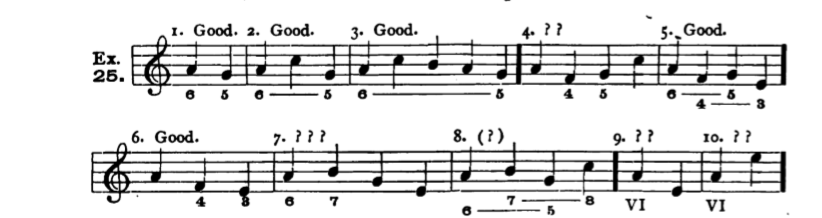
Explanation. Groups 1, 2 and 3 are good, because step 6 reaches step 5 soon enough. Group 4 is poor, because step 4 is not resolved; group 6 is good; and in group 5, both tendencies are satisfied. Group 7 contains too many irregularities; group 8 is better, — like group 5. Groups 9 and 10 represent an inferior chord. Groups 11 and 12 are justified by Ex. 19. Groups 13 and 14 seem to be adjusted by the resolution of step 7. Group 15 is right, for the reasons given in Ex. 24, group 15, which review.
27. Third, with reference to scale-step 4:
Ex.26
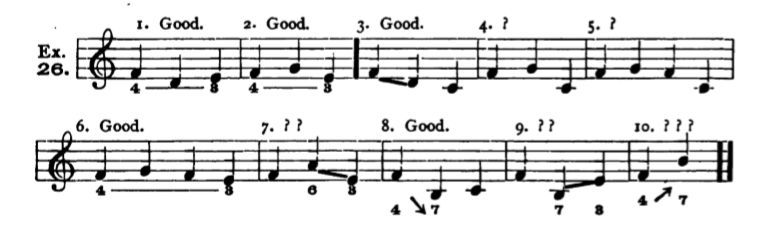
Explanation. Groups 4 and 5 are doubtful, because step 4 ascends and does not return to step 3; compare groups 2 and 6. Group 7 is too irregular. Group 9 has the bad leap from 7 to 3; see Ex. 14, No. 2, and Ex. 24, No. 13. Group 10 is very poor, like Ex. 24, No. 11, and for similar reasons.
28. Rule 9. One of the most vital traits (possibly the supreme one) of good, effective, comprehensible and significant melody, is the arrangement of the tones in uniform or similar groups or figures. Thus, a figure (usually a half-measure, whole measure, or two measures in length) may be reproduced as repetition, sequence, or some other closely corresponding form, — generally in some corresponding rhythmic group. For example:
Ex.27

Observe the similarity of formation in the two figures marked a; the second measure is a sequence of the first. Also the agreement of b and b. Also the general resemblance between figures a and b. Also the slight intentional differences,—exact agreement being by no means necessary.
See also Ex. 13, b; Ex. 21; Ex. 23, b.
29. Such syntactic agreement (uniformity of delineation), if perfectly distinct, is often a sufficient excuse for certain irregularities of progression. For example:
Ex.28-1

Ex.28-2

Ex.28-3

In No. 1, the poor progressions 7-6-7 and 5-4-5 are both justified by being sequences of the first measure (which is a blameless figure). In No. 2, the awkward movement from 4 up to 7 is justified by the repetition of the first figure. In No. 3, several poor successions are palliated, as sequences of the very first one, — which is a perfectly good figure.
The Minor Mode
30. The harmonic minor scale is derived from the major, by lowering the 3rd and 6th scale-steps of the latter. C minor corresponds to C major, but has e-flat and a-flat, instead of e and a. Comp. Ex. 29 with the scale of C major.
Every rule given above applies to minor precisely as to major. That is, the rules which govern C major also govern C minor (not A minor), — with one single exception, as follows:
Rule 10. The movement from step 7 to 6, and reversed, from 6 to 7, gives rise in minor to an awkward interval (augmented second) which it is better to avoid. Thus, in the so-called " harmonic " or true form of the minor scale:
Ex.29

31. These progressions, from 6 to 7, and from 7 to 6, are, in themselves, justified by Rule 2, Ex. 9. But they must be avoided if the minor scale is to be " melodious " ( singable).
32. The remedy is simple, and very common, and consists in so " altering " the active step as to remove the unmelodious augmented interval. Namely, in passing down from 7 to 6 (in the group 8-7-6-5 only), lower the 7th scale-step, by an accidental; and in passing up from 6 to 7 (in the group 5-6-7-8 only), raise the 6th scale-step. This results in good singable intervals, and changes the harmonic form to the so-called " melodic " form of the minor scale. Thus:
Ex.30

See Ex. 42. Otherwise, as stated, every melodic condition in major is absolutely valid for minor.
Exercise 3
Exceptional Movements, and the Minor Mode.
a. First review every one of the given examples that is in C major, transposing each one to C minor (first at the piano, then with the voice, then with the eye; always with close mental application).
b. Then transpose every original melody of Exercises I and 2 to the corresponding minor mode (that of the same keynote').
c. Also write a very large number of original melodies, in major and minor, applying the principles of this chapter. Before doing this, examine very carefully the melodies given in Exercises 4, 5, 6, and so forth.
All these original melodies may be used in the coming lessons.