 Playable Books
Percy Goetschius · section 6 of 29
Chapter IV. The Association Of Two Melodic Lines
Read and hear this section in the playable edition →Try it yourself: add a part to Goetschius's melodies, and have it checked →


33. The principle which naturally governs the association of melodies is that of harmonious agreement. The condition of consonance should prevail; not to the exclusion of dissonance (as will be seen in a later lesson), for the latter, in its proper place and proportion, is precisely as necessary and important in music as consonance. But consonance should predominate sufficiently to create the impression of " harmonious agreement'' as the ruling condition.
34. The contrapuntal structure — the association of melodies — is generally obtained in the following manner: some single melody is adopted as leading part— in a sense, as basis or principal melody (though it must never be forgotten that, in true counterpoint, the melodies are to be of equal value and significance, associated upon an equal footing). To this melody another tone-line is added, by careful adjustment of each of its successive tones to each successive tone of the first melody, in keeping with the simple regulations of harmonious union. In other words, for each tone of the given melody, a tone is chosen that will blend or harmonize consonantly with it, so that the new melody which results will agree, tone for tone, with the former. The new melody is therefore in a peculiar sense a product out of the original one, obtained, not by deduction or evolution from within, but by adjustment to it from without.
35. It is quite as correct, however, to create both melodies together, at once, letting each in turn suggest the next melodic move to be made, and making each thus alternately dependent upon the other. This is what the composer no doubt unconsciously does, ultimately. The student will use both processes, but should adopt the former (working with, or " against," a given complete melody) for the present.
36. Rule 1. The " harmonious " intervals, those that are invariably consonant and therefore acceptable for the union of two melodies, are the Third (or tenth), major and minor;
the Sixth, major and minor; and the Octave (or unison), perfect, of course. If, for example, C is given, as lower tone, we may add to it either E, its third; or A, its sixth; or C, its octave. If D is given, either F, B, or D, will properly counterpoint it. And so forth. For illustration:
Ex.31

If C is given as upper tone, either A, E, or C may be added to it below; and the same rule applies to all other tones. Thus:
Ex.32

37. These three intervals are unquestionably permissible at any single point of contact, and the task of the beginner consists simply in determining which of the three is the best at the moment.
38. This choice depends partly upon the melodic movement, — for it must be remembered that each part, the given one and the added one, must describe a faultless melodic line (see par. 44). But it also depends partly upon the underlying harmonic result, — for the implied chord-successions must also be natural and rational.
39. For illustration of this harmonic distinction: — If the tone C is given, either in the upper or the lower melody (in C major), the 3rd above (and 6th below) will produce the Tonic harmony. The 6th above (and 3rd below) will represent the Subdominant chord, or, possibly, the VI. The 8ve and unison exert no positive influence on the harmony, and become therefore solely a question of melodic preference.
Ex.33

Note. For the rules of good chord-succession, see the author's " Tone-Relations." Or glance at pars. 169 to 176.
40. Whether the major or minor form of the 3rd, ioth, or 6th is to be chosen, depends merely upon the key, and therefore takes care of itself.
Note i. The distinction between 3rd and ioth, and between octave and unison, may hereafter be dropped altogether, because they are identical.
Note 2. In the first lessons, the rhythmic form of the two associated melodylines will exactly (or nearly) correspond; that is, each separate note in the given part will have its companion, or " counterpoint," in the added part. An occasional exception to this adopted rhythmic scheme may be permitted for good melodic reasons. See Ex. 39, e.
41. If the interval 8 (octave) is applied to each successive tone of a given melody, the result is as follows:
Ex.34

The agreement of the added melody with the one that was given, is complete; the harmony of the association is absolute. But the student perceives at once that here some vital condition is wanting, for by this process nothing more has been obtained than an exact duplication of the given melody. No new melody has been produced, and therefore this cannot be called an association of different melodies.
42. The result is more ample if the interval 3, or the interval 6, is used with each of the given tones. Thus:
Ex.35

But even here, though a new series of tones is produced in each case, it is evident that the added melody is but little more, after all, than a reflection of the given one; an almost exact duplication; precisely the same tone-line, and therefore practically the same melodic product, merely shifted to other steps of the scale. As true counterpoint is to be no such artless multiplication of one and the same melodic line, but the harmonious association of independent and individually perfect melodies, the following rule must be observed:
43. Rule 2. In order to secure the independence of the added melody, the interval of the 8ve must be limited to single points, and not be used twice in immediate succession. The interval of the 3rd (and also that of the 6th) may appear consecutively, but never throughout the entire phrase, and, as a rule, not oftener than three (or four) times in direct succession. The best result is evidently to be achieved by a sensible interchange of these three different consonant intervals. Thus, as applied to the above given melody:
Ex.36

44. Rule 3. The choice of contrapuntal interval (whether the 3rd, 10th, 6th, 8ve, or unison) must be dictated by the rules of correct melodic progression. For this reason it is necessary to play or sing the added melody, by itself, after the contrapuntal union has been effected. Such a test, applied to Ex. 36, is wholly satisfactory. Applied to the following ones, it reveals several obvious errors in the added melody, despite the fact that each separate interval is consonant, and that the two melodies, sung or played together, form a harmonious union:
Ex.37

See also Ex. 40, e.
45. Furthermore, given the following major melody:
Ex.38

the following counterpoints may be added:
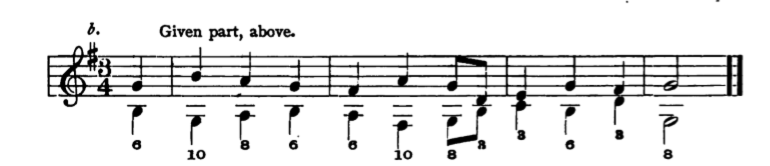
Ex.39a

Ex.39b
Ex.39c

This brief example, simple as it is, should already afford the student a very clear conception of the principle of melody-association, or counterpoint, and an appreciation of its value as a technical exercise. He should compare these three given solutions, and observe how completely the added parts differ from each other; and he may be sure that these are not the only acceptable solutions. Each added part should be played, sung (and conceived mentally, by eye, as usual), first alone by itself; then the two melodies must be studied together, and the student must endeavor to conceive their association, mentally, and obtain a perfectly clear impression of their union,— their effect together. After doing this very thoroughly.— slowly and thoughtfully,— he must transpose them (by finger and by eye) to G minor. And, finally, he must invert each one of them; that is, copy it out, placing the upper part an octave lower, and the lower part an octave higher, than here written.
' 46. Further, a few inferior and faulty versions, with the same given melody:
Ex.40d

Ex.40e

Explanation. The first half of version d is inferior, because the long succession of (parallel) 3rds gives the added part the effect of mere duplication. The same objection partly attends the parallel lines (in 6ths) further on. At the beginning of version e, the added part uses the octave three times in succession, which results in exactly similar melodic progressions and defeats the purpose of the union of lines. It is like parallel 3rds and 6ths in principle, but more objectionable. See Rule 2, par. 43.
The rest of version e is all poor counterpoint, because of the faulty, awkward leading of the added part, in obvious disregard of the laws of melody. —Invert both of these versions, as before.
47. In manipulating a complete sentence, it is desirable that the two parts should not begin with the same beat, in the interest of greater independence. And, as a rule, it is well to end with the octave of the tonic (the keynote in both parts); this, however, is not imperative. For example:
Ex.41a

Ex.41b

Exercise 4
Two-Part Counterpoint with Fundamental Intervals, Major Mode.
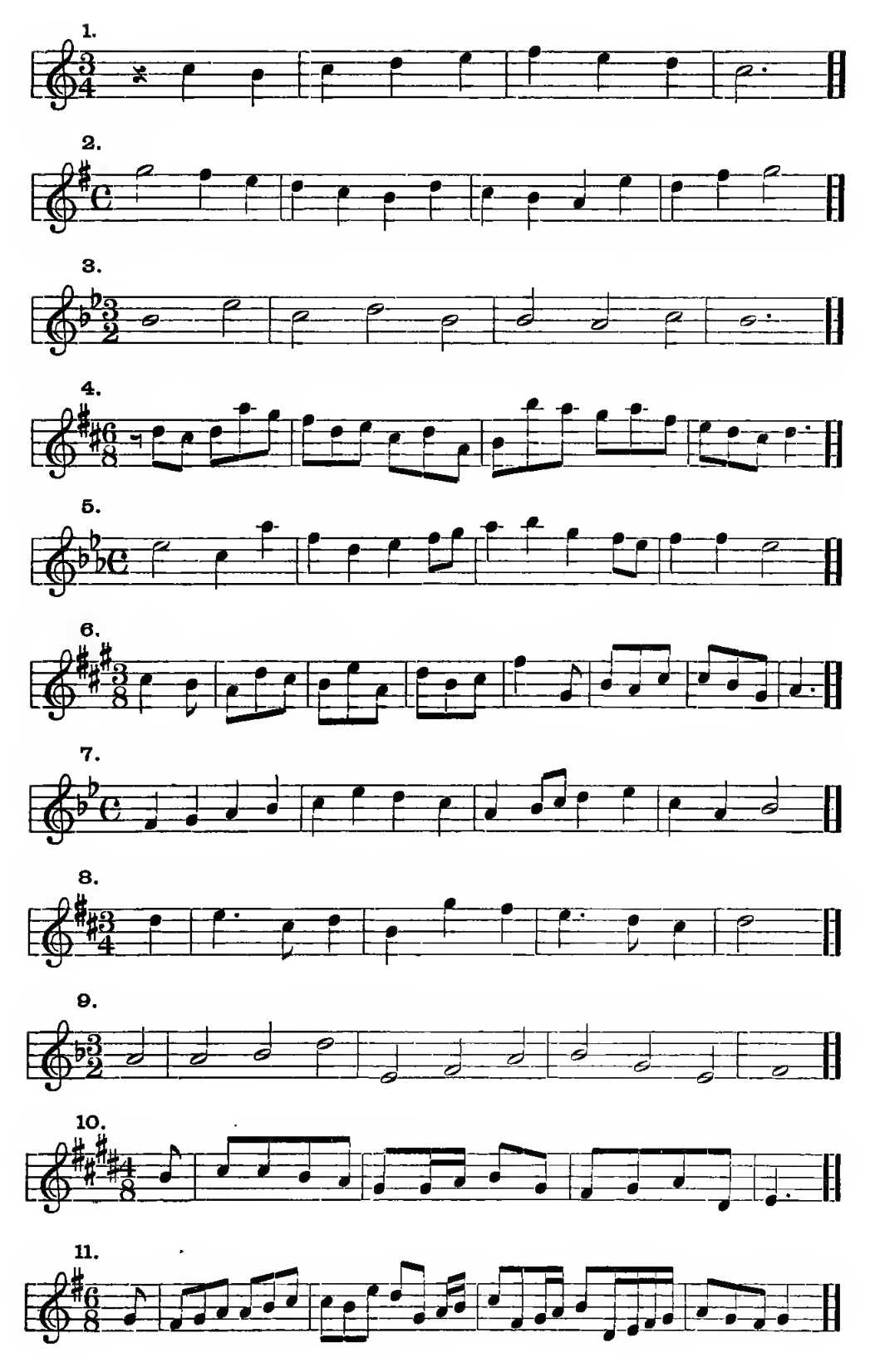
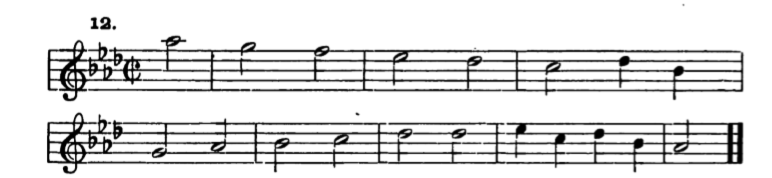
To each of the following given major melodies, a second part is to be added, in corresponding rhythm, according to the above rules, and as shown in Ex. 39.
The given melody is to be used first as upper part, where it is written, and the counterpoint added below. This may be done on the same staff (as in Ex. 39), or upon a separate staff (with bass clef, as seen in Ex. 43, b and c). The use of two staves is preferable, as it permits greater freedom.
Then the given melody is to be used as lower part, an octave lower than where it is written (or two octaves lower, if necessary), and counterpointed above, — with an added part that differs reasonably from the preceding solution.
Several different versions of the added part should be made in every case, — as was seen in Ex. 39.
Exercise 4.1

Exercise 4.2

Exercise 4.3

Exercise 4.4

Exercise 4.5

Exercise 4.6

Exercise 4.7

Exercise 4.8

Exercise 4.9

Exercise 4.10

Exercise 4.11

Exercise 4.12
[A solution of Melody 4 will be found in the Appendix, to which the student may refer, after conscientiously completing his own versions.]
Besides these, the student is to write a number of original melodies with added counterpoint, — designing the melodies together (as duets). See the Note following Ex. 52.