48. As stated in par. 30, all rules of melodic movement in the major mode are valid for minor, with no other modification than that they are applied somewhat more strictly in minor (as far as the movements of the active steps are concerned). Review, carefully, paragraphs 30, 31 and 32, and observe the rule of par. 32, that, in minor, the 7 th step must be lowered in the descending succession 8-7-6-5; and the 6th step must be raised in the ascending succession
49. Further, all the rules given in Chap. IV for the contrapuntal association of two melodies, in major, apply without exception to minor also. The choice of fundamental intervals (3rd, 6th and 8th) for the counterpoint of a given melody is precisely the same in both modes.
It is simply necessary, in minor, to guard the melodic progressions more carefully, and to be sure that each part, alone, is a perfectly acceptable melodic line.
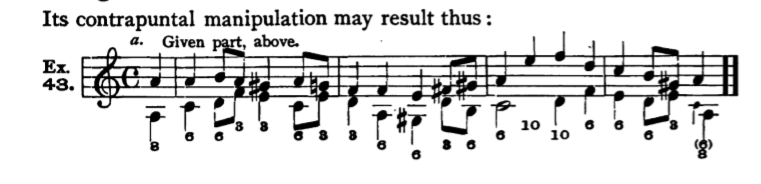
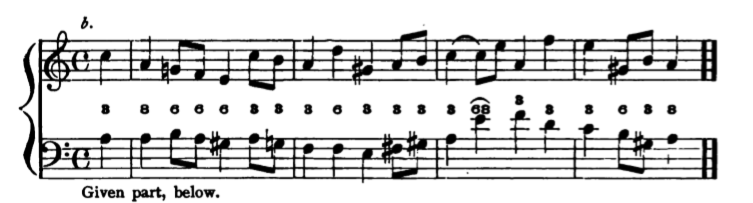
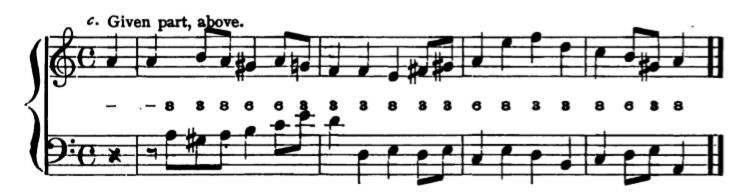
Explanation. In one instance only, there are four successive 3rds (in version b). This should be the limit. The added parts all move with considerable freedom, but are everywhere melodically correct.
At the beginning of measure 3 in version a, one note counterpoints two of the given part. In version c the added part has a wider range than usual, and diverges farther from the given part (at one point, in the third measure, the two lines are over two octaves apart). This is entirely defensible, as long as the melodies are separately perfect.
Compare the three different added parts, carefully.
Exercise 5
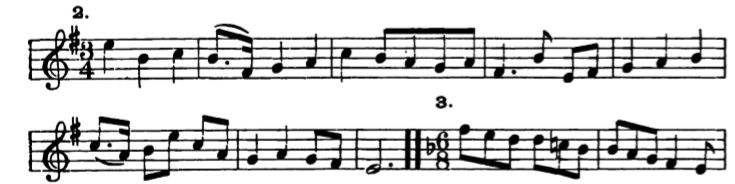
Two-Part Counterpoint with Fundamental Intervals, Minor Mode.
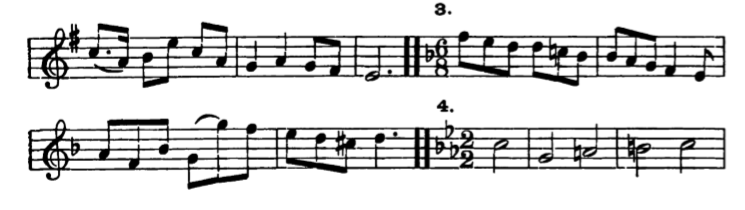
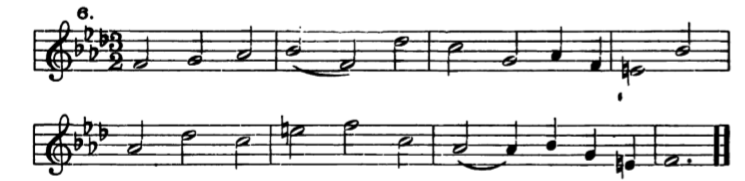
Manipulate the following minor melodies, exactly according to the directions given in Exercise 4: — 1.
 Playable Books