 Playable Books
Percy Goetschius · section 8 of 29
Chapter VI. Exceptional Intervals
Read and hear this section in the playable edition →Try it yourself: use the secondary intervals, and have them checked →
51. Greater freedom of melodic progression may often be obtained by a few judicious exceptions to the above fundamental rule of harmonious contrapuntal association. While the 3rd, 6th and 8ve are undeniably the most reliable, and must at all times constitute the real basis of the contrapuntal union of parts, there are a few other intervals, mostly of a mildly dissonant character, which, when used in moderation, greatly improve the effect, without in the least impairing the general harmonious or consonant character of the sentence as a whole.
52. Rule 4. These secondary intervals, of somewhat exceptional character, are the perfect fifth, the augmented fourth, or diminished fifth, and certain major seconds, or minor sevenths.
53. The perfect fifth is very rare, and should be used only when it represents the Dominant chord (—possibly, more rarely, the Tonic chord).
It can, therefore, occur only singly, — not successively. And it should never appear in inverted form (as perfect fourth). For example:
Ex.44

54. The augmented 4th, and its inversion, the diminished 5th, are fairly common, and always good. In Major, they occur only in the chord of the Dom.-7th, as union of steps 4 and 7. For example:
Ex.45
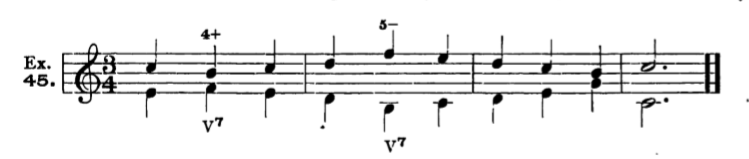
Invert this example; that is, copy it out, placing the upper part; an octave lower, and the lower part an octave higher, than here written. Do this, without fail.
55. Observe that these intervals are used in counterpointing the tones b and f in C major, —the 7th and 4th scale-steps.
Observe, further, that the augmented interval generally strives " outward," into a larger interval; and that the diminished one draws " inward," to a smaller one.
Or, observe simply that the correct resolution of each of these active steps takes care of the melodies.
For further illustration:
Ex.46
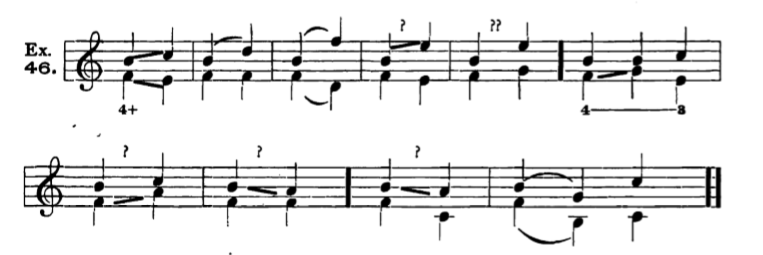
The slurs in this example indicate where the chord remains unchanged, — a circumstance which always justifies nearly every irregularity. Note this fact well.
Invert this example, as before, and it will illustrate the treatment of the diminished 5th. Do this, without fail.
56. In minor, the augmented fourth and diminished fifth appear in exactly the same way, at steps 4 and 7, in the chord of the Dom.-7th.
But they also appear (though more rarely) in the union of steps 6 and 2, in minor; possibly also in the union of step 3 and the raised 6th step (par. 32).
As usual, the melodic resolutions must be respected, whereby the results noted in par. 55 will be observed.
Thus (C minor):
Ex.47

57. The minor 7th, and its inversion, the major 2nd, are rare. They should be limited to the union of steps 4 and 5, as part of the chord of the Dom.-7th. Possibly, though very rarely indeed, they may occur as steps 1 and 2, in the II7. For illustration (C major and C minor, alike):
Ex.48

Invert this example, as before. Also write it out in C minor.
58. Observe that the interval of a 7th draws "inward," and the interval of the and " outward," as a rule. This statement is correct, but not sufficiently explicit. As usual, almost ever7thing depends upon the proper resolution of the active (4th) step. The whole matter may be stated thus:
In the interval of a 7 th, the lower tone is a chord-root, the upper tone a chord-seventh. (When inverted, as 2nd, the lower tone is, of course, the chord-seventh.) This tone, — the chord-seventh, — generally moves downward one step; but it may remain where it is; and it may make a leap (usually downward) when the chord remains unchanged. Thus (C major and C minor):
Ex.49
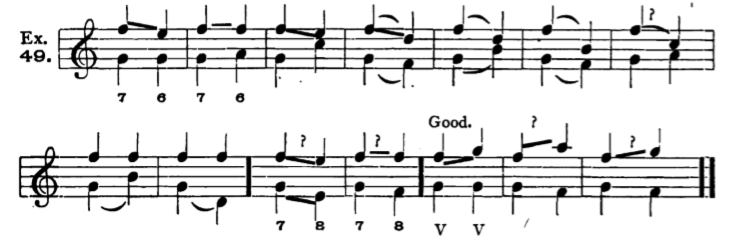
The slurs again indicate where the chord remains the same, and thus account for the apparent violations of the rule. Invert this example for the illustration of the treatment of the interval of a and. Do this, without fail. Also write out both versions in C minor.
59. For general illustration: Given the following major melody:
Ex.50

Ex.51a
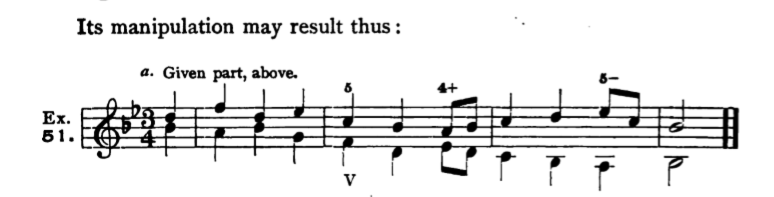
Its manipulation may result thus:
Ex.51b

Ex.52a
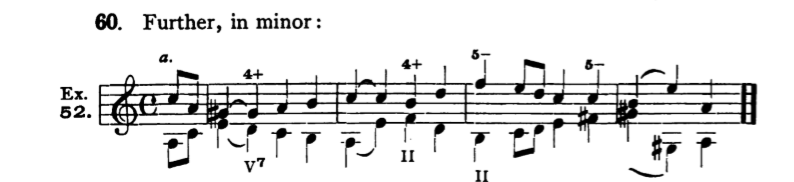
Ex.52b

Note. There is not the slightest evidence that either of the two parts, in these two illustrations, was a " given part." Evidently, they were conceived together, under the constant influence of the two vital requirements,
(1) perfect melodic formation of each part alone, and
(2) good intervals at the points of contact, to ensure harmonious cooperation.
Invert both of these examples, without fail.
61. Rule 5, — very rare. In minor, it is also possible to use a diminished 7th (and its inversion, an augmented and) in the union of steps 6 and 7 only. They are subject to the usual rules (given in par. 58). Thus:
Ex.53

Exercise 6
Fundamental and Secondary Intervals; Major and Minor Modes.
1. Manipulate Ex. 38 and Ex. 42 again, according to this lesson.
2. Also a few of the given melodies of Exercise 4 and Exercise 5 again.
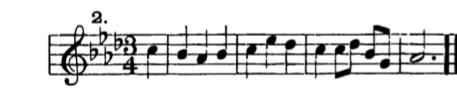
3. Also the following given melodies, according to former directions, and the roles of this chapter:
Exercise 6.1

Exercise 6.3
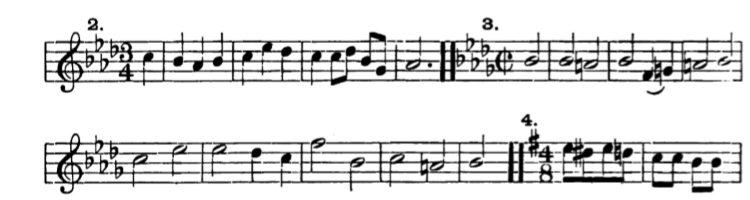
Exercise 6.2
Exercise 6.4
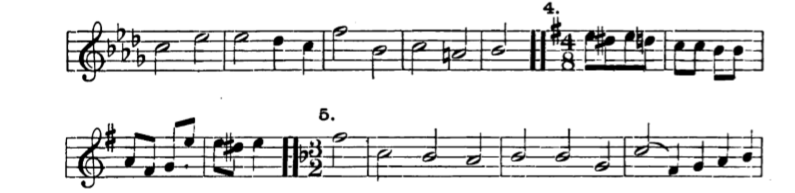
Exercise 6.5
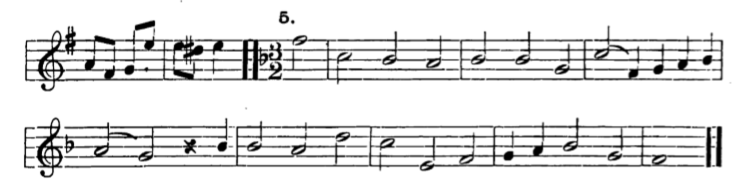
Exercise 6.6

Exercise 6.8
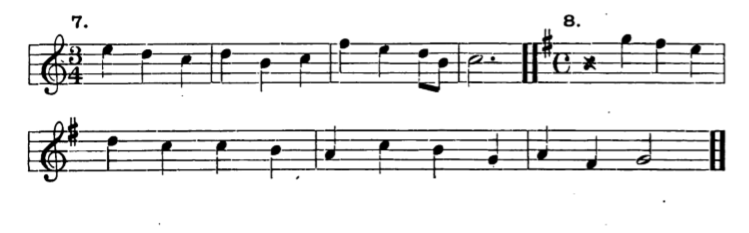
Exercise 6.7
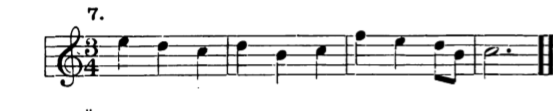
Exercise 6.9

Exercise 6.10

Exercise 6.11

Exercise 6.12
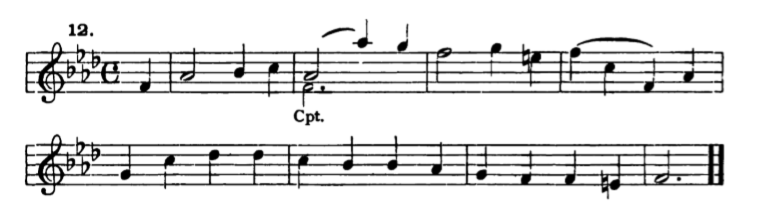
[A solution of Melody 5 will be found in the Appendix.]
4. Also write, as usual, a number of original melodies with counterpoint, composing the two parts together, — like Ex. 52.