 Playable Books
Percy Goetschius · section 9 of 29
Chapter VII. Rhythmic Diversity. Two Notes To A Given Beat
Read and hear this section in the playable edition →Try it yourself: write two notes to each beat, and have them checked →


62. The rhythm of the added voice does not always correspond to that of the given melody. That is, the counterpoint may not only be devised " note against note " in exactly or nearly similar rhythm, as in the preceding lessons, but may run in a more rapid rhythm of two (or more) notes to each note of the given melodic part.
63. When this takes place, — when two or more notes accompany each given note, — a necessary distinction arises, with reference to the relative importance of the several tones in each group (or beat); for it is probable that not every single one of the added tones can be of equal harmonic significance.
In making this distinction, the tones are defined as essential and unessential. In a group of two notes (against one in the other part), one is usually essential and the other unessential; in a group of three notes, there will generally be one essential and two unessential tones. The distinction is important, because the burden of contrapuntal agreement devolves, naturally, almost wholly upon the essential tones; whereas the unessential ones slip smoothly between, with little or no responsibility.
64. In thus qualifying the tones, the student is influenced largely by the rhythmic location of the tones; the one which occupies the accented fraction of the beat is somewhat more likely to be essential, while the unaccented fractions are apt to be filled in with unessential tones. For illustration (the unessential tones marked x):
Ex.54
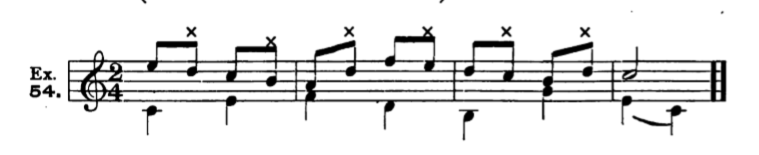
The d and b in the first measure are so-called Passing Notes.
As may be seen, this counterpoint would be quite perfect if the unessential tones (marked x) were all omitted, — thus:
Ex.55

from which the conclusion is drawn, that these tones are unimportant, unessential.
Invert these examples; that is, copy them out, placing the upper part an octave lower, and the lower part an octave higher, than here written.
65. But this is not the only test. The most reliable guide is, after all, the harmonic quality of the tone. A tone which is foreign to the chord of the beat cannot be essential; it must be unessential, even when it occupies the accented fraction of its beat. This is seen in Ex. 54; all the tones marked unessential are foreign to the harmony (chord) of the beat, excepting the d in the second measure, and the d at the end of the third measure. (These two <f s are considered unessential, because they are less accented than the harmonic tones which precede them.)
In the following version, with three notes to each one of the given part, some of the unessential tones, foreign to the chord of the beat, appear on the accented fraction:
Ex.56

The f in the first beat is the " upper Neighbor " of the essential tone e; and the a in the second beat of the 3rd measure is the " lower Neighbor" of the essential tone b.
Invert this example, as usual. And test it, as before, by omitting all the marked notes; it will agree exactly with Ex. 55.
66. Rule 1. In general, then, all tones that do not constitute a plausible chord-form, that do not belong to the chord which the beat evidently represents, are unessential tones, whether they occupy the unaccented or the accented fraction of the beat. And tones which do form a part of the chord are usually essential. If two or more such chord-tones appear in the same group, only the accented one, however, is regarded as essential; see the first beat in the second measure of Ex. 54 and Ex. 56 (the note d in each case).
67. Rule 2. The essential tones, in the added part, must be determined precisely as if they stood alone, — note against note, as in former lessons. They are therefore defined according to the table of permissible intervals, 6th, 3rd, 8ve, occasionally the augmented 4th, diminished 5th, and so forth, as has been learned.
This implies that Ex. 54 and Ex. 56 were actually conceived first in the form given in Ex. 55. Such a conclusion is just, to a certain extent; but the unessential tones which " slip smoothly in between " will be found to exert considerable influence upon the counterpoint as a whole, and it is therefore not wise to construct the basis of the contrapuntal part without regard to them. Ex. 55 should not exactly appear as the original, pre-defined form, but rather as the result; as the form to which Exs. 34 and 56 could be reduced.
68. Rule 3. An unessential'tone may form any intervalwith the given tone, but its movements are governed strictly by its relation to the essential tone of its group, as follows:
69. Rule 4. In general, an inharmonious interval (that is, a "doubtful " interval, and, 4th, 5th, 7th) should be followed immediately by some "good" interval. Scan Ex. 56 again, with reference to this rule, thus:
Ex.57

Explanation. In the first beat, the "poor" interval of a 4th (permitted because the tone is unessential) is immediately followed by the " good " interval of a 3rd. In the second beat, the " poor " 7th (unessential) is followed by the " good " 6th. And so on, throughout.
This being properly provided for, the reduction of the embellished form to the original essential form usually follows as a matter of course. Comp. par. 67.
Invert this example, as usual, and note the change in the interval numbers.
70. Rule 5. Harmonic tones, — such as belong to the chord which the beat represents, — may leap to any other tone of the same chord. This confirms the rule of par. n. See Ex. 54, the first beat of the second measure; and the following:
Ex.58
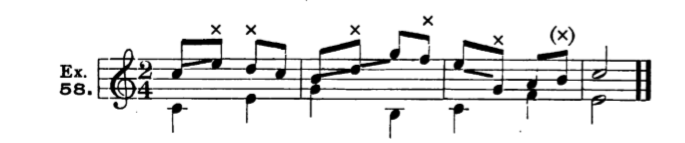
Invert this example, as usual.
71. Rule 6. On the contrary, inharmonic tones, — those not belonging to the chord, — should not leap, but must progress stepwise. They must be accounted for as passing-notes or neighboring notes which refer diatonically (scalewise) to the following essential tone. And, as a rule, such tones should not enter with a leap, either. In a word, skips should be limited to harmonic (chord) tones. The following is not good:
Ex.59
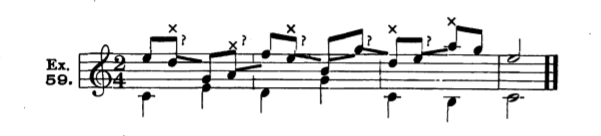
To this rule there are two notable exceptions, as follows:
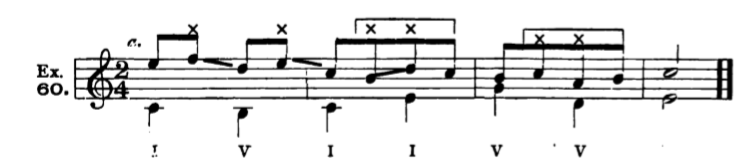
(1) The upper " neighbor" of a chord-tone may leap a 3rd down to the lower neighbor; or the lower neighbor may leap to the upper one; in other words, the two neighbors of any chord-tone may appear successively,— if their chord-tone follows, as resolution of both.
(2) The upper " neighbor " may leap down a 3rd, under any circumstances.
The following forms are correct:
Ex.60a
Ex.60b
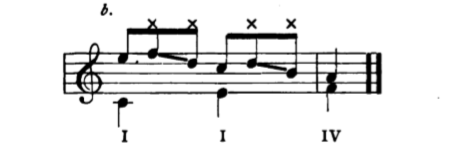
Explanation. The tone f in the first measure is the upper neighbor of the chordtone e (the I of C major). Instead of moving stepwise, back into e (or on up into g): it leaps down a 3rd. The irregularity is more fully illustrated in the triplet-figures at b.
In measure 2, the tone b is the lower neighbor of c; it leaps up to d, which is the upper neighbor of the same c, and then c itself appears and resolves them both. In the third measure, c and a are the two neighbors of the chord-tone b, which follows both properly.
It will be observed that the upper neighbor has more liberty than the lower one.
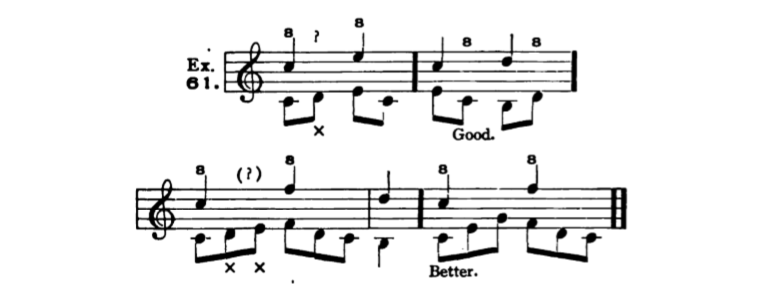
73. Rule 8. Successive octaves (which were proven objectionable in Ex. 34) are not rectified when separated by one unessential tone, but may be excused when an accented essential tone intervenes (or, possibly, when separated by two unessential tones). Thus:
Ex.61
74. Reverting to par. 67 (which review), the student may find it helpful, at first, to counterpoint the given melody with essential tones (fundamental intervals) in corresponding rhythm, and then adjust the unessential tones to these (as Ex. 54 was adjusted to Ex. 55).
At all events, such a process is instructive, and worth pursuing for a while.
Given the figure of three ascending scale-steps (upper part of Ex. 62), with a number of possible counterpoints in similar rhythm: —
Ex.62

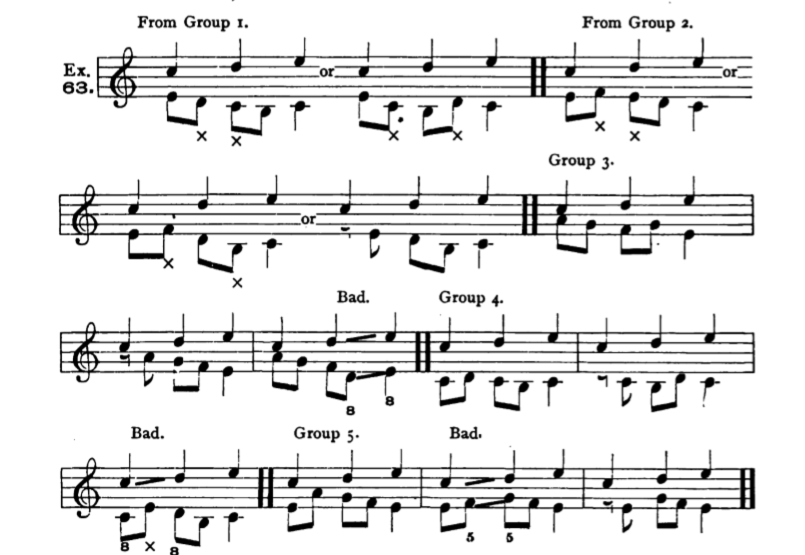
These simple counterpoints may be transformed into a rhythm of two notes to each beat, as follows:
Ex.63
From Group i. From Group 2.
Ex.63also

Compare these two examples carefully (mentally, and also at the keyboard), and observe:
1. That the progressions of the quicker part in Ex. 63 are mostly stepwise. Compare par. 71.
2. That when a skip is made, it always represents a good chord-line. Compare par. 70.
3. That the unessential tone may lie between the beats (unaccented), or may fall upon the beat (accented). See the first and second measures of Ex. 63. Compare par. 65.
4. That two unessential tones may appear in succession, when the progression is stepwise. See the first and third measures of Ex. 63.
5. That a rest may sometimes take the place of the accented fraction (measure 5). This depends upon what precedes, and is easily controlled. It is common at the very beginning (compare par. 47), but may also occur, occasionally, in the course of the phrase, after a " good " interval.
6. That a direct succession of octaves, or of perfect fifths, is not good; but that the error may be rectified by sufficiently separating the intervals, — see par. 73.
7. That the last three measures of Ex. 63 diverge from the original groups (of Ex. 62). This is because the last unessential tone (the fourth 8th-note), being a chord-interval, becomes practically " essential" in character, and therefore chooses its own progression. This is important, and shows that, ultimately, the student will not first define the essential tones throughout, but will let the choice depend upon momentary conditions, created by the trend of the parts. Compare, again, par. 67.
75. Quick repetitions should be avoided, as a rule. In their place, the leap of an octave is always permitted, and is extremely effective. Thus, Ex. 64 is awkward; but changed to Ex. 65, the very same notes are excellent:
Ex.64

Ex.65

76. Further, it is by no means necessary that the quicker rhythm should be sustained in the same part throughout. For example:
Ex.66
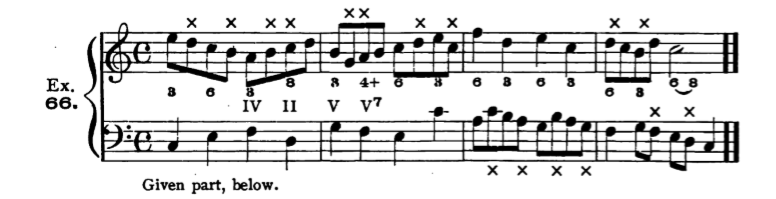
In measure 3, the given part, itself, has two notes to a beat, and the added part, reversing the rule, relaxes its rhythm and counterpoints one note against two. In the fourth measure (second beat), both parts have the quicker rhythm together.
Such alternation (and occasional union) of rhythmic movement adds greatly to the musical interest of the sentence, without affecting any of the rules.
Exercise 7
Two-Part Counterpoint, Two Notes to Each Beat.
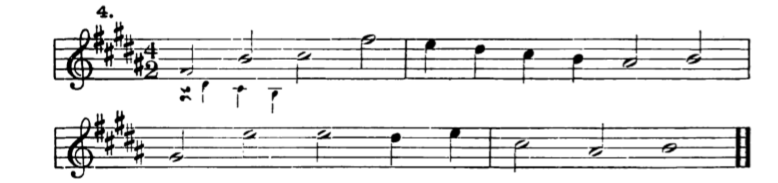
Manipulate the following given melodies, in a constant rhythm of two notes to each beat, — similar to Ex. 66, — using two staves. Follow the general directions given in Exercise 4.
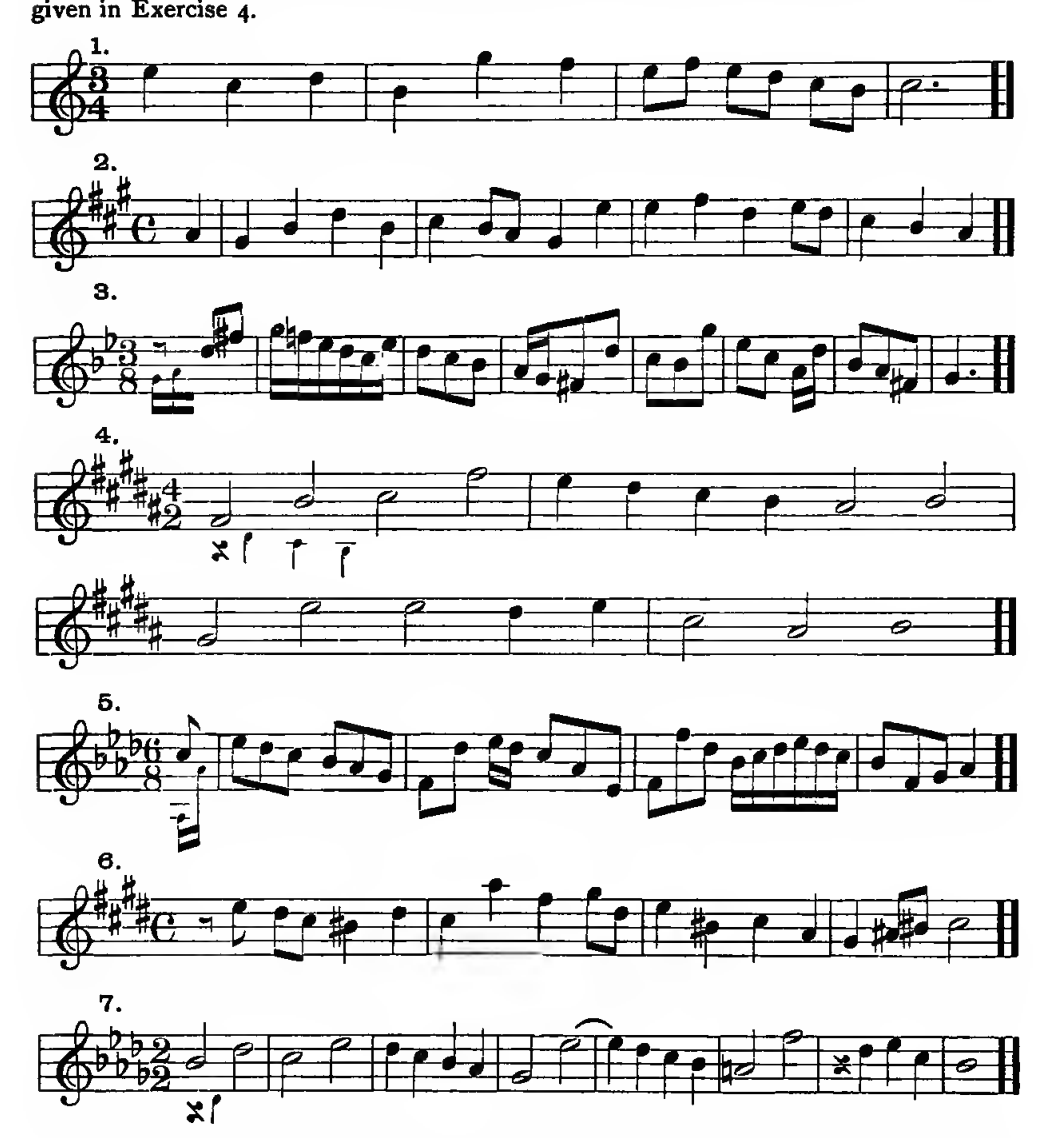
Exercise 7.1

Exercise 7.2

Exercise 7.3

Exercise 7.4
Exercise 7.5

Exercise 7.6

Exercise 7.7

[A solution of Melody 6 will be found in the Appendix, with which the student may carefully compare his own versions.]
Besides these, re-counterpoint the given melodies of the preceding Exercises, according to the rules of this chapter (with two notes to each beat). The student will do wisely not to neglect this additional task, for practice is here of the greatest value.
Also write, as usual, a number of original melodies with counterpoint (as, duets) imitating the style of Ex. 66.