 Playable Books
Percy Goetschius · section 11 of 29
Chapter IX. Three Notes To A Beat
Read and hear this section in the playable edition →Try it yourself: write three notes to a beat, and have them checked →
91. When the rhythm of the added part is again quickened, so that three tones accompany each beat of the given part, there will generally be one essential tone, and two unessential ones, in each group.
92. The rules governing these are exactly the same as before (Chap. VII):
1. The essential tones are chosen according to the fundamental rule of good intervals (6th, 3rd, 8ve; occasionally the perfect 5th, diminished 5th, augmented 4th, etc.).
2. The unessential tones may form any interval.
3. The quicker part runs chiefly stepwise (smoothly); but may leap, along any good chord-line.
4. Successive 8ves and perfect 5ths should be avoided.
5. Each part must be melodically perfect, in and by itself.
6. The essential tone generally stands at the beginning of the group
(on the accented fraction), — but by no means necessarily.
7. Either " neighbor " of a harmonic tone may leap (a 3rd) to the other neighbor, on condition that the principal (harmonic) tone follows, and resolves both. Par. 72, (1). fe. The upper " neighbor " may occasionally leap down a 3rd, without this condition (usually in the upper part). Par. 72, (2). For illustration:
Ex.74
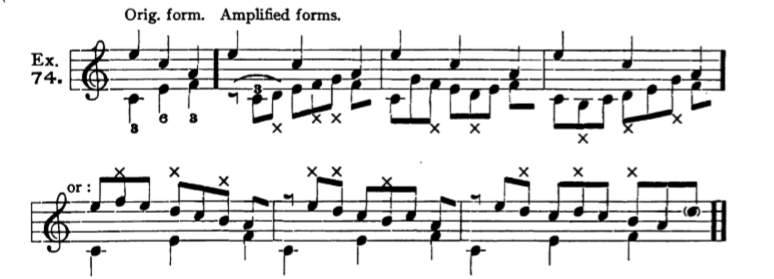
Ex.74also
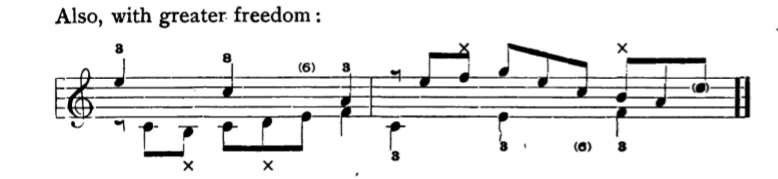
Also, with greater freedom:
Ex.75

In group I, the two neighbors, b and d, precede their principal tone c (par. 92-7). Exactly the same thing takes place in groups 2 and 3; but observe the change in their location in the group. In group 5, the upper neighbors leap down a 3rd, without ultimate resolution (par. 92-8; see also Ex. 60, b).
In inverting these examples, the student will learn that the result is perfectly good in every instance, — excepting Ex. 75, group 5. That is, all these irregularities are permissible in either the upper or the lower part, — excepting that of par. 92—8, which, if used, should be carefully tested.
94. Further, with alternating rhythmic movement (review par. 76):
Ex.76
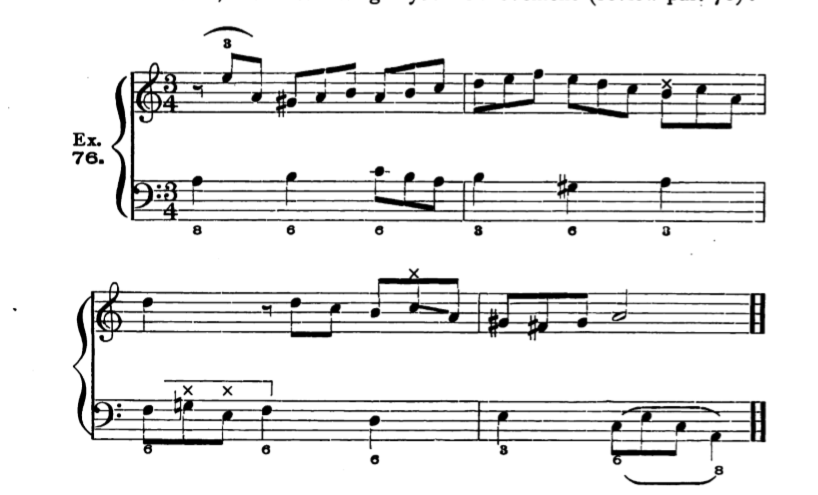
Invert this example, as usual.
In the first beat of the third measure, the 7th scale-step (g-sharp) is lowered to g-natural, because it descends, In the first beat of the last measure the 6th scale-step (f) is raised to f-sharp, because it ascends. Compare par. 32, and Ex. 3o.
95. As the rhythm quickens and the tones multiply, in this manner, the principle of par. 28 becomes more and more imperative.
Review par. 28 thoroughly, and endeavor to apply the rule of the sequence, and of uniform grouping generally, as much as possible in the running part.
For example: The following two versions are both faultless counterpoint; but version b is far better music than version a because the uniform arrangement of its groups gives it a more definite character, and clearer significance than the other,—which creates a more rambling, purposeless impression.
Ex.77
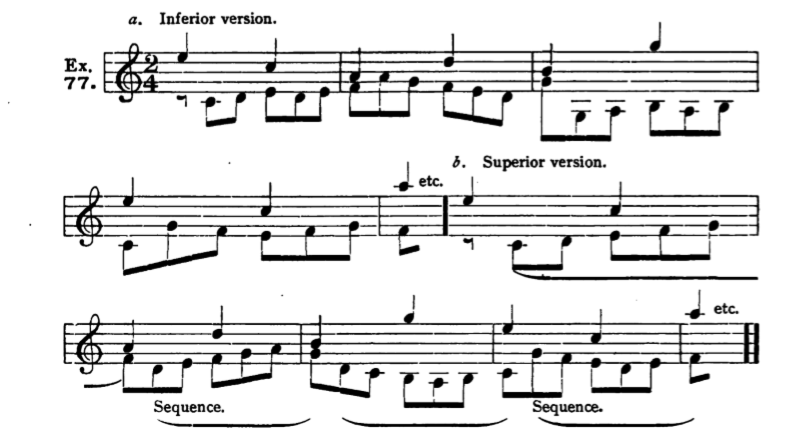
Invert both versions, as usual.
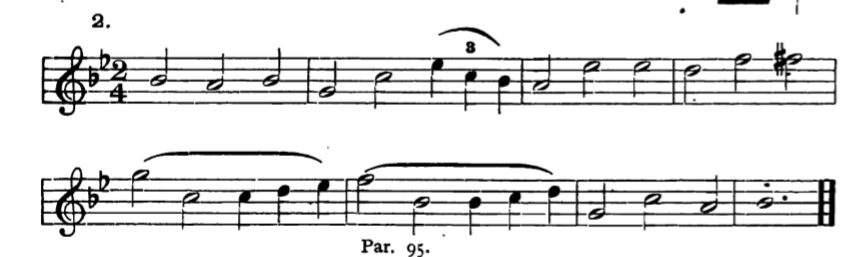
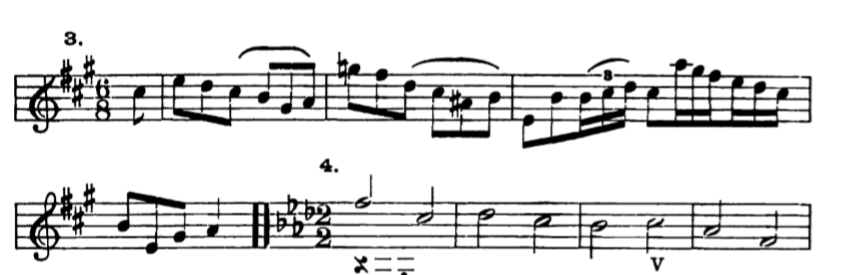
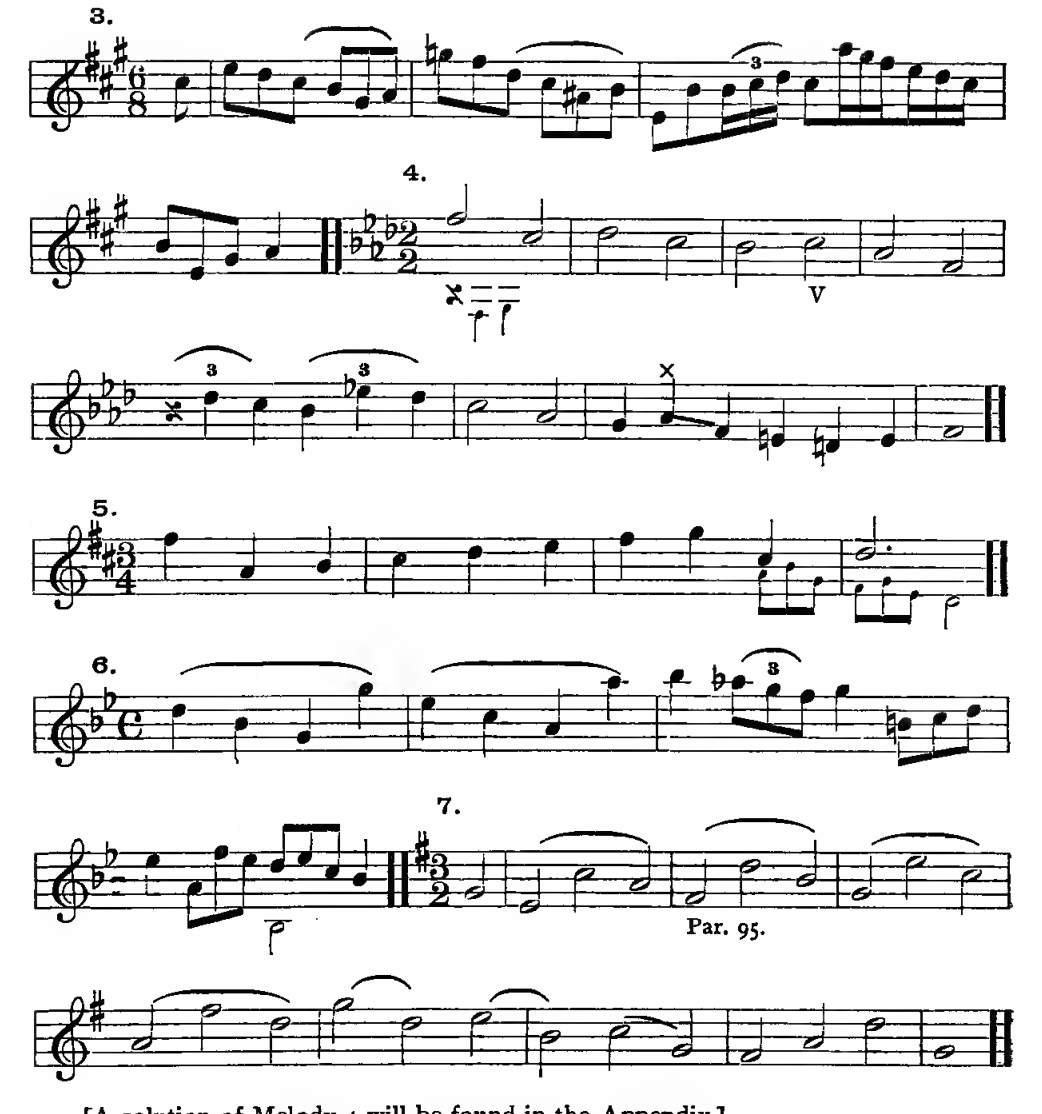
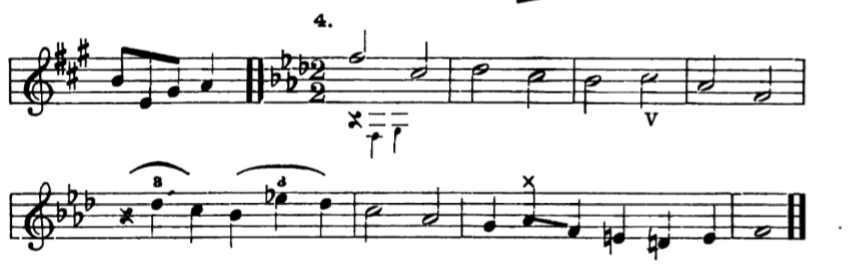
Exercise 9
Three Notes to a Beat.
Manipulate the following melodies (each one twice, as usual), in a constant rhythm of three notes to each beat (as triplets). Use two staves, as a rule:
Exercise 9.1

Exercise 9.2
Exercise 9.3
Exercise 9.4
Exercise 9.5

Exercise 9.6
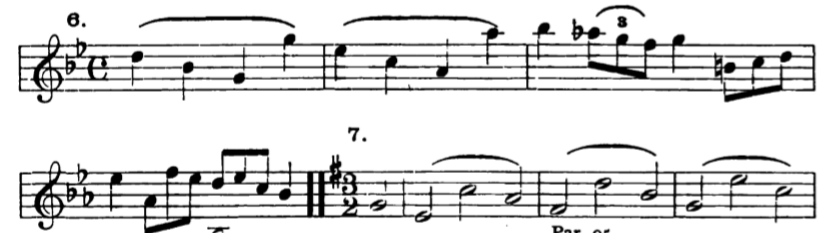
Exercise 9.7
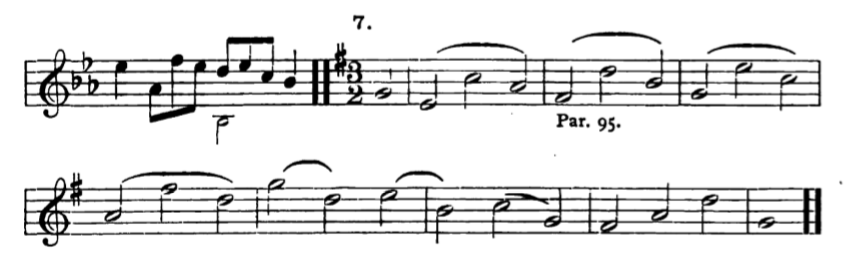
[A solution of Melody 4 will be found in the Appendix.]
Besides these, manipulate some of the given melodies of the preceding Exercises. And, as usual, write a number of original melodies with counterpoint, imitating the style of the above.