 Playable Books
Percy Goetschius · section 10 of 29
Chapter VIII. Modulations
Read and hear this section in the playable edition → Theory of HarmonyArnold Schoenberg · modulation
 Practical Manual of HarmonyNikolai Rimsky-Korsakov · modulation
 Treatise on HarmonyJean-Philippe Rameau · modulation
 Guide to the Practical Study of HarmonyPyotr Ilyich Tchaikovsky · modulation
 Supplement to the Theory of ModulationMax Reger · modulation
 Harmonic AnalysisBenjamin Cutter · modulation
77. It is neither necessary nor desirable that the added part, or the given melody, should remain in the same key from beginning to end. Modulations in either, or in both, of the parts, are likely to add greatly to the beauty and smoothness of the counterpoint. Such changes of key may be made at any point in the course of a musical sentence, and may be of any reasonable duration, but are subject to certain fairly strict conditions.
78. The most important of these is the limitation naturally imposed by the varying degrees of relation between the keys. Each key is a member of the greater family of keys; each key has its individual place in the system, and stands in perfectly definite relations to the other members of the key family.
79. The proper index of any key in the system of keys is its Signature; the number of flats or sharps it contains indicates precisely the degree of similarity or of difference between it and C major, — the central or zero key, the one which has accidentally been chosen for the plain alphabetic letters, without flats or sharps to inflect their pitch. The comparison of the signatures therefore exhibits the relative location of the keys, their degrees of similarity or difference, and, consequently, the degrees of relation or non-relation. For instance, the two-sharp and threesharp keys are more nearly related than the two-sharp and the four-sharp, or five-sharp (or any more remote) keys. Also, the two-sharp key is more closely located to the one-sharp, than it is to the zero (the " natural" scale), or any flat key.
80. The next-related keys are those whose signatures differ by no more than one similar sign. That is, the two-sharp key is next-related to the one-sharp key (which has only one sharp less); and is also nextrelated to the three-sharp key (which has only one sharp more). Further, the two-sharp key is next-related, — most closely related, in fact, — to the other key which has the same two-sharp signature; namely, the socalled Relative minor, — or Relative major, as the case may be.
Note. This rule of Signature-relations applies, strictly speaking, to major. But it is absolutely valid for both major and minor modes (those with corresponding signatures), because of their very close proximity to each other in the system of keys.
For illustration: D major is next-related to A major, to F-sharp minor, to G major, to E minor, and to B minor. And B minor (with the same signature) has the same group of next-related keys, — A major, Fsharp minor, G major, E minor, and D major.
Further, the next relatives of a three-flat key are: the two-flat keys, the four-flat keys, and the other key with three flats. That is, C minor is next-related to B-flat major and G minor, to A-flat major and F minor, and to E-flat major.
N. B. If the student is not absolutely familiar with all the signatures, major and minor, he will do well to pause here, and not undertake any exercises in modulation before thoroughly mastering this necessary item of musical knowledge.
81. Rule i. Modulations that are made during a brief melodic sentence (phrase, period, or double-period) should be limited to the next-related keys of the principal or central key. Thus, a sentence in C major may contain brief modulations into A minor (same signature), into G major or E minor (one-sharp keys), and into F major or D minor (oneflat keys). A sentence in E-flat major may exhibit transiently the keys of C minor, A-flat major, F minor, B-flat major, or G minor,— any one, or more, or all of these.
For example, a phrase with a three-sharp signature, containing brief excursions into the keys of two and of four sharps (the capital letters indicating major, and the small letters minor):
Ex.67
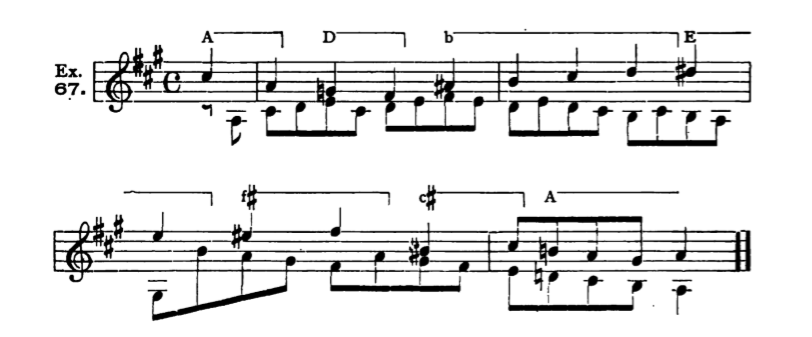
Invert this example, as in the preceding lessons.
82. There are, naturally, other possibilities beyond the closer range of the five next-related keys; such, for instance, as the so-called opposite mode of each related key (that is, the other mode of the same keynote,— D major and D minor, etc.). But in the elementary studies of counterpoint, the next-related keys should suffice for all modulatory changes.
83. Sometimes, as in Ex. 67, the changes of key are indicated by accidentals in the given part, in which case they are, of course, obligatory. But it is quite as likely that they may be effected partly, or entirely, in the added part, at the option of the student. For example, there are no accidentals in the following given melody, and it may therefore be counterpointed without changes of key, as in the foregoing lessons; thus (the given part above):
Ex.68
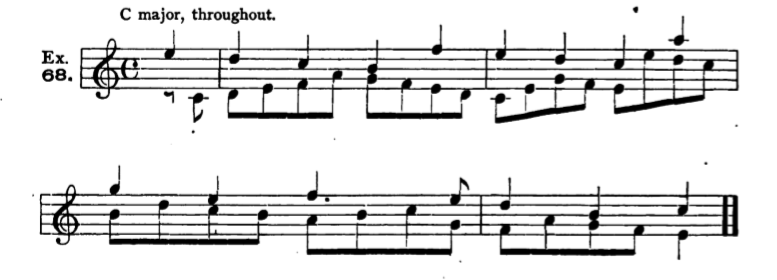
Invert this example, as usual.
84. Or, this same melody may be counterpointed in such a manner as to contain one or more modulations. For example:
Ex.69
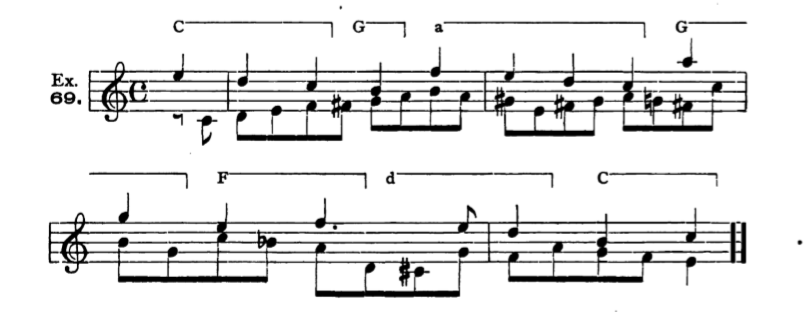
Invert this example, as usual.
85. It is naturally impossible, in these elementary lessons, to give complete explanations and directions for the manifold details of modulation. Besides close attention to the general rules, the student must rely upon his musical judgment to some extent. The main requirements, not only in counterpoint but in music-writing generally, are smoothness, and euphony; the union of tones must sound well, and each part must flow easily and naturally.
Such results can be obtained by every intelligent student who carefully notes the given rules, and who has diligence and patience.
86. Rule 2. The great fundamental rules of modulation are, to finish one key before passing into another; and to enter the new key at some yielding point— not abruptly.
Technically stated, this means that it is best to close a key (before modulating) upon some form of the Tonic harmony of that key, as this has a concluding quality; and to enter the new key with one of its Dominant (possibly Subdominant) chords, because these lead naturally into the desired Tonic. This may be best illustrated in chord-forms:
Ex.70
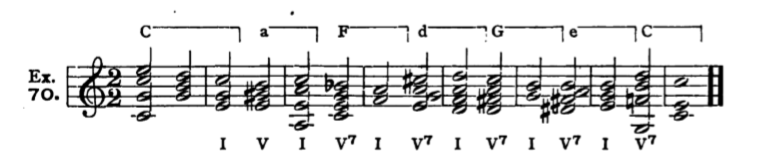
In every case, here, the keys close upon some form of their Tonic harmony (the I), and each new key begins with some form of its Dominant harmony (the V or V⁷). Further, in tone-lines:
Ex.71
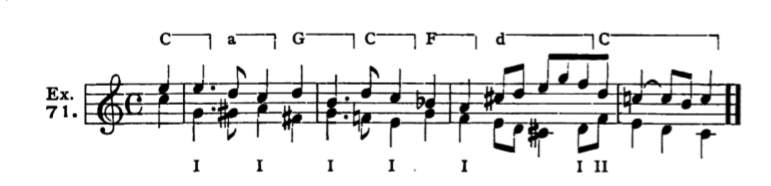
Invert this example, as usual.
Observe, that both here and in Ex. 70 only the keys of one flat and one sharp are represented, as nearest relatives of the principal key (C major, zero signature). Observe, also, that each key terminates with a Tonic impression, and that each modulation is made through the Dominant harmony of the desired key; in one case only (at the end) the new key begins with a Subdominant harmony (the II).
Also analyze Ex. 67, with reference to the chords employed in modulating.
87. In the following example (Ex. 72) most of the changes of key are made by means of a chromatic movement.
88. Rule 3. When a modulation is made chromatically, it is generally needless to regard the fundamental rule (par. 86); that is, when the chromatic inflection is used, it does not matter at what harmonic point the old key is abandoned. But the new key is generally entered through its dominant or subdominant, in any case. For illustration:
Ex.72

Invert this example, as usual. And analyze it carefully, with reference to the key-relations and the chords. Also analyze Ex. 69.
89. It is evident, then, that modulations may be made most freely and easily by means of the chromatic change. On the other hand, the manner of treating the chromatic change itself is subject to stricter regulations. Namely:
90. Rule 4. Chromatic changes are usually good; but they should not be made too rapidly (as a general rule not quicker than eighth-notes); and the chromatic movement should be introduced in the corresponding direction if possible, — so as to form part of a continuous line. Thus:
Ex.73
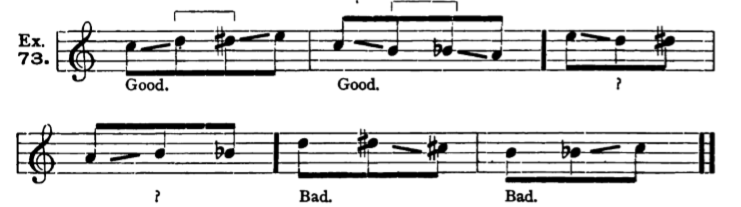
Examine Ex. 72 again, and, observe the straight-forward manner in which each chromatic progression is introduced, and how it continues in the same direction. There is one exception, — at the end of the third measure (in the lower part); the upward chromatic move is preceded by a leap, downward, and therefore confirms the rule of "turning after a wide leap" (par. 16). The same thing occurs at the begin. ning of Ex. 71, in the lower part.
Exercise 8
Two-Part Counterpoint, with Changes of Key.
1. Manipulate the following melodies, in corresponding rhythm (as in Exercises 4, 5 and 6, and examples 71 and 72), modulating wherever possible or necessary. In the first three melodies, the * indicates where changes of key are to be made. Use each melody twice, first as upper and then as lower part, as usual:
Exercise 8.1

Exercise 8.2
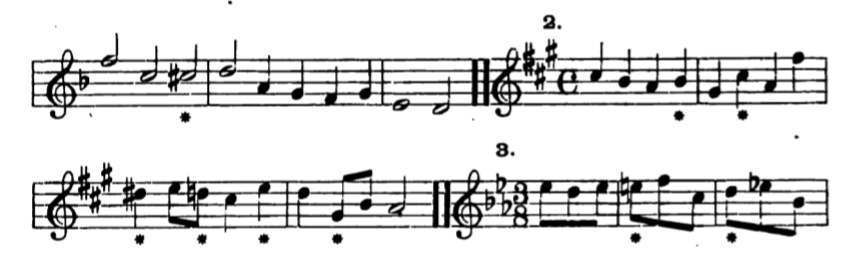
Exercise 8.3
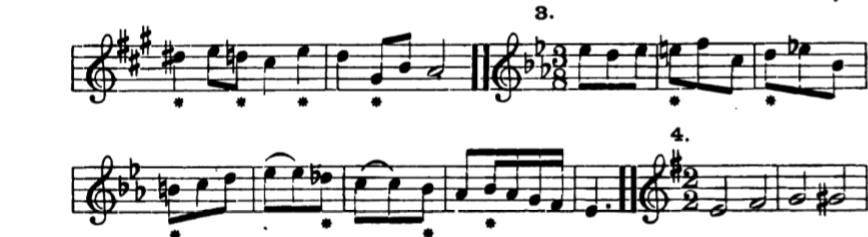
Exercise 8.4
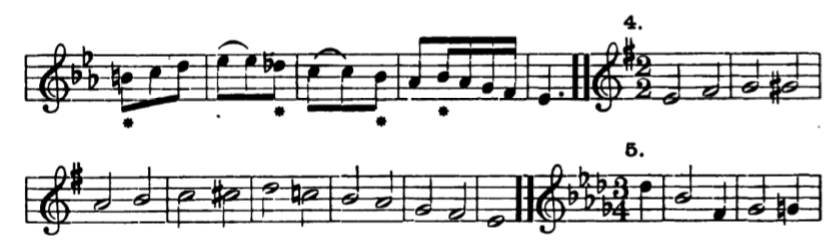
Exercise 8.5
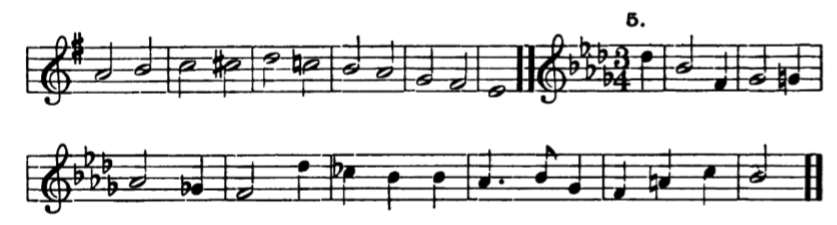
Exercise 8.6

2. Manipulate the following melodies in a constant rhythm of two notes to each beat (as in Exercise 7) with modulations,—similar to Ex. 67 and Ex. 69. Use two staves, as a rule.
Exercise 8.8
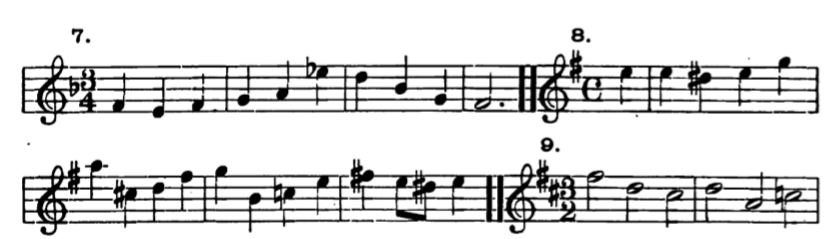
Exercise 8.7
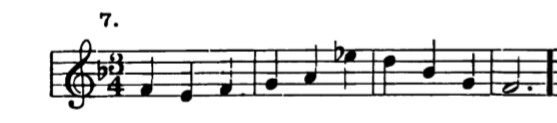
Exercise 8.9
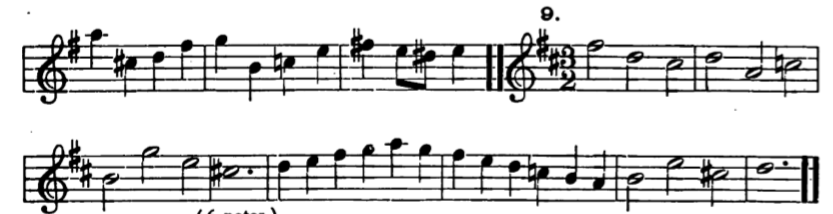
Exercise 8.10
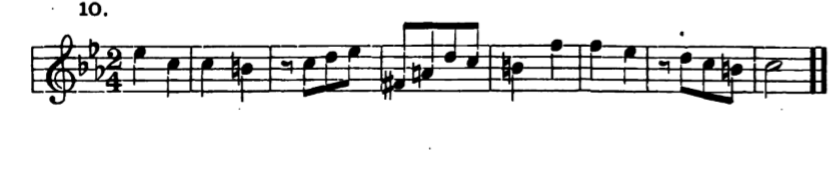
Exercise 8.11

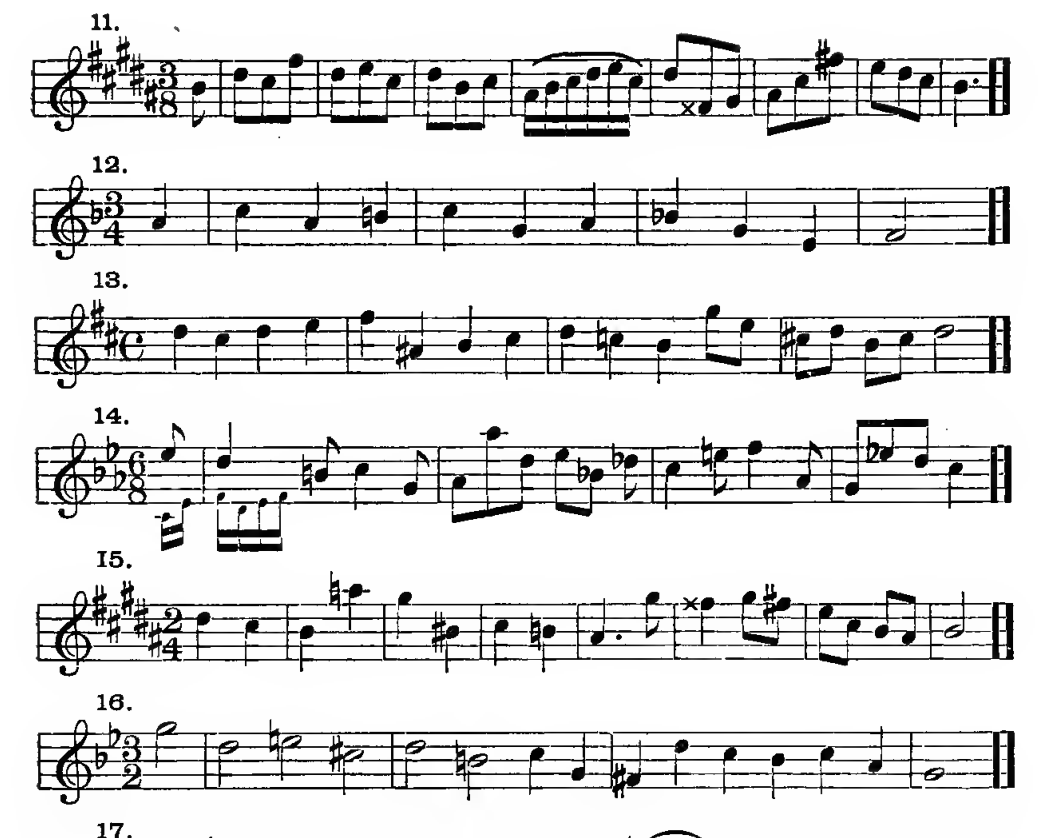
Exercise 8.12

Exercise 8.13

Exercise 8.14

Exercise 8.15

Exercise 8.16

Exercise 8.17

Exercise 8.18

[A solution of Melody It will be found in the Appendix.]
3. Also experiment with some melodies of the preceding Exercises, with a view to possible modulations in the added part, — on the principle of examples 68 and 69 (review pars. 83 and 84).
4. Also write, as usual, a number of original melodies with counterpoint.