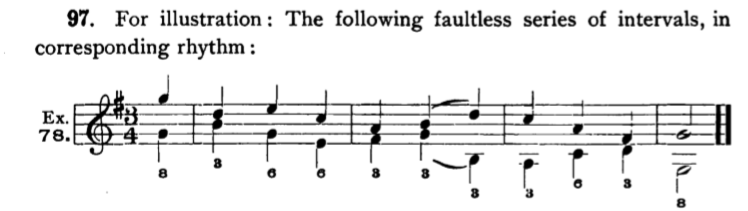
96. Another method of obtaining quicker rhythm in the counterpoint of a given melody, consists in simply shifting the tones of the added part forward, so that they fall between (instead of upon) the beats. The resuit is syncopation, and is invariably permissible when applied to a counterpoint that is entirely smooth and faultless to begin with. (Comp. par. 108.)
98. This process involves the Tie, — a device which the student must regard as one of the most important and effective means of relieving the monotony of the rhythm and of increasing the energy of the musical sentence.
When obtained in the above manner, as modification of a perfectly good interval-succession, the tie is as reliable as it is valuable, and suggests no other objection than that of possible monotony.
99. But this possible monotony may be easily avoided, either by using the tie in alternating parts, or by employing it occasionally only, instead of constantly.
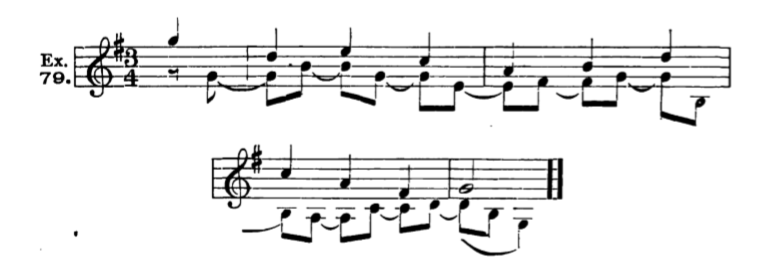
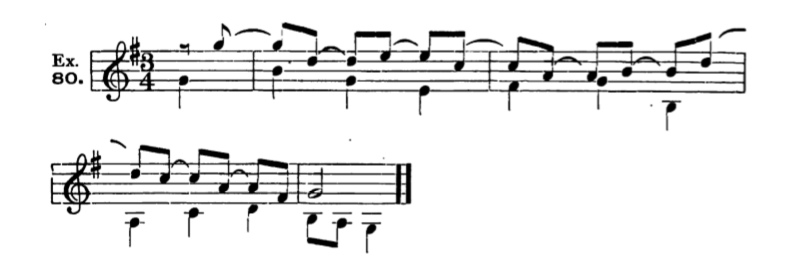
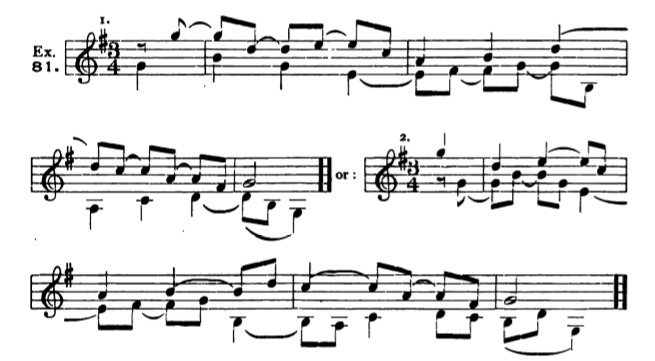
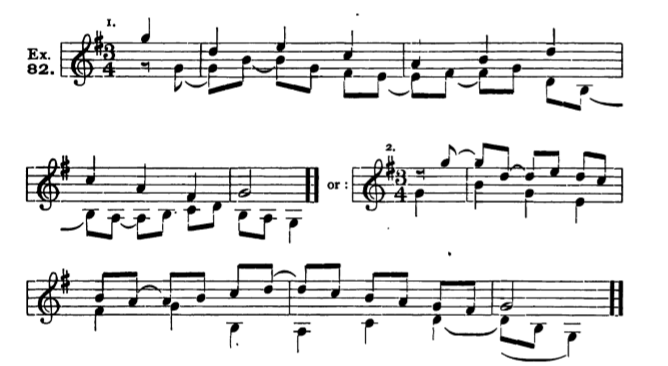
In the following examples the parts are alternately syncopated (in two of an almost endless variety of forms):
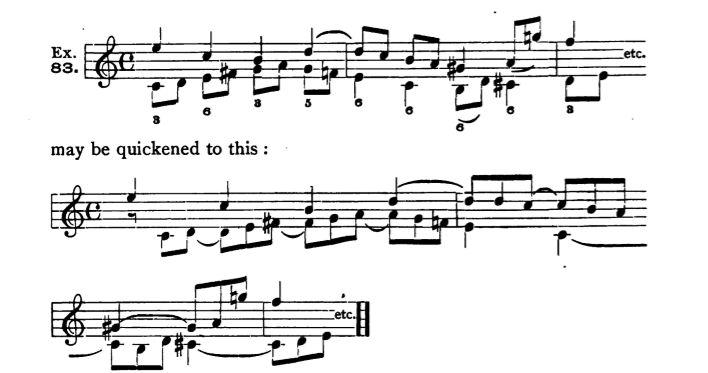
100. The same principle applies, naturally, to an original counterpoint of two notes to each beat, which, — if smooth and faultless in itself, — may be accelerated to a rhythm of three notes to each beat, by means of the tie and shifted rhythm. Thus, the following faultless counterpoint:
101. The greatest emphasis must be laid upon the necessity of avoiding all doubtful or irregular conditions, in the original construction of the counterpoint that is to be manipulated in these syncopated forms. Only the smoothest and most perfect models can be thus utilized.
Exercise 10
Shifted Rhythm And Ties; Two And Three Notes To A Beat
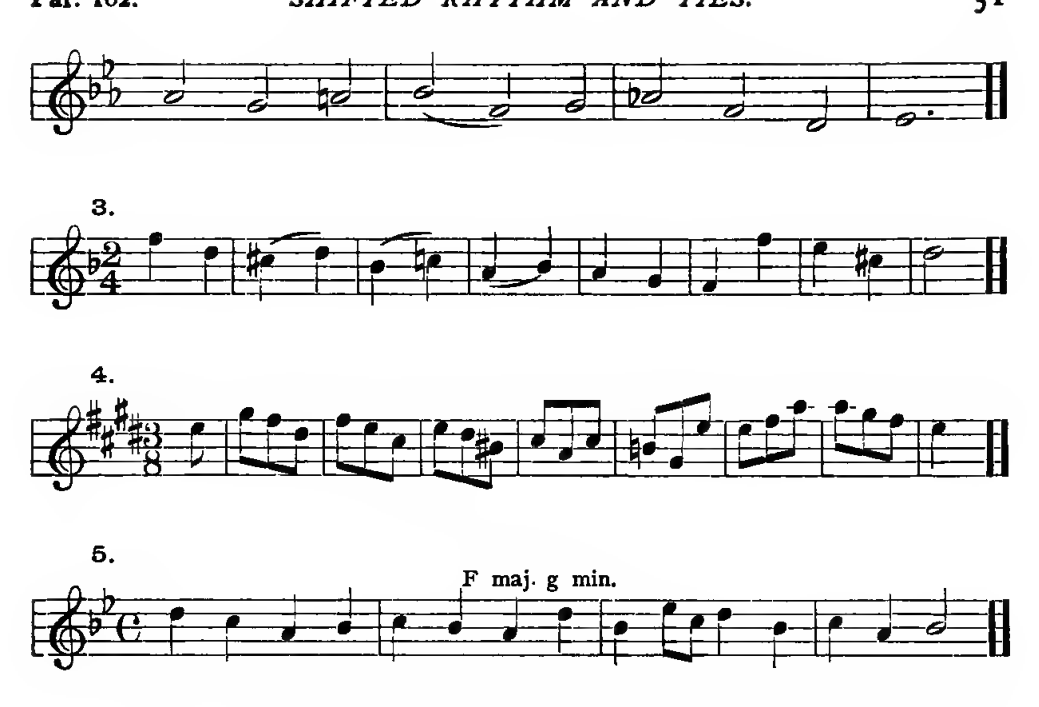
Manipulate the following melodies, according to the above rules, as follows: i. Construct (with each given melody) a faultless counterpoint in corresponding rhythm (like Ex. 78), and alter this to various accelerated forms with two notes to each 'beat (as in Exs. 79 to 82). At least six different versions of each melody should be obtained. Each melody to be used both as upper and as lower part, as usual.
2. Construct a faultless counterpoint with two notes to each beat (as in Exercise 7), and modify this to various accelerated forms with three notes to each beat (as in Ex. 83).
3. Besides these, experiment with some of the counterpoints constructed in earlier exercises (possibly omitting Exercise 6, because of the irregularities), modifying them to quicker rhythms. This may be done at sight, at the keyboard.
 Playable Books