 Playable Books
Percy Goetschius · section 13 of 29
Chapter XI. The Tie, Continued. Rests
Read and hear this section in the playable edition →102. It is also possible, of course, to introduce a tie without such reference to a pre-defined counterpoint as formed the basis of the preceding lesson. But in this case, — if the student undertakes to make independent use of the tie, — it is necessary that the nature of this technical device should be more fully understood.
103. Ties differ greatly in their effect. The longer tone, which results from using a tie, and therefore consists of portions of two contiguous beats (or measures), may produce a gentle strain upon the second beat; or, on the contrary, it may prove to be a dead weight upon both beats. Compare the two different applications of the tie in the following:
Ex.84-1
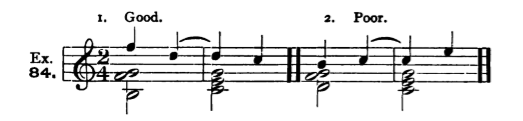
Ex.84-2
Note. In order to distinguish easily and quickly, we shall call the first of the two tied notes the "tying" note; and the second one the "tied" note. In the first group, the J at the end of the first measure is the tying note, the next d (at the beginning of the second measure) is the tied note.
In the first group (Ex. 84), the tied note appears to vitalize the rhythm and melody, because it is a foreign tone and strives for resolution. Such tones are called Suspensions, because they hold the correct harmonic tone " in suspense." Here, the second d " suspends " the real chord-tone c.
In the second group the tie acts as an incubus upon both melody and rhythm. The tying note (the first c) is called an Anticipation, because it does not belong to the chord of its beat, but " anticipates " the harmonic tone of the next beat. While such tones are sometimes used with striking effect, they are, when tied, usually disappointing.
104. A similar paralyzing effect is generally created when the tied note is longer than the tying note. And, in any case, it is not wise to leave the tying note very short; it (the note where the tie begins) should not, as a rule, be less than a half-beat.
Ex.85

The second group is not wholly wrong, as the tied note is a suspension; and suspensions are rarely limited in their time-value. Groups 1 and 4 are intolerable, because the tying notes are abrupt anticipations.
Note. When the tones are struck, instead of being tied, the case is entirely different; omitting the ties, the above are all possible. But see far. 73, and note the analogy between that rule and this one.
105. Rule 1. In using a tie, it is always best to make the tied note (the second one of the two) a suspension. In other words, the tied tone had best be foreign to the harmony of its beat, and then progress stepwise into the essential harmonic tone. In still other words, it is usually best to tie from one of the "good" intervals (3rd, 6th, 8th, augmented 4th, etc.) over into a "poor " one. Thus:
Ex.86
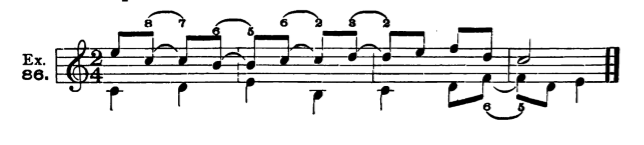
In the first measure, an 8th (good interval) is tied over into a 7th (poor interval); then a 6th is tied over into a cth, — and so on.
In the last measure, the suspension f is treated as upper neighbor, and carried over into the lower neighbor before resolving to e. See par. 92-7.
The whole example may, it is true, be reduced to a series of good essential intervals, from which it may appear to have been derived. This goes to prove that the simple process of syncopation explained in the preceding lesson (Exs. 78 to 82) is likely to prove quite sufficient for the ordinary applications of the tie, though it covers a narrower range of possibilities.
Invert Ex. 86, as usual, copying it out, and placing the upper part an octave lower, and the lower part an octave higher, than here written.
106. In the above example, each tied note was a suspension; the effect is therefore good.
When, on the contrary, the rule is reversed, and the tying note is an anticipation, the result is as follows:
Ex.87

107. Here, poor intervals are tied over into good ones. The effect is decidedly inferior to that of Ex. 86, and would be intolerable but for the significant fact that this condition prevails throughout; the device of anticipation is applied persistently and uniformly. Such consistency is an excuse for almost any irregularity.
108. This example, if reduced to its essential intervals, will be found to differ vitally from those of the preceding chapter. There, one of the parts was shifted forward; here, one of the parts is shifted backward. Evidently, both methods are possible; but it is surely far better to shift one part forward (par. 96).
109. Rule 2. It is also permissible to tie one good interval over into another good one; that is, to use the tie for a tone that is common to both beats. In this case, skips may occur, of course. For example:
Ex.88

Invert this example, as usual.
This arrangement of the intervals occurs quite frequently in Exs. 79 to 82,— which should now be analyzed with reference to these more general rules of the tie.
There, not every tied note is a suspension, but often a " good " interval,—in exact keeping with the faultless model, from which it was derived by merely shifting the notes forward.
110. Another important device for increasing the effectiveness of a tone-line, especially in counterpoint, is the short Rest.
111. Rule 3. It is a somewhat singular fact that a rest (uniform in value with the general rhythm of the part) may always be substituted for the tied note (on the accented fraction). Thereby the tie simply drops out, but its effect is retained. For illustration, Ex. 86 may be written as follows:
Ex.89-1
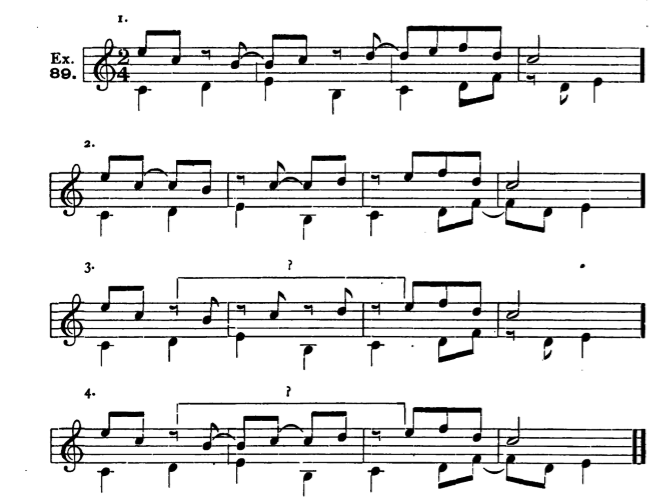
Ex.89-2
Ex.89-3
Ex.89-4
Invert these as usual.
The third version of the above example contains too many rests; the melody loses its cohesion and force. The fourth version is also inferior, because the rests are irregularly distributed; the melody loses its evenness of structure, and becomes spasmodic.
112. From this it appears that occasional brief rests, on corresponding beats, yield the best results. The student may experiment (at the keyboard) with Exs. 87 and 88; also with Exs. 79 to 83, — introducing rests.
113. Rule 4. A tied note may be followed: —
1. By its proper stepwise resolution, if it is an inharmonic suspension (as in Ex. 86): or by any good leap, if it chances to be an harmonic interval (as in Ex. 88).
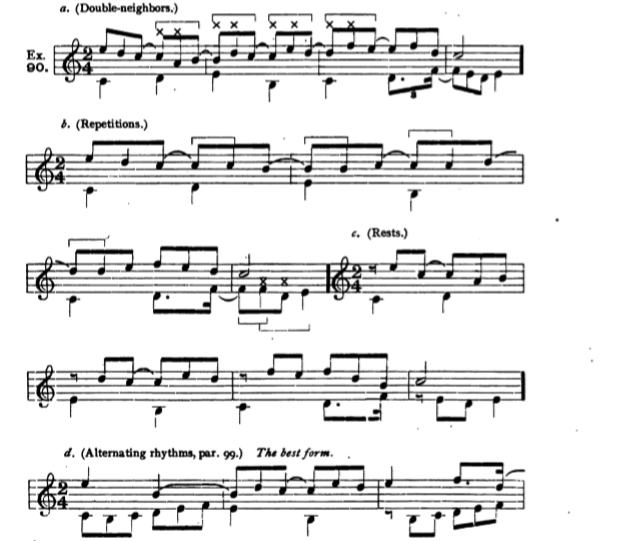
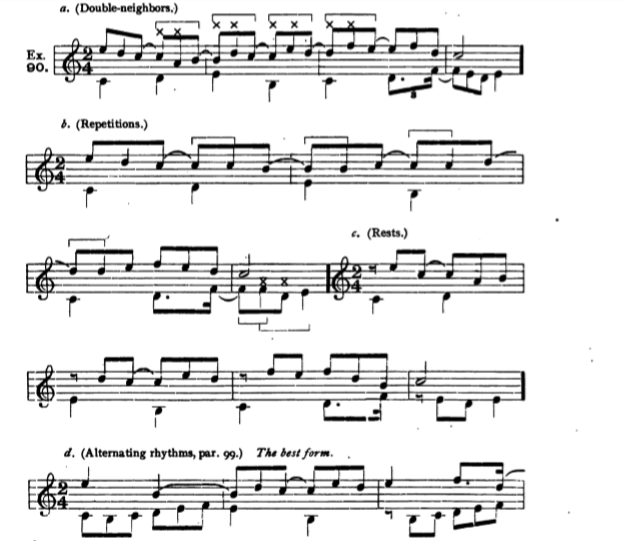
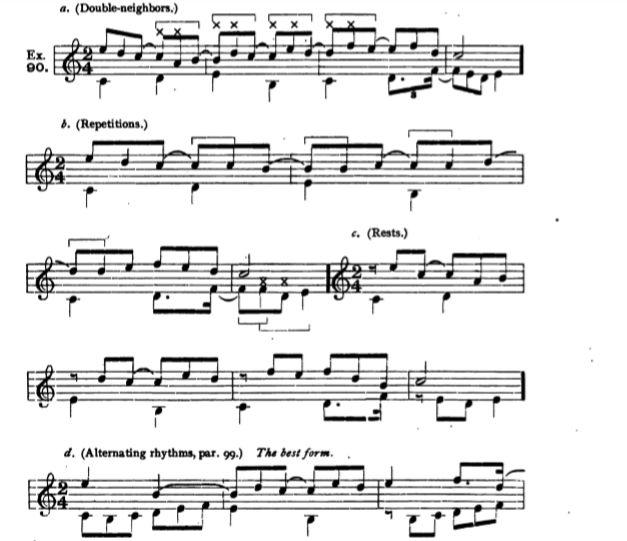
2. By the other neighbor of the resolving tone, — leaping a 3rd, up or down as the case may be, as in Ex. 86, last measure (and Ex. 90, a).
3. By a repetition of the tied note (Ex. 90, b).
114. The first of these methods is, of course, always good and always applicable. The second and third are peculiarly useful in quicker rhythms (of 3 or 4 notes to a beat). For illustration, Ex. 86 may be accelerated from two notes to three in each beat, in the following ways:
Ex.90a
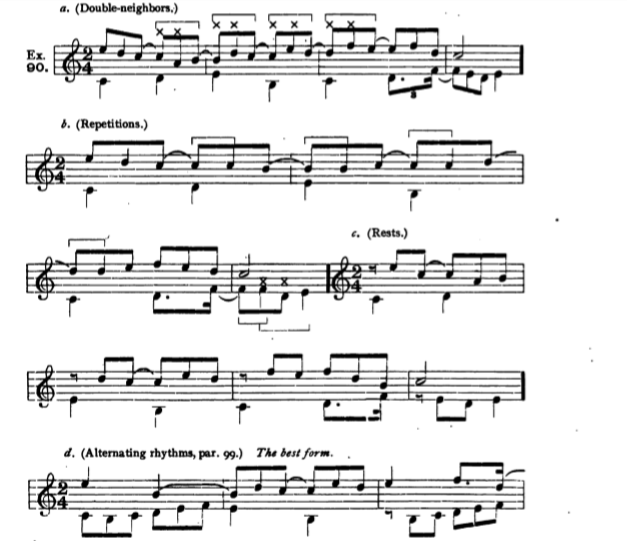
Ex.90b
Ex.90c
Ex.90d
Invert each of these examples as usual.
Observe that these methods, Rule 4, apply best to the note which is legitimately tied as a result of shifting the original essential interval forward; not so well to the tie which creates an anticipation (Ex. 87).
Exercise 11
Ties and Rests; Two and Three Notes to a Beat.
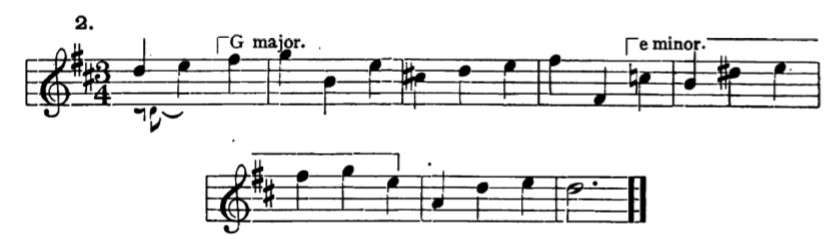
1. Add a contrapuntal part to each of the following melodies, in a rhythm of two notes to each beat, with ties, as in Ex. 86.
The tie need not be used in every group; the occasional omission of the tie, and substitution of passing-notes, is not only effective, but often convenient. See par. 99 (Ex. 82).
Each melody to be used as upper, and also as lower part, as usual.
N. B. The student must remember that in case of embarrassment, it is always permissible to fall back upon the process given in pars. 96, 97.
Exercise 11.1

Exercise 11.2
Exercise 11.3

Exercise 11.4

Exercise 11.5
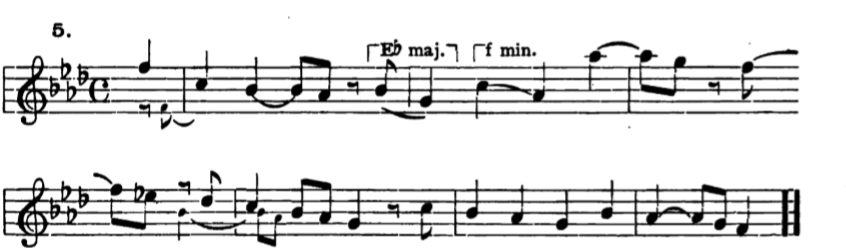
2. Each version thus obtained is then to be quickened into a rhythm of three notes to each beat, according to the above rules (pars, m, 113, — Ex. 90). At least four different forms of each should be written out; and still other versions may be made at sight, at the keyboard.
[A solution of Melody 3 will be found in the Appendix.]
3. Besides these, write a number of original melodies with counterpoint, as usual, composing the parts together.